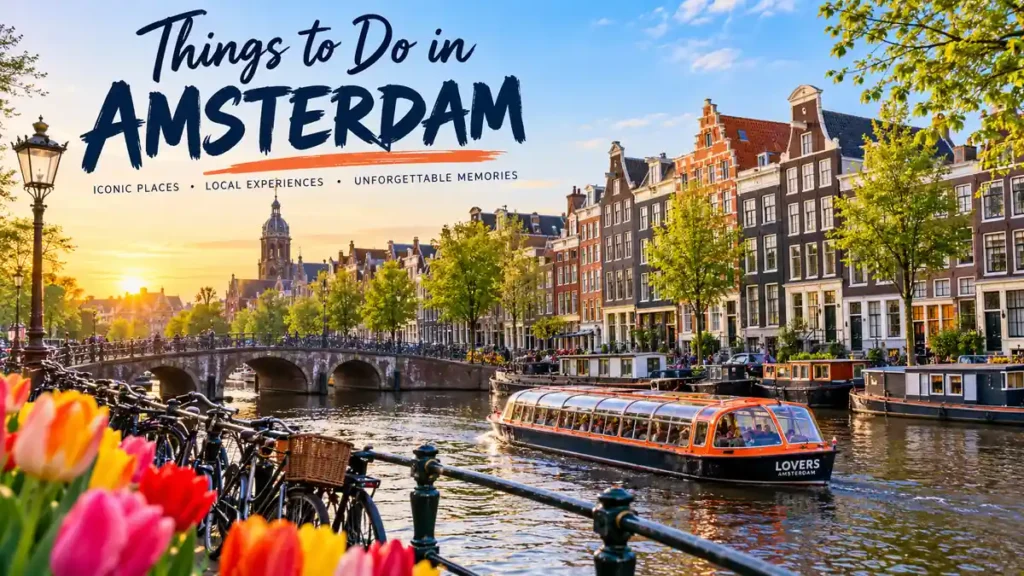
Amsterdam can look deceptively simple on a map. The historic centre is compact, many famous sights sit within walking distance, and canals seem to lead everywhere. Yet the city rewards visitors who move beyond the obvious checklist.
The best things to do in amsterdam include cruising the UNESCO-listed canal ring, seeing Dutch masterpieces at the Rijksmuseum and Van Gogh Museum, visiting the Anne Frank House, wandering Jordaan and De Pijp, cycling through Vondelpark, exploring Amsterdam Noord, browsing street markets, and experiencing the city’s cafés, architecture, food, and waterfront.
Amsterdam works particularly well when you mix major attractions with unplanned wandering. Spend part of the day inside a museum, then slow down beside a canal, cross the IJ on a ferry, or explore a neighborhood where everyday Amsterdam feels much closer.
Best things to do in amsterdam for first-time visitors
If this is your first visit, don’t try to cover every museum and attraction. Amsterdam’s atmosphere is one of its biggest attractions, so leaving room for walking, cycling, cafés and canals usually creates a better trip.
Here are the experiences worth putting near the top of your list.
1. Explore Amsterdam’s historic canal ring
Start with the feature that defines Amsterdam: its canals.
Herengracht, Keizersgracht and Prinsengracht curve through the historic centre, passing rows of narrow canal houses, bridges, houseboats and tree-lined streets. The canal district developed largely during Amsterdam’s major 17th-century expansion.
UNESCO inscribed the Seventeenth-Century Canal Ring Area inside the Singelgracht on its World Heritage List in 2010, recognizing its significance in urban planning, hydraulic engineering and architecture.
Walking is one of the best ways to appreciate it. Instead of following only the busiest streets, wander along the smaller sections connecting the main canals. Early morning is particularly pleasant, before tour groups and bicycle traffic increase.
Quick takeaway: If you only have a few hours in Amsterdam, walk through the Canal Ring and Jordaan. You’ll see many of the city’s defining features without entering a single attraction.
2. Take an Amsterdam canal cruise
Walking beside the canals is one experience; seeing Amsterdam from water level is another.
A canal cruise reveals details you easily miss from the pavement: bridge construction, unusual façades, houseboats, former warehouses and the distinctive proportions of historic canal houses.
The city’s official tourism organization considers cruising the UNESCO-listed canal belt one of Amsterdam’s essential experiences. Cruises range from conventional sightseeing boats to smaller vessels and evening trips.
For photography, late afternoon and early evening can be especially rewarding. After dark, illuminated bridges give the canal district a completely different character.
3. Visit the Rijksmuseum
For anyone interested in art or Dutch history, the Rijksmuseum deserves several hours.
Its collection covers roughly 800 years of Dutch history and includes works by Rembrandt, Johannes Vermeer, Frans Hals and Jan Steen. One of its defining spaces is the Gallery of Honour, where major Dutch Golden Age paintings are displayed.
Rembrandt’s The Night Watch is the headline attraction, but rushing directly toward it misses much of what makes the museum worthwhile.
As of September 2026, the Rijksmuseum is open daily from 9:00 to 17:00, including public holidays, and visitors need to reserve a start time.
Allow around two to three hours for a first visit.
4. See Van Gogh’s work at the Van Gogh Museum
The Van Gogh Museum is another essential stop on Museumplein.
Rather than simply presenting famous paintings, the museum helps visitors follow Vincent van Gogh’s artistic development and understand how his style changed throughout his career.
Because admission is tied to a selected date and time, planning ahead is sensible. The museum’s official ticket system confirms that tickets are valid for the selected time and date.
If you want to visit both the Van Gogh Museum and Rijksmuseum, avoid squeezing them into a rushed morning. Museum fatigue is real. Visit one early, have lunch or walk through Vondelpark, then see the other later.
5. Visit the Anne Frank House
The Anne Frank House offers one of Amsterdam’s most powerful historical experiences.
Visitors move through the building associated with Anne Frank and the Secret Annex while learning about Anne, her family, Nazi occupation, persecution of Jewish people and the Second World War.
This is one attraction where advance planning really matters.
The museum states that tickets are sold only online for specific time slots. New tickets are released every Tuesday at 10:00 CEST for visits six weeks later, and there is no waiting list once a date sells out.
Do not assume you can simply arrive and purchase admission at the entrance.
6. Spend time around Museumplein
Museumplein is much more than a place to move between museums.
The district brings together the Rijksmuseum, Van Gogh Museum, Stedelijk Museum and other cultural institutions, making it Amsterdam’s main museum hub.
The Stedelijk Museum Amsterdam is particularly worthwhile if your interests lean toward modern and contemporary art rather than Old Masters.
Nearby you’ll also find the Royal Concertgebouw, galleries, cafés and easy access to Vondelpark.
Things to do in amsterdam outdoors
Amsterdam shouldn’t be experienced entirely from inside museums.
Its parks, canals, streets and cycling routes are central to how the city feels.
7. Walk or cycle through Vondelpark
Vondelpark provides an easy break after Museumplein.
Locals come here to walk, jog, cycle, meet friends and relax around its lawns and ponds. The park also contains a rose garden and a Picasso sculpture.
Walking works perfectly well, but renting a bicycle gives you a more recognizably Dutch experience.
Just don’t treat Amsterdam’s cycle lanes as pedestrian space. Bicycle traffic moves quickly, and visitors who stop unexpectedly in a bike lane create genuine hazards.
8. Experience Amsterdam by bicycle
Few activities are more closely associated with Amsterdam than cycling.
A bicycle gives you enough range to leave the busiest central streets and reach quieter neighborhoods, parks and waterfront areas.
Beginners should first get comfortable somewhere relatively calm. Amsterdam cycling involves local traffic conventions, tram tracks, pedestrians and experienced commuters who may move considerably faster than a sightseeing visitor.
If central Amsterdam feels intimidating, consider cycling farther from the core rather than learning during rush hour around Amsterdam Centraal.
9. Walk across the Magere Brug
The Magere Brug, or Skinny Bridge, crosses the Amstel and has become one of Amsterdam’s recognizable bridges.
Include it as part of a longer riverside walk rather than making a special journey just to photograph it.
From here you can continue toward the eastern canal district, Hermitage-area cultural sites, De Plantage or back into the historic canal belt.
Explore Amsterdam’s best neighborhoods
One of the biggest mistakes first-time visitors make is spending the entire trip around Dam Square and the Red Light District.
Amsterdam’s neighborhoods have noticeably different personalities, and the official city guide specifically encourages visitors to explore beyond the Canal Ring.
10. Wander through Jordaan
Jordaan is one of the best neighborhoods for slow exploration.
Historically a working-class area, it is now known for intimate streets, cafés, boutiques, galleries and attractive residential corners. UNESCO’s Amsterdam heritage material describes Jordaan as a former workers’ and artisans’ district characterized by narrow streets and smaller houses.
Don’t approach Jordaan as a single attraction with an entrance and exit.
Walk.
Turn down quieter side streets. Look into small galleries. Stop for coffee. Follow whichever canal looks appealing.
That’s the attraction.
11. Browse the Nine Streets
De Negen Straatjes, or Nine Streets, cuts through the Canal Ring with a compact network of attractive shopping streets.
It’s a good area for independent boutiques, vintage clothing, design stores and cafés. The city’s tourism guide highlights the Nine Streets among the centre’s alternatives to mainstream shopping districts.
Even if shopping isn’t part of your plans, the architecture and canals make this an enjoyable walking route between Jordaan and central Amsterdam.
12. Experience De Pijp
For a different side of the city, head south to De Pijp.
The neighborhood feels busier and more lived-in than the museum district next door. Restaurants, cafés and terraces make it particularly good around lunch and early evening.
Its best-known attraction is the Albert Cuyp Market.
13. Visit the Albert Cuyp Market
The Albert Cuyp Market is ideal for experiencing Amsterdam beyond formal sightseeing.
Expect produce, snacks, clothing and everyday market goods alongside plenty aimed at visitors.
This is also an easy place to try Dutch food without structuring your entire day around restaurant reservations.
Pair the market with a walk through De Pijp rather than treating it as an isolated stop.
14. Take the ferry to Amsterdam Noord
Crossing the IJ immediately changes your perspective on Amsterdam.
Amsterdam Noord combines former industrial areas with striking modern architecture, cultural venues, street art and creative spaces. The city’s official tourism guide recommends taking the ferry toward NDSM for street art, vintage shopping and industrial-style surroundings.
The waterfront itself also provides excellent views back toward central Amsterdam.
15. Explore NDSM Wharf
NDSM is one of the best places to see Amsterdam’s more experimental side.
Former industrial spaces have become studios, restaurants, cultural venues and creative businesses.
Street-art fans should consider the STRAAT Museum, housed in an enormous former industrial building and focused on street art and graffiti.
The contrast with the narrow 17th-century streets around the Canal Ring is dramatic—and that’s exactly why it’s worth visiting.
Amsterdam museums and cultural attractions beyond the big three
Rijksmuseum, Van Gogh Museum and Anne Frank House receive enormous attention, but Amsterdam’s cultural scene extends far beyond them.
The official city guide highlights institutions covering photography, maritime history, Jewish heritage, resistance history, cinema and the history of Amsterdam’s canals.
16. Visit the Rembrandt House Museum
The Rembrandt House Museum occupies the house where Rembrandt van Rijn lived and worked.
It complements the Rijksmuseum nicely.
At the Rijksmuseum you encounter Rembrandt’s masterpieces in a grand national collection; here the focus becomes the artist’s working environment, techniques and daily life.
The surrounding area also puts you close to Amsterdam’s Jewish Cultural Quarter.
17. Explore Amsterdam’s Jewish Cultural Quarter
Understanding Amsterdam’s Jewish history adds important context to a visit.
The Jewish Cultural Quarter encompasses sites including the Jewish Museum, Portuguese Synagogue and National Holocaust Museum. The official Amsterdam tourism guide recommends these institutions as significant cultural attractions around Waterlooplein.
Together with the Anne Frank House, they offer a broader historical perspective than visiting the Secret Annex alone.
18. Visit the Oude Kerk
Oude Kerk stands in Amsterdam’s oldest urban core.
Its location is striking: a historic church surrounded by the busy streets of De Wallen.
Today, the building combines its architectural and religious history with cultural programming and contemporary art.
The contrast between the church and its surroundings tells you something important about Amsterdam: different periods of the city’s history often occupy exactly the same few streets.
19. Discover Ons’ Lieve Heer op Solder
Museum Ons’ Lieve Heer op Solder—Our Lord in the Attic—is one of Amsterdam’s most unusual historic interiors.
Hidden within a 17th-century canal house is a remarkably preserved Catholic church constructed in the upper floors.
It’s an excellent choice if you enjoy smaller museums that reveal how ordinary buildings were adapted to changing religious and social conditions.
Free and low-cost things to do in Amsterdam
Amsterdam can become expensive quickly, particularly once several major museums and attractions are added to an itinerary.
Fortunately, some of its best experiences cost little or nothing.
20. Create your own canal walking tour
You don’t need a guide to enjoy Amsterdam’s architecture.
Start around Jordaan and follow Prinsengracht through the Canal Ring. Cross whenever a bridge or side street catches your attention, then continue toward the Amstel.
Look for different gable shapes, leaning façades, old warehouses, houseboats and unusually narrow properties.
Amsterdam’s historic canals aren’t merely decorative. UNESCO describes the Canal Ring as a major example of hydraulic engineering and planned urban development, with its waterways forming part of an integrated city design.
Knowing that makes a simple walk considerably more interesting.
21. Relax in Amsterdam’s parks
Vondelpark gets most of the attention, but it isn’t the city’s only green space.
Oosterpark, Westerpark, Rembrandtpark, Flevopark, Erasmuspark and Amstelpark all appear among Amsterdam’s notable parks and outdoor sights.
Choose whichever fits naturally into your route instead of crossing the entire city simply to visit a park.
Westerpark works especially well when combined with the Westergas cultural complex.
22. Explore Amsterdam Centraal and the waterfront
Amsterdam Centraal is more than a transportation hub.
Its location creates a natural dividing point between historic Amsterdam and the IJ waterfront.
Walk behind the station and the tightly packed historic centre suddenly opens into a broad waterscape with ferries moving between central Amsterdam and Noord.
It’s an easy, free change of scenery.
Food experiences worth trying in Amsterdam
Food may not be the first reason everyone visits Amsterdam, but it should be part of the experience.
Rather than chasing a checklist of viral snacks, sample a mixture of traditional Dutch foods and the international cuisines that reflect modern Amsterdam.
23. Try traditional Dutch foods
Stroopwafels are the obvious starting point: thin waffles sandwiching a caramel-like syrup filling.
Other foods to look for include:
- Bitterballen, crisp fried snacks usually served with mustard
- Poffertjes, small fluffy pancakes
- Dutch cheeses such as Gouda
- Herring, traditionally served with onions and pickles
- Appeltaart, Dutch apple pie
- Patat, thick fries commonly served with mayonnaise or other sauces
Try these where they fit naturally into your day rather than spending hours queueing for a social-media-famous version.
24. Experience an Amsterdam brown café
A traditional brown café—bruin café—is Amsterdam’s answer to a classic neighborhood pub.
Expect dark wood, warm lighting, simple drinks and an atmosphere very different from modern cocktail bars.
They’re particularly enjoyable in Jordaan and around older parts of central Amsterdam.
Amsterdam also has a strong brewing tradition. One distinctive stop is Brouwerij ‘t IJ, a brewery beside the De Gooyer windmill, which the official tourism guide highlights among notable local experiences.
25. Visit Foodhallen or a neighborhood food market
When a group can’t agree on what to eat, a food hall solves the problem quickly.
Foodhallen in Oud-West gathers multiple food vendors under one roof and is useful for sampling different dishes in a casual setting.
But don’t make food halls your only dining experience. Smaller neighborhood cafés and restaurants are often where Amsterdam feels most personal.
Things to do in Amsterdam at night
Amsterdam changes character after sunset.
The illuminated Canal Ring becomes quieter and more atmospheric, while neighborhoods such as De Pijp, Jordaan and Oud-West fill with people heading to bars, restaurants and music venues.
A good evening doesn’t have to mean nightlife in the conventional sense.
Walk the illuminated canals
One of the simplest nighttime activities is also one of the best.
Walk along Herengracht, Keizersgracht and Prinsengracht after dark and watch the lights reflect from the canal houses and bridges.
For couples, this can be more memorable than another paid attraction.
Experience Amsterdam’s live music scene
Amsterdam has everything from classical performances to electronic music.
The Royal Concertgebouw is the obvious destination for classical music, while venues such as Paradiso and Melkweg represent important parts of the city’s contemporary music culture.
Amsterdam Dance Event also demonstrates the city’s international importance in electronic music; the official tourism organization points to it as one of Amsterdam’s major music events.
Check current schedules rather than assuming performances happen every evening.
Unusual and hidden things to do in Amsterdam
Once you’ve covered the major sights, Amsterdam becomes even more interesting.
Visit Begijnhof
Begijnhof is a historic courtyard hidden behind the busy streets of central Amsterdam.
Its enclosed setting feels surprisingly quiet considering its location.
Because this is a historic residential and religious space rather than an entertainment attraction, visit respectfully and keep noise low.
Explore Haarlemmerstraat and Haarlemmerdijk
These streets offer an alternative to Amsterdam’s busiest retail corridors.
The city’s tourism guide highlights Haarlemmerstraat and Haarlemmerdijk for their independent stores, vintage fashion, specialist shops and food businesses.
They also connect naturally with Jordaan and Westerpark, making them useful additions to a walking itinerary.
Discover Amsterdam’s botanical side
Hortus Botanicus Amsterdam provides a quieter alternative to Amsterdam’s major art museums.
It’s particularly useful on a trip dominated by historic buildings and paintings because the experience feels completely different.
Combine it with the Plantage neighborhood and nearby cultural attractions.
Best day trips from Amsterdam
If you have four or more days, Amsterdam makes an excellent base for seeing more of the Netherlands.
Zaanse Schans
Zaanse Schans is famous for historic windmills and traditional Dutch architecture.
The official Amsterdam tourism guide recommends it among the easiest ways to experience the windmill-filled landscapes outside the city.
It is highly visited, so an early start usually makes the experience more pleasant.
Haarlem
Haarlem is a strong alternative if you’d rather visit another historic city.
The centre has attractive architecture, museums, shops and restaurants while remaining easily accessible from Amsterdam. The city’s official visitor guide notes that Haarlem is roughly 20 minutes from Amsterdam Centraal by train.
It’s particularly suitable for travelers who like Amsterdam’s architecture but want a smaller-scale setting.
Keukenhof
Keukenhof is a seasonal option rather than a year-round attraction.
If your trip falls during its spring opening period, the enormous flower displays can justify dedicating much of a day to the excursion.
Outside the flowering season, choose another day trip rather than building plans around Keukenhof.
What can you do in Amsterdam in one day?
With only one day, focus on geography rather than collecting attractions.
A practical route is:
- Start around Amsterdam Centraal and walk into the historic centre.
- Explore the Canal Ring and Jordaan.
- Visit either the Anne Frank House or Rijksmuseum if you have a reservation.
- Eat lunch around Jordaan or the Nine Streets.
- Walk through Museumplein and Vondelpark.
- Return toward the centre through the canals.
- Finish with an evening canal cruise or waterside walk.
Trying to visit Rijksmuseum, Van Gogh Museum and Anne Frank House in a single day leaves very little time to experience Amsterdam itself.
How many days do you need in Amsterdam?
Three days is a strong minimum for a first visit.
One day gives you the central highlights. Two days allow time for major museums and neighborhoods. Three days let you slow down enough to appreciate the city rather than constantly moving between attractions.
With four or five days, you can comfortably add Amsterdam Noord, less central neighborhoods and a day trip to Haarlem or Zaanse Schans.
| Trip length | What you can realistically cover |
|---|---|
| 1 day | Canal Ring, Jordaan, one major museum, canal cruise |
| 2 days | Main sights, Museumplein, Vondelpark, De Pijp |
| 3 days | Major attractions plus Noord, NDSM and local neighborhoods |
| 4 days | Amsterdam at a relaxed pace plus one day trip |
| 5+ days | Deeper neighborhood exploration and multiple excursions |
Is Amsterdam expensive to visit?
Amsterdam is not generally a cheap European city.
Major museum admissions, central accommodation and frequent restaurant meals can push costs upward quickly. For example, Rijksmuseum adult admission is €25 as of September 2026. Amsterdam also levies a tourist tax of 12.5% of the overnight accommodation price excluding VAT.
You can keep sightseeing costs manageable by mixing paid attractions with free experiences such as canal walks, parks, neighborhoods, markets and waterfront exploration.
A city pass only makes financial sense if the included attractions and transportation match what you genuinely intend to use. Don’t buy one automatically.
How to get around Amsterdam
Walking is the best default for central Amsterdam.
Many major attractions are close enough together that using public transportation for every journey can actually slow you down.
For longer distances, Amsterdam has trams, buses, metro services and ferries.
GVB confirms that visitors can use OVpay to check in and out with a contactless debit card, credit card or compatible mobile device. No advance registration is required. Just make sure you check in and out using the same card or device.
Cycling can be excellent, but visitors should only rent a bicycle if they feel comfortable riding in busy urban traffic.
Practical tips for visiting Amsterdam
A little planning makes a substantial difference here.
Reserve high-demand attractions first. Anne Frank House should be one of the first things you organize because its ticket-release system is strict and popular dates sell out. Rijksmuseum also requires visitors to book a start time.
Group attractions geographically. Do Rijksmuseum, Van Gogh Museum, Museumplein and Vondelpark together. Combine Anne Frank House with Jordaan and the Nine Streets. Pair Albert Cuyp Market with De Pijp.
Don’t walk in bicycle lanes. They are functioning traffic lanes, not additional pedestrian space.
Bring rain protection. Amsterdam weather can change quickly, and a compact umbrella or waterproof jacket is useful.
Leave empty time in your itinerary. Amsterdam is unusually good for wandering. An unscheduled hour beside the canals can be more enjoyable than racing toward another ticketed attraction.
Look beyond Dam Square. Central Amsterdam contains important landmarks, but Jordaan, De Pijp, Oud-West, Noord, Westerpark and other districts provide a broader impression of the city. Amsterdam’s own tourism organization specifically emphasizes exploring beyond the historic centre.
Are there enough things to do in Amsterdam without museums?
Absolutely.
You could spend several days exploring Amsterdam without entering a traditional museum.
Walk the Canal Ring, cycle through parks, browse Albert Cuyp Market, explore Jordaan and the Nine Streets, cross the IJ to NDSM, visit local cafés, wander De Pijp, photograph bridges, discover street art and take a canal cruise.
Museums deepen your understanding of the city, but Amsterdam itself functions almost like an open-air exhibit of architecture and urban history.
Final thoughts on things to do in amsterdam
The best things to do in amsterdam aren’t limited to its headline attractions. Rijksmuseum, Van Gogh Museum and Anne Frank House deserve their reputations, but canals, neighborhood streets, parks, markets and everyday city life are equally important to understanding Amsterdam.
For a first trip, build each day around one or two major attractions and leave the rest flexible. Walk through Jordaan without a destination. Watch boats pass beneath a canal bridge. Cross the IJ to Noord. Eat something you’ve never tried. Spend an evening beside the illuminated canals.
Amsterdam’s historic Canal Ring has survived as a living part of the city rather than a frozen monument, which is part of what makes it remarkable.
See the famous places, but give yourself enough time to notice everything between them.