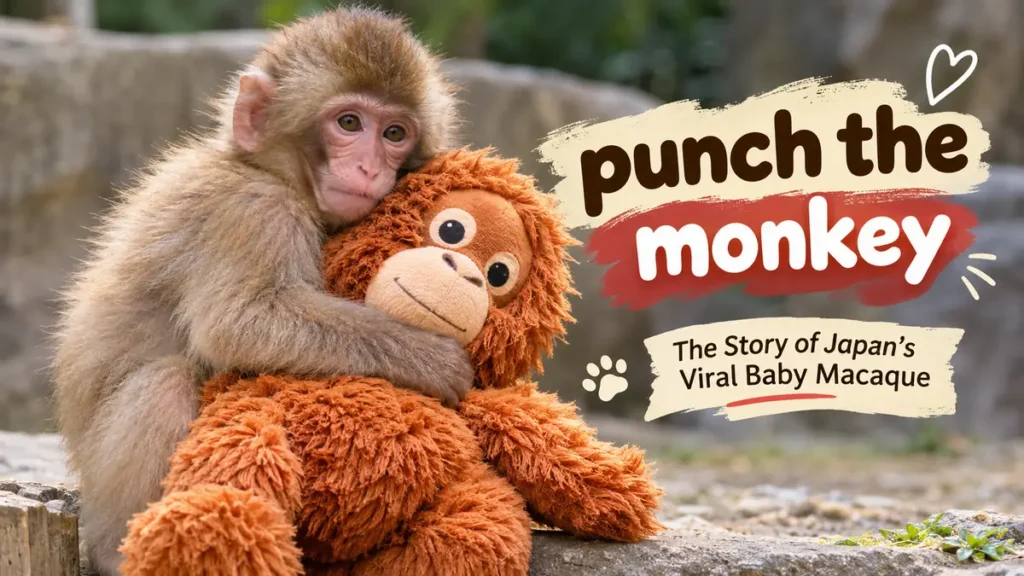
A tiny monkey dragging a stuffed orangutan almost as big as himself became one of the internet’s most emotional animal stories of 2026. His name is Punch, and his journey from maternal rejection to finding companionship captured attention far beyond Japan.
punch the monkey is a young Japanese macaque born on July 26, 2025, at Ichikawa City Zoo in Japan. After his mother did not care for him, zookeepers raised him by hand and provided a plush orangutan for comfort. Videos of Punch carrying the toy and navigating relationships with other monkeys went viral in February 2026. Know Your Meme+1
Who Is punch the monkey?
Punch, also called Punch-kun, is a male Japanese macaque (Macaca fuscata) living at Ichikawa City Zoo in Chiba Prefecture, near Tokyo.
Japanese macaques are also known as snow monkeys. They are highly social primates that form complex relationships, establish dominance hierarchies, groom one another, and learn important behaviors through interaction with their groups.
Punch became famous not because of a special trick or unusual physical appearance, but because of his attachment to a stuffed animal.
緊抱玩偶學會長大!日本小猴「Panchi」全球爆紅 背後成長故事藏滿洋蔥 | 時尚名人 | udnSTYLE
VIDEO: Abandoned baby monkey finds comfort in stuffed ora…
The Entire Internet Is Rooting For Punch The Monkey
7
Quick facts about Punch
| Detail | Information |
|---|---|
| Name | Punch (Punch-kun) |
| Species | Japanese macaque |
| Scientific name | Macaca fuscata |
| Date of birth | July 26, 2025 |
| Sex | Male |
| Location | Ichikawa City Zoo, Japan |
| Famous companion | Stuffed orangutan |
| Viral breakthrough | February 2026 |
| Main social platforms | X, TikTok, Instagram |
Punch’s story attracted worldwide attention because it combined a recognizable emotional narrative with genuine questions about animal development and social behavior. The Indian Express+1
Why Was punch the monkey Abandoned by His Mother?
Punch’s mother did not provide the care he needed shortly after birth, requiring intervention from zoo staff.
For infant macaques, maternal care is particularly important. Newborn monkeys rely on their mothers for feeding, physical protection, warmth, and opportunities to learn social behavior.
Mother-infant contact also helps young primates develop a sense of security.
Why do mother monkeys reject their babies?
Maternal rejection can happen for several reasons, including:
- Inexperience among first-time mothers
- Stress or disruption within the environment
- Health problems affecting the mother or infant
- Difficulties establishing normal maternal behavior
- Complicated social conditions within a troop
These are general explanations for maternal rejection in primates. The precise cause of Punch’s mother’s behavior has not been conclusively established in the reporting reviewed.
Rather than leaving him without care, keepers raised Punch by hand during his earliest months.
That intervention helped him survive, but it also created a challenge: he would eventually need to develop relationships with other macaques.
Why Does Punch Carry a Stuffed Orangutan?
One of the most recognizable images from Punch’s story shows him gripping an orange plush orangutan while walking around his enclosure.
The toy was provided by his caretakers after his mother rejected him.
It became a familiar object that Punch could hold, climb onto, drag around, or rest against.
The story behind Punch’s IKEA orangutan
The stuffed companion is an orangutan plush associated with IKEA’s DJUNGELSKOG collection.
Although Punch is a macaque and the toy represents an orangutan, the difference between the two species is not the important part of the relationship.
What matters is the physical contact the toy provides.
Infant primates naturally cling to their mothers. Holding onto a soft object may offer some of the tactile reassurance missing when normal maternal contact is unavailable.
Animal-behavior researchers have described the toy as a form of environmental enrichment, while emphasizing that it cannot fully replace social relationships with living animals. Northeastern Global News+1
Can a stuffed toy replace a mother monkey?
No. A stuffed toy can provide physical comfort, but it cannot perform the full developmental role of a mother.
A mother macaque provides several things that an inanimate object cannot:
| Maternal care | What a stuffed toy provides |
|---|---|
| Feeding and nursing | No nutritional support |
| Warmth and physical contact | A surface to hold |
| Grooming | No reciprocal grooming |
| Protection | No active protection |
| Social learning | No behavioral guidance |
| Emotional reassurance | Potential tactile comfort |
The distinction helps explain why Punch’s gradual integration into the monkey troop is more important for his long-term development than his attachment to the toy alone.
How Did Punch Become Famous on Social Media?
Punch’s online popularity grew rapidly in February 2026, after photographs and videos showed him carrying his plush companion around Ichikawa City Zoo.
On February 5, the zoo’s official X account shared information identifying Punch as a male infant born in July 2025 and explaining that he had been hand-reared after being abandoned.
The zoo also reported that Punch had been living with the troop since January 19, 2026.
Videos subsequently circulated on X, Instagram, and TikTok, attracting millions of views and widespread sympathy. Know Your Meme+1
The viral videos that captured worldwide attention
Several kinds of footage helped Punch become internationally recognizable.
Punch hugging his plush toy: Images of the infant holding tightly to the stuffed orangutan created an immediate emotional connection with viewers.
Punch struggling with other monkeys: Videos showing older macaques pushing or chasing him generated concern about his treatment within the group.
Punch seeking comfort after stressful interactions: Clips of Punch returning to his toy reinforced the public perception that it served as a source of reassurance.
Punch beginning to interact with other macaques: Later footage showing more positive social interactions gave viewers a reason to follow his progress.
The story moved beyond ordinary animal entertainment because audiences became invested in what would happen to Punch as he grew older.
Was Punch the Monkey Really Being Bullied?
Some viral videos show Punch being pushed, chased, or handled roughly by other macaques.
Understandably, viewers interpreted these interactions as bullying.
However, researchers caution that applying human social labels to monkey behavior can oversimplify what is happening.
Japanese macaques live in hierarchical groups. Dominant individuals may display aggression toward lower-ranking animals, particularly during competition for resources or social positioning.
Young monkeys also have to learn how to interpret signals, avoid conflicts, and participate in group interactions.
Primatologists discussing Punch’s case explained that his behavior must be understood within this broader social structure. The Indian Express
Understanding Japanese macaque social hierarchy
Japanese macaque society includes several important behavioral patterns:
- Dominance: Individuals occupy different social positions within a troop.
- Matrilineal relationships: Female macaques generally remain in their natal groups, with family relationships influencing rank.
- Grooming: Social grooming helps maintain relationships and reduce tension.
- Social learning: Younger monkeys learn appropriate behavior through observation and interaction.
- Aggression and reconciliation: Conflicts occur, but they do not necessarily indicate permanent rejection.
Punch’s unusual early upbringing may have complicated his initial interactions because he lacked some of the normal mother-infant experiences that help young macaques learn social behavior.
Does aggression mean Punch is permanently rejected?
Not necessarily.
An aggressive encounter can be distressing without proving that the troop will never accept an individual.
Researchers emphasize the importance of looking at patterns over time rather than interpreting a single short video as a complete account of an animal’s welfare.
For Punch, evidence of continued interaction, grooming, play, and proximity to other macaques provides a more meaningful picture of his social development than isolated viral clips.
What Happened to Punch After He Went Viral?
Punch’s story did not end with the videos that made him famous.
Reports published after February 2026 described encouraging developments in his relationships with other macaques.
He began showing signs of greater social acceptance, and later coverage indicated that he was becoming more integrated into the troop.
Timeline of Punch’s story
July 2025
Punch is born
His mother does not provide normal care, and zookeepers begin raising him by hand.
Jan 2026
Introduction to the troop
Punch begins living with other macaques on January 19.
Feb 2026
Worldwide viral fame
Videos of Punch carrying his stuffed orangutan spread across social media.
Mar 2026
Growing social connections
Coverage reports improving relationships with other members of the troop.
July 2026
First birthday
Punch turns one year old, with fans continuing to celebrate his development.
Oct 2026
Continued progress
Later reporting describes Punch as having gradually joined his troop.Know Your Meme+2
Is Punch the monkey still alive?
Reports available through October 2026 describe Punch’s continued development and social integration. There is no credible evidence in the reviewed reporting that Punch died.
Earlier online death rumors were also challenged by fact-checking coverage. Hindustan Times+1
For the most recent day-to-day information, official updates from Ichikawa City Zoo are more reliable than reposted social media videos.
Has Punch stopped carrying his stuffed toy?
Later accounts suggest Punch became less dependent on his plush orangutan as his social relationships developed.
That would be a positive developmental sign, provided he is forming healthy relationships and showing normal behavior.
The important measure is not whether he completely abandons the toy, but whether he can interact comfortably with other macaques and participate in everyday troop life.
Why Did Punch the Monkey Make So Many People Emotional?
Punch’s story resonated with audiences because it appeared to reflect familiar human experiences: loneliness, rejection, comfort, and the desire to belong.
A small animal holding a soft toy is easy to interpret emotionally, even without knowing much about macaque behavior.
His story also developed over time, allowing viewers to follow his progress rather than simply watch a single amusing clip.
The psychology behind Punch’s popularity
Researchers describe a phenomenon called anthropomorphism, in which humans attribute human-like feelings, intentions, or characteristics to animals.
This can help people connect with wildlife, but it can also lead to misunderstandings.
For example, a monkey clutching a toy may look exactly like a lonely child hugging a teddy bear. The behavior may involve comfort-seeking, but viewers cannot determine the animal’s complete emotional state from appearance alone.
Researchers at George Washington University highlighted this issue when discussing the public reaction to Punch, noting the importance of understanding behavior within its environmental and social context. The George Washington University
How Punch became an internet underdog
Punch’s popularity also reflects the way audiences respond to stories of vulnerability and improvement.
His early difficulties encouraged viewers to support him, while later signs of social progress made his story more hopeful.
The emotional narrative was particularly powerful because it unfolded through real footage rather than a fictional character.
Like other viral zoo animals, including Moo Deng, the pygmy hippopotamus from Thailand, Punch became recognizable to people who had never visited his home zoo.
Yet his popularity also raises a broader question: how can public attention benefit animals without putting additional pressure on them?
What Does Punch’s Story Teach Us About Animal Welfare?
Punch’s experience provides an opportunity to understand several aspects of primate care.
Hand-rearing requires more than feeding
When a zoo must raise an infant primate by hand, providing nutrition and warmth is only part of the responsibility.
Young primates also need opportunities to develop normal species-specific behavior.
That includes appropriate social contact, movement, exploration, and interaction with other members of their species.
Human care may be essential for survival, but it cannot automatically reproduce everything an infant would learn from its mother and troop.
Environmental enrichment supports natural behavior
Environmental enrichment refers to objects, activities, or changes to an animal’s surroundings that encourage appropriate physical and psychological activity.
Examples can include climbing structures, foraging opportunities, puzzle feeders, and manipulable objects.
Punch’s stuffed orangutan is one example of an object that may provide comfort and enrichment.
However, enrichment should complement suitable social conditions rather than substitute for them.
Why social integration matters
For a Japanese macaque, learning to live within a troop is an important part of development.
Healthy social integration can involve:
- Spending time near other monkeys without persistent distress.
- Learning appropriate responses to social signals.
- Participating in play and exploratory behavior.
- Developing grooming relationships.
- Establishing a place within the group’s social structure.
These processes can take time, particularly for an animal that experienced an unusual infancy.
Punch’s development illustrates why long-term behavioral observation is more informative than a handful of viral moments.
Where Can You See Punch the Monkey?
Punch lives at Ichikawa City Zoo, part of the Ichikawa City Zoological and Botanical Garden in Chiba Prefecture, Japan.
The facility is located in the greater Tokyo region and houses a variety of animals.
Visitors interested in Punch should consult the zoo’s official announcements for current viewing arrangements, opening information, and animal welfare guidance.
Animals may be temporarily unavailable for public viewing because of health, enclosure management, weather, or other care requirements.
How to follow official Punch updates
The zoo’s official social media communications have been an important source of information about Punch.
When following his story online, distinguish between:
- Original footage published by the zoo
- News reports with identifiable dates and sources
- Reposted videos that may be several months old
- Edited clips that omit the surrounding behavior
- Unverified claims about his health or relationships
This is especially important because older footage showing distress can continue circulating even after an animal’s circumstances have changed.
What Is the Punch the Monkey Google Easter Egg?
Punch’s popularity also inspired an unusual Google Search feature.
In February 2026, users searching for “Punch the Monkey” reported seeing animated hearts appearing across their search results.
The playful visual effect became another part of his viral story.
Several news outlets documented the Easter egg as Punch’s popularity spread internationally. The Indian Express+1
Google Easter eggs are temporary or hidden interactive features associated with particular searches.
The Punch animation was reported in February, but its availability can change, and it should not be assumed to appear for every user or remain active indefinitely.
How Punch Compares With Other Viral Zoo Animals
Punch is part of a wider phenomenon in which individual zoo animals attract international audiences through social media.
| Animal | Species | Why it became famous |
|---|---|---|
| Punch | Japanese macaque | Attachment to a plush toy and social development |
| Moo Deng | Pygmy hippopotamus | Expressive behavior and playful personality |
| Pesto | King penguin | Unusually large, fluffy chick appearance |
| Fiona | Nile hippopotamus | Premature birth and remarkable survival |
| Haggis | Pygmy hippopotamus | Social media attention and comparisons with Moo Deng |
These animals became popular for different reasons, but their stories demonstrate how online attention can generate interest in wildlife.
There are potential benefits, including greater awareness of animal care and conservation.
There are also concerns. Increased visitor numbers, excessive noise, and pressure to produce entertaining footage can conflict with animal welfare.
A responsible approach puts the animals’ needs ahead of their online popularity. People.com+1
What Makes Punch’s Story Different?
Unlike many viral animal stories that center on amusing behavior, Punch’s popularity developed around a continuing social and developmental journey.
His plush orangutan became a recognizable symbol of comfort, but the deeper story involves the challenges of raising an infant primate without normal maternal care.
Punch also prompted discussions about how people interpret animal emotions, the importance of social relationships, and the responsibilities of zoos caring for vulnerable animals.
His growing acceptance within the troop adds a meaningful dimension to a story that initially appeared to be about loneliness.
The most encouraging part is not simply that millions of people supported him online. It is that later reports describe progress in the relationships that matter most to a young macaque: those with other members of his species.
Final Thoughts on punch the monkey
The story of punch the monkey began with a vulnerable baby macaque who needed human assistance after maternal rejection. His attachment to a stuffed orangutan made him internationally famous, but his gradual development within the troop is the more significant part of his journey.
Punch’s experience reminds us that primates depend on physical contact, social learning, and complex relationships throughout their lives.
As he grows, the most valuable updates will be those showing his health, natural behavior, and ability to interact with other macaques.
His story is both an endearing internet phenomenon and an opportunity to better understand the needs of animals living under human care.