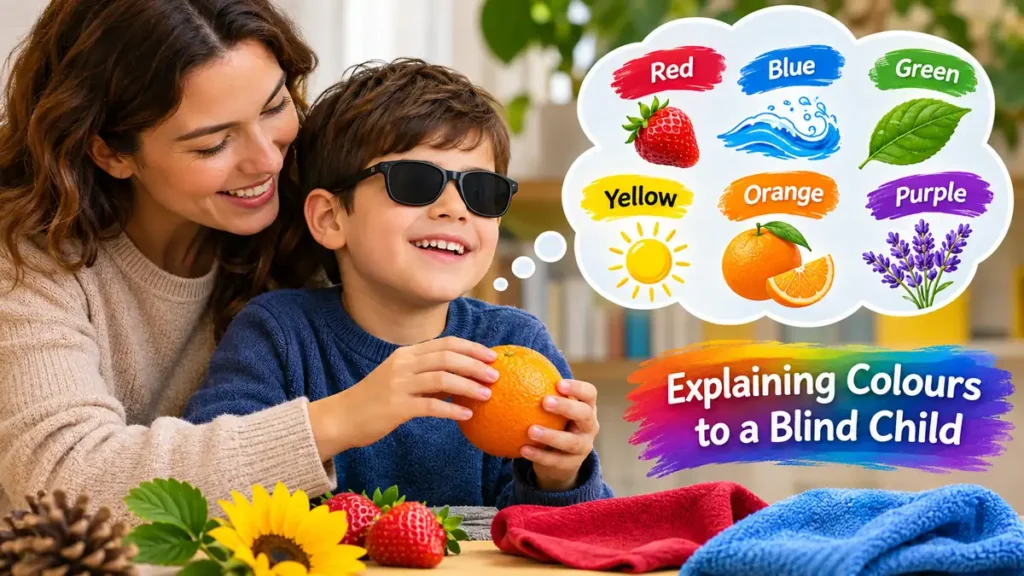
Your son may not be able to see the blue sky, a red rose, or a golden sunset, but that doesn’t mean colours have to remain meaningless to him. Colours are part of language, nature, emotions, and everyday life. He can learn about them through experiences that make sense to him.
My son can’t see. how do i explain colours to him? Connect each colour with familiar objects, sounds, temperatures, textures, and emotions. Describe red through warmth, blue through cool water, and green through grass and leaves. These associations won’t reproduce visual perception, but they can help your son understand what colours represent and how people use them.
The most helpful approach is to make colour a natural part of your conversations rather than a difficult lesson he must master.
my son can’t see. how do i explain colours to him?
Yes. A child who is blind can develop a meaningful understanding of colours, even without experiencing them visually.
However, there is an important distinction between understanding a colour and seeing it.
A child born completely blind may learn that strawberries are usually red, grass is generally green, and the sky often appears blue. He can also understand that colours describe physical properties of objects and that people use them to communicate information.
He may not experience the visual sensation of redness or blueness, but that doesn’t prevent him from learning relationships between colours.
Research published in Proceedings of the National Academy of Sciences found that adults born blind can develop sophisticated knowledge about object colours and why particular objects have certain colours. Their understanding goes beyond memorising simple associations. PMC
Understanding colours without visual experience
Consider how people understand things they cannot directly experience.
Someone who has never visited Antarctica can still understand that it is extremely cold, covered extensively with ice, and home to penguins.
Likewise, your son can understand colours through descriptions, conversations, and knowledge of the world.
For example, he might learn that:
- Red is associated with strawberries, fire engines, and warning signs.
- Blue is associated with the sky, many bodies of water, and certain clothing.
- Green is common in leaves, grass, and growing plants.
- Yellow is associated with sunshine, bananas, and some flowers.
These associations provide useful information, even when he cannot visually identify the colours himself.
Does it matter whether your son was born blind?
Yes. His visual history can influence how you explain colours.
A child who previously had sight may remember some colours. You can build on those memories, although their clarity will vary.
A child born without sight may develop colour concepts through language, experiences, and relationships between objects.
A child with partial vision might still distinguish certain colours, especially under suitable lighting or with strong contrast.
If your son has some usable vision, a teacher of students with visual impairments or a low-vision specialist can help determine which visual activities are accessible to him.
How to Explain Colours Through Touch, Temperature, and Sound
One of the easiest ways to introduce colours is to connect them with things your son already recognises.
Touch, sound, smell, and temperature can make an abstract conversation more engaging.
The key is to explain that these are associations, not literal equivalents. Red does not physically feel hot, and blue does not always feel cold.
Red: Warmth, energy, and excitement
Red is often associated with warmth, intensity, and strong emotions.
Let your son feel the gentle warmth of sunlight on his hands or hold a comfortably warm object.
You might say:
“Red is a colour people often connect with warmth and energy. The warmth you feel from the sun can help you remember that association. Strawberries and many roses are red.”
You can also use familiar sounds, such as a fire engine siren, to discuss why red is commonly used on emergency vehicles.
Explain that red can represent love, excitement, or danger, depending on the situation.
Blue: Coolness, water, and calmness
Blue is often associated with coolness, peacefulness, and open spaces.
Invite your son to touch cool water in a bowl.
Then explain:
“Blue is a colour people often associate with cool water and the wide sky. The sky looks blue to many people during a clear day, although it changes with the weather and time.”
Soft music or the sound of gentle waves may provide another memorable association.
Remember that water itself is not always visibly blue. Small amounts of clean water are generally transparent, while large bodies of water can appear blue for several reasons.
Green: Grass, leaves, and growing things
Green is particularly suitable for outdoor learning.
Let your son explore grass, leaves, and safe plants using his hands.
You might say:
“These leaves are green. Green is a colour we often see in healthy plants. It is associated with growing things and nature.”
You can also explain that leaves change colour during different seasons.
This helps him understand that an object’s colour may change over time.
Yellow: Sunshine, brightness, and happiness
Yellow is commonly associated with sunshine and brightness.
Sit together in a comfortable, shaded outdoor space where he can feel mild sunlight.
Explain:
“Yellow is a colour people often describe as bright and cheerful. Many sunflowers are yellow, and ripe bananas are usually yellow too.”
The feeling of warmth may help him remember the association, but clarify that yellow itself is not a temperature.
Orange: Citrus fruits and autumn
Orange can be introduced through the smell and texture of an orange fruit.
Allow your son to hold an orange, feel its peel, and smell it.
Explain:
“The fruit you’re holding is called an orange, and its peel is usually orange in colour. Some autumn leaves and pumpkins are orange too.”
This is a particularly useful example because the fruit and colour share the same name.
Purple: Flowers, fruit, and imagination
Purple can be associated with certain flowers, grapes, and decorative fabrics.
Let your son smell lavender or explore a bunch of grapes.
You might say:
“Some grapes and flowers are purple. People sometimes associate purple with creativity, mystery, or royalty.”
Avoid assuming that a particular smell or texture is unique to purple objects.
White, black, and grey: Light and darkness
These colours may require a slightly different explanation.
White and black are often described in relation to how much visible light a surface reflects.
You can explain:
“White surfaces usually reflect a lot of visible light, while black surfaces absorb much of it. Grey is between them in brightness.”
For a younger child, simpler comparisons may work better.
You might explain that white is commonly associated with snow, while black is associated with night and shadows.
However, avoid teaching that white always means soft or that black always means rough. Colour and texture are separate properties.
A Simple Colour Association Chart for Parents
The following chart offers starting points for conversations and activities.
| Colour | Familiar example | Sensory association |
|---|---|---|
| Red | Strawberry, rose | Warmth, excitement |
| Blue | Sky, ocean | Cool water, calm sounds |
| Green | Grass, leaves | Plant textures, nature |
| Yellow | Banana, sunflower | Sunshine, cheerfulness |
| Orange | Orange fruit, pumpkin | Citrus smell, textured peel |
| Purple | Grapes, lavender | Fruit, floral scents |
| Pink | Rose, cotton candy | Sweetness, affection |
| Brown | Soil, tree bark | Earthy smell, rough bark |
| White | Snow, cotton | Snow’s coldness, soft cotton |
| Black | Night sky, charcoal | Darkness, charcoal texture |
| Grey | Stones, clouds | Smooth stones, rainy weather |
These examples are memory aids, not definitions. A red object can be cold, a blue object can be rough, and a black object can be soft.
Encourage your son to develop his own associations instead of requiring him to adopt yours.
How to Teach Colours Through Everyday Activities
Formal lessons are not always necessary.
Short, enjoyable conversations during ordinary activities can help your son build colour vocabulary naturally.
1. Describe colours while preparing food
Food provides opportunities to explore colour alongside smell, taste, shape, and texture.
While preparing breakfast, describe the ingredients.
For example:
“This banana has a yellow peel. Inside, the fruit is pale cream. The apple beside it has red skin.”
Let your son safely explore the food if he wants to.
Over time, introduce variations. Apples can be red, green, or yellow, and bananas change appearance as they ripen.
This prevents the mistaken assumption that every type of object has exactly one colour.
2. Explore colours during nature walks
A walk can become an opportunity to discuss the environment.
Describe green grass, brown tree trunks, colourful flowers, and the changing appearance of leaves.
Let your son touch safe natural objects and listen to birds, insects, and rustling leaves.
You might say:
“The leaves we’re touching are green now. Some may turn yellow, orange, or brown as the seasons change.”
The objective is not to make him memorise a long list. It is to connect colour words with meaningful experiences.
3. Use music and storytelling
Stories can introduce colours without relying on pictures.
For example:
“A little red bird lived in a green tree. Every morning, it sang while the golden sunlight warmed the branches.”
You can add sound effects, textured objects, and questions.
Music can also support associations. Your son might personally connect a gentle melody with blue or an energetic drumbeat with red.
These associations are subjective, and there is no single correct match.
4. Describe clothing colours
When helping your son choose clothes, mention their colours naturally.
For example:
“Today you have a blue shirt and grey trousers. They look nice together.”
Explain that people sometimes choose colours to match, contrast, express personal style, or follow cultural traditions.
As he grows, accessible clothing labels, tactile markers, or assistive technology may help him identify clothing independently.
5. Introduce colours through art
Blind children can enjoy art through texture, shape, movement, and materials.
Try raised-line drawings, modelling clay, textured paper, or safe craft materials.
If he makes a textured flower, you can describe the colours of its different parts.
Let him decide what colours he wants to assign to his creation.
Art does not have to reproduce the visible world to be meaningful.
How to Explain What Colour Actually Is
As your son becomes curious about why colours exist, you can introduce the science in age-appropriate language.
Colour is connected to visible light and how the brain interprets information received through the eyes.
A simple explanation for younger children
You could say:
“Light travels from things around us into people’s eyes. Their brains use that light to experience different colours. People call some of those colours red, blue, yellow, and green.”
Explain that colour is different from texture, shape, temperature, and smell.
A ball can be round, smooth, cold, and red. Each word describes a different property.
A scientific explanation for older children
Visible light is part of the electromagnetic spectrum.
Different wavelengths of visible light can contribute to different colour experiences.
For example, light toward the longer-wavelength end of the visible spectrum is commonly perceived as red, while light toward the shorter-wavelength end is commonly perceived as violet.
Objects absorb, reflect, or transmit different amounts of light at different wavelengths.
The eyes detect incoming light, and the brain processes signals that contribute to colour perception.
This explains why an object can have a colour even when someone cannot visually perceive it.
Perkins School for the Blind discusses how the eyes and brain contribute to colour perception and how individual visual abilities affect colour recognition. Perkins School for the Blind
Can Blind Children Have Favourite Colours?
Yes. A child who cannot see may still develop favourite colours.
A favourite colour does not have to depend on visual appearance.
Your son might prefer blue because he associates it with water, peaceful music, or a favourite character.
He might choose green because he loves spending time outdoors.
Or he might like red because it is associated with his favourite sports team.
A 2025 qualitative study of people without typical colour vision found that participants could develop colour preferences and emotional associations despite lacking direct visual experiences of colour. PubMed
Let your son choose his own associations
Ask questions such as:
“What colour would you give your favourite song?”
“Which colour would you choose for your bedroom?”
“Do you think of a particular colour when you’re happy?”
His answers may surprise you.
Avoid correcting subjective associations simply because they differ from conventional descriptions.
If he associates blue with excitement instead of calmness, that can be a perfectly meaningful personal connection.
Common Mistakes to Avoid When Explaining Colours
Parents naturally want to make unfamiliar concepts understandable. However, certain teaching approaches can create confusion.
Treating sensory associations as exact definitions
Saying “red is hot” without explanation may lead a child to believe every hot object is red.
Instead, say that people often associate red with warmth.
Keep the distinction between the colour itself and the experience used to explain it.
Assuming blindness prevents colour understanding
A child does not need visual experience to learn meaningful facts about colour.
Research comparing congenitally blind and sighted adults has found similarities in how they understand relationships among colour terms. Get Access
Avoid telling your son that colours are impossible for him to understand.
Avoiding colour words entirely
Some parents hesitate to mention colours because they worry that doing so might upset their child.
However, avoiding colour language can unnecessarily limit opportunities to learn about everyday life.
The National Braille Press’s Great Expectations programme recommends discussing colours naturally and using them as meaningful information about the world. Great Expectations
Making every conversation into a test
Repeatedly asking your son to remember the colour of every object can become frustrating.
Instead, introduce information naturally.
There is no need to quiz him on the colours of ten different fruits after breakfast.
Learning should remain enjoyable and relevant to his interests.
Assuming all blind children learn the same way
Children’s experiences differ depending on their age, visual history, additional disabilities, interests, and preferred ways of learning.
Some enjoy detailed verbal descriptions.
Others prefer tactile activities or brief, practical explanations.
Follow your son’s curiosity and adjust your approach accordingly.
How to Answer Difficult Questions About Colours
As your son learns, he may ask questions that are difficult to answer precisely.
You do not need a perfect explanation for every question.
Clear, respectful answers are more useful than elaborate metaphors.
“What does red really look like?”
You might say:
“Red is something people experience through sight. I can’t make it feel exactly like something you touch or hear. But I can tell you about red things, how red differs from other colours, and why people use it.”
This acknowledges the difference between sensory experience and conceptual understanding without suggesting that the subject is beyond his reach.
“Why can’t I feel a colour?”
Explain that colour is not the same property as texture.
“You can feel whether something is rough or smooth. Colour is information that people usually get through their eyes. The same object can have a colour and a texture, but they are different things.”
Use a familiar object to demonstrate the distinction.
“Can I understand colours if I can’t see them?”
A helpful response might be:
“Yes. You can learn what colours mean, which things have different colours, and how people use them. Your understanding might be different from someone who sees colours, but it can still be useful and meaningful.”
“Does everyone see colours the same way?”
Explain that people do not necessarily experience colours identically.
Some people have colour vision deficiencies, some have partial sight, and some cannot see colours at all.
Lighting conditions also affect how colours appear.
Even among sighted people, individual colour perception can vary.
Helping Your Son Learn Colour Language at School
Colour knowledge can be useful in education, even when visual identification is not possible.
Teachers may refer to coloured maps, classroom materials, diagrams, or illustrations.
Your son should have access to the same underlying information without being required to identify colours visually.
For example, if a geography map uses green for forests and blue for water, the teacher can explain the meaning of those categories verbally or provide a tactile map with different textures.
Use accessible learning materials
Depending on your son’s needs, useful resources may include:
- Tactile diagrams and raised-line drawings
- Braille or large-print labels, where appropriate
- Audio descriptions of pictures and illustrations
- Textured objects for hands-on exploration
- Accessible digital learning materials
- Colour-identification tools for practical tasks
A teacher of students with visual impairments can help select suitable approaches.
Teach colour as useful information
Colours are not only decorative.
They can communicate warnings, categories, identity, and social conventions.
For example, traffic signals commonly use red, amber, and green.
Your son can learn what those colours mean without needing to visually identify the signals.
For actual travel and road crossing, he should rely on accessible orientation and mobility techniques rather than colour information alone.
Encourage independence
As your son grows, allow him to make decisions about his clothes, personal belongings, artwork, and surroundings.
Describe available choices without making every decision for him.
For example:
“You have two jackets. One is dark blue and the other is brown. The blue one is lighter in weight, while the brown one has a softer lining.”
This gives him both colour information and directly accessible details.
What Research Tells Us About Blindness and Colour Knowledge
Scientific research provides encouraging evidence that visual experience is not the only route to colour understanding.
A study published in 2021, Shared Understanding of Color Among Sighted and Blind Adults, examined how people born blind and sighted people reason about object colours.
The researchers found that both groups could make similar predictions about whether objects of the same type would generally share a colour.
They also offered comparable explanations for why certain objects have particular colours. PMC
Another study, Colour Envisioned: Concepts of Colour in the Blind and Sighted, found that people born blind could organise colour concepts into relationships broadly resembling those reported by sighted participants. Taylor & Francis Online
These findings suggest that language and shared cultural knowledge play important roles in colour understanding.
They do not mean that someone born completely blind experiences colours visually, or that every blind child develops identical colour concepts.
The practical lesson for parents is that talking about colours can be worthwhile.
Your son can build meaningful knowledge without needing to reproduce someone else’s sensory experience.
Building Your Son’s Confidence Through Colour Conversations
The way you discuss colours matters as much as the information itself.
If you treat colour as a mysterious subject that your son cannot understand, he may become reluctant to ask questions.
If you treat it as an ordinary topic that can be explored through conversation, he has more opportunities to participate.
Describe colours when they are relevant, but do not make them the centre of every activity.
Encourage questions, acknowledge uncertainty, and invite him to explain his own understanding.
Remember that he already experiences the world through many rich sources of information.
He can recognise voices, enjoy music, identify familiar objects, explore textures, appreciate stories, and develop personal preferences.
Colour language can become one more part of that knowledge.
A gentle activity to try together
Choose three familiar objects, such as an orange, a leaf, and a piece of fabric.
Allow your son to explore each object using senses that are comfortable and accessible to him.
Describe its colour, then discuss other properties.
For example:
“This orange has an orange-coloured peel. It feels slightly bumpy and smells fresh. Some pumpkins are orange too, although they feel and smell different.”
Ask what he notices and whether he wants to know anything else.
There is no need for a right or wrong answer.
The purpose is to connect language, knowledge, and personal experience.
Final Thoughts: Explaining Colours With Patience and Understanding
If you have been wondering, “my son can’t see. how do i explain colours to him?”, remember that you do not need to recreate sight through words.
You can explain colours by describing familiar objects, connecting them with sounds and sensations, introducing their cultural meanings, and answering questions as they arise.
Be accurate about what colours are, while allowing room for imaginative comparisons.
Most importantly, let your son develop his own relationship with colour language.
Start with something familiar today. Describe the colour of a favourite fruit, toy, or piece of clothing, and allow the conversation to develop naturally.
Your son does not have to see colours to learn about them, talk about them, or find personal meaning in them.