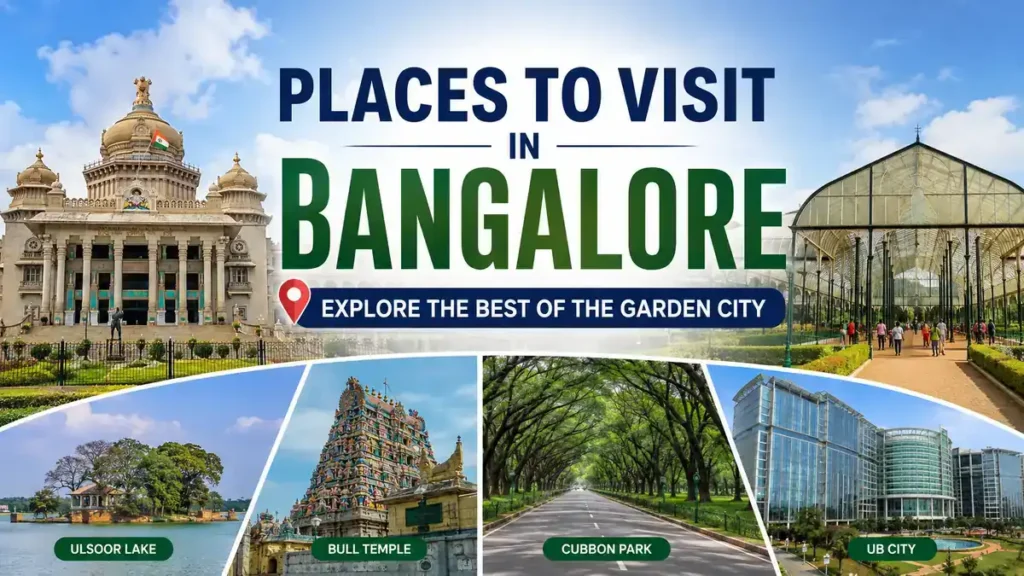
Bangalore rewards travelers who look beyond its reputation as India’s technology capital. Between glass-and-steel office districts are botanical gardens, royal buildings, centuries-old temples, lively markets, museums, lakes, art spaces, and neighborhoods where some of the city’s best experiences happen over filter coffee and a dosa.
If you are searching for places to visit in bangalore, start with Lalbagh Botanical Garden, Cubbon Park, Bangalore Palace, Vidhana Soudha, Tipu Sultan’s Summer Palace, ISKCON Temple, Bannerghatta Biological Park, Church Street, Commercial Street, and the city’s museums. Add Nandi Hills or another nearby escape if you have an extra day.
The city is officially called Bengaluru, although Bangalore remains widely used by travelers. Karnataka Tourism describes Bengaluru as a destination shaped by gardens, historic institutions, art, culture, innovation, and a mix of heritage buildings and contemporary urban life.
Best places to visit in bangalore at a glance
| Place | Best for | Suggested time |
|---|---|---|
| Lalbagh Botanical Garden | Gardens, photography | 2–3 hours |
| Cubbon Park | Walking, greenery | 1–2 hours |
| Bangalore Palace | History, architecture | 1.5–2 hours |
| Vidhana Soudha | Architecture | 30–45 minutes |
| Tipu Sultan’s Summer Palace | Heritage | 1 hour |
| Bangalore Fort | History | 30–60 minutes |
| ISKCON Temple | Spirituality, architecture | 1–2 hours |
| Bull Temple | Local heritage | 30–60 minutes |
| Visvesvaraya Museum | Science, families | 2–3 hours |
| Museum of Art & Photography | Art, culture | 1.5–2 hours |
| Karnataka Chitrakala Parishath | Indian art | 1–2 hours |
| HAL Aerospace Museum | Aviation | 2–3 hours |
| Bannerghatta Biological Park | Wildlife | Half/full day |
| Church Street | Cafes, books, nightlife | 2–4 hours |
| Commercial Street | Shopping | 2–3 hours |
| KR Market | Local life, photography | 1–2 hours |
| Ulsoor Lake | Relaxation | 1–2 hours |
| Sankey Tank | Evening walks | 1 hour |
| Wonderla Bengaluru | Rides, families | Full day |
| Nandi Hills | Sunrise, nature | Half/full day |
1. Lalbagh Botanical Garden
Among all the famous places to visit in bangalore, Lalbagh is one of the easiest recommendations to make. It combines history, horticulture, architecture, photography, and open space in one central attraction.
The garden traces its origins to Hyder Ali in the 18th century and was subsequently developed under Tipu Sultan. Today, its landscape includes mature trees, botanical collections, walking paths, water features, and the well-known Glass House. Travel sources consistently place Lalbagh among Bengaluru’s leading visitor attractions.
What to see at Lalbagh
The Glass House is the visual centerpiece and is particularly associated with Lalbagh’s flower shows. Elsewhere, explore the lake, landscaped sections, giant old trees, and Lalbagh Rock.
The garden works especially well early in the morning. The temperature is usually more comfortable, photography is easier, and you experience more of the peaceful character that makes Bangalore’s parks special.
Best for: Nature lovers, couples, families, photographers
Allow: 2–3 hours
2. Cubbon Park
Cubbon Park offers a different experience from Lalbagh. While Lalbagh feels like a formal botanical garden, Cubbon Park feels woven directly into the civic heart of Bengaluru.
Official tourism information describes it as a roughly 300-acre green haven, while the Bengaluru Urban district identifies it by its official name, Sri Chamarajendra Park.
Broad avenues, enormous trees, lawns, historic buildings, statues, and shaded walking routes make it one of the best places in Bangalore for an unhurried morning.
It is also conveniently positioned near several cultural attractions, making it useful for an efficient sightseeing itinerary.
Combine Cubbon Park with nearby attractions
From this part of central Bengaluru, you can conveniently combine the park with the Visvesvaraya Industrial and Technological Museum, Government Museum, Vidhana Soudha and Museum of Art & Photography.
Best for: Walking, families, greenery, relaxed mornings
Allow: 1–2 hours
3. Bangalore Palace
Bangalore Palace provides the strongest dose of royal architecture within the city.
Turrets, battlements, fortified towers, arches and ornate interiors give it an appearance that contrasts sharply with modern Bengaluru. Government tourism information notes the palace’s English-castle influence, while descriptions of its interiors highlight Tudor-style elements and historic furnishings.
Inside, visitors can see decorative woodwork, paintings, furniture and ceremonial spaces linked with the city’s royal history.
Do not rush the palace simply to collect photographs. Its value comes from looking at architectural details and understanding the royal chapter of Bengaluru’s development.
Best for: Architecture, history, first-time visitors
Allow: 1.5–2 hours
4. Vidhana Soudha
Few buildings communicate Bengaluru’s civic identity as effectively as Vidhana Soudha.
Completed in 1956, the monumental granite building houses the Karnataka legislature and state secretariat. The Bengaluru Urban district describes it as one of the city’s major landmarks, while Karnataka Tourism highlights its neo-Dravidian architecture.
Most travelers admire the exterior rather than treating it as a conventional indoor tourist attraction.
Its position beside Cubbon Park makes it easy to include in a central Bengaluru walking or driving circuit.
Best for: Architecture, photography, civic history
Allow: 30–45 minutes
5. Tipu Sultan’s Summer Palace
Tipu Sultan’s Summer Palace is much smaller than Bangalore Palace, but historically it is just as interesting.
The palace is known for its teak construction, ornate pillars, balconies and Indo-Islamic architectural character. It provides an accessible introduction to the period associated with Tipu Sultan and the Kingdom of Mysore.
Because the attraction is relatively compact, it fits well into a heritage route through old Bengaluru.
Pair it with Bangalore Fort, KR Market and nearby historic neighborhoods rather than making a separate cross-city journey.
Best for: History and architecture
Allow: Around 1 hour
6. Bangalore Fort
Bangalore Fort is useful for understanding how dramatically Bengaluru changed from a fortified settlement into a modern metropolis.
The city’s origins are closely associated with Kempegowda, who established the settlement in the 16th century. Bengaluru later passed through several political eras involving the Mysore rulers and British influence. Incredible India dates the founding of the town to 1537.
What remains of the fort is modest compared with India’s giant fortress complexes, so expectations matter. Come for historical context rather than monumental scale.
Its location also makes it easy to combine with Tipu Sultan’s Summer Palace.
Best for: Heritage enthusiasts
Allow: 30–60 minutes
7. ISKCON Temple Bangalore
The ISKCON Sri Radha Krishna Temple on Hare Krishna Hill is one of Bengaluru’s major religious landmarks and consistently ranks among the city’s most visited attractions. Tripadvisor currently lists it among its top attractions in Bengaluru.
The complex is associated with Sri Radha Krishnachandra and combines worship spaces with cultural and community activities.
Even visitors whose primary interest is architecture rather than pilgrimage can appreciate the scale and atmosphere of the complex.
As with any active religious site, dress respectfully and allow worshippers space.
Best for: Spiritual travelers, architecture, families
Allow: 1–2 hours
8. Bull Temple
Dodda Basavana Gudi, commonly called the Bull Temple, belongs on a heritage-focused Bangalore itinerary.
It is particularly known for its enormous monolithic Nandi sculpture. Nandi is traditionally regarded as the mount of Shiva, giving the temple both artistic and religious significance.
The temple is associated with Kempegowda’s era and is often cited as an example of Bengaluru’s older Dravidian architectural heritage.
The surrounding Basavanagudi neighborhood is worth exploring as well. This is one of the better parts of the city for experiencing traditional Bengaluru away from business districts and technology parks.
Best for: Temple architecture, heritage
Allow: 30–60 minutes
9. Visvesvaraya Industrial and Technological Museum
Traveling with children does not mean limiting your Bangalore itinerary to parks and amusement rides.
The Visvesvaraya Industrial and Technological Museum is one of the city’s strongest educational attractions, using interactive exhibitions to explain science, engineering and technology. Both tourism guides and current attraction lists regularly identify it among Bengaluru’s important museums.
Plan more time than you might expect. Interactive exhibits make this a place where curious children—and plenty of adults—can easily spend several hours.
Its central location near Cubbon Park is another advantage.
Best for: Families, children, science enthusiasts
Allow: 2–3 hours
10. Museum of Art & Photography
Bengaluru’s identity is not limited to gardens, temples and technology. The city has a substantial contemporary cultural scene too.
The Museum of Art & Photography, commonly called MAP, is among the attractions currently highlighted by Karnataka Tourism.
Its exhibitions bring photography, visual culture and art into a modern museum environment, making it a particularly useful stop for visitors who want something different from conventional monuments.
Because MAP sits in central Bengaluru, it can fit naturally into a day involving Cubbon Park and nearby museums.
Best for: Art, photography, contemporary culture
Allow: 1.5–2 hours
11. Karnataka Chitrakala Parishath
Karnataka Chitrakala Parishath is another strong choice for understanding Bengaluru’s artistic side.
Karnataka Tourism describes CKP as an important center in Bengaluru’s visual arts scene.
Depending on when you visit, the experience may include permanent collections, exhibitions, art events or markets. That variability is part of its appeal.
Rather than expecting a giant encyclopedic museum, approach it as a living arts institution connected with the city’s creative community.
Best for: Art lovers, students, cultural travelers
Allow: 1–2 hours
12. HAL Aerospace Museum
There are few better reminders of Bangalore’s relationship with Indian aerospace and engineering than the HAL Aerospace Museum.
Located around the Old Airport Road area, it explores aviation history through aircraft, engines and related exhibits. Current travel guides recommend it particularly for science, aircraft and technology enthusiasts.
Children who are fascinated by machines often find it far more engaging than another historic monument.
It also provides useful context for why Bengaluru became such an important center for Indian science, engineering and aerospace long before its international reputation as an IT hub fully developed.
Best for: Aircraft enthusiasts, families, engineering students
Allow: 2–3 hours
13. Bannerghatta Biological Park
For wildlife, Bannerghatta is one of the most popular tourist places around southern Bengaluru.
Visitors typically come for its zoo and wildlife-focused experiences, while the broader Bannerghatta landscape represents an important natural area near a rapidly expanding metropolis. Tripadvisor continues to rank Bannerghatta Biological Park among Bengaluru’s major visitor attractions.
Give this attraction substantially more time than a downtown museum. Traffic to and from Bannerghatta Road can significantly affect journey time.
A half-day is the minimum practical allocation; families often find a full day more comfortable.
Best for: Wildlife, families, children
Allow: Half to full day
14. Church Street
If gardens and monuments reveal Bangalore’s history, Church Street shows its contemporary personality.
The street and its immediate surroundings are filled with restaurants, cafes, bookstores and places to socialize. It connects naturally with the MG Road and Brigade Road area and is particularly lively later in the day.
This is one reason an effective Bangalore itinerary should not consist entirely of traditional sightseeing attractions. Exploring neighborhoods tells you considerably more about how the city actually lives.
Come in the late afternoon, browse slowly, stop for coffee and stay into the evening if you enjoy urban nightlife.
Best for: Cafes, books, food, evening walks
Allow: 2–4 hours
15. Commercial Street
Commercial Street remains one of Bangalore’s classic shopping areas.
Rather than functioning as a single modern mall, the district combines established stores, smaller shops and busy lanes selling clothing, footwear, accessories and other goods. It appears repeatedly in major Bangalore tourism guides as one of the city’s principal shopping destinations.
The fun lies partly in the density of the experience. Traffic, crowds, storefronts and street activity all contribute to its character.
Go without an excessively rigid schedule, particularly if shopping is one of your priorities.
Best for: Shopping, street atmosphere
Allow: 2–3 hours
16. KR Market
Krishna Rajendra Market, generally called KR Market or City Market, provides a completely different impression of Bengaluru.
It is busy, crowded and intensely local. Flower vendors are one of its most photographed features, particularly during the early part of the day.
This is not a polished attraction designed exclusively for tourists—it is a functioning market. That is precisely why it can be so memorable.
Visit early if photography interests you, but remain considerate of vendors who are working rather than performing for visitors.
Nearby Tipu Sultan’s Summer Palace and Bangalore Fort make it easy to create an Old Bangalore heritage circuit.
Best for: Markets, local culture, street photography
Allow: 1–2 hours
17. Ulsoor Lake
After several hours in dense traffic and busy markets, Bengaluru’s lakes can provide a welcome change in pace.
Ulsoor Lake is one of the best-known urban lakes near central Bangalore. Travel guides highlight it for relaxed walks, scenery and birdlife.
It is not a destination that requires half a day. Instead, use it as a quieter stop between more intensive sightseeing activities.
Early morning and late afternoon generally create a more pleasant atmosphere than the hottest part of the day.
Best for: Couples, quiet walks, photography
Allow: 1–2 hours
18. Sankey Tank
Sankey Tank is another peaceful urban option, particularly for people who prefer an evening stroll to another indoor attraction.
The landscaped surroundings are popular with local walkers and provide a glimpse of everyday recreational life in Bengaluru.
It works best as an itinerary filler rather than a must-see landmark. If you are staying nearby, however, it can be considerably more rewarding than spending the same hour traveling across the city to tick another famous attraction off a list.
That principle matters in Bangalore: proximity is often more important than attraction count.
Best for: Walking, couples, relaxed evenings
Allow: Around 1 hour
19. Wonderla Bengaluru
For families, groups of friends and travelers looking for rides rather than museums, Wonderla is one of the most prominent amusement parks near Bangalore.
The park combines amusement rides and water-oriented attractions and is widely listed among the area’s leading recreational destinations.
Treat Wonderla as a dedicated excursion. Trying to combine it with central Bangalore sightseeing usually creates an unnecessarily rushed day.
A weekday can also feel less hectic than peak weekends and holiday periods.
Best for: Families, teenagers, groups
Allow: Full day
20. Nandi Hills
Nandi Hills is technically outside central Bengaluru, but it appears so consistently in Bangalore travel planning that excluding it would leave a major gap.
Karnataka Tourism highlights Nandi Hills as a popular hill retreat near Bengaluru, and major travel guides routinely recommend it as one of the city’s leading nearby excursions.
Its elevated landscape and views make it especially popular around sunrise.
That popularity creates a downside: weekends can become crowded, particularly during desirable weather. Leaving very early and checking current access conditions before departure is sensible.
Best for: Sunrise, views, couples, short road trips
Allow: Half to full day
Historical places to visit in bangalore
Travelers interested primarily in history should concentrate their time around old and central Bengaluru.
Bangalore Palace represents the city’s royal heritage, while Tipu Sultan’s Summer Palace and Bangalore Fort connect visitors with the Mysore period. The Bull Temple takes the story further back toward Kempegowda’s Bengaluru, while Vidhana Soudha represents the post-independence civic city. Incredible India’s official tourism overview likewise emphasizes Bangalore Palace, Tipu Sultan’s Summer Palace and the Bull Temple when describing the city’s historical character.
A good heritage day can therefore move roughly from KR Market to Bangalore Fort and Tipu Sultan’s Summer Palace, then through Basavanagudi before continuing toward central Bengaluru.
The key is not to treat every historical attraction as an isolated stop. Seeing them chronologically makes the city’s development easier to understand.
Places to visit in bangalore with family
Families have more variety than the standard palace-and-park itinerary suggests.
Cubbon Park and Lalbagh work well for children who need outdoor space. The Visvesvaraya Industrial and Technological Museum adds interactive science, HAL Aerospace Museum introduces aviation, and Bannerghatta offers a wildlife-focused day. Wonderla is the obvious choice when entertainment matters more than traditional sightseeing.
Jawaharlal Nehru Planetarium is another useful option. It appears among prominent attractions in current Bengaluru tourism guides and is particularly suitable for children interested in astronomy.
For a short family visit, avoid squeezing five distant attractions into one day. Two or three well-grouped stops usually produce a better experience.
Best places in Bangalore for couples
Couples looking for quieter experiences have plenty of options without relying exclusively on restaurants and shopping malls.
Lalbagh and Cubbon Park are strongest in the morning, while Ulsoor Lake and Sankey Tank suit slower evenings. Art-oriented couples may prefer MAP or Karnataka Chitrakala Parishath before spending the evening around Church Street.
Nandi Hills can work well as a scenic excursion if you are prepared for an early start.
One practical warning: Bangalore traffic can turn a seemingly romantic cross-city itinerary into several hours in a car. Pick two neighboring areas instead.
Best places to visit in Bangalore at night
Bengaluru becomes a different city after sunset.
Church Street, MG Road and Brigade Road form one of the easiest areas for first-time visitors to experience the city’s evening atmosphere. Indiranagar and Koramangala are also known for dining, cafes and nightlife.
Vidhana Soudha is worth seeing from outside when illuminated, subject to current lighting arrangements and security restrictions.
If your priority is exploring rather than nightlife, simply walking through a busy central district after dinner can be more rewarding than adding another formal attraction.
What to eat while exploring Bangalore
Food should be treated as part of sightseeing here rather than something that happens between attractions.
Bangalore’s culinary identity stretches from traditional South Indian breakfast institutions and neighborhood darshinis to modern cafes, specialty coffee and contemporary dining. Tripoto specifically highlights Mavalli Tiffin Rooms, commonly called MTR, and Vidyarthi Bhavan when discussing local cuisine, while other travel guides emphasize the broader cafe and food culture of neighborhoods such as Indiranagar and Koramangala.
Try classic dishes such as masala dosa, idli, vada, khara bath, kesari bath and filter coffee.
VV Puram Food Street is another established name associated with Bangalore street food. It is particularly suited to travelers who would rather sample several small dishes than sit down for one large meal.
How many days are enough for Bangalore?
Two days are enough for Bangalore’s major highlights, while three days provide a much more relaxed visit. Four days are useful if you want to add Bannerghatta, Wonderla, Nandi Hills or another excursion outside the central sightseeing zone.
For a one-day visit, concentrate on central landmarks rather than attempting to cross the whole city.
One day in Bangalore
Start at Lalbagh in the morning, visit Tipu Sultan’s Summer Palace and Bangalore Fort, then continue to Cubbon Park and Vidhana Soudha. Finish around Church Street or MG Road.
Two days in Bangalore
Use the first day for central and historic Bangalore.
On day two, visit Bangalore Palace and ISKCON Temple before choosing a museum, Commercial Street or another attraction matching your interests.
Three days in Bangalore
Keep the first two days relatively similar, then dedicate your third day to Bannerghatta Biological Park, Nandi Hills, Wonderla or a deeper exploration of Bengaluru’s neighborhoods and museums.
This approach works much better than simply selecting the 15 highest-ranked attractions and attempting to visit them sequentially.
Best time to visit Bangalore
Bengaluru can be visited throughout the year, a point also reflected in current travel guides. Its elevation on the Deccan Plateau contributes to generally milder conditions than many other major Indian cities.
For sightseeing, the cooler months are usually the easiest time for spending long periods outdoors.
Morning remains the best part of the day for Lalbagh, Cubbon Park, markets and hill excursions regardless of season.
Rain can disrupt outdoor itineraries during wetter periods, so museums, galleries and indoor attractions are useful backups.
Lalbagh is particularly notable around its major flower-show periods. Karnataka Tourism’s 2026 calendar, for example, featured the Bengaluru Independence Day celebrations and Lalbagh Flower Show in August.
How to get around Bangalore
Distances on a map can be deceptive here. Bengaluru is enormous, and road congestion can consume far more time than first-time visitors expect. Holidify likewise flags traffic congestion as one of the city’s main drawbacks for tourists.
Namma Metro is therefore extremely useful when your starting point and attraction are near stations. Auto-rickshaws and app-based taxis are practical for shorter connections and areas without convenient rail access.
The most effective strategy is geographical clustering.
Visit Lalbagh, Basavanagudi, Tipu Sultan’s Summer Palace and other southern or old-city attractions together. Keep Cubbon Park, Vidhana Soudha, museums, MG Road and Church Street in another cluster.
Reserve destinations such as Bannerghatta, Wonderla and Nandi Hills for separate excursions.
That simple change can save hours.
Bangalore tourist places beyond the obvious attractions
If this is your second visit—or you simply dislike doing exactly the same circuit as everyone else—Bengaluru has plenty more depth.
The National Gallery of Modern Art expands the city’s art offering, while Government Museum provides archaeological and artistic collections. Incredible India notes that the Government Museum holds prehistoric material alongside Vijayanagara, Hoysala and Chalukya sculpture and other collections.
Freedom Park offers another layer of modern history. The site occupies Bengaluru’s former Central Jail and was transformed into a public park with spaces including a library, museum, amphitheater and walking areas.
St. Mary’s Basilica, Gavi Gangadhareshwara Temple, Halasuru Someshwara Temple, Bugle Rock Park, Devanahalli Fort and Hesaraghatta are further possibilities depending on your interests. These names recur across current tourism and attraction guides, but they rarely fit comfortably into a first-time two-day itinerary.
Places near Bangalore for a day trip
Once the major city attractions are covered, Bengaluru makes a useful base for short escapes.
Nandi Hills is the most recognizable option. Ramanagara attracts travelers interested in rocky landscapes and outdoor activities, while Devanahalli adds fort history. Karnataka’s Bengaluru Rural district officially identifies Devanahalli Fort and Tipu Sultan’s birthplace among its tourist attractions.
Savandurga, Skandagiri and other trekking areas also appear frequently in Bangalore getaway itineraries. Holidify highlights Savandurga among the destinations near Bangalore, while Thrillophilia includes Skandagiri and Ramanagara in its broader Bangalore attraction coverage.
These are better treated as excursions rather than city attractions. Always verify current access rules, trekking permissions and opening conditions before leaving, since these can change.
Practical tips for visiting Bangalore
A little planning makes a disproportionate difference in this city.
- Group attractions geographically. Central Bengaluru, Basavanagudi/old Bengaluru, northern Bengaluru and the outskirts should not be mixed randomly into one day.
- Start outdoor sightseeing early. Lalbagh, Cubbon Park, markets and Nandi Hills are generally more enjoyable before the middle of the day.
- Expect traffic. Build substantial buffer time around journeys, especially at weekday commuting hours.
- Use the Metro where practical. It can eliminate unpredictable road delays on suitable routes.
- Check official timings before visiting. Museum holidays, temple schedules, safari sessions, entry rules and maintenance closures can change.
- Dress respectfully at religious sites. Some temples may have specific rules regarding footwear, photography and access to worship areas.
- Keep an indoor backup. MAP, Visvesvaraya Museum, HAL Aerospace Museum and other cultural attractions are useful when weather changes.
- Do not judge Bengaluru only by its landmarks. Spending time in Basavanagudi, Malleshwaram, Church Street, Jayanagar or another established neighborhood often reveals more of the city’s character than rushing through another checklist attraction.
Which places to visit in bangalore should you prioritize?
For a first trip, Lalbagh Botanical Garden, Cubbon Park, Bangalore Palace, Vidhana Soudha and Tipu Sultan’s Summer Palace provide the strongest introduction to the city’s gardens, architecture and history. Add ISKCON Temple for spiritual heritage, Visvesvaraya Museum or MAP for culture, and Church Street for contemporary Bengaluru.
Families can prioritize Bannerghatta Biological Park, the science museum, HAL Aerospace Museum and Wonderla. Travelers with an extra day can head toward Nandi Hills.
The best places to visit in bangalore ultimately depend less on how many attractions you can collect and more on experiencing the city’s contrasts: an 18th-century garden before breakfast, a royal palace before lunch, contemporary art in the afternoon, and a lively neighborhood after dark. That combination of heritage, greenery, technology, food and modern culture is what makes Bengaluru worth exploring rather than simply passing through.