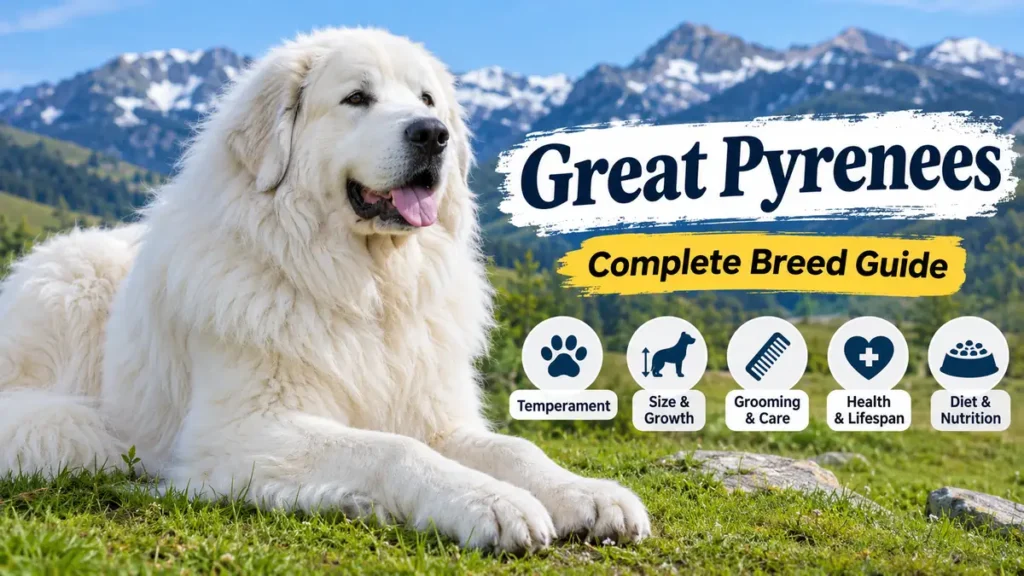
The great pyrenees is a majestic, powerful dog with a thick white coat, a calm personality, and a natural instinct to protect. Known for its loyalty and independent thinking, this mountain breed has guarded livestock for centuries and remains a devoted family companion.
But beneath that beautiful, fluffy appearance is a serious working dog. Great Pyrenees dogs can bark through the night, wander beyond unsecured boundaries, and make decisions without waiting for human instructions. Understanding these traits is essential before bringing one into a household.
The great pyrenees is a large livestock guardian dog originally developed in the Pyrenees Mountains between France and Spain. Typically weighing 85–100 pounds or more, this breed is known for its protective instincts, gentle family temperament, thick double coat, and independent nature. It requires secure fencing, consistent training, regular grooming, and thoughtful socialization.
What Is a Great Pyrenees?
The Great Pyrenees, also known as the Pyrenean Mountain Dog or Chien de Montagne des Pyrénées, is a large working breed developed to protect sheep and other livestock from predators.
Unlike herding dogs such as Border Collies, which move livestock, Pyrenees dogs traditionally remain with their flocks and discourage threats through their imposing presence, deep barking, and defensive behavior when necessary.
The breed belongs to the Working Group of the American Kennel Club (AKC). Its distinctive appearance includes a dense white coat, dark expressive eyes, triangular ears, and a powerful yet elegant body.
Great Pyrenees breed overview
| Characteristic | Details |
|---|---|
| Breed name | Great Pyrenees |
| Other name | Pyrenean Mountain Dog |
| Origin | Pyrenees Mountains, France and Spain |
| Breed group | Working |
| Height | Males 27–32 inches; females 25–29 inches |
| Weight | Males approximately 100+ lb; females approximately 85+ lb |
| Life expectancy | Approximately 10–12 years |
| Coat | Thick, weather-resistant double coat |
| Common colors | White; white with gray, tan, reddish-brown, or badger markings |
| Temperament | Calm, loyal, independent, protective |
| Exercise needs | Moderate |
| Grooming | Regular brushing and seasonal heavy shedding |
| Trainability | Intelligent but independently minded |
| Original purpose | Livestock guarding |
Individual dogs vary considerably in size, energy, and behavior. Genetics, early experiences, health, and environment all influence how a Great Pyrenees develops.
History and Origin of the Great Pyrenees
The Great Pyrenees has a long history as a livestock guardian in the mountainous border region of France and Spain.
For generations, shepherds relied on these dogs to watch over flocks in isolated mountain pastures. Their thick coats protected them from harsh weather, while their size and vigilance helped deter predators, including wolves and bears.
From mountain guardian to royal companion
Although the breed’s precise ancient ancestry is difficult to establish, large white livestock guardian dogs have been associated with European mountain regions for centuries.
During the seventeenth century, the breed gained prominence among French nobility. It is traditionally associated with King Louis XIV and the royal court, where its impressive appearance and protective reputation increased its popularity.
However, the Great Pyrenees never completely lost its working identity.
Its ability to remain outdoors, assess danger independently, and form protective bonds with livestock continued to define the breed.
Development in North America
The American Kennel Club recognized the Great Pyrenees in 1933.
Organizations such as the Great Pyrenees Club of America have helped preserve breed knowledge, promote responsible breeding, and educate owners about the differences between livestock guardians and conventional companion dogs.
Today, the breed serves several roles, including:
- Family companion and household guardian
- Livestock guardian on farms and ranches
- Working dog protecting sheep, goats, and other animals
- Participant in conformation dog shows
- Companion in suitable rural and suburban homes
The breed’s versatility does not mean it adapts equally well to every environment. Its traditional working instincts remain particularly important.
Great Pyrenees Size, Appearance, and Growth
The Great Pyrenees is a giant-looking, strongly built dog with a balanced, slightly longer-than-tall body.
Its appearance combines strength with an unexpectedly graceful movement. Although these dogs are substantial, healthy adults should not look excessively heavy or cumbersome.
How big does a Great Pyrenees get?
Adult males generally stand between 27 and 32 inches at the shoulder, while females typically measure 25 to 29 inches.
Males commonly weigh at least 100 pounds, while females generally weigh at least 85 pounds. Many healthy adults exceed these minimum weights.
A dog’s ideal weight depends on its height, frame, muscle development, and body condition rather than a single target number.
Great Pyrenees puppy growth
Puppies grow rapidly during their first year, but skeletal and muscular maturity takes longer.
| Age | Typical development |
|---|---|
| 8–12 weeks | Rapid growth, early socialization, and basic training |
| 3–6 months | Increasing height, weight, and independence |
| 6–12 months | Adolescent behavior and substantial physical growth |
| 12–18 months | Approaching adult height, continuing to fill out |
| 18–24+ months | Gradual physical and behavioral maturity |
These are developmental stages, not strict milestones. Some giant-breed dogs continue filling out beyond their second birthday.
Owners should avoid forcing growing puppies into strenuous running, repeated high jumps, or excessive exercise that could stress developing joints.
Coat colors and distinctive features
Although the breed is famous for its white coat, the AKC breed standard also permits white dogs with certain markings.
Common markings include gray, badger, reddish-brown, and varying shades of tan, particularly around the head, ears, and body.
Other recognizable features include dark brown eyes, a black nose, a long plumed tail, and double dewclaws on the rear legs.
Those rear double dewclaws are a characteristic breed feature and should not automatically be considered a defect.
Great Pyrenees Temperament and Personality
The Great Pyrenees temperament is one of the breed’s most appealing and most misunderstood characteristics.
These dogs are often affectionate and gentle with familiar people, but they are also independent guardians bred to recognize potential danger.
Are Great Pyrenees good family dogs?
Great Pyrenees can be excellent family companions in households prepared for their size and guarding behavior.
Many are patient, affectionate, and deeply attached to family members. Some are particularly gentle around children they know.
However, no large dog should be left unsupervised with young children. Even a friendly Pyrenees can accidentally knock over a small child.
Children should also learn to respect the dog’s resting space, avoid pulling its fur, and never disturb it while eating.
Are Great Pyrenees aggressive?
Great Pyrenees are not inherently aggressive toward people, but they are naturally protective and may react defensively when they perceive a threat.
Their traditional role required them to challenge predators, so alertness and territorial behavior are expected breed characteristics.
A well-socialized dog should be capable of distinguishing ordinary visitors and daily activities from genuine danger.
Poor socialization, fear, pain, inappropriate handling, or unmanaged guarding behavior can increase the risk of problematic reactions.
Owners should never encourage aggression as a substitute for responsible training.
Why are Great Pyrenees so independent?
Livestock guardian dogs historically worked without constant human direction.
A Great Pyrenees might spend hours watching livestock and deciding whether a distant animal represented a threat.
That background explains why the breed may appear stubborn during obedience training.
It is often more accurate to describe these dogs as independent decision-makers than unintelligent or deliberately disobedient.
Training works best when the dog understands the desired behavior and finds cooperation rewarding.
Do Great Pyrenees bark a lot?
Yes. Frequent barking is a normal and significant characteristic of the breed.
Great Pyrenees use barking to announce unfamiliar sounds, approaching animals, visitors, and perceived changes in their surroundings.
Some are particularly vocal after dark because livestock guardians historically needed to remain alert when predators were active.
Training and environmental management can reduce unnecessary barking, but owners should not expect complete silence.
This is one reason the breed can be challenging in densely populated neighborhoods or apartment buildings.
Great Pyrenees Training and Socialization
Training a Great Pyrenees requires patience, consistency, and realistic expectations.
These dogs are intelligent and capable of learning commands, but their independent nature means they may not respond with the immediate enthusiasm of breeds developed for close handler cooperation.
How to train a Great Pyrenees puppy
Begin training as soon as the puppy arrives home.
Focus on practical household behaviors rather than demanding perfect obedience.
- Teach name recognition. Reward the puppy for responding to its name and making eye contact.
- Introduce basic cues. Practice sit, stay, come, leave it, and settle in short sessions.
- Reward calm behavior. Reinforce relaxed responses to visitors, noises, and everyday activities.
- Practice leash walking. Teach loose-leash skills before the puppy becomes too large to manage comfortably.
- Build a reliable routine. Establish predictable feeding, sleeping, grooming, and bathroom schedules.
- Use positive reinforcement. Reward successful behavior with treats, praise, toys, or other appropriate motivators.
Harsh punishment can damage trust and increase defensive behavior, particularly in a naturally protective dog.
Early socialization matters
The early puppy period is especially important for building confidence around unfamiliar experiences.
Introduce the puppy gradually to different people, surfaces, sounds, vehicles, and appropriate animals.
These experiences should be controlled and positive rather than overwhelming.
Socialization does not mean allowing every stranger to touch the puppy or requiring it to greet every dog.
The goal is to develop a confident adult that can remain composed in ordinary situations.
Can Great Pyrenees be trained off-leash?
Off-leash reliability can be difficult for this breed.
Great Pyrenees may follow scents, investigate distant movement, or patrol beyond their property.
Even a dog that responds well in a quiet training area may ignore recall when its guarding instincts are activated.
For safety, secure fencing and a leash are generally more dependable than relying on obedience alone.
Electronic containment systems are not a substitute for a physical fence, especially when a large guardian dog is motivated to investigate a perceived threat.
Exercise, Living Space, and Daily Care
Despite their size, Great Pyrenees are not typically high-intensity exercise dogs.
They were developed for sustained vigilance and steady movement rather than continuous sprinting or repetitive athletic activity.
How much exercise does a Great Pyrenees need?
Many healthy adult Great Pyrenees do well with approximately 30–60 minutes of moderate daily activity, adjusted to age, fitness, temperature, and individual needs.
Suitable activities include leisurely walks, supervised exploration of a securely fenced yard, scent games, and calm interactive play.
Working livestock guardians may naturally cover much greater distances while patrolling their territory.
Puppies require shorter, age-appropriate activity sessions with plenty of rest.
Senior dogs may benefit from several gentle walks instead of one long outing.
Can Great Pyrenees live in apartments?
Apartment living is possible for some individual dogs, but it is often difficult.
Their large bodies, frequent barking, shedding, and instinct to monitor unfamiliar activity can create challenges in shared buildings.
A house with secure outdoor space is generally more practical, although yard size alone does not determine whether a dog receives adequate care.
A Great Pyrenees living in a large yard still needs companionship, enrichment, training, and daily attention.
Are Great Pyrenees good in hot weather?
Great Pyrenees have thick double coats that help protect them in cold and variable mountain conditions.
However, their large size and dense fur make them vulnerable to overheating, especially in hot, humid climates.
Provide constant access to fresh water, shade, and a cool indoor environment.
Avoid strenuous exercise during the hottest hours of the day.
Signs of heat-related illness can include excessive panting, weakness, drooling, vomiting, disorientation, or collapse. Suspected heatstroke requires immediate veterinary attention while cooling begins.
Do not shave a healthy double coat simply to manage ordinary shedding or summer heat. Coat removal can affect its protective function, and shaving does not eliminate heatstroke risk.
Great Pyrenees Grooming and Shedding
The Great Pyrenees coat is beautiful, but maintaining it requires consistent effort.
Its double coat consists of a dense, soft undercoat and longer, coarser outer guard hairs.
Together, these layers provide insulation and weather protection.
Do Great Pyrenees shed a lot?
Yes. Great Pyrenees shed throughout the year and often experience heavier seasonal shedding when they release substantial amounts of undercoat.
Owners may notice loose white fur on clothing, furniture, carpets, and floors.
Regular brushing helps remove dead hair before it becomes tangled or spreads throughout the home.
How often should you brush a Great Pyrenees?
Most dogs benefit from thorough brushing at least two or three times weekly.
During heavy shedding periods, more frequent brushing may be necessary.
Useful grooming tools include an appropriate slicker brush, pin brush, and long-toothed metal comb.
Pay particular attention to areas where mats commonly develop, such as behind the ears, around the collar, beneath the legs, and near the tail.
Brush gently and avoid scraping the skin.
Bathing, nails, ears, and teeth
Great Pyrenees generally do not require frequent bathing unless they become dirty or develop a veterinary skin condition.
Overbathing with unsuitable products can irritate the skin.
Nails should be checked regularly, including the rear double dewclaws, which may not wear down naturally.
Inspect ears for redness, unusual odor, discharge, or discomfort.
Dental care is also important. Regular toothbrushing with dog-safe toothpaste helps reduce plaque accumulation and periodontal disease.
Great Pyrenees Health Problems and Lifespan
The typical Great Pyrenees lifespan is approximately 10–12 years, although individual dogs may live shorter or longer lives.
Like many large and giant breeds, Great Pyrenees are predisposed to certain orthopedic and other medical conditions.
Responsible breeding, appropriate nutrition, weight management, preventive care, and early veterinary attention can improve health outcomes.
Common health concerns
| Health condition | What owners should know |
|---|---|
| Hip dysplasia | Abnormal hip development may contribute to pain and arthritis |
| Elbow dysplasia | Joint abnormalities can cause forelimb lameness |
| Osteochondrosis | A developmental joint disorder affecting growing dogs |
| Patellar luxation | Displacement of the kneecap that can affect mobility |
| Gastric dilatation-volvulus (GDV) | A life-threatening stomach emergency |
| Eye disorders | Certain inherited and acquired conditions can affect vision |
| Osteosarcoma | A serious bone cancer seen more frequently in large and giant breeds |
| Obesity | Excess weight increases strain on joints and may worsen other health problems |
Not every Great Pyrenees develops these conditions. Risk varies with genetics, age, lifestyle, and other factors.
Hip dysplasia and joint protection
Hip dysplasia occurs when the hip joint develops abnormally, potentially leading to instability, pain, and degenerative joint disease.
Possible signs include stiffness after rest, reluctance to climb stairs, difficulty rising, and reduced willingness to exercise.
Maintaining a lean body condition is one of the most useful ways to reduce unnecessary stress on the joints.
For breeding dogs, orthopedic evaluations through recognized programs such as the Orthopedic Foundation for Animals (OFA) or PennHIP can help inform breeding decisions.
What is bloat in Great Pyrenees?
Gastric dilatation-volvulus, commonly called GDV or bloat, occurs when the stomach becomes distended and may twist.
It is a medical emergency.
Warning signs include repeated unsuccessful attempts to vomit, a swollen or painful abdomen, restlessness, drooling, weakness, and collapse.
A dog showing these symptoms needs emergency veterinary care immediately.
Owners should discuss GDV risk and preventive gastropexy with their veterinarian, particularly when the dog is already undergoing another appropriate surgical procedure.
Recommended health screening
Responsible breeders should be willing to discuss relevant hereditary health risks and provide documented screening results.
Depending on current breed-club guidance and family history, evaluations may include hip and patellar assessments, eye examinations, and other appropriate tests.
A routine veterinary examination alone does not establish that breeding dogs are free of inherited conditions.
Prospective owners can consult the Great Pyrenees Club of America and the OFA for information about recommended screening.
Great Pyrenees Diet and Nutrition
Feeding a Great Pyrenees correctly is particularly important during puppyhood.
Rapid growth, excessive calorie intake, and inappropriate mineral balance can contribute to developmental orthopedic problems in large and giant breeds.
What should Great Pyrenees puppies eat?
Puppies should receive a complete and balanced diet formulated for the growth of large-sized dogs, including those expected to weigh 70 pounds or more as adults.
Look for an appropriate nutritional adequacy statement from the Association of American Feed Control Officials (AAFCO), where applicable.
Large-breed puppy diets are designed to provide controlled energy and suitable calcium and phosphorus levels for skeletal development.
Avoid adding calcium supplements unless specifically prescribed by a veterinarian.
How much should an adult Great Pyrenees eat?
Daily food requirements depend on body weight, age, activity level, reproductive status, metabolism, and the calorie density of the food.
A sedentary companion may require substantially fewer calories than an active livestock guardian of similar size.
Use the manufacturer’s feeding guidance as a starting point, then adjust portions according to body condition and veterinary recommendations.
A healthy dog should generally have ribs that can be felt beneath a light layer of tissue and a visible waist when viewed from above.
Feeding practices that support health
Many owners divide an adult dog’s daily ration into two meals rather than one large feeding.
Avoid vigorous activity immediately around meals, especially in dogs at increased risk of GDV.
Food puzzles and slow-feeding bowls may help dogs that eat too quickly, although they should not be considered proven protection against GDV.
Fresh drinking water should always be available.
Treats should make up only a small portion of total daily calorie intake.
Great Pyrenees vs Similar Large Dog Breeds
The Great Pyrenees is sometimes confused with other large, fluffy dogs, especially livestock guardian breeds.
Although they may share physical traits, their working backgrounds and typical behaviors differ.
| Breed | Original role | General temperament | Key distinction |
|---|---|---|---|
| Great Pyrenees | Livestock guardian | Calm, independent, protective | Strong territorial vigilance and frequent barking |
| Anatolian Shepherd Dog | Livestock guardian | Alert, independent, reserved | Often more athletic and strongly territorial |
| Maremma Sheepdog | Livestock guardian | Devoted, watchful, independent | Traditionally closely associated with flock protection |
| Bernese Mountain Dog | Farm and draft work | Affectionate, generally sociable | Typically more oriented toward close family interaction |
| Newfoundland | Water work and draft tasks | Gentle, patient, sociable | Strong swimming heritage and different guarding instincts |
| Kuvasz | Livestock and property guardian | Loyal, independent, protective | Another white guardian breed with a distinct history |
These are broad breed tendencies, not guarantees about individual dogs.
Great Pyrenees vs Anatolian Shepherd
Both breeds were developed to protect livestock and make independent decisions.
Anatolian Shepherd Dogs are generally leaner and may be more physically agile, while Great Pyrenees have a particularly dense white coat and a different historical development.
Both require experienced handling, secure boundaries, and careful socialization.
Great Pyrenees vs Bernese Mountain Dog
These breeds are both large and often affectionate with their families, but their original jobs differ substantially.
Bernese Mountain Dogs were developed for Swiss farm tasks, including draft work, while Great Pyrenees were specialized livestock guardians.
A Bernese Mountain Dog may be more responsive to conventional household training, whereas a Great Pyrenees is more likely to independently monitor its surroundings.
Great Pyrenees vs Maremma Sheepdog
The Maremma Sheepdog originates from Italy and shares the Great Pyrenees’ livestock-protection heritage.
Both can be calm with familiar people and highly vigilant around potential threats.
Their similarities make individual temperament, breeding background, and working suitability more meaningful than appearance alone.
Is a Great Pyrenees Right for Your Lifestyle?
A Great Pyrenees can be a wonderful companion, but the breed requires a household that appreciates independent guarding behavior rather than simply its beautiful appearance.
Advantages of living with a Great Pyrenees
- Often affectionate and devoted to familiar family members
- Naturally watchful and protective
- Generally moderate exercise requirements compared with highly athletic working breeds
- Frequently gentle and patient when appropriately socialized
- Well suited to certain livestock-guardian roles
- Adapted to cold weather through its thick double coat
Challenges owners should expect
- Frequent barking, especially during evening and nighttime hours
- Heavy seasonal shedding and regular grooming
- A strong tendency to patrol or roam without secure boundaries
- Independent behavior that can complicate obedience training
- Significant food, veterinary, and general care requirements associated with a large dog
- Potential difficulty adapting to busy apartments or closely spaced neighbors
Can Great Pyrenees live with cats and other dogs?
Many Great Pyrenees can coexist peacefully with cats and other household animals, particularly when introduced appropriately and socialized from an early age.
However, compatibility depends on individual temperament, previous experiences, and management.
Introductions should be gradual and supervised.
Do not assume that a dog’s livestock-guardian ancestry automatically makes it safe around every animal.
Are Great Pyrenees good for first-time owners?
Some first-time owners successfully raise Great Pyrenees, but the breed is generally more demanding than its relaxed appearance suggests.
A new owner must be prepared to manage barking, train a very large adolescent dog, maintain fencing, and address guarding behavior appropriately.
Working with a qualified reward-based trainer who understands livestock guardian breeds can be particularly helpful.
What should you know before bringing one home?
Consider the dog’s likely adult size, available space, climate, household schedule, and proximity to neighbors.
A secure physical fence is especially important because roaming can expose the dog to traffic, wildlife, and conflicts with other animals.
It is also worth considering the practical cost of veterinary treatment for a giant dog, since medication, imaging, surgery, and boarding may be more expensive than for smaller breeds.
Dogs bred primarily for livestock work may differ in their early experiences and behavior from those raised specifically as household companions.
Learning about the individual dog’s background helps establish realistic expectations.
Great Pyrenees Behavior: Common Problems and Practical Solutions
Many behaviors that owners consider problematic are closely connected to the breed’s original purpose.
Understanding why a behavior occurs makes it easier to manage humanely.
Excessive barking
Identify common triggers, such as passing pedestrians, neighboring dogs, wildlife, or nighttime noises.
Reduce unnecessary exposure where possible by using visual barriers, bringing the dog indoors at night, and rewarding calm behavior.
Teach a quiet cue through positive reinforcement.
Avoid punishment-based methods that may increase anxiety or frustration.
Digging and escaping
Some Great Pyrenees dig to create comfortable resting spots, investigate scents, or escape confinement.
Provide shaded resting areas, suitable enrichment, and secure fencing.
Check gates, fence bottoms, and potential climbing points regularly.
A dog that repeatedly escapes may need a veterinary or behavioral assessment to identify unmet needs or stress.
Separation-related distress
Although Great Pyrenees are independent thinkers, they can still develop distress when separated from familiar people or animals.
Signs may include destructive behavior, persistent vocalization, pacing, or attempts to escape.
Gradual alone-time training can help prevent some problems.
Dogs showing significant distress may benefit from a veterinarian and qualified behavior professional.
Resource guarding
Some dogs become defensive around food, toys, resting areas, or valued objects.
Never forcibly remove items or punish warning signals such as growling.
Instead, use safe management and reward-based behavior modification.
Consult a qualified professional if guarding behavior creates a risk of biting.
Final Thoughts on the great pyrenees
The great pyrenees is a remarkable combination of gentle companionship, physical strength, and independent protective instinct.
Its centuries-old livestock-guardian heritage explains both its most appealing qualities and its everyday challenges. Loyalty, patience, and watchfulness can make the breed deeply rewarding, while barking, roaming, shedding, and independent decision-making require thoughtful management.
For households that can provide secure boundaries, appropriate socialization, regular grooming, veterinary care, and patient training, a Great Pyrenees can become a devoted companion.
The most important step is understanding the breed’s working nature before making a long-term commitment.