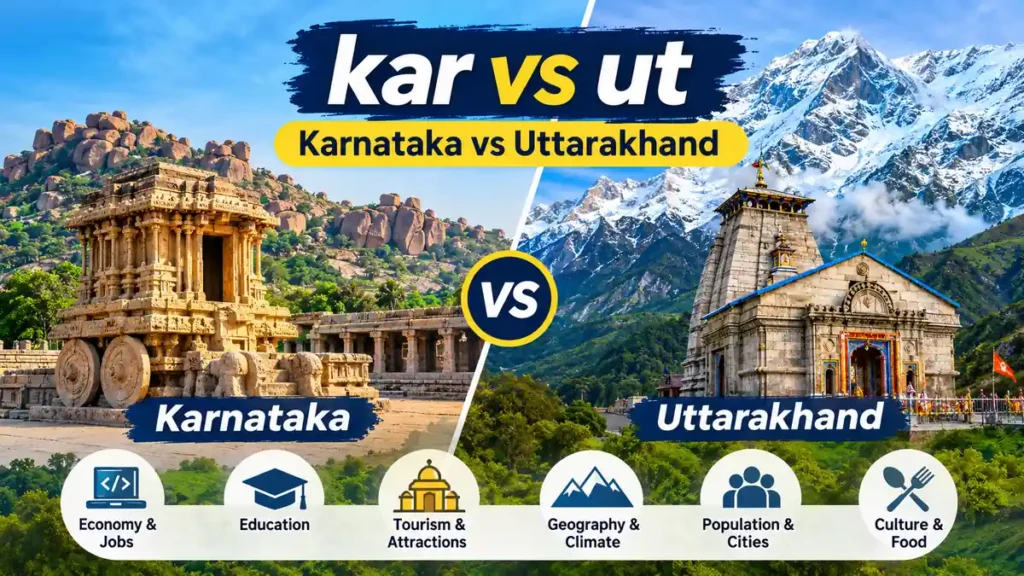
Karnataka and Uttarakhand are two Indian states with strikingly different landscapes, economies, cultures, and lifestyles. Karnataka is known for its technology industry, major cities, and southern heritage, while Uttarakhand is recognized for its Himalayan mountains, pilgrimage destinations, and natural beauty.
The search term kar vs ut can refer to Karnataka versus Uttarakhand, particularly in state comparisons and sports abbreviations. Understanding the differences between these states involves examining their geography, economic development, population, education, infrastructure, tourism, and regional identities. This guide focuses on their broader characteristics rather than a particular sporting fixture.
kar vs ut: Quick Comparison of Karnataka and Uttarakhand
| Feature | Karnataka (KAR) | Uttarakhand (UT) |
|---|---|---|
| Location | Southwestern India | Northern India |
| Capital | Bengaluru | Dehradun (winter), Gairsain (summer) |
| Formation | November 1, 1956, as Mysore State | November 9, 2000 |
| Area | Approximately 191,791 km² | Approximately 53,483 km² |
| Population (2011 Census) | 61.1 million | 10.1 million |
| Principal language | Kannada | Hindi; Garhwali and Kumaoni widely spoken |
| Landscape | Plateau, hills, coastal plains | Himalayan mountains, valleys, foothills |
| Major economic activities | IT, manufacturing, agriculture, services | Tourism, agriculture, manufacturing, hydropower |
| Major cities | Bengaluru, Mysuru, Mangaluru, Hubballi | Dehradun, Haridwar, Haldwani, Rudrapur |
| Famous attractions | Hampi, Mysore Palace, Coorg | Kedarnath, Badrinath, Nainital, Rishikesh |
| Climate | Tropical to semi-arid, with cooler highlands | Subtropical foothills to alpine mountains |
These differences reflect each state’s geography and historical development.
Geography and Location: How Karnataka and Uttarakhand Differ
Karnataka’s geography and natural regions
Karnataka lies in southwestern India and shares borders with Maharashtra, Goa, Telangana, Andhra Pradesh, Tamil Nadu, and Kerala. Its western edge meets the Arabian Sea.
The state has three broad geographical regions:
- Coastal Karnataka: A humid region along the Arabian Sea, including Mangaluru and Udupi.
- Malnad: The hilly Western Ghats region, known for forests, coffee plantations, and heavy monsoon rainfall.
- Bayaluseeme: The interior plateau, where Bengaluru and many agricultural and industrial centers are located.
The Western Ghats are a UNESCO-recognized biodiversity hotspot, supporting diverse plant and animal species.
Karnataka’s varied terrain influences agriculture, rainfall, settlement patterns, and economic activity.
Uttarakhand’s Himalayan landscape
Uttarakhand lies in northern India and borders Himachal Pradesh, Uttar Pradesh, Nepal, and China’s Tibet Autonomous Region.
Its landscape is dominated by the Himalayas, with steep mountain slopes, river valleys, glaciers, and forested foothills.
The state is traditionally divided into two major regions: Garhwal and Kumaon.
Important geographical features include the Gangotri and Yamunotri glaciers and the headwaters of major river systems associated with the Ganga.
Unlike Karnataka’s extensive plateau, Uttarakhand has limited flat land in its mountainous districts. This affects road construction, agriculture, population distribution, and access to services.
Which state is larger?
Karnataka covers approximately 191,791 square kilometers, compared with Uttarakhand’s 53,483 square kilometers.
Karnataka is therefore about 3.6 times larger by geographical area.
However, a state’s physical size alone does not indicate its economic strength, environmental importance, or quality of life.
kar vs ut: Population, Cities, and Urban Development
Population is another major difference between Karnataka and Uttarakhand.
According to India’s 2011 Census, Karnataka had approximately 61.1 million residents, while Uttarakhand had approximately 10.1 million.
These are historical census figures, not current population estimates.
Urbanization in Karnataka
Karnataka has several major urban centers, with Bengaluru serving as its largest city and primary economic hub.
Bengaluru attracts professionals, students, entrepreneurs, and technology companies from across India.
Other important cities include Mysuru, Mangaluru, Hubballi-Dharwad, Belagavi, and Kalaburagi.
Urban development has supported business growth and educational opportunities, but it has also created challenges involving traffic congestion, housing affordability, water supply, and pollution.
Population distribution in Uttarakhand
Uttarakhand’s population is concentrated heavily in its plains and foothill districts, particularly around Dehradun, Haridwar, Udham Singh Nagar, and parts of Nainital district.
Many mountain villages have experienced outward migration because of limited employment opportunities, difficult transportation, and restricted access to healthcare and education.
This creates an important development challenge: supporting economic opportunities in mountain communities without damaging fragile Himalayan ecosystems.
Economy and Employment Opportunities
Karnataka’s diversified economy
Karnataka has one of India’s major state economies, supported by information technology, manufacturing, biotechnology, aerospace, agriculture, and financial services.
Bengaluru is widely recognized as a leading technology and startup center.
Major economic sectors include:
- Information technology and software services
- Electronics and semiconductor-related industries
- Aerospace and defense manufacturing
- Biotechnology and pharmaceutical research
- Automotive and industrial manufacturing
- Agriculture, including coffee, sugarcane, and millets
The presence of research institutions, universities, multinational companies, and startups helps create a large professional employment market.
However, opportunities differ substantially between Bengaluru and less industrialized districts.
Uttarakhand’s economy
Uttarakhand’s economy combines tourism, manufacturing, agriculture, services, and hydropower.
Industrial development is particularly significant in areas such as Haridwar, Rudrapur, Pantnagar, and Sitarganj.
Tourism supports hotels, restaurants, transport providers, guides, and local businesses.
Religious destinations such as Kedarnath, Badrinath, Gangotri, and Yamunotri attract pilgrims, while Rishikesh, Mussoorie, and Nainital support leisure and adventure tourism.
Agriculture remains important in rural areas, although mountainous terrain limits large-scale cultivation.
Which state offers better employment opportunities?
Karnataka generally offers a broader range of opportunities in software engineering, corporate services, technology, and specialized research.
Uttarakhand has opportunities in tourism, hospitality, manufacturing, public services, education, and selected industrial sectors.
The better choice depends on the profession, location, salary expectations, and preferred lifestyle.
Comparing job availability without accounting for housing costs, transport expenses, and local wages can produce misleading conclusions.
Education and Higher Learning
Education plays a central role in the development of both states, although their academic institutions and opportunities differ.
Universities and institutions in Karnataka
Karnataka has a large network of universities, engineering colleges, medical institutions, and research centers.
Prominent institutions include the Indian Institute of Science (IISc), Indian Institute of Management Bangalore (IIM Bangalore), National Institute of Technology Karnataka (NITK), and Manipal Academy of Higher Education.
Bengaluru’s technology industry creates opportunities for internships, research collaboration, and employment after graduation.
The state’s educational environment is particularly significant for students interested in engineering, computer science, management, medicine, and scientific research.
Universities and institutions in Uttarakhand
Uttarakhand also has respected educational institutions, including IIT Roorkee, AIIMS Rishikesh, Doon University, and Hemvati Nandan Bahuguna Garhwal University.
Dehradun is an established educational center with numerous schools and higher education institutions.
Uttarakhand offers opportunities in engineering, medicine, environmental sciences, forestry, and Himalayan studies.
Its geographical setting is particularly relevant for research involving glaciers, climate change, mountain ecology, and disaster management.
Which state is better for students?
Karnataka offers a larger concentration of technology-oriented institutions and industry connections, especially around Bengaluru.
Uttarakhand provides notable opportunities in engineering, medicine, environmental research, and specialized mountain-related disciplines.
Students should compare individual institutions, accreditation, course quality, affordability, and placement outcomes rather than judging educational quality solely by state.
Tourism: Historical Heritage vs Himalayan Adventures
Tourism reveals some of the clearest differences between Karnataka and Uttarakhand.
The Best 20 Solo Travel destination in INDIA.
KarnatakaHistoric temples and architectural heritage
UttarakhandHimalayan scenery and pilgrimage sites
Popular tourist destinations in Karnataka
Karnataka combines ancient architecture, wildlife, beaches, and hill stations.
Major attractions include Hampi, Mysore Palace, Coorg, Chikmagalur, Gokarna, and Bandipur National Park.
Hampi, a UNESCO World Heritage Site, preserves remarkable monuments associated with the Vijayanagara Empire.
Mysuru is famous for its royal heritage and Dasara celebrations, while Coorg and Chikmagalur are known for coffee plantations and scenic landscapes.
Coastal destinations such as Gokarna attract visitors seeking beaches and quieter surroundings.
Popular tourist destinations in Uttarakhand
Uttarakhand is often called Devbhoomi, meaning Land of the Gods, because of its many religious sites.
Its famous destinations include Kedarnath, Badrinath, Haridwar, Rishikesh, Mussoorie, Nainital, and Jim Corbett National Park.
The Char Dham pilgrimage includes Yamunotri, Gangotri, Kedarnath, and Badrinath.
Adventure activities include trekking, river rafting, camping, and mountaineering, subject to weather conditions and local regulations.
Which state is better for tourism?
Karnataka is especially appealing for travelers interested in historical monuments, architecture, beaches, coffee-growing regions, and wildlife.
Uttarakhand is particularly suitable for Himalayan landscapes, pilgrimage journeys, trekking, and mountain retreats.
Both states offer natural beauty, but their attractions serve different travel interests.
Climate, Environment, and Natural Hazards
Climate can strongly influence daily life, tourism, agriculture, and infrastructure.
Karnataka’s climate
Karnataka experiences several climate types because of its geographical diversity.
Coastal districts receive heavy monsoon rainfall and remain humid for much of the year.
Bengaluru generally has more moderate temperatures than many other major Indian cities because of its elevation, although urban heat and changing weather patterns remain concerns.
Northern interior districts experience hotter and drier conditions.
Environmental challenges include water scarcity, urban flooding, forest degradation, and irregular rainfall.
Uttarakhand’s climate
Uttarakhand experiences dramatic climatic variation across elevation zones.
The foothills can become hot during summer, while high-altitude regions experience freezing temperatures and significant snowfall.
Monsoon rainfall can trigger landslides, road closures, and flash floods in mountainous areas.
The state is also exposed to earthquakes because of the tectonically active Himalayan region.
The 2013 Uttarakhand floods demonstrated the severe consequences of extreme rainfall, vulnerable infrastructure, and development in hazard-prone areas.
Environmental protection
Both states contain ecologically sensitive regions.
Karnataka’s Western Ghats support biodiversity and important river catchments, while Uttarakhand’s Himalayan ecosystems provide essential water resources and habitats.
Responsible development requires protecting forests, improving land-use planning, and accounting for climate-related risks.
Culture, Languages, Food, and Traditions
Karnataka’s cultural identity
Kannada is Karnataka’s official language and an important part of its literary and cultural heritage.
Other languages, including Tulu, Konkani, Urdu, and Kodava, are spoken in different communities.
Traditional cultural forms include Yakshagana, Mysore painting, Carnatic music, and regional folk performances.
Popular foods include:
- Bisi bele bath
- Ragi mudde
- Mysore pak
- Neer dosa
- Rava idli
Regional cuisines vary considerably between coastal, northern, and southern Karnataka.
Uttarakhand’s cultural identity
Uttarakhand’s cultural traditions are strongly influenced by Garhwali and Kumaoni communities.
Hindi is the official language, while Garhwali and Kumaoni remain important regional languages.
Traditional music, folk dances, festivals, and religious customs reflect the state’s mountain heritage.
Regional dishes include kafuli, chainsoo, phaanu, and bhatt ki churkani.
Festivals such as Harela and regional celebrations associated with the agricultural calendar highlight the connection between local communities and their environment.
Both states have distinctive cultural traditions that cannot be reduced to a single language, cuisine, or festival.
Infrastructure, Transportation, and Quality of Life
Transportation in Karnataka
Karnataka has extensive highway, railway, and aviation connections.
Kempegowda International Airport serves Bengaluru, while other airports support regional travel.
Bengaluru also has an expanding metro network.
However, rapid urban growth has created significant traffic congestion and pressure on public infrastructure.
Transport quality varies between major cities, smaller towns, and rural districts.
Transportation in Uttarakhand
Uttarakhand relies heavily on road networks connecting mountain towns and valleys.
Dehradun’s Jolly Grant Airport and Pantnagar Airport provide important air connections.
Rail services primarily serve accessible foothill and plains areas.
Mountain roads can be affected by landslides, snowfall, and extreme weather, particularly during the monsoon.
Infrastructure development must balance connectivity with environmental safety.
Cost of living and lifestyle
Living expenses vary more by city and neighborhood than by state alone.
Bengaluru can be expensive, particularly in neighborhoods close to major technology employment centers.
Smaller Karnataka cities may offer lower housing costs.
In Uttarakhand, living expenses in Dehradun, Haridwar, and smaller towns vary substantially. Popular tourist destinations may have high accommodation costs during peak seasons.
Remote mountain locations can also involve additional transport and supply expenses.
For someone considering relocation, employment availability, healthcare access, housing, education, and transportation should be assessed together.
kar vs ut in Indian Domestic Cricket
Beyond geography and state comparisons, kar vs ut is also used in cricket scorecards to represent Karnataka versus Uttarakhand.
Karnataka and Uttarakhand participate in major Indian domestic cricket competitions organized under the Board of Control for Cricket in India (BCCI).
These include the Ranji Trophy, Vijay Hazare Trophy, and Syed Mushtaq Ali Trophy.
The abbreviations generally mean:
- KAR: Karnataka
- UT or UTK: Uttarakhand
Recent Karnataka vs Uttarakhand cricket results
| Season | Competition | Result |
|---|---|---|
| 2025–26 | Ranji Trophy semifinal | Draw; Karnataka advanced on first-innings lead |
| 2025 | Syed Mushtaq Ali Trophy | Karnataka won by 5 wickets |
In the February 2026 Ranji Trophy semifinal, Karnataka scored 736 in its first innings, compared with Uttarakhand’s 233. The match was drawn, but Karnataka advanced because of its first-innings lead. Devdutt Padikkal scored 232 and was named Player of the Match. Match Centre+1
In November 2025, Karnataka defeated Uttarakhand by five wickets in the Syed Mushtaq Ali Trophy, successfully reaching 198/5 in response to Uttarakhand’s 197/5. Cricbuzz+1
Why the cricket format matters
A Ranji Trophy match tests endurance, batting depth, and bowling consistency over several days.
The Vijay Hazare Trophy uses a 50-over format, while the Syed Mushtaq Ali Trophy features 20-over matches.
Consequently, results across these competitions should not be combined without considering format and season.
Anyone searching for a specific kar vs ut score should check the tournament name, match date, venue, and full scorecard.
Final Comparison: Which State Stands Out?
Karnataka and Uttarakhand have different strengths rather than one state being universally better.
Karnataka stands out for its diversified economy, technology industry, urban employment, educational institutions, and combination of historical and coastal attractions.
Uttarakhand is distinguished by its Himalayan environment, religious destinations, mountain culture, and opportunities in tourism and environmental studies.
For professional opportunities in technology, Karnataka generally provides a broader employment ecosystem. For Himalayan tourism and mountain-focused experiences, Uttarakhand offers a distinctive setting.
Ultimately, kar vs ut represents two states with different geographical, economic, and cultural identities. Understanding those differences provides a more useful comparison than relying on a single measure such as population, land area, or economic output.