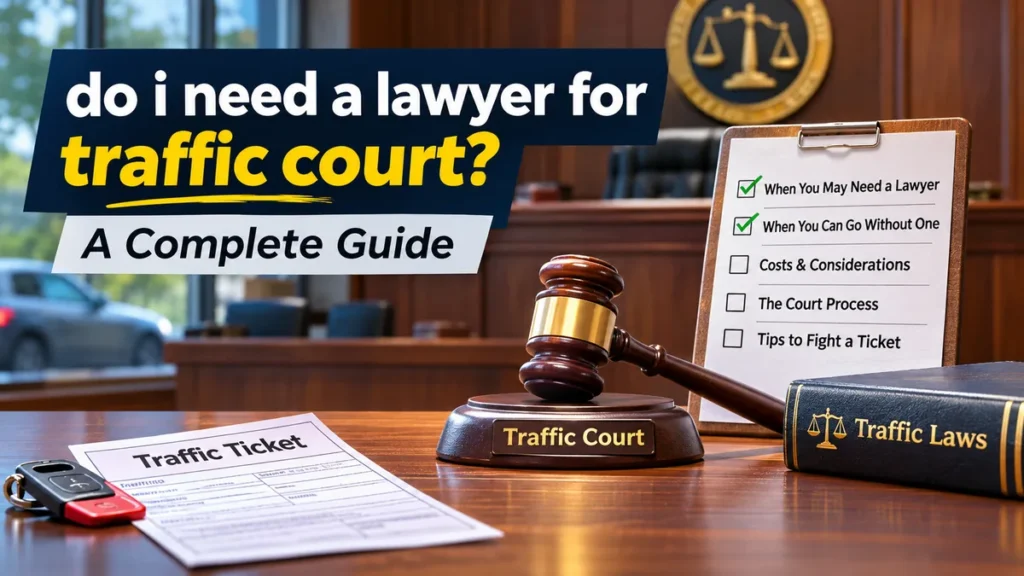
Receiving a traffic ticket can be frustrating, especially when it comes with a court date, expensive fines, or the possibility of losing your driving privileges. What initially appears to be a minor violation can have lasting financial and legal consequences.
If you are wondering, “do i need a lawyer for traffic court,” the answer depends on the seriousness of your violation, driving history, and potential penalties.
You generally do not need a lawyer for traffic court when dealing with minor traffic violations. However, hiring an attorney is advisable when you face criminal charges, license suspension, substantial fines, multiple driving violations, or employment-related consequences. A traffic lawyer can evaluate evidence, negotiate penalties, and represent your interests in court.
When do i need a lawyer for traffic court?
Most routine traffic infractions can be handled without legal representation. However, certain circumstances make professional legal assistance particularly valuable.
Serious traffic violations
Some traffic offenses carry consequences beyond ordinary fines and driving record points. Depending on state law, these offenses may result in misdemeanor or felony charges.
Examples include:
- Driving under the influence (DUI or DWI)
- Reckless driving
- Driving with a suspended license
- Hit-and-run offenses
- Excessive speeding classified as a criminal offense
- Leaving the scene of an accident
- Traffic violations resulting in serious injuries
These cases may involve criminal records, probation, substantial fines, or imprisonment. A criminal defense attorney with experience in traffic law can help protect your legal rights. FindLaw+1
Your driver’s license is at risk
Accumulating too many traffic violation points may result in a suspended or revoked driver’s license.
Losing your driving privileges can affect your ability to commute, attend school, support your family, and maintain employment.
A traffic attorney may identify legal options for challenging the citation or reducing its consequences.
You hold a commercial driver’s license
Commercial driver’s license (CDL) holders face additional risks because their employment depends on maintaining driving eligibility.
Even violations committed while driving a personal vehicle can have professional consequences.
Truck drivers, delivery drivers, and other commercial vehicle operators should carefully evaluate a ticket before pleading guilty or paying a fine.
You have received multiple traffic tickets
A single minor speeding ticket might not create significant problems. However, repeated violations can increase the risk of higher insurance premiums, license suspension, and additional penalties.
An attorney can review your driving history and explain how another conviction might affect your record.
Can you go to traffic court without a lawyer?
Yes. In most United States jurisdictions, individuals can represent themselves when contesting ordinary traffic infractions.
Self-representation is commonly known as pro se representation. It means you are responsible for preparing your defense, presenting evidence, understanding court procedures, and responding to questions.
Representing yourself may be reasonable in the following situations:
| Traffic violation | Is a lawyer recommended? |
|---|---|
| Minor speeding ticket | Usually optional |
| Parking violation | Generally unnecessary |
| Broken taillight | Generally unnecessary |
| Expired vehicle registration | Usually optional |
| Running a red light | Depends on circumstances |
| Multiple speeding tickets | Worth considering |
| Reckless driving | Strongly recommended |
| Suspended license | Strongly recommended |
| DUI or DWI | Strongly recommended |
| Criminal hit-and-run | Strongly recommended |
A correctable equipment violation, sometimes called a fix-it ticket, may only require repairing the problem, submitting proof of correction, and paying an administrative fee.
For example, California courts provide procedures for resolving qualifying fix-it tickets without a contested trial. Self Help Guide
What does a traffic ticket lawyer do?
A traffic ticket attorney provides legal representation to individuals accused of violating motor vehicle laws. Their responsibilities depend on the nature of the citation and the procedures of the local court.
Reviews the traffic citation
An attorney examines the citation, applicable vehicle codes, police reports, and available evidence to determine whether the allegation is legally supported.
A minor clerical mistake does not automatically invalidate a ticket, but a material error may provide grounds for challenging it.
Examines evidence
Depending on the violation, a lawyer may review:
- Radar and LIDAR speed measurements
- Police officer testimony
- Dashcam recordings
- Traffic camera images
- Witness statements
- Road signs and speed limit notices
- Accident reports
- Equipment maintenance and calibration records
The purpose is to determine whether the available evidence adequately supports the alleged offense.
Negotiates reduced penalties
Where local court rules permit negotiations, an attorney may discuss alternative resolutions with the prosecutor.
Possible outcomes include a reduced charge, lower fine, fewer license points, dismissal, or participation in an eligible diversion program.
However, no lawyer can guarantee that a traffic ticket will be dismissed or reduced.
Represents you in court
Some courts allow attorneys to attend certain traffic hearings on behalf of their clients.
This may prevent unnecessary travel and time away from work. However, mandatory personal appearances may still apply, particularly in criminal traffic cases. Always confirm the court’s requirements before skipping a hearing.
How much does a traffic court lawyer cost?
Traffic ticket attorney fees vary depending on location, case complexity, potential penalties, and the amount of legal work required.
The following figures are illustrative budgeting estimates rather than verified national averages.
| Type of traffic case | Estimated attorney fees |
|---|---|
| Minor traffic ticket | $100–$300 |
| Standard speeding ticket | $150–$500 |
| Serious speeding violation | $300–$1,000 |
| Reckless driving | $500–$2,500+ |
| Suspended license case | $500–$2,000+ |
| DUI defense | $1,500–$10,000+ |
Some attorneys charge a flat fee for routine traffic tickets, while others charge hourly rates or require an upfront retainer.
Court costs, fines, expert witnesses, and administrative fees may be separate from attorney charges.
Is hiring a lawyer for a speeding ticket worth it?
The financial value of hiring an attorney depends on more than the original ticket amount.
Consider this hypothetical example:
| Potential expense | Amount |
|---|---|
| Traffic ticket fine | $200 |
| Court fees | $75 |
| Annual insurance increase | $300 |
| Insurance increase over three years | $900 |
| Total potential financial impact | $1,175 |
If an attorney charges $250 and successfully prevents some of these expenses, hiring legal representation could be financially worthwhile.
However, insurance increases vary between providers, and a favorable court outcome is never guaranteed.
Can you get a public defender for traffic court?
Public defenders are generally unavailable for routine traffic infractions that carry no possibility of imprisonment.
If you face criminal traffic charges involving potential incarceration and cannot afford an attorney, you may qualify for court-appointed legal representation under applicable law.
Eligibility depends on the nature of the charge, your financial circumstances, and local legal requirements.
What happens in traffic court without a lawyer?
Traffic court procedures differ between states and counties. Understanding the general process can help you prepare and avoid unnecessary mistakes.
1. Review your traffic ticket
Your citation typically identifies the alleged violation, issuing authority, court location, response deadline, and appearance requirements.
Check whether your court appearance is mandatory or whether alternative resolution methods are available.
2. Enter your plea
Depending on the jurisdiction, you may have three possible plea options.
| Plea | Meaning |
|---|---|
| Guilty | You admit committing the violation. |
| Not guilty | You dispute the allegation and request adjudication. |
| No contest | You do not admit guilt but decline to contest the charge. |
A no-contest plea may still result in a conviction, fines, and driving record consequences.
Paying a traffic ticket without contesting it can also be treated as accepting the violation.
3. Prepare supporting evidence
Gather relevant documentation before your hearing. Useful materials may include photographs, video recordings, vehicle registration documents, insurance certificates, repair receipts, and witness statements.
Organize your evidence in chronological order and prepare a clear explanation of the circumstances.
4. Attend your court hearing
Arrive early, dress appropriately, and follow courtroom instructions.
During a contested hearing, you may have an opportunity to question witnesses, challenge the evidence, and explain your defense.
The judge or other authorized decision-maker evaluates the evidence according to the applicable legal standard.
5. Receive the court’s decision
Potential outcomes include:
- Dismissal of the citation
- A guilty or not-guilty finding
- Reduced penalties
- Traffic school eligibility
- Deferred adjudication, where available
- An order to pay fines and court costs
If the decision is unfavorable, you may have appeal rights. Appeal deadlines and requirements vary by jurisdiction.
The California Courts Self-Help Guide provides an example of how traffic trials operate, including evidence presentation and possible outcomes. Self Help Guide
How to fight a traffic ticket without an attorney
Successfully challenging a ticket requires preparation and a legally relevant defense. Simply explaining that you were late for work or unfamiliar with the area is unlikely to establish that a violation did not occur.
Challenge the accuracy of the evidence
You may be able to dispute whether the evidence reliably establishes the alleged offense.
For a speeding citation, this could involve questions about vehicle identification, measurement accuracy, or the circumstances under which the speed was recorded.
The availability and effectiveness of these defenses depend on local law and the facts of the case.
Provide evidence of incorrect or obstructed road signs
Missing, damaged, or obstructed traffic signs may be relevant when evaluating whether a restriction was adequately communicated.
Photographs taken near the time of the alleged violation can help establish the actual road conditions.
Consider traffic school or defensive driving
Some jurisdictions allow eligible drivers to complete an approved traffic school or defensive driving course.
Depending on the program, successful completion may prevent certain points from affecting insurance records or provide another form of penalty relief.
For example, California generally considers factors such as license validity, violation type, vehicle use, and traffic school attendance within the previous 18 months when determining eligibility. Self Help Guide
Ask about deferred adjudication
Deferred adjudication and traffic diversion programs may allow eligible drivers to avoid certain conviction-related consequences by satisfying specified conditions.
These conditions can include completing an educational course, paying administrative fees, or avoiding additional violations for a designated period.
Not every court offers these programs, and commercial drivers may face additional restrictions.
Check whether a written or remote hearing is available
Some jurisdictions allow drivers to challenge traffic citations without attending a traditional courtroom hearing.
California, for example, offers a trial by written declaration for qualifying cases. Drivers submit written evidence, and a judicial officer determines the outcome. Self Help Guide
Remote hearings may also be available in certain courts.
What if the police officer does not appear?
An officer’s absence does not automatically result in dismissal.
Depending on the jurisdiction and hearing type, the court may dismiss the case, reschedule the hearing, or consider other admissible evidence.
Do not build your entire defense around the assumption that the issuing officer will fail to attend.
do i need a lawyer for traffic court if I plan to plead guilty?
You do not ordinarily need an attorney to plead guilty to a minor traffic violation. However, understanding the consequences before entering a plea is essential.
A traffic conviction may affect:
- Motor vehicle driving records
- Department of Motor Vehicles (DMV) points
- Auto insurance premiums
- Commercial driving eligibility
- Employment opportunities
- Future traffic violation penalties
- Driver’s license status
For serious traffic offenses, pleading guilty may also create criminal consequences that extend beyond your driving record.
Should you pay the ticket or go to court?
| Paying the ticket | Contesting the ticket |
|---|---|
| Usually faster | Requires more preparation |
| May avoid a court appearance | May require attending hearings |
| May result in a conviction | Creates an opportunity to challenge the charge |
| May affect insurance premiums | May reduce or prevent some penalties |
| Usually involves fewer immediate legal expenses | May involve attorney fees |
Paying the ticket may be practical when the violation is minor and the consequences are limited.
Contesting it may be more appropriate when you believe the citation is incorrect, have supporting evidence, or risk significant financial or legal consequences.
What happens if you ignore a traffic ticket?
Ignoring a traffic citation is generally worse than resolving it through the appropriate legal process.
Depending on the jurisdiction and offense, failure to respond or appear may result in additional penalties, collection proceedings, license-related consequences, or a warrant in certain cases.
If you cannot afford the fine, contact the court before the deadline. Some courts offer installment payments, financial hardship reductions, extensions, or community service alternatives.
Conclusion
The answer to “do i need a lawyer for traffic court” ultimately depends on the potential consequences of your traffic violation.
For minor speeding tickets, correctable equipment violations, and other straightforward infractions, representing yourself may be sufficient. However, criminal traffic charges, multiple violations, commercial driving restrictions, and potential license suspension warrant greater caution and professional legal guidance.
Before deciding, review your citation, understand the applicable traffic laws, calculate the potential long-term financial impact, and confirm your court deadlines.
This guide focuses on United States traffic court procedures. State and local laws differ, so consult your court’s official resources or a licensed attorney for advice specific to your circumstances.