Running advertisements, publishing social media posts, and attracting website visitors do not automatically create a successful business. Without a clear direction, even well-funded marketing campaigns can produce disappointing results.
This is where strategic marketing makes a difference. It helps organizations understand their customers, identify market opportunities, and make informed decisions that support long-term business objectives.
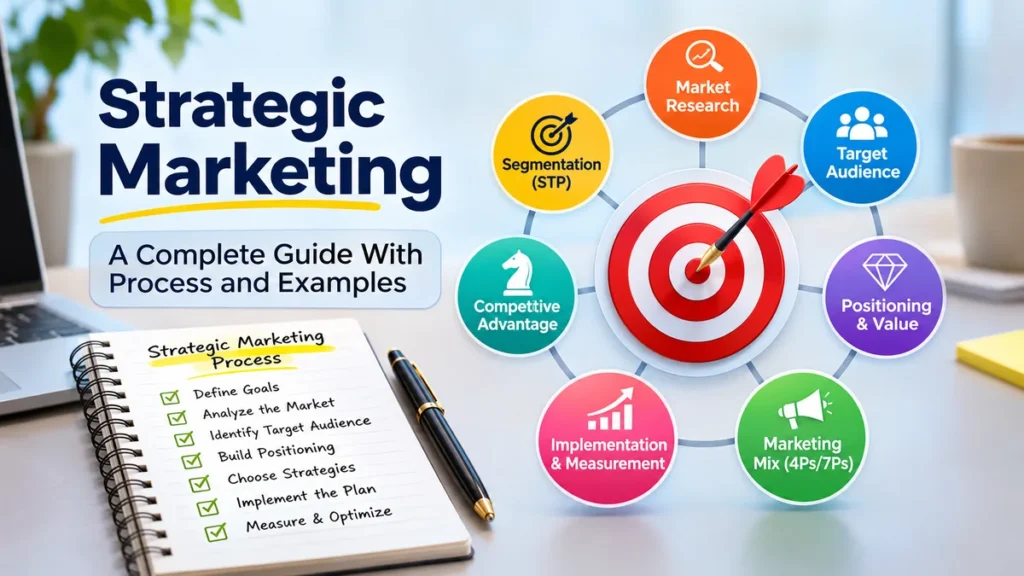
Strategic marketing is the process of researching markets, identifying target customers, establishing competitive advantages, and developing long-term plans to achieve business objectives. It combines customer segmentation, brand positioning, market analysis, resource allocation, and performance measurement to improve customer satisfaction, strengthen profitability, and support sustainable business growth.
Understanding strategic marketing and Its Importance
Strategic marketing focuses on the relationship between a business, its customers, and its competitive environment. Instead of concentrating exclusively on immediate sales, it establishes a direction for future growth.
The American Marketing Association (AMA) emphasizes the alignment of marketing activities with long-term organizational objectives and competitive advantage. American Marketing Association
An effective approach answers five fundamental questions:
- Where does the business currently stand?
- Who are its ideal customers?
- What problems does its product or service solve?
- Why should customers choose it over competitors?
- How can the business achieve measurable and profitable growth?
The answers influence everything from product development and pricing to advertising, distribution, and customer retention.
Why Is Strategic Marketing Important?
Businesses operate in markets where customer preferences, technology, economic conditions, and competition continually change.
A well-developed strategy helps organizations respond to these changes rather than relying entirely on assumptions.
Its primary benefits include stronger brand recognition, improved customer loyalty, more efficient marketing expenditure, better resource allocation, clearer competitive positioning, and increased opportunities for long-term profitability.
For example, a small software company with a limited marketing budget may achieve better results by targeting independent accounting firms than by advertising to every type of business.
The narrower focus allows it to develop relevant products, communicate specific benefits, and concentrate its resources on customers most likely to need its services.
Strategic Marketing vs. Tactical Marketing
Strategic marketing determines the direction of marketing activities, while tactical marketing focuses on the actions required to execute that direction.
| Feature | Strategic Marketing | Tactical Marketing |
|---|---|---|
| Focus | Long-term growth | Immediate execution |
| Time frame | Months to years | Days to months |
| Main objective | Competitive advantage | Campaign performance |
| Activities | Research and positioning | Advertising and promotion |
| Decision-making | Business and market priorities | Channel and campaign choices |
| Measurement | Profitability and market share | Clicks, leads and conversions |
| Example | Entering a new market | Launching an advertising campaign |
Both approaches are interconnected. Strategy provides direction, while tactics turn strategic decisions into measurable activities. Oxford College of Marketing Blog
Strategic Marketing vs. Marketing Strategy
Although these terms are frequently used interchangeably, they describe slightly different concepts.
Strategic marketing is the ongoing discipline of understanding markets and making decisions about long-term business development. A marketing strategy is the specific approach developed through that process.
Similarly, a marketing plan documents the budget, responsibilities, timelines, channels, and activities required to implement the strategy.
Key Components of Strategic Marketing
A strong marketing strategy combines several elements that help businesses understand opportunities and deliver superior customer value.
1. Market Research and Situation Analysis
Market research provides the information businesses need to make evidence-based decisions.
Primary research involves collecting information directly through surveys, interviews, focus groups, and customer feedback. Secondary research uses existing industry reports, competitor websites, government statistics, and market studies.
Effective research examines market size, industry trends, consumer behavior, purchasing preferences, competitor strengths, and potential barriers to entry.
A company should also distinguish between what customers say they want and what their actual purchasing behavior demonstrates.
2. Segmentation, Targeting, and Positioning
The STP marketing model helps businesses identify attractive customer groups and develop relevant market positioning.
Segmentation divides a broad market into smaller groups based on demographic, geographic, psychographic, or behavioral characteristics.
Targeting involves selecting customer segments based on their needs, purchasing power, profitability, and alignment with business capabilities.
Positioning establishes how a brand wants customers to perceive its products or services relative to competing alternatives.
For example, a fitness equipment manufacturer could target apartment residents who need compact exercise equipment rather than competing directly with commercial gym suppliers.
3. Unique Value Proposition
A unique value proposition (UVP) explains why customers should choose a particular business.
It should communicate the customer problem, the solution offered, the expected benefit, and the meaningful difference between the business and its competitors.
A strong value proposition is specific and credible. Simply claiming to provide excellent quality or outstanding service rarely creates meaningful differentiation without supporting evidence.
4. Competitive Advantage
Competitive advantage refers to an organization’s ability to offer value that competitors cannot easily match.
It may result from lower operating costs, innovative products, proprietary technology, specialist expertise, superior distribution, or an established brand reputation.
The strongest advantages are difficult to imitate and valuable to the intended customer.
5. Marketing Mix
The marketing mix translates strategic priorities into decisions about how products and services reach customers.
The traditional 4Ps framework includes:
| Element | Purpose | Example |
|---|---|---|
| Product | Meet customer needs | Designing a compact laptop |
| Price | Establish perceived value | Competitive or premium pricing |
| Place | Ensure product availability | Online and retail distribution |
| Promotion | Communicate benefits | Advertising and content marketing |
For service-based businesses, the extended 7Ps model adds people, process, and physical evidence.
These additional elements address employee performance, service delivery, and tangible indicators of quality, such as professional facilities or customer-facing documentation.
The strategic marketing Process: 7 Essential Steps
Strategic marketing planning is not a one-time exercise. It involves research, decision-making, implementation, evaluation, and continuous improvement.
Step 1: Define the Mission and Business Goals
A mission statement establishes the organization’s purpose, while its vision describes the future it intends to achieve.
Marketing objectives should support both.
Using the SMART framework helps businesses create objectives that are specific, measurable, achievable, relevant, and time-bound.
For example, increasing qualified leads by 25% within six months is more actionable than simply wanting more customers.
Step 2: Conduct a Marketing Audit
A marketing audit evaluates the organization’s internal capabilities and external market environment.
Businesses can use SWOT analysis to identify:
| Internal factors | External factors |
|---|---|
| Strengths: expertise, brand reputation, financial resources | Opportunities: emerging markets, unmet customer needs |
| Weaknesses: limited budget, outdated systems | Threats: new competitors, economic uncertainty |
PESTLE analysis complements SWOT by examining political, economic, social, technological, legal, and environmental factors.
Together, these frameworks help organizations identify realistic opportunities and anticipate potential risks.
Step 3: Identify the Target Audience
A target audience should be based on research rather than assumptions.
Developing buyer personas helps businesses understand customer motivations, challenges, purchasing habits, budgets, and preferred communication channels.
A business selling accounting software, for example, may create separate personas for freelancers, small business owners, and enterprise finance managers.
Each group has different requirements, meaning a single marketing message may not work equally well for everyone.
Step 4: Establish Brand Positioning
Brand positioning defines the specific place a business intends to occupy in the customer’s mind.
An effective positioning statement identifies the target customer, product category, primary benefit, and reason customers should trust the offering.
For instance, an educational platform might position itself as an affordable, self-paced learning solution for working professionals who cannot attend traditional classes.
This gives the marketing team a clear message to reinforce across different customer touchpoints.
Step 5: Select Strategies and Allocate Resources
Once the target market and positioning are established, the business must determine how to reach its objectives.
Potential channels include search engine optimization, email marketing, social media, paid advertising, public relations, partnerships, and direct sales.
Channel selection should depend on customer behavior, acquisition costs, expected returns, and available resources.
A business-to-business (B2B) company might prioritize LinkedIn and industry publications, while a business-to-consumer (B2C) retailer may benefit more from visual social platforms and search advertising.
Step 6: Implement the Marketing Plan
Implementation converts strategic decisions into practical activities.
A marketing action plan should establish campaign schedules, budget limits, team responsibilities, content requirements, milestones, and performance targets.
Coordination between marketing, sales, finance, and customer service departments is particularly valuable because customer experience extends beyond advertising.
Step 7: Measure Performance and Optimize
The final stage involves comparing actual results against established objectives.
Businesses should identify successful activities, investigate underperforming campaigns, and adjust budgets or processes when necessary.
The planning, implementation, and evaluation cycle enables organizations to refine their marketing decisions as conditions change. HubSpot Blog+2
A strategy should provide consistency without becoming so rigid that it prevents experimentation or adaptation.
Types of Strategic Marketing Strategies and Frameworks
Different organizations require different approaches depending on their industry, competitive environment, growth objectives, and financial resources.
Ansoff Matrix
Developed by Igor Ansoff, the Ansoff Matrix helps businesses evaluate four potential growth strategies.
| Strategy | Market | Product | Example |
|---|---|---|---|
| Market penetration | Existing | Existing | Increasing sales to current customers |
| Market development | New | Existing | Expanding into another country |
| Product development | Existing | New | Introducing a new product line |
| Diversification | New | New | Entering a different industry |
Market penetration generally involves less uncertainty because the organization already understands its products and customers. Diversification typically involves greater risk because both the product and market are unfamiliar.
Porter’s Generic Strategies
Michael Porter’s competitive strategy framework identifies three broad approaches to building competitive advantage:
- Cost leadership: Achieving lower operating costs than competitors.
- Differentiation: Offering distinctive products, features, or customer experiences.
- Focus strategy: Serving a specific customer segment through cost advantages or differentiation.
Businesses should select an approach that reflects their capabilities rather than attempting to compete on every possible advantage.
Relationship Marketing
Relationship marketing prioritizes long-term customer engagement and retention rather than concentrating exclusively on acquiring new customers.
Personalized communication, loyalty programs, responsive customer service, and post-purchase support are common relationship marketing activities.
This approach is particularly relevant for subscription businesses, professional services, and companies that depend on repeat purchases.
Digital Marketing Strategy
Digital marketing uses online channels to achieve broader marketing objectives.
Its main components include search engine optimization (SEO), content marketing, pay-per-click advertising (PPC), email marketing, social media marketing, and conversion rate optimization (CRO).
Digital marketing also enables businesses to test messaging, observe customer behavior, and evaluate campaign performance using measurable data.
However, digital channels are tools for executing a strategy. Simply maintaining a website or publishing content does not constitute a complete marketing strategy.
Integrated Marketing Communications
Integrated marketing communications (IMC) ensures that customers receive consistent brand messaging across multiple communication channels.
For example, a company promoting environmentally responsible products should reinforce its positioning through its website, packaging, advertising, email campaigns, and customer service.
Inconsistent messaging can weaken brand identity and reduce customer trust.
Real-World Examples of strategic marketing
Successful brands demonstrate how customer research, differentiation, positioning, and marketing execution can work together.
Apple: Premium Positioning and Product Ecosystem
Apple illustrates a differentiation-based approach built around product design, user experience, innovation, and ecosystem integration.
Products such as the iPhone, Mac, iPad, and Apple Watch complement one another, giving customers additional reasons to remain within the brand’s ecosystem.
Its premium positioning supports a strategy that does not depend exclusively on competing through lower prices. Smartsheet
Nike: Emotional Branding
Nike demonstrates how a company can build an identity beyond the functional characteristics of its products.
Its marketing frequently connects sportswear with athletic achievement, determination, personal development, and self-expression.
By associating its brand with these values, Nike communicates benefits that extend beyond footwear and clothing.
Coca-Cola: Global Branding and Local Adaptation
Coca-Cola combines a recognizable global brand identity with marketing activities adapted to individual markets.
Its campaigns frequently emphasize shared experiences, celebration, and social connections.
The company illustrates how consistent brand positioning can coexist with localized advertising, packaging, and promotional decisions.
Netflix: Customer-Centric Marketing
Netflix illustrates the role of customer data in strategic decision-making.
Personalized recommendations, audience viewing patterns, and content preferences help shape the customer experience.
Its subscription business model also makes customer retention an important consideration alongside acquiring new subscribers.
Strategic Marketing Example for a Small Business
Consider a small online skincare business that wants to increase annual revenue by 30%.
Instead of competing against established brands across every product category, it identifies customers looking for affordable skincare products designed for sensitive skin.
Its strategic marketing plan could look like this:
| Component | Strategic Decision |
|---|---|
| Business objective | Increase annual revenue by 30% |
| Target audience | Customers with sensitive skin |
| Positioning | Affordable, gentle skincare |
| Competitive advantage | Transparent ingredient information |
| Marketing channels | SEO, email and social media |
| Content strategy | Educational skincare guides |
| Retention strategy | Product recommendations and follow-up emails |
| Performance indicators | Revenue, retention and acquisition costs |
This hypothetical example demonstrates how a smaller business can concentrate its resources on a defined market without requiring the advertising budget of a multinational company.
How to Measure Strategic Marketing Performance
Marketing success should be measured through business outcomes rather than visibility alone.
Key performance indicators (KPIs) help organizations determine whether their strategies are generating meaningful results.
Essential Marketing KPIs
| KPI | What It Measures |
|---|---|
| Customer Acquisition Cost (CAC) | Average cost of acquiring a customer |
| Customer Lifetime Value (CLV) | Estimated customer value across the business relationship |
| Marketing ROI | Financial return generated by marketing investment |
| Conversion Rate | Percentage of users completing a desired action |
| Customer Retention Rate | Percentage of existing customers retained |
| Market Share | Business sales relative to total market sales |
| Return on Ad Spend (ROAS) | Revenue generated per advertising dollar |
| Organic Traffic | Visitors arriving through unpaid search results |
Businesses should select metrics that directly support their objectives.
For instance, an online retailer may prioritize conversion rates and customer acquisition costs, while a subscription company may focus more heavily on customer lifetime value and retention.
Calculating Customer Acquisition Cost
Customer acquisition cost measures how much a business spends to gain new customers.
CAC = Total Acquisition Costs ÷ Number of New Customers
If a business spends $5,000 on customer acquisition and gains 100 customers, its CAC is $50.
The figure becomes more meaningful when compared with customer lifetime value and profit margins.
Calculating Marketing ROI
Marketing return on investment measures the financial effectiveness of marketing expenditure.
Marketing ROI = [(Incremental Gross Profit Before Marketing Costs − Marketing Costs) ÷ Marketing Costs] × 100
If a campaign generates $15,000 in incremental gross profit before marketing expenses and costs $5,000, its marketing ROI is 200%.
Revenue alone should not be confused with profit. Businesses must account for relevant costs when evaluating marketing performance.
Marketing Analytics and Automation
Tools such as Google Analytics 4, Google Search Console, HubSpot, and customer relationship management (CRM) platforms can help businesses understand customer interactions and campaign performance.
Marketing automation can support email segmentation, lead nurturing, reporting, and personalized communication.
Artificial intelligence can also assist with audience analysis, forecasting, and content development. However, human oversight remains necessary to verify data quality, protect customer privacy, and ensure marketing decisions reflect actual business needs.
Common Strategic Marketing Mistakes and How to Avoid Them
Even a detailed marketing plan can fail when its underlying assumptions or execution are weak.
Targeting Everyone
Trying to appeal to every potential customer often produces generic messaging and inefficient spending.
Businesses should prioritize customer segments where they can deliver meaningful value and compete effectively.
Ignoring Customer Retention
Acquiring customers without developing a retention strategy can make growth expensive.
Repeat purchases, customer satisfaction, and long-term relationships should receive attention alongside new customer acquisition.
Focusing on Vanity Metrics
Social media followers, impressions, and website traffic can indicate visibility, but they do not necessarily translate into profitability.
These measurements should be connected to qualified leads, conversions, customer retention, or other relevant business outcomes.
Copying Competitors Without Research
Competitor analysis is valuable, but copying another company’s strategy without understanding its resources, customer base, and business model can create poor results.
A successful strategy should reflect the organization’s own strengths and market opportunities.
Failing to Review the Marketing Plan
Customer preferences, operating costs, and competitive conditions change over time.
Businesses should review campaign performance regularly, evaluate strategic priorities quarterly where practical, and conduct a broader strategic review annually or when significant market changes occur.
Setting Unrealistic Marketing Budgets
An insufficient budget can prevent effective implementation, while excessive spending can reduce profitability.
Marketing budgets should reflect business objectives, historical performance, customer acquisition costs, available cash flow, and expected financial returns.
There is no universal marketing budget percentage that works for every organization.
Conclusion
Effective strategic marketing connects market research, customer understanding, competitive positioning, business objectives, and measurable execution into a coordinated approach.
Frameworks such as SWOT analysis, the STP model, the Ansoff Matrix, and the marketing mix help organizations evaluate opportunities and make informed decisions. Performance indicators such as customer acquisition cost, customer lifetime value, and marketing ROI help determine whether those decisions are delivering meaningful results.
The most effective starting point is to understand your current market position, identify your most valuable customer segments, establish realistic objectives, and develop a marketing plan that can adapt to changing conditions.
A successful strategy is not necessarily the one with the largest budget or the most advertising channels. It is the one that consistently delivers relevant customer value while supporting sustainable and profitable business growth.