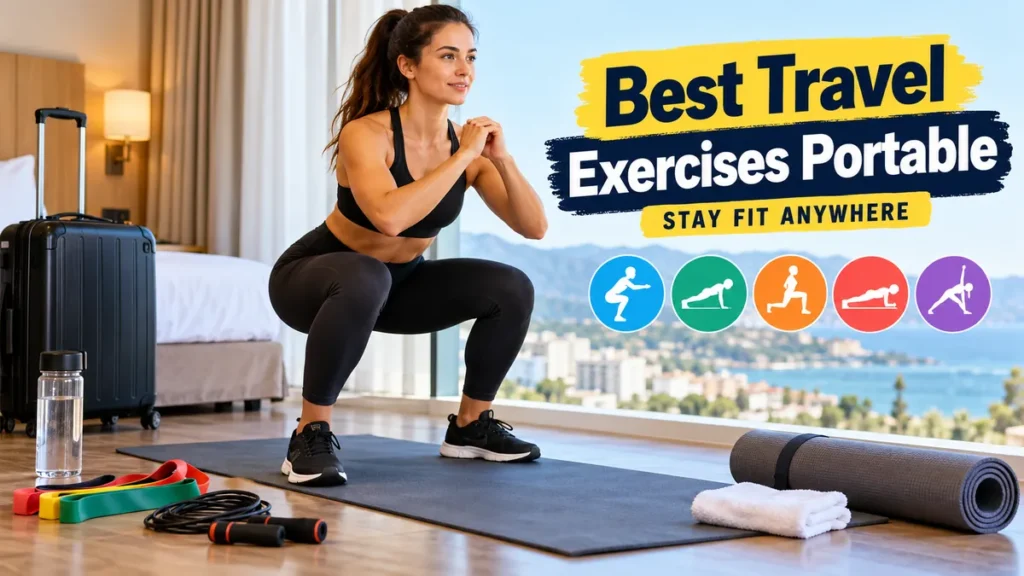
Travel can disrupt even the most consistent fitness routine. Long flights, unfamiliar hotel rooms, packed schedules, and limited access to gym equipment make regular workouts challenging. Yet staying active while traveling doesn’t require a fitness center, expensive gear, or an hour of free time.
The best travel exercises portable routines combine bodyweight movements, resistance bands, mobility drills, and short cardio sessions that can be performed almost anywhere. Whether you’re traveling for business, exploring a new destination, or spending several days on the road, these exercises help maintain strength, mobility, and cardiovascular fitness.
Quick answer: The best portable travel exercises include squats, lunges, push-ups, planks, glute bridges, resistance band rows, and jumping jacks. Most require little space and no specialized equipment. A balanced 15–20-minute routine combining strength, cardio, and stretching can help travelers maintain fitness without access to a traditional gym.
Why Portable Travel Exercises Matter
Travel often involves prolonged sitting, disrupted sleep, irregular meal schedules, and reduced physical activity. Even an otherwise active person may spend hours seated on an airplane, train, or bus.
Portable workouts offer a practical way to counter some of these effects without disrupting a trip.
Maintain Strength and Muscle Fitness
Bodyweight resistance exercises help stimulate muscles when traditional weight training isn’t available.
Push-ups, squats, lunges, and resistance band exercises can challenge major muscle groups. Maintaining adequate training intensity is particularly useful during extended trips.
For example, someone who regularly performs weighted squats at home can use slow-tempo bodyweight squats, split squats, or single-leg variations while traveling.
Reduce Stiffness From Prolonged Sitting
Sitting for long periods can contribute to temporary stiffness in the hips, shoulders, and back.
Gentle mobility exercises such as hip flexor stretches, thoracic rotations, and ankle circles can help restore comfortable movement.
However, exercise does not eliminate the risk of travel-related blood clots. During prolonged journeys, regular movement and following appropriate medical advice remain important.
Support Energy and Mental Well-Being
Physical activity can improve mood, sleep quality, and overall well-being. Even brief movement sessions may help travelers feel more alert after extended periods of inactivity.
The goal isn’t to achieve peak athletic performance on every trip. It’s to preserve healthy movement habits.
Best Travel Exercises Portable Without Equipment
These exercises can be performed in hotel rooms, apartments, outdoor spaces, or other safe locations with enough room to move.
1. Bodyweight Squats
Squats are among the most practical lower-body exercises for travelers because they require no equipment.
They primarily target the quadriceps, glutes, and other muscles involved in hip and knee movement.
How to perform them:
- Stand with your feet approximately shoulder-width apart.
- Keep your chest lifted and brace your abdominal muscles.
- Bend your hips and knees as though sitting in a chair.
- Lower as far as your mobility comfortably allows.
- Push through your feet to return to standing.
Suggested volume: 2–3 sets of 10–15 repetitions.
For a greater challenge, pause at the bottom or lower yourself slowly over three seconds.
2. Push-Ups
Push-ups strengthen the chest, shoulders, triceps, and core.
They are particularly useful for maintaining upper-body training during trips without weights.
Begin in a high plank with your hands slightly wider than shoulder-width. Keep your body aligned while bending your elbows to lower your chest toward the floor. Press back to the starting position.
Suggested volume: 2–3 sets of 6–15 repetitions.
Beginners can perform wall push-ups or incline push-ups using a stable surface. Experienced exercisers can try slower repetitions or decline variations.
Avoid unstable hotel furniture that might slide or tip.
3. Reverse Lunges
Reverse lunges train the quadriceps, glutes, and muscles responsible for lower-body stability.
They can also be easier to control than forward lunges for some beginners.
Stand upright, step one foot backward, and bend both knees. Keep your front foot planted before pushing back to the starting position.
Suggested volume: 2 sets of 8–12 repetitions per leg.
Hold onto a stable support if balance is difficult.
4. Forearm Planks
Planks strengthen the abdominal muscles and challenge the body’s ability to resist unwanted movement.
Place your forearms on the floor, extend your legs, and support your weight on your elbows and toes.
Maintain a straight, comfortable alignment from your head to your heels. Avoid excessively arching your lower back.
Suggested duration: 20–45 seconds per set.
A modified plank with your knees on the floor is a suitable starting variation.
5. Glute Bridges
Glute bridges are useful after long periods of sitting and provide a simple way to activate the posterior chain.
Lie on your back with your knees bent and feet flat on the floor. Tighten your abdominal muscles and lift your hips by contracting your glutes.
Pause briefly before lowering.
Suggested volume: 2–3 sets of 12–15 repetitions.
For additional difficulty, try alternating leg lifts while maintaining stable hips.
6. Mountain Climbers
Mountain climbers combine core stability with dynamic movement and can raise your heart rate.
Begin in a high plank and alternately draw your knees toward your chest while keeping your hands firmly planted.
Move at a controlled pace before increasing speed.
Suggested duration: 20–40 seconds.
Slow mountain climbers are a lower-intensity option that emphasizes stability.
7. Jumping Jacks
Jumping jacks are a familiar cardiovascular exercise requiring minimal space.
Stand upright with your arms at your sides. Jump your feet apart while raising your arms overhead, then return to the starting position.
Suggested duration: 30–60 seconds.
For travelers concerned about noise or joint impact, step jacks provide a quieter alternative.
8. Bird Dogs
Bird dogs train core stability, coordination, and controlled movement.
Start on your hands and knees. Extend your right arm and left leg while keeping your hips level. Return to the starting position and switch sides.
Suggested volume: 8–12 repetitions per side.
Move slowly rather than attempting to extend your limbs as far as possible.
9. Calf Raises
Calf raises are especially convenient during road trips and hotel stays.
Stand upright, lift your heels, and rise onto the balls of your feet. Pause briefly before lowering.
Suggested volume: 15–20 repetitions.
They can strengthen the calf muscles and encourage lower-leg movement after sitting.
10. Standing Hip Flexor Stretches
Long periods of sitting may leave the front of the hips feeling tight.
Step one foot backward into a staggered stance. Gently tuck your pelvis and shift forward until you feel a comfortable stretch at the front of the rear hip.
Hold for 20–30 seconds on each side.
Avoid forcing the movement or arching your lower back.
Best Portable Exercise Equipment for Travel
Although bodyweight workouts are effective, lightweight fitness equipment can provide more exercise variety and adjustable resistance.
The most useful equipment is compact, easy to pack, and practical in small spaces.
| Equipment | Main purpose | Portability |
|---|---|---|
| Resistance bands | Full-body strength training | Excellent |
| Mini loop bands | Glutes, hips, activation | Excellent |
| Jump rope | Cardio and coordination | Excellent |
| Suspension trainer | Upper-body and core strength | Good |
| Travel yoga mat | Stretching, yoga, floor exercises | Good |
| Sliders | Core and lower-body training | Excellent |
| Massage ball | Self-massage and muscle comfort | Excellent |
Resistance Bands
Resistance bands are among the most versatile travel fitness tools.
They provide resistance when stretched and can be used for upper-body, lower-body, and core exercises.
Common variations include flat therapy bands, mini loop bands, long loop bands, and tube bands with handles.
The American Council on Exercise includes resistance bands in short full-body travel routines because they are portable and can be adapted to different fitness levels.
ACE Fitness
Useful resistance band exercises include:
- Band rows for the back and arms
- Band biceps curls
- Standing shoulder presses
- Lateral band walks
- Band-assisted squats
- Pallof presses for core stability
Inspect bands for damage before use. Never stretch a band toward your face, and avoid attaching it to unsecured furniture or unfamiliar doorframes.
Jump Rope
A jump rope is a compact option for travelers who want vigorous cardiovascular exercise.
It challenges coordination, endurance, and lower-leg muscles.
Beginners can start with 20–30 seconds of jumping followed by 30–60 seconds of recovery.
However, jumping rope may not be suitable for rooms with low ceilings, fragile flooring, or downstairs neighbors.
Suspension Trainers
Suspension training systems, including TRX-style equipment, use straps and body weight to create resistance.
They support exercises such as rows, chest presses, assisted squats, and plank variations.
Their main limitation is the need for a secure, manufacturer-approved anchor point.
A suspension trainer should never be attached to an unverified door, railing, or fixture.
Travel Yoga Mats and Sliders
A foldable yoga mat provides a more comfortable surface for floor-based workouts, stretching, and yoga.
Exercise sliders add variety to lunges, mountain climbers, and core exercises.
For minimalist travelers, a towel on a clean, nonslip floor may be sufficient for basic stretching, although it won’t offer the same cushioning or grip as a proper exercise mat.
Best Travel Exercises Portable for Hotel Rooms
Hotel workouts should be quiet, efficient, and adaptable to limited space.
You don’t need to perform every exercise in one session. A small selection that covers the major muscle groups is usually more useful than an unnecessarily complicated routine.
10-Minute Beginner Hotel Workout
This routine is designed for travelers returning to exercise or working with limited time.
| Exercise | Duration |
|---|---|
| Marching in place | 1 minute |
| Bodyweight squats | 1 minute |
| Wall push-ups | 1 minute |
| Reverse lunges | 1 minute |
| Standing knee raises | 1 minute |
| Glute bridges | 1 minute |
| Bird dogs | 1 minute |
| Calf raises | 1 minute |
| Gentle hip stretches | 1 minute |
| Shoulder and chest stretches | 1 minute |
Move at a comfortable pace and take breaks whenever necessary.
The objective is to activate major muscle groups without creating excessive fatigue before a busy travel day.
20-Minute Full-Body Travel Workout
Travelers with some exercise experience can use a circuit combining strength and cardiovascular movements.
Full-body circuit
20 minutes
4 min
Warm-up
12 min
3 circuit rounds
2 min
Between-round rests
2 min
Cool-down
Repeat this four-minute circuit three times:Squats
40 secPush-ups
40 secReverse lunges
40 secResistance band rows
40 secMountain climbers or marching
40 secPlank
40 sec
Each exercise includes 40 seconds of movement and 20 seconds of transition. Rest for one minute between rounds.
Reset checklist
Choose exercise variations appropriate to your current ability. If maintaining proper technique becomes difficult, reduce the repetitions or take additional rest.
Quiet, Low-Impact Hotel Exercises
Jumping and running in place aren’t always appropriate in shared accommodation.
For a quieter workout, use slow squats, wall sits, glute bridges, standing marches, bird dogs, resistance band rows, and controlled lunges.
These movements can provide meaningful muscular effort without repeated impact against the floor.
Portable Exercises for Long Flights and Road Trips
Travel fitness isn’t limited to hotel workouts.
Long journeys provide opportunities for gentle movement, particularly during safe breaks.
Seated Ankle Pumps
While seated, keep your heels on the floor and raise your toes. Then lower your toes and lift your heels.
Repeat the movement several times.
This activates the lower-leg muscles without requiring additional space.
Ankle Circles
Lift one foot slightly and rotate your ankle slowly in both directions.
Repeat with the other foot.
Ankle circles can help maintain comfortable movement after prolonged sitting.
Seated Shoulder Rolls
Roll your shoulders backward and forward using slow, controlled movements.
Avoid forcing your neck or upper back into uncomfortable positions.
Walking During Travel Breaks
Whenever practical, stand up and walk during appropriate travel breaks.
On airplanes, move only when permitted and when the seat belt sign is off. During road trips, use safe rest stops rather than attempting exercises inside a moving vehicle.
For travelers at increased risk of deep vein thrombosis, ordinary stretches should not replace individualized medical guidance.
How to Build a Portable Workout Routine for Different Fitness Goals
A travel workout becomes more effective when its exercises match your priorities.
For Maintaining Muscle
Focus on resistance exercises involving major movement patterns:
- Squat: bodyweight squats or split squats
- Hinge: hip bridges or band Romanian deadlifts
- Push: push-ups or band chest presses
- Pull: resistance band rows
- Core: planks or Pallof presses
Perform approximately 2–3 challenging sets per movement, depending on your fitness level and available time.
Select resistance that makes the final repetitions demanding without compromising technique.
For Cardiovascular Fitness
Brisk walking, stair climbing, jogging, cycling, and jumping rope can help maintain aerobic activity.
High-intensity interval training (HIIT) is another option for experienced exercisers, but it isn’t necessary for everyone.
A practical travel cardio session might involve alternating 30 seconds of brisk movement with 30 seconds of recovery for 10 minutes.
For Flexibility and Mobility
Mobility sessions can focus on areas that commonly feel stiff after sitting:
- Hip flexors
- Calves
- Thoracic spine
- Shoulders
- Hamstrings
Gentle dynamic movements can prepare the body for activity, while comfortable static stretches can be included after workouts.
Stretching should create mild tension rather than pain.
For Weight Management
Portable exercises can support weight management by contributing to overall physical activity.
However, no specific hotel exercise selectively burns abdominal fat.
Long-term changes in body weight depend on factors including overall energy balance, dietary habits, sleep, and activity patterns.
Walking throughout a destination may contribute as much practical value as a short scheduled workout.
How Often Should You Exercise While Traveling?
Travel workouts don’t need to follow an identical schedule every day.
According to the Centers for Disease Control and Prevention, adults should generally aim for at least 150 minutes of moderate-intensity aerobic activity weekly, or 75 minutes of vigorous activity, alongside muscle-strengthening activities on two or more days.
CDC
+1
A flexible weekly travel plan could look like this:
| Day | Activity | Suggested duration |
|---|---|---|
| Monday | Full-body strength | 20 minutes |
| Tuesday | Brisk walking and mobility | 30 minutes |
| Wednesday | Full-body strength | 20 minutes |
| Thursday | Brisk walking | 30 minutes |
| Friday | Resistance band workout | 20 minutes |
| Saturday | Walking, hiking, or cycling | 45 minutes |
| Sunday | Light walking and stretching | 30 minutes |
This is an example, not a rigid prescription. Adjust the routine based on travel demands, recovery, and fitness level.
The CDC also emphasizes that smaller amounts of physical activity still provide benefits.
CDC
How to Make Portable Travel Workouts More Effective
Use Progressive Overload
Maintaining fitness requires an appropriate training challenge.
When exercises become easy, you can gradually increase repetitions, resistance, sets, or time under tension.
For example, a traveler who finds 15 ordinary squats comfortable might progress to split squats or use a resistance band.
Choose Exercises That Match Your Space
Before starting a workout, check the available floor space, ceiling height, and surrounding furniture.
Avoid movements that require large jumps or wide lateral movements in crowded rooms.
Keep sufficient clearance around your body.
Plan Around Travel Fatigue
Jet lag, poor sleep, dehydration, and long travel days can affect exercise performance.
On particularly tiring days, gentle walking and mobility may be more appropriate than vigorous training.
Missing one intense session is less consequential than consistently ignoring recovery.
Prioritize Technique Over Speed
Fast repetitions aren’t automatically more effective.
Controlled movements help maintain appropriate muscular effort and reduce unnecessary strain.
If an exercise causes sharp pain, dizziness, or unusual discomfort, stop rather than attempting to finish the planned repetitions.
Pack Only What You’ll Use
A useful travel fitness kit doesn’t need to be elaborate.
For most travelers, one or two resistance bands and comfortable workout clothing are sufficient.
A jump rope, yoga mat, or suspension trainer may be worthwhile when the trip includes suitable workout space.
Equipment should support the routine rather than make it more complicated.
Common Travel Workout Mistakes to Avoid
Doing only abdominal exercises: Crunches and planks can train the core, but they don’t replace exercises for the legs, back, chest, and shoulders.
Skipping warm-ups: Beginning intense movements immediately after prolonged sitting can feel uncomfortable. Start with several minutes of gentle movement.
Training too intensely after poor sleep: Travel fatigue may reduce coordination and recovery. Adjust intensity to how you feel.
Ignoring pulling exercises: Push-ups are convenient, but upper-body routines also benefit from rows and other pulling movements. Resistance bands help fill this gap.
Using unsafe anchor points: Improvised suspension trainer or resistance band attachments can fail unexpectedly.
Expecting every session to be perfect: A manageable routine completed consistently is generally more sustainable than an ambitious workout repeatedly postponed.
Are Portable Travel Exercises Effective Without a Gym?
Yes. Portable exercises can provide meaningful strength, endurance, and mobility benefits when performed with sufficient effort and appropriate progression.
Bodyweight exercises and resistance bands count as muscle-strengthening activities under CDC physical activity guidance.
CDC
However, there are limitations.
Experienced strength athletes may find it difficult to reproduce the heavy loading available through barbells and weight machines. Some movements, particularly heavy lower-body exercises, require creative variations or additional resistance.
Still, travel workouts don’t need to reproduce every aspect of a regular gym program.
For short trips, maintaining activity and exercising major muscle groups can be a sensible priority. During longer trips, a structured progression plan becomes more useful.
Conclusion: Best Travel Exercises Portable for Everyday Fitness
The best travel exercises portable routines are simple enough to fit into a real travel schedule and challenging enough to support your fitness goals.
Bodyweight squats, push-ups, lunges, planks, and glute bridges provide a reliable foundation. Resistance bands expand your strength-training options, while walking, jumping rope, and mobility exercises help address cardiovascular fitness and movement.
Start with a short full-body routine that suits your available space and current fitness level. Gradually adjust the difficulty as needed.
With a little planning, staying active can become a practical part of traveling rather than another task competing for your time.