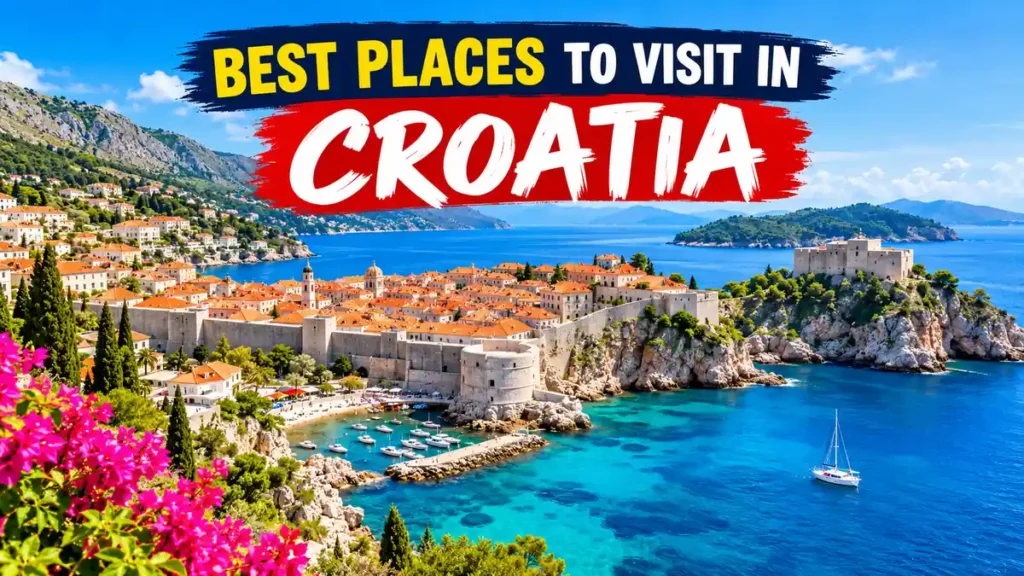
Croatia packs an extraordinary variety of experiences into one relatively small country. Medieval coastal cities, turquoise waterfalls, Roman palaces, pine-covered islands, and picturesque mountain villages are all within reach. The challenge isn’t finding somewhere beautiful to visit. It’s deciding which destinations deserve a place on your itinerary.
The best places to visit in croatia include Dubrovnik, Split, Plitvice Lakes National Park, Hvar, Rovinj, Zagreb, Zadar, Korčula, and Krka National Park. Dubrovnik is famous for its medieval walls, Split combines Roman history with coastal life, and Plitvice offers spectacular lakes and waterfalls. The ideal choices depend on your interests, season, and travel time.
1. Dubrovnik: Croatia’s Most Famous Coastal City


6
Dubrovnik is often the first destination travelers associate with Croatia, and for good reason. Its remarkably preserved medieval Old Town rises above the Adriatic Sea, surrounded by imposing stone fortifications.
The historic center is a UNESCO World Heritage Site, known for its Gothic, Renaissance, and Baroque architecture.
Best things to do in Dubrovnik
- Walk the famous city walls for panoramic views of terracotta rooftops and the sea.
- Explore Stradun, the Old Town’s main limestone-paved street.
- Visit Fort Lovrijenac, a historic fortress outside the western walls.
- Take the cable car toward Mount Srđ for a sweeping view of the coastline.
- Explore nearby Lokrum Island, known for its botanical gardens and rocky swimming spots.
Dubrovnik also served as a filming location for Game of Thrones, attracting visitors interested in the fictional city of King’s Landing.
Best time to visit: May, June, September, and early October generally offer a more comfortable balance of weather and crowds than peak summer.
Recommended stay: Two to three days.
Travel tip: Walk the walls early in the morning, particularly during July and August, when exposed sections can become very hot.
2. Split: Roman History Meets Modern Mediterranean Life


6
Split is Croatia’s second-largest city and one of the most practical bases for exploring the Dalmatian coast.
At its heart stands Diocletian’s Palace, a sprawling Roman complex built around the turn of the fourth century. Unlike many archaeological sites, the palace remains an active part of the city, filled with homes, shops, restaurants, and narrow pedestrian streets.
What makes Split worth visiting?
The city’s greatest appeal is the combination of history, beaches, and island access.
Explore the Peristyle courtyard, see the Cathedral of Saint Domnius, and wander through the palace’s underground halls. Then head to the Riva promenade, where cafés overlook the harbor.
For outdoor activities, Marjan Forest Park offers wooded walking trails and scenic coastal viewpoints. Bačvice Beach is a popular option close to the city center.
Split is also a major ferry hub for Brač, Hvar, Vis, and other Adriatic islands.
Best time to visit: May through June or September.
Recommended stay: Two to four days.
Travel tip: Staying within walking distance of the Old Town makes it easier to explore the historic center without a car.
3. Plitvice Lakes National Park: Croatia’s Natural Masterpiece


8
Plitvice Lakes National Park is among Europe’s most spectacular protected natural landscapes.
This UNESCO-listed national park features 16 named lakes connected by waterfalls and natural cascades. The lakes are arranged in upper and lower sections, with trails and wooden walkways offering different perspectives of the water.
The distinctive turquoise, emerald, and blue colors vary according to light, minerals, microorganisms, and water conditions.
How much time do you need at Plitvice Lakes?
Allow at least four to six hours for a meaningful visit. Travelers who enjoy hiking and photography may prefer a full day.
The park provides several marked routes, and some itineraries incorporate electric boats or panoramic vehicles when operating.
Swimming is not permitted in the lakes.
Best time to visit: Late spring and early autumn. Summer is beautiful but often crowded.
Recommended stay: One full day, with an optional overnight stay nearby.
Travel tip: Purchase admission through the park’s official ticketing system and check current routes, entry arrangements, and weather conditions before arrival.
4. Hvar Island: Beaches, Lavender, and Historic Harbor Towns


8
Hvar has a reputation for glamorous summer nightlife, but the island offers considerably more than beach clubs and yachts.
Historic settlements, lavender-growing landscapes, quiet coves, and traditional villages make it appealing to different types of travelers.
Hvar Town is the island’s busiest destination, featuring a picturesque harbor, a large historic square, and a hilltop fortress.
Highlights of Hvar Island
The Spanish Fortress, commonly called Fortica, provides sweeping views over Hvar Town and the nearby Pakleni Islands.
A short boat trip brings visitors to the Pakleni archipelago, where secluded bays and clear water are ideal for swimming.
Farther inland, Stari Grad offers a quieter atmosphere. The nearby Stari Grad Plain is a UNESCO World Heritage Site recognized for its ancient agricultural landscape.
Jelsa and smaller coastal villages are worth considering for a more relaxed island experience.
Best time to visit: June or September.
Recommended stay: Two to four days.
Travel tip: Hvar Town becomes particularly busy during summer evenings. Stari Grad or Jelsa may suit visitors seeking a quieter base.
5. Rovinj: A Romantic Seaside Town in Istria


Rovinj is one of the most picturesque towns on the Istrian Peninsula in northern Croatia.
Its colorful buildings rise closely together on a compact peninsula, with narrow cobblestone streets leading toward the Church of St. Euphemia.
The town’s Venetian-influenced architecture reflects centuries of cultural connections across the Adriatic.
Why visit Rovinj?
Rovinj is particularly appealing for leisurely exploration. You can spend hours wandering the Old Town, visiting small galleries, photographing the harbor, and enjoying views from the waterfront.
The surrounding coastline includes rocky beaches and clear swimming areas. Nearby Golden Cape Forest Park, also known as Punta Corrente, offers shaded walking and cycling paths.
Rovinj also makes a convenient base for exploring Istria’s inland villages, vineyards, olive groves, and culinary traditions.
Best time to visit: May, June, or September.
Recommended stay: Two to three days.
Travel tip: The Old Town has many uneven stone streets and steps, so comfortable walking shoes are more useful than fashionable footwear.
6. Zagreb: Croatia’s Cultural and Historic Capital


Croatia’s capital offers a completely different atmosphere from the coastal destinations.
Instead of beaches and island ferries, Zagreb features elegant Central European architecture, leafy parks, lively markets, museums, and a strong café culture.
The city is divided into historic Upper Town, known as Gornji Grad, and Lower Town, or Donji Grad.
Best attractions in Zagreb
St. Mark’s Church is one of Zagreb’s most recognizable landmarks, distinguished by its colorful tiled roof.
Ban Jelačić Square serves as the city’s central gathering place, while Dolac Market introduces visitors to local produce and everyday Croatian life.
The Museum of Broken Relationships offers an unusual collection of personal objects and stories exploring human relationships.
For outdoor recreation, Maksimir Park provides woodland paths, lakes, and spacious green areas.
Zagreb is particularly enjoyable for travelers interested in culture, architecture, and local neighborhoods rather than coastal resorts.
Best time to visit: April through June or September through October. December is also appealing for seasonal festivities.
Recommended stay: Two days.
Travel tip: Zagreb works well as a starting point for an itinerary continuing toward Plitvice Lakes and the Dalmatian coast.
7. Zadar: Ancient Streets and Spectacular Sunsets


8
Zadar combines ancient history with contemporary waterfront attractions.
Situated in northern Dalmatia, the city is known for its Roman remains, medieval churches, and distinctive seaside installations.
Its compact Old Town occupies a peninsula, making it easy to explore on foot.
What should you see in Zadar?
The Sea Organ, designed by architect Nikola Bašić, uses waves and air movement to create musical sounds through pipes beneath the waterfront steps.
Nearby, the Greeting to the Sun installation features a large circular arrangement of solar-powered glass panels that produces changing light effects after dark.
Historic highlights include the ninth-century Church of St. Donatus, the Roman Forum, and the Cathedral of St. Anastasia.
Zadar also provides access to the surrounding archipelago and excursions toward Kornati National Park.
Best time to visit: May, June, or September.
Recommended stay: Two to three days.
Travel tip: Visit the Sea Organ shortly before sunset, then stay to experience the waterfront after dark.
8. Krka National Park: Waterfalls and Scenic Walking Trails


6
Krka National Park is one of Croatia’s most accessible destinations for waterfall scenery.
Located near Šibenik, the park protects sections of the Krka River, including dramatic waterfalls, limestone formations, and diverse plant and animal habitats.
Its best-known attraction is Skradinski Buk, a series of cascading waterfalls surrounded by lush vegetation.
Krka vs. Plitvice Lakes: Which is better?
Plitvice is generally the stronger choice for travelers seeking extensive lake landscapes and longer walking routes.
Krka is particularly convenient for visitors staying in Split, Šibenik, or the surrounding Dalmatian region.
Other attractions include Roški slap and Visovac Island, home to a historic Franciscan monastery.
Swimming rules require special attention. Swimming is prohibited at Skradinski Buk, while the park permits swimming only at designated locations during specified seasonal periods, subject to conditions.
NP Krka
+1
Best time to visit: May, June, September, or October.
Recommended stay: Half a day to one full day.
Travel tip: Check which park entrances, boat excursions, and attractions are operating before choosing your route.
9. Korčula Island: Medieval Charm and Beautiful Beaches


8
Korčula is among Croatia’s most attractive islands for travelers who enjoy history, beaches, and a relaxed Mediterranean atmosphere.
Its principal town features stone fortifications, narrow streets, and an exceptionally picturesque waterfront.
Korčula Town is sometimes called Little Dubrovnik because of its medieval appearance, although it has a distinct character.
What is Korčula famous for?
The island is traditionally associated with the explorer Marco Polo, although his birthplace remains historically disputed.
Korčula is also known for the Moreška sword dance, a cultural performance involving elaborate costumes and choreographed combat.
The countryside features vineyards, olive groves, and traditional villages.
Near Lumbarda, visitors can find some of the island’s best-known sandy beaches, including Vela Pržina.
Korčula is particularly appealing to travelers who want a balance of sightseeing, swimming, and quieter evenings.
Best time to visit: June or September.
Recommended stay: Two to three days.
Travel tip: Ferries and passenger catamarans connect Korčula with various coastal destinations, but routes and frequencies change seasonally.
10. Brač Island: Home of Croatia’s Famous Zlatni Rat Beach


8
Brač is one of the easiest Croatian islands to reach from Split and is particularly famous for its distinctive beaches.
The island’s most recognizable attraction is Zlatni Rat, also called the Golden Horn, near the town of Bol.
This remarkable pebble beach extends into the Adriatic Sea, with its tip changing shape in response to waves, currents, and wind.
Best experiences on Brač
Spend time swimming or relaxing at Zlatni Rat, where the surrounding waters are especially attractive in calm weather.
Explore Bol’s waterfront, visit traditional stone villages, or travel inland to discover a quieter side of the island.
Vidova Gora, the highest peak among the Adriatic islands, offers outstanding views over Zlatni Rat and neighboring islands.
Brač is also famous for its pale limestone, which has long been used in regional architecture and stonework.
Best time to visit: June through September.
Recommended stay: Two to three days.
Travel tip: Strong afternoon winds can make some beaches more suitable for windsurfing than relaxed swimming.
11. Pula: Roman Architecture and Istrian Heritage


7
Pula is one of Croatia’s most important destinations for Roman history.
Located near the southern tip of the Istrian Peninsula, the city contains impressive ancient monuments alongside a working harbor and modern neighborhoods.
Its main attraction is the Pula Arena, a remarkably preserved Roman amphitheater constructed during the Roman imperial period.
What can you see in Pula?
The amphitheater is the centerpiece, but other notable landmarks include the Temple of Augustus, Arch of the Sergii, and remains of ancient Roman gates.
Pula also provides access to coastal areas around Cape Kamenjak, known for its rocky coves and striking natural scenery.
The nearby Brijuni Islands form a national park with historical sites, Mediterranean landscapes, and archaeological remains.
Pula is particularly worthwhile for travelers exploring Istria by car.
Best time to visit: May through September.
Recommended stay: One to two days.
Travel tip: Combine Pula with Rovinj and inland Istrian towns rather than treating it as an isolated destination.
12. Šibenik: Historic Fortresses and UNESCO Landmarks


6
Šibenik is often overlooked in favor of Split and Dubrovnik, but it offers some of the most interesting historic architecture on the Dalmatian coast.
Its old center climbs steeply from the waterfront, creating a maze of narrow lanes, stone stairways, and hidden squares.
Why is Šibenik worth visiting?
The Cathedral of St. James is a UNESCO World Heritage Site celebrated for its exceptional stone construction and architectural design.
St. Nicholas Fortress, positioned at the entrance to the St. Anthony Channel, is also part of a UNESCO-listed collection of Venetian defensive works.
Above the city, St. Michael’s Fortress offers impressive views across the rooftops and surrounding islands.
Šibenik is also a convenient base for visiting Krka National Park.
Best time to visit: May, June, or September.
Recommended stay: One to two days.
Travel tip: Allow time to explore the upper streets beyond the main waterfront, where some of the city’s most atmospheric corners are located.
13. Vis Island: Quiet Villages and Clear Adriatic Waters


8
Vis offers a slower-paced island experience than some of Croatia’s more heavily visited destinations.
Its distance from the mainland and history as a restricted military area helped preserve a comparatively traditional atmosphere.
The island features fishing villages, dramatic cliffs, vineyards, and secluded bays.
Best places to explore on Vis
Vis Town has a pleasant waterfront and historic stone buildings, while Komiža is a picturesque fishing settlement on the island’s western coast.
Stiniva Cove is famous for its narrow opening between towering cliffs. Reaching it overland involves a steep, demanding path, and boat access depends on sea conditions.
Excursions to nearby Biševo Island often include the Blue Cave, where sunlight produces an extraordinary blue illumination under suitable conditions.
Vis also attracted international attention as a filming location for Mamma Mia! Here We Go Again.
Best time to visit: June or September.
Recommended stay: Three to four days.
Travel tip: Boat excursions to the Blue Cave can be canceled when sea conditions are unsuitable. Keep your itinerary flexible.
14. Makarska Riviera: Beaches Beneath Dramatic Mountains


9
The Makarska Riviera stretches along a scenic section of the Dalmatian coast, where the Biokovo mountain range rises dramatically behind beautiful beaches.
The contrast between steep limestone peaks and clear Adriatic water makes this region especially photogenic.
Popular coastal destinations include Makarska, Brela, Baška Voda, and Tučepi.
What makes the Makarska Riviera special?
The region is ideal for travelers prioritizing beaches and outdoor recreation.
Punta Rata Beach in Brela is particularly well known for its turquoise water, pine-fringed coastline, and distinctive rock formations.
Makarska itself has a lively harbor, attractive waterfront, and convenient access to nearby beaches.
Inland, Biokovo Nature Park provides mountain scenery and hiking opportunities. The Biokovo Skywalk features a glass viewing platform extending over a steep mountainside.
Best time to visit: June or September.
Recommended stay: Three to five days.
Travel tip: Mountain roads can be narrow and demanding. Check access restrictions and weather conditions before visiting Biokovo.
15. Mljet Island: Forests, Saltwater Lakes, and Peaceful Nature


8
Mljet is one of Croatia’s most appealing islands for nature lovers.
Much of its northwestern landscape is protected within Mljet National Park, which is famous for its forests, walking trails, and two connected saltwater lakes.
The lakes are known as Veliko Jezero, or Great Lake, and Malo Jezero, or Small Lake.
Best things to do on Mljet
Explore the national park by walking or cycling along designated routes.
Take a boat to the small island of St. Mary in Veliko Jezero, where a historic Benedictine monastery creates one of Mljet’s most recognizable scenes.
The island also offers opportunities for kayaking, swimming in permitted areas, and exploring small coastal settlements.
Compared with Dubrovnik or Hvar, Mljet generally feels quieter and more focused on nature.
Best time to visit: May through September.
Recommended stay: Two to three days.
Travel tip: An overnight stay allows you to experience the island after many day visitors have departed.
How to Choose the Best Places to Visit in Croatia
With so many appealing destinations, the right itinerary depends on your interests and available time.
The following comparison helps match Croatia’s major attractions with different travel styles.
| Destination | Best for | Suggested stay |
|---|---|---|
| Dubrovnik | Medieval history and coastal views | 2–3 days |
| Split | Roman architecture and island trips | 2–4 days |
| Plitvice Lakes | Waterfalls and nature walks | 1 day |
| Hvar | Island scenery and nightlife | 2–4 days |
| Rovinj | Romantic streets and Istrian culture | 2–3 days |
| Zagreb | Museums, markets, and city culture | 2 days |
| Zadar | Sunsets and historic attractions | 2–3 days |
| Krka National Park | Waterfalls and easy nature excursions | 1 day |
| Korčula | Medieval towns and relaxed island life | 2–3 days |
| Brač | Beaches and coastal activities | 2–3 days |
| Pula | Roman ruins | 1–2 days |
| Šibenik | Fortresses and architecture | 1–2 days |
| Vis | Quiet island escapes | 3–4 days |
| Makarska Riviera | Beaches and mountain scenery | 3–5 days |
| Mljet | Forests, lakes, and peaceful surroundings | 2–3 days |
Where Are the Best Places to Visit in Croatia?
Croatia’s attractions are spread across several distinct regions. Understanding their locations can prevent unnecessary travel and help you combine nearby destinations.
4.8
4.3
4.8
4.7
4.9
4.5
4.8
4.5
4.6
5.0
4.6
5.0
4.5
4.7
4.5
Use two fingers to move the map
Use ctrl + scroll to zoom the map
All groups
For first-time visitors, the Dalmatian coast offers an especially rewarding combination of historic towns, beaches, and islands. Northern Croatia and Istria are excellent alternatives for travelers interested in culture, countryside, and regional food.
Best Time to Visit Croatia for Sightseeing and Beaches
Croatia has distinct travel seasons, and the best month depends on what you want to experience.
| Season | Typical conditions | Best activities |
|---|---|---|
| March–May | Mild to warm, variable weather | Cities, hiking, national parks |
| June–August | Hot coastal weather, busiest season | Beaches, swimming, island hopping |
| September–October | Warm early autumn, fewer crowds | Coastal exploration, sightseeing |
| November–February | Cooler, wetter, limited island services | Museums, Zagreb, city breaks |
Is May or September better for visiting Croatia?
May is especially attractive for sightseeing, hiking, and exploring historic towns before peak summer crowds arrive. However, the Adriatic can still feel cool for swimming.
September is often better for travelers who want both sightseeing and beach time. The sea generally retains summer warmth, while visitor numbers begin to decline.
July and August are best for those prioritizing lively island resorts and summer activities, although accommodation demand and temperatures are typically higher.
Winter can be enjoyable in Zagreb and larger cities, but many seasonal coastal businesses and island excursions operate reduced schedules.
How Many Days Do You Need in Croatia?
A short visit can introduce you to one region, but traveling across the entire country takes considerably longer than its size might suggest.
Five days in Croatia
Focus on one coastal region instead of trying to cover the whole country.
A practical five-day itinerary could include Split, a day trip to Krka National Park, and time on Brač or Hvar.
Alternatively, spend several days in Dubrovnik with excursions to nearby islands and coastal villages.
Seven days in Croatia
One week allows you to combine two or three major destinations.
A possible itinerary is:
- Days 1–2: Explore Split and Diocletian’s Palace.
- Day 3: Visit Krka National Park or Šibenik.
- Days 4–5: Spend time on Hvar or Korčula.
- Days 6–7: Discover Dubrovnik and its historic surroundings.
Ferry schedules and transfer times should guide the exact order.
Ten to fourteen days in Croatia
A longer trip makes it possible to include more varied landscapes.
You could begin in Zagreb, explore Plitvice Lakes, continue to Zadar and Split, spend several days on an island, and finish in Dubrovnik.
Travelers interested in Istria may instead devote several days to Rovinj, Pula, and inland hill towns before continuing south.
The most enjoyable itineraries leave time for unplanned discoveries rather than treating every day as a race between attractions.
How to Travel Between Croatia’s Best Destinations
Croatia has a useful network of roads, intercity buses, ferries, and passenger catamarans.
Traveling by car
Renting a car provides flexibility for visiting national parks, rural villages, Istria, and the Makarska Riviera.
However, vehicles are less practical in pedestrianized historic centers, and parking can be expensive or limited in popular coastal towns.
Traveling by bus
Intercity buses connect many major destinations, including Zagreb, Zadar, Split, Šibenik, and Dubrovnik.
They are often a practical choice for travelers who prefer not to drive.
Traveling by ferry
Ferries and catamarans connect the mainland with popular islands such as Hvar, Brač, Korčula, Vis, and Mljet.
Some routes carry vehicles, while others accommodate passengers only. Schedules vary substantially by season, and not every island has a direct connection to every other island.
Check current departures through operators such as Jadrolinija before planning transfers.
Traveling by plane
Croatia has airports serving Zagreb, Split, Dubrovnik, Zadar, Pula, and several other destinations.
Domestic flights may help with certain longer journeys, although schedules and connections should be compared with overland alternatives.
Practical Tips for Visiting Croatia
A few details can make a significant difference to your experience.
- Currency: Croatia uses the euro, having adopted it in January 2023.
- Travel documents: Croatia belongs to the Schengen Area. Entry requirements depend on nationality and residency status.
- Footwear: Many beaches are pebbly or rocky, making water shoes useful.
- Summer weather: Carry drinking water and sun protection, especially when exploring exposed historic sites.
- National parks: Follow marked trails and swimming restrictions. Plitvice prohibits swimming in its protected lakes.
Nacionalni park “Plitvička jezera”+1
- Island travel: Check ferry schedules before booking accommodation, especially outside summer.
- Accommodation: Staying slightly outside the busiest Old Town areas can provide quieter evenings.
- Local culture: Respect residential neighborhoods and historic monuments, particularly in heavily visited cities.
Croatia also rewards travelers who explore beyond the most photographed attractions. Inland Istrian villages, quiet Adriatic coves, and less-visited coastal settlements can be just as memorable as the famous landmarks.
Final Thoughts on the Best Places to Visit in Croatia
The best places to visit in croatia showcase the country’s remarkable combination of natural beauty, cultural heritage, and Mediterranean scenery.
Dubrovnik and Split are excellent starting points for history lovers. Plitvice Lakes and Krka National Park appeal to nature enthusiasts, while Hvar, Brač, Korčula, Vis, and Mljet offer different island experiences.
Rovinj, Pula, Zagreb, Zadar, and Šibenik add architectural and cultural variety, while the Makarska Riviera is particularly attractive for beach-focused holidays.
For a first trip, combining Split, one island, a national park, and Dubrovnik provides a memorable introduction without trying to see everything at once. Travelers with more time can explore Istria, Zagreb, and quieter islands to discover the broader character of Croatia.