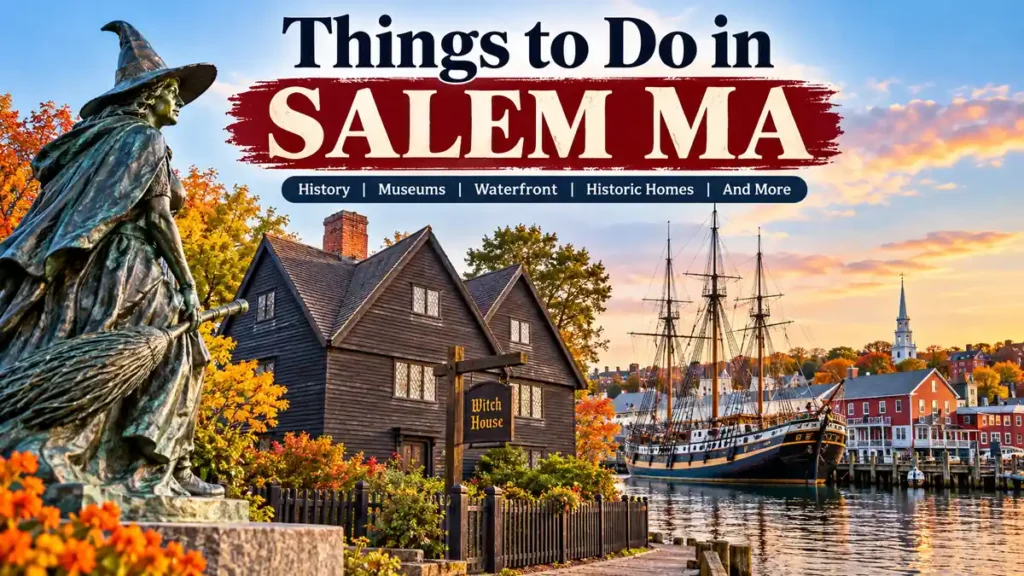
Salem may be famous for witches and Halloween, but limiting the city to its spooky reputation means missing much of what makes it special. This compact Massachusetts destination combines colonial history, maritime heritage, architecture, art, literature, waterfront scenery, museums, and an unusually walkable downtown.
If you’re searching for things to do in salem ma, start with the Salem Witch Trials Memorial, Witch House, Peabody Essex Museum, House of the Seven Gables, and Salem Maritime National Historical Park. Then explore Essex Street, Derby Wharf, Pickering Wharf, historic Chestnut Street, local shops, and Salem’s harborfront.
Most major attractions are close enough together that you can explore a surprising amount without a car. That makes Salem suitable for a Boston day trip, although two days gives you much more time to understand the city’s history rather than simply rushing between attractions.
1. Understand the Salem Witch Trials at the Salem Witch Museum
For many first-time visitors, the Salem Witch Museum is an introduction to the events that made the city internationally famous.
The Salem witch trials unfolded in 1692, when accusations of witchcraft spread through Salem Village and surrounding communities. The resulting prosecutions, imprisonment, and executions became one of the best-known episodes of colonial American history.
The museum uses presentations and exhibits to introduce visitors to the trials and to examine how ideas about witches have changed over time.
This is worth doing early in your visit because the historical context makes several later stops easier to understand. Just remember that Salem contains multiple museums and attractions interpreting the witch trials in different ways. No single stop tells the complete story.
2. Visit the Salem Witch Trials Memorial
The Salem Witch Trials Memorial offers a quieter and more reflective experience.
Located beside the Old Burying Point Cemetery, the memorial commemorates the people who lost their lives during the 1692 trials. Stone benches bear victims’ names, creating a deliberately simple setting that keeps attention on the human cost of the hysteria.
Unlike some of Salem’s theatrical attractions, this isn’t intended as entertainment.
Take your time here. Reading the names and thinking about the individuals involved can give the historical events a weight that dates and statistics alone cannot convey.
Because the memorial is centrally located, it fits easily into a walking itinerary through downtown Salem.
3. Tour the Witch House
The Witch House at 310 Essex Street is one of the most important historic buildings connected to the trials.
It was the home of Judge Jonathan Corwin, who was involved in the 1692 proceedings. Today, the property interprets 17th-century domestic life, architecture, material culture, and its connection with the witchcraft crisis.
The house was built between 1642 and 1675 and was restored to a 17th-century appearance before opening to the public in 1947. Salem, MA Official Website
Rather than expecting a haunted-house attraction, visit for history. The rooms, furnishings, and architecture help put the witch trials into the social world in which they occurred.
During the main season, self-guided tours are generally offered daily, while winter hours are more limited. October may require reservations, so checking current admission arrangements before arriving is sensible. Salem, MA Official Website
4. Explore the Peabody Essex Museum
One of the best things to do in Salem MA that has little to do with Halloween is spending a few hours at the Peabody Essex Museum, commonly called PEM.
This major art and culture museum demonstrates just how international Salem’s history really is.
Salem once had deep connections with global maritime trade, and PEM’s collections reflect centuries of cultural exchange. Exhibitions range across art, history, nature, science, and design.
A standout attraction is Yin Yu Tang, a roughly 200-year-old Chinese home reconstructed on the museum campus. Timed reservations are required, with entry included in general museum admission. pem.org
PEM also manages several historic properties around Salem. In 2026, for example, the Ropes Mansion is open for tours seasonally through October 18. pem.org
The museum currently operates Thursday through Monday from 10 a.m. to 5 p.m., but checking current hours before your visit is always wise. pem.org
Allow at least two hours if museums are a priority.
5. Tour the House of the Seven Gables
Literature and architecture meet at the House of the Seven Gables.
Built in 1668 for merchant and shipowner John Turner, the waterfront mansion later became associated with Nathaniel Hawthorne and his 1851 novel The House of the Seven Gables. The House of the Seven Gables
The property isn’t simply a literary landmark.
Its approximately two-acre campus includes historic buildings, gardens, waterfront scenery, collections, and thousands of archival materials. The museum also preserves the legacy of Caroline Emmerton, who restored the mansion and opened it as a museum and settlement house in 1910. The House of the Seven Gables
Tours reveal architectural features and stories connected with the people who occupied the property over several centuries.
Afterward, don’t immediately leave. The seaside lawn and gardens are among the property’s pleasures.
6. Walk Through Salem Maritime National Historical Park
Witchcraft dominates Salem’s popular image, but maritime trade once shaped the city’s wealth and international importance.
Salem Maritime National Historical Park preserves that story.
The historic waterfront encompasses wharves, buildings, gardens, and sites connected with Salem’s seafaring past. Outdoor areas, including the waterfront and wharves, are accessible seven days a week. National Park Service
Better still for budget travelers, no entrance pass is required to access the national historical park. National Park Service
Stop by the Salem Armory Visitor Center for orientation before exploring the surrounding area. As of fall 2026, its seasonal daily hours are 9:30 a.m.–4:30 p.m. National Park Service
Don’t miss Derby Wharf
Walk toward the end of Derby Wharf for broad harbor views and the Derby Wharf Light Station.
It’s an easy way to combine history with fresh air, particularly after spending several hours inside museums.
7. See the Friendship of Salem
While exploring the maritime district, look for the Friendship of Salem, a reconstructed tall ship associated with Salem’s merchant history.
It provides an immediate visual reminder that this small New England city once participated in an enormous international trading network.
The ship is located within Salem Maritime National Historical Park at 160 Derby Street and is listed among the city’s current attractions. Destination Salem
Access can vary according to programming, maintenance, and seasonal conditions, so verify whether boarding or ranger activities are available when you visit.
Even when viewed from the waterfront, the ship adds atmosphere to a Derby Street walk.
8. Follow the Salem Heritage Trail
If you prefer exploring independently, follow the Salem Heritage Trail.
The trail connects significant areas of the city and provides a convenient framework for a self-guided walking tour. Instead of constantly checking directions between individual attractions, you can use the route to connect museums, historic buildings, public spaces, and waterfront sites.
This is particularly useful on a first visit because Salem rewards wandering.
Interesting architecture, small shops, old streets, cemeteries, and historic markers appear between the headline attractions.
Comfortable shoes matter more than you might expect.
9. Walk Essex Street Pedestrian Mall
Essex Street is one of the liveliest parts of downtown Salem.
The pedestrian area brings together restaurants, boutiques, souvenir stores, museums, witch-themed businesses, street activity, and historic surroundings.
It can also serve as a natural break between more serious historical sites.
Salem’s modern identity includes contemporary witchcraft culture, alternative spirituality, Halloween tourism, art, and independent retail. Essex Street is one of the easiest places to observe how those elements coexist.
October transforms the atmosphere dramatically, while quieter months provide more room to appreciate the streetscape itself.
10. Visit the Old Burying Point Cemetery
Beside the Witch Trials Memorial lies one of Salem’s oldest cemeteries, commonly known as the Old Burying Point or Charter Street Cemetery.
Its weathered gravestones provide another window into colonial New England.
Look carefully at the carvings. Early New England gravestones frequently used symbolic imagery relating to mortality, religion, and changing ideas about death.
Treat the site as a historic cemetery rather than a spooky attraction. People buried here were real residents whose lives were intertwined with Salem’s early history.
Combining the cemetery with the adjacent memorial creates one of downtown Salem’s most historically meaningful stops.
11. Discover Nathaniel Hawthorne’s Salem
Nathaniel Hawthorne is an essential part of Salem’s literary identity.
The author was born in Salem in 1804, and his family history connected him indirectly with the witch trials: his ancestor John Hathorne served as one of the judges.
That legacy influenced Hawthorne’s writing and complicated relationship with his hometown.
Literature lovers should combine the House of the Seven Gables with Hawthorne-related sites around the city. His birthplace is part of the Seven Gables museum campus, giving visitors an opportunity to connect the writer with both Salem’s architecture and history.
Knowing this background also makes the city feel less like a collection of witch-themed attractions and more like a place that repeatedly influenced American culture.
12. Walk Through the McIntire Historic District
Architecture enthusiasts should make time for Salem’s McIntire Historic District.
The area is associated with celebrated Salem architect and woodcarver Samuel McIntire and contains elegant Federal-era architecture.
Chestnut Street is especially rewarding.
Here, Salem feels noticeably different from the busy tourist core. Grand historic homes, balanced facades, mature trees, and quieter sidewalks reveal the wealth created during the city’s maritime era.
The Witch House sits within the broader McIntire historic area, so combining both attractions requires little additional travel. Salem, MA Official Website
A slow walk costs nothing and provides valuable context for understanding Salem beyond 1692.
13. Explore Pickering Wharf
Pickering Wharf combines waterfront scenery with restaurants, shops, and an easygoing harbor atmosphere.
It’s a useful place to slow down after a museum-heavy morning.
Walk along the waterfront, browse stores, stop for something to eat, or simply watch boats in Salem Harbor.
Because Pickering Wharf sits near Derby Street and Salem Maritime National Historical Park, you can easily incorporate it into the same section of your itinerary.
This is also a good example of why walking Salem works so well: history, shopping, food, and harbor views frequently sit only minutes apart.
14. Take a Salem Walking Tour
A guided walking tour can reveal details you’d probably overlook independently.
Salem offers tours centered on several themes, including:
- Witch-trial history
- Colonial Salem
- Maritime history
- Architecture
- Ghost stories
- Local legends
- Modern witchcraft
- Literary history
Destination Salem currently lists numerous historical, mystical, ghost, and specialty walking experiences. Destination Salem
Choose based on what you actually want to learn.
If historical accuracy matters most, look for a tour that clearly distinguishes documented events from folklore. If you’re primarily looking for evening entertainment, a ghost tour may be a better fit.
15. Ride the Salem Trolley
Visitors who don’t want to walk everywhere can use the Salem Trolley as both transportation and sightseeing.
A narrated trolley tour helps you understand how Salem’s major districts fit together geographically while introducing landmarks along the route.
It’s particularly helpful if you’re visiting with children, older relatives, or anyone who would find an entire day of walking difficult.
Consider doing the trolley early in your visit. Once you’ve seen the city from the route, you can return on foot to whichever attractions interest you most.
Seasonal schedules can change, so check operating information before building your day around it.
16. Relax at Salem Willows
Need a break from museums and witch-trial history?
Head toward Salem Willows.
This waterfront area provides a more relaxed side of the city, with coastal views and recreational surroundings. Destination Salem includes Salem Willows among the city’s museums and attractions listings. Destination Salem
It works particularly well for families or travelers spending more than one day in Salem.
Rather than trying to squeeze Salem Willows between downtown attractions, consider saving it for late afternoon when you’re ready to escape the busiest streets.
17. Explore Salem’s Maritime History on Foot
For travelers who like self-guided itineraries, Salem’s maritime story can become a walking tour of its own.
Destination Salem outlines a 1.6-mile maritime history walk beginning around the Peabody Essex Museum and finishing at the House of the Seven Gables. Destination Salem
Along the way, you’ll encounter places connected with merchants, churches, ships, waterfront commerce, and the city’s international connections.
This route demonstrates something visitors sometimes miss: Salem’s historic importance extended far beyond the witch trials.
Its maritime prosperity shaped the architecture, institutions, and cultural collections visitors see today.
18. Experience Salem During Halloween Season
October is Salem’s most famous season.
Halloween decorations, special events, costumes, performances, nighttime tours, and seasonal attractions create an atmosphere unlike the rest of the year.
It’s exciting—but also exceptionally busy.
If you’re planning an October trip, reserve major attractions, accommodations, and tours well ahead of time. The Witch House specifically notes that reservations may be required during October. Salem, MA Official Website
Expect crowds and allow more time to move around downtown.
For travelers who want Salem’s history without the Halloween intensity, spring, early summer, or the quieter parts of fall may provide a more relaxed experience.
19. Look Beyond the Witch-Themed Attractions
One of the easiest mistakes first-time visitors make is booking witch-related attraction after witch-related attraction.
Mix things up.
A more balanced Salem itinerary might include one witch-trial museum, the memorial, an art museum, a historic house, and a waterfront walk.
Destination Salem itself emphasizes that the city’s identity encompasses witches, maritime trade, literature, settlers, pirates, museums, restaurants, shops, and cultural events. Destination Salem
That variety is what makes a full day here interesting.
If every stop covers essentially the same story, Salem can begin to feel repetitive. Alternating themes keeps the history in perspective.
20. Enjoy Free Things to Do in Salem MA
You don’t need a ticket for every worthwhile experience.
Some of the best free things to do in Salem MA include walking the historic downtown, exploring the waterfront, seeing Derby Wharf, following portions of the Heritage Trail, strolling Chestnut Street, browsing Essex Street, and visiting outdoor areas of Salem Maritime National Historical Park.
The national historical park itself does not require an entrance pass. National Park Service
A good budget strategy is to pay for one or two major museums and build the rest of your itinerary around outdoor historic sites.
That approach also prevents museum fatigue.
What Are the Best Things to Do in Salem MA in One Day?
If you only have one day, resist trying to see everything.
Start downtown in the morning with the Witch House or another major historical attraction. Then visit the Salem Witch Trials Memorial and Old Burying Point Cemetery.
Spend late morning or early afternoon at the Peabody Essex Museum.
After lunch, walk toward Derby Street and Salem Maritime National Historical Park. Continue along the waterfront to the House of the Seven Gables.
A practical one-day route looks like this:
- Witch House
- Essex Street
- Salem Witch Trials Memorial
- Old Burying Point Cemetery
- Peabody Essex Museum
- Salem Maritime National Historical Park
- Derby Wharf
- House of the Seven Gables
- Pickering Wharf
- Evening walking or ghost tour
Don’t treat that as a checklist you must complete. Removing two stops and spending longer at the others often creates a better experience.
What Can You Do in Salem MA With Kids?
Salem can work well for families, but parents should choose attractions carefully.
Some ghost-themed experiences deliberately aim to frighten visitors, while the historical reality of the witch trials involves imprisonment and executions.
For younger children, consider mixing history with lighter activities such as a trolley ride, waterfront exploration, Salem Willows, harbor scenery, and family-oriented museum experiences.
Older children and teenagers may appreciate the witch-trial sites more when adults explain that these were historical events involving real people rather than simply Halloween stories.
The Peabody Essex Museum can also provide a useful change of pace from witch-themed attractions.
Is Salem MA Worth Visiting Outside October?
Absolutely.
In fact, visiting outside October can make Salem easier to appreciate.
The museums, architecture, maritime sites, historic homes, literary connections, restaurants, and waterfront aren’t dependent on Halloween.
Crowds are generally the biggest reason to consider another season.
Travelers primarily interested in historical interpretation may enjoy having more space and time to explore. October remains unbeatable for people specifically seeking Salem’s Halloween atmosphere, costumes, and seasonal energy.
Winter requires more planning because some attractions reduce their hours. For example, the Witch House shifts from daily main-season operation to a more limited Thursday-through-Sunday winter schedule. Salem, MA Official Website
How Long Should You Spend in Salem?
One full day is enough for the highlights.
Two days is better.
With two days, you can devote one day to witch-trial history and downtown Salem, then use the second for the Peabody Essex Museum, House of the Seven Gables, maritime district, waterfront, and neighborhoods.
Three days makes sense for travelers who enjoy museums, architecture, photography, detailed historical tours, or a slower pace.
Salem’s compact size can be deceptive. Distances are short, but museums and guided tours consume time quickly.
Can You Visit Salem From Boston Without a Car?
Yes. Salem is a popular day-trip destination from Boston, and once you reach downtown, many major attractions can be explored on foot.
A car isn’t particularly useful when moving between central Salem attractions because so many are clustered around Essex Street, Washington Street, Derby Street, and the waterfront.
Walking also lets you notice historic architecture and smaller landmarks that you’d miss while driving.
If you’re staying overnight, choose accommodation near downtown if walkability is a priority.
Practical Tips for Visiting Salem
A little planning makes a significant difference, especially during peak season.
Book ahead in October. Popular tours and attractions can become much harder to visit spontaneously.
Check current opening hours. Museums and historic houses often operate seasonal schedules. PEM, for example, is currently closed Tuesdays and Wednesdays, while other attractions follow different schedules. pem.org
Wear comfortable shoes. Salem is best experienced on foot.
Don’t overbook. Three museums plus several tours in one day can turn an enjoyable visit into a race against the clock.
Respect historical sites. Cemeteries and memorials aren’t Halloween props.
Explore the waterfront. It provides important context for understanding how Salem became prosperous and internationally connected.
Separate history from legend. Ghost stories are part of modern Salem tourism, but they’re not substitutes for learning what actually happened during the 1692 witch trials.
Making the Most of Things to Do in Salem MA
The best things to do in salem ma reveal several different versions of the same city.
There’s the Salem of 1692, remembered through the Witch House and Salem Witch Trials Memorial. There’s maritime Salem, preserved along Derby Wharf and Salem Maritime National Historical Park. There’s literary Salem, connected with Nathaniel Hawthorne and the House of the Seven Gables. And there’s modern Salem, filled with museums, shops, restaurants, tours, art, and Halloween culture.
For a first visit, don’t choose just one version.
Combine a serious historical site with the Peabody Essex Museum, walk the waterfront, explore a historic neighborhood, and leave enough unscheduled time to wander downtown. Salem’s biggest attractions deserve attention, but some of the city’s character appears in the spaces between them.