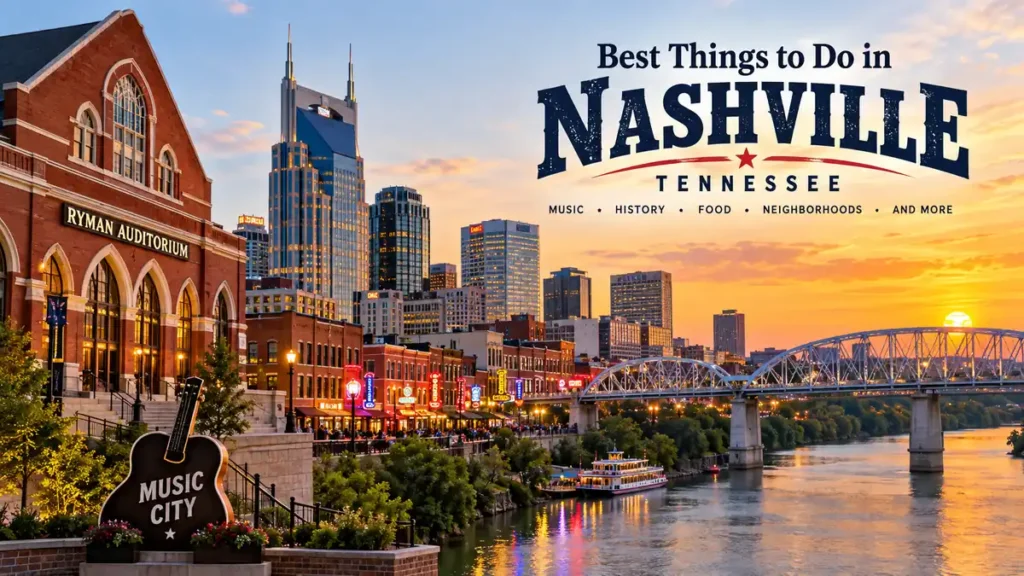
Nashville has a way of sounding familiar before you even arrive. You know about country music, neon-lit Broadway, cowboy boots, and hot chicken—but those are only the opening notes.
The best things to do in nashville tennessee include seeing a show at the Grand Ole Opry or Ryman Auditorium, exploring the Country Music Hall of Fame, hearing live music on Lower Broadway, visiting the Parthenon, discovering African American music history, eating Nashville hot chicken, and exploring neighborhoods such as 12South and East Nashville.
Nashville is nicknamed “Music City,” but a good visit goes well beyond country music. Art museums, botanical gardens, Tennessee history, professional sports, family attractions, green spaces, distinctive neighborhoods, and a surprisingly varied food scene can easily fill several days.
Best things to do in nashville tennessee for first-time visitors
First-time visitors face one problem: there is far more to see than most weekend itineraries can handle.
If you have limited time, prioritize experiences that tell you something specifically about Nashville rather than filling your schedule with attractions you could find in another major city.
| Nashville experience | Best for | Suggested time |
|---|---|---|
| Ryman Auditorium | Music history | 1–2 hours |
| Country Music Hall of Fame | Country music | 2–3 hours |
| Lower Broadway | Live music/nightlife | 2–4 hours |
| Grand Ole Opry | Live performance | 2–3 hours |
| National Museum of African American Music | American music history | 2–3 hours |
| Centennial Park & Parthenon | Parks, architecture | 1–2 hours |
| RCA Studio B | Recording history | About 1 hour |
| 12South | Shopping, food, walking | 2–3 hours |
| Cheekwood | Gardens and art | 2–4 hours |
| Bicentennial Capitol Mall | Tennessee history | 1–2 hours |
A practical first visit mixes one major museum, one historic music venue, one neighborhood, a local meal, and an evening of live music each day. That gives you more variety than spending the entire trip downtown.
1. Step inside Ryman Auditorium


6
Few buildings explain Nashville’s musical identity better than Ryman Auditorium.
Originally built as a tabernacle, the Ryman became home to the Grand Ole Opry in 1943. The Opry remained there until 1974, helping give the venue its famous “Mother Church of Country Music” identity. Artists associated with its history include Johnny Cash, Hank Williams and many other major figures in American music.
You don’t have to attend an evening concert to experience it. Daytime tours let visitors explore the auditorium, exhibits and stage area. As of September 2026, regular daytime tour hours are generally 9 a.m. to 4 p.m., although event schedules can alter availability.
Quick takeaway: If you only have time for one historic music venue downtown, the Ryman gives you an unusually concentrated introduction to Nashville’s performance history.
2. Experience the Grand Ole Opry


6
The Grand Ole Opry isn’t simply a concert venue. It is one of Nashville’s defining cultural institutions.
The Opry began as a radio program and developed into one of country music’s most enduring stages. Performances bring together established artists and newer performers rather than following the format of a standard single-headliner concert.
Visitors can also take backstage tours and see areas normally associated with performers, including dressing rooms and the stage.
One common planning mistake is assuming the Opry House is on Broadway. It isn’t. The venue is in the Opryland/Music Valley area, so allow travel time when combining it with downtown attractions.
3. Explore the Country Music Hall of Fame and Museum
Even casual country listeners can spend hours inside the Country Music Hall of Fame and Museum.
The museum traces the development of country music through recordings, instruments, costumes, photographs, vehicles and memorabilia. Rather than concentrating solely on modern stars, its exhibits help connect early country traditions with the commercial music industry Nashville later became famous for.
The Hall of Fame Rotunda is one of the key stops.
If music history is your priority, consider pairing the museum with Historic RCA Studio B. That combination makes sense because one explains the broader history while the other places you inside an actual recording environment.
4. Tour Historic RCA Studio B
Music Row doesn’t look as theatrical as Lower Broadway—and that’s precisely part of its appeal.
Historic RCA Studio B represents the working side of Nashville’s music industry. The studio became associated with the “Nashville Sound” and recordings by major artists, including Elvis Presley.
A studio tour adds useful context after visiting the Country Music Hall of Fame because you move from looking at artifacts to seeing where recordings were actually made.
Don’t expect Music Row itself to resemble a giant entertainment district. Many of its buildings are working offices and studios. The significance is largely behind the doors.
5. Hear live music on Lower Broadway


5
For sheer concentration of live entertainment, Lower Broadway is difficult to match.
The downtown stretch often called the Honky Tonk Highway is packed with stages, rooftop venues and bars. Music begins well before evening, making daytime a useful option for travelers who want the Broadway experience without staying out late.
Nashville’s tourism organization notes that free live music is available throughout the year, which makes simply walking between venues one of the more accessible ways to experience Music City.
Broadway is loud, busy and unapologetically tourist-oriented. That’s part of its character, but it isn’t the entirety of Nashville nightlife.
For a broader picture of the city’s music scene, spend another evening at a neighborhood venue. Places such as East Nashville showcase rock, indie and other genres alongside the country music Nashville is famous for.
6. Visit the National Museum of African American Music
A complete account of American music cannot be told through country music alone.
The National Museum of African American Music provides a wider perspective, examining the influence of African American musicians across gospel, blues, jazz, R&B, hip-hop and related traditions.
Its location downtown makes it easy to combine with Broadway, the Ryman or the Country Music Hall of Fame.
This is an especially valuable stop for visitors who initially associate Nashville exclusively with country. It helps explain the connections between musical traditions rather than treating genres as isolated histories.
7. See the Parthenon in Centennial Park
Yes, Nashville really does have a full-scale replica of Athens’ Parthenon.
The The Parthenon originated with Tennessee’s 1897 Centennial Exposition and reflects Nashville’s long-standing “Athens of the South” nickname. Inside stands a 42-foot representation of Athena.
The surrounding Centennial Park is worth time of its own. The 132-acre urban park includes Lake Watauga, walking areas, gardens, recreational spaces and event facilities.
The outdoor portion is particularly useful when you’re looking for free things to do in Nashville.
8. Learn more at the Tennessee State Museum
Country music may dominate Nashville’s tourism image, but Tennessee’s story is much broader.
The Tennessee State Museum provides historical context for the state through exhibitions dealing with its people, culture, conflicts and development.
Combine it with Bicentennial Capitol Mall State Park for an efficient history-focused half-day.
That pairing also works well when Nashville’s summer heat or rain makes an entirely outdoor itinerary uncomfortable.
9. Walk through Bicentennial Capitol Mall State Park
Bicentennial Capitol Mall State Park functions almost like an outdoor introduction to Tennessee.
The 19-acre park sits near the Tennessee State Capitol and incorporates historical features into its landscape. These include a 1,400-foot history wall, a representation of Tennessee’s geography and a carillon with 95 bells representing the state’s counties.
Walk across to the Nashville Farmers’ Market afterward for food.
This combination is useful for budget-conscious travelers because the park itself doesn’t require a paid attraction ticket.
10. Discover the Frist Art Museum
The Frist Art Museum offers a change of pace after several music-focused attractions.
Located in a historic Art Deco building, the museum doesn’t rely on one permanent collection. Instead, its exhibition program changes, bringing different periods, artists and forms of visual art into the galleries.
That makes checking the current exhibition calendar worthwhile before your trip.
It’s also a smart rainy-day option and evidence that Nashville’s creative identity extends well beyond recording studios.
11. Explore Cheekwood Estate & Gardens
For a quieter afternoon, head away from downtown to Cheekwood Estate & Gardens.
The 55-acre property combines botanical gardens, art, exhibitions and the historic Cheek family mansion. Visitors can choose garden access or admission that also includes the mansion.
Season matters here. Gardens change throughout the year, and special displays can significantly alter the experience. In fall 2026, for example, Cheekwood Harvest runs from September 19 through November 1.
Families should look for the two-acre Bracken Foundation Children’s Garden, with interactive spaces designed for younger visitors.
12. Try Nashville hot chicken
You can visit Nashville without eating hot chicken, but you’ll miss one of the city’s most recognizable culinary traditions.
The dish generally combines fried chicken with a cayenne-heavy spicy coating, often served with white bread and pickles. Heat levels vary considerably.
The practical rule is simple: don’t automatically order the hottest option.
First-time visitors sometimes underestimate how seriously Nashville restaurants interpret “hot.” Start lower than your maximum tolerance and focus on flavor rather than proving anything.
Prince’s Hot Chicken is closely associated with the dish’s history, while Nashville now has numerous restaurants serving their own versions. Lonely Planet specifically highlights Prince’s as part of the city’s food experience.
Also leave room for Southern staples such as biscuits, barbecue and meat-and-three meals.
13. Wander through 12South
If Broadway shows Nashville at full volume, 12South reveals a more relaxed side.
This walkable neighborhood is known for restaurants, independent shopping, coffee, murals and casual places to stop between activities. Nashville’s tourism organization highlights 12South among the city’s distinctive neighborhoods, while local visitor guides regularly include it as an alternative to spending all day downtown.
It’s particularly useful for an unstructured afternoon. Instead of moving between ticketed attractions, you can walk, shop, eat and explore at your own pace.
14. Spend time in East Nashville
East Nashville helps break the stereotype that Music City means only country music and Broadway honky-tonks.
The neighborhood has an independent personality built around restaurants, shops, bars and smaller music venues.
The Basement East is one example. It hosts touring acts and local performers across rock and other genres, demonstrating how broad Nashville’s live-music ecosystem has become.
Come here when you want nightlife that feels different from downtown.
15. Walk around The Gulch
The Gulch sits close to downtown but has a noticeably different atmosphere.
Formerly an industrial area, it has developed into a dense district of restaurants, hotels, shops and contemporary development. Murals—including the frequently photographed wings—have also made the neighborhood a popular photography stop.
You don’t need an entire day here.
Instead, combine The Gulch with nearby SoBro, downtown or Music Row to reduce unnecessary travel.
16. Explore Nashville’s murals and public art
Nashville’s creative output spills onto exterior walls across the city.
Murals appear on restaurants, shops, garages, water tanks and former industrial buildings. The city’s official tourism site also notes a substantial permanent public-art collection across Nashville.
Rather than racing from mural to mural solely for photographs, use public art as a reason to explore neighborhoods you might otherwise miss.
Downtown, The Gulch, 12South and East Nashville are natural areas to incorporate into that kind of self-guided outing.
17. Watch Hatch Show Print at work
Concert posters are part of Nashville’s visual identity, and Hatch Show Print has helped shape that tradition.
The historic letterpress operation produces the bold typography and graphic style associated with countless entertainment posters.
Visitors interested in design, printing or music memorabilia should make time for it while exploring the downtown museum district.
Even without taking an extensive tour, seeing traditional letterpress work provides an interesting counterpart to Nashville’s digital-era entertainment industry. The official tourism site describes Hatch as one of America’s oldest working letterpress print shops.
18. Find family-friendly things to do in Nashville
Nashville works surprisingly well with children once you look beyond nightlife.
One of the strongest options is Adventure Science Center, where interactive science exhibits are supplemented by the Sudekum Planetarium and its 63-foot dome.
The science center is in Wedgewood-Houston, only a short drive from downtown.
Families can also combine Centennial Park, Cheekwood’s Children’s Garden and Nashville’s outdoor attractions for days that don’t revolve around museums.
What can you do in Nashville with kids?
A balanced family day might start with Adventure Science Center, include lunch and downtime at Centennial Park, and finish with an early live-music experience suitable for the children’s ages.
That keeps the trip connected to Nashville without forcing children through a long sequence of adult-oriented attractions.
19. Escape into nature at Radnor Lake
You don’t need to leave the Nashville area to find quieter landscapes.
Radnor Lake State Natural Area offers trails, woodland and opportunities to observe wildlife, creating a dramatic contrast with downtown’s neon and amplified music.
Lonely Planet highlights Radnor Lake as one of Nashville’s worthwhile outdoor escapes, particularly for wildlife enthusiasts.
Go earlier in the day when possible. You’ll generally have a calmer experience, especially on popular weekends.
For travelers staying several days, a morning outdoors can provide a welcome reset between busy sightseeing days.
20. Visit Belle Meade Historic Site
Belle Meade Historic Site & Winery introduces another layer of Middle Tennessee history.
The estate’s story encompasses horses, agriculture and hospitality, but its history also includes slavery. A worthwhile visit should engage with that full history rather than reducing the property to architecture and scenery.
The site lies several miles west of downtown and can be paired geographically with Cheekwood.
Grouping those attractions together saves time compared with returning downtown between them.
21. See Andrew Jackson’s Hermitage
Travelers interested in early U.S. and Tennessee history can visit Andrew Jackson’s Hermitage.
The National Historic Landmark encompasses more than 1,000 acres and includes historic buildings, grounds, gardens and walking areas.
The site is associated with Andrew Jackson, the seventh U.S. president, and interpretation of the property also needs to be understood in the context of the enslaved people who lived and worked there.
Because the Hermitage sits away from central Nashville, give it a dedicated block of time rather than trying to squeeze it between downtown attractions.
22. Catch a Nashville sports event
Music isn’t Nashville’s only live spectacle.
Depending on the season, visitors may find the Tennessee Titans playing football at Nissan Stadium, the Nashville Predators playing hockey at Bridgestone Arena, or Nashville SC competing at GEODIS Park. The city’s tourism calendar also regularly features additional sporting events.
Bridgestone Arena is especially convenient for visitors because it sits directly beside the Broadway entertainment district.
Check schedules before arriving. A home game can also affect downtown traffic, parking prices and restaurant crowds even if you aren’t attending.
23. Look for free things to do in Nashville
Nashville can become expensive quickly if every hour involves an admission ticket.
Fortunately, some memorable experiences cost little or nothing.
- Walk through Centennial Park.
- Explore Bicentennial Capitol Mall State Park.
- Listen to free live music at participating venues.
- Browse Nashville’s murals and public art.
- Explore neighborhoods such as 12South.
- Walk around Music Row.
- Visit galleries during the First Saturday Art Crawl when scheduled.
- Explore Nashville Farmers’ Market before deciding what to eat.
The official tourism organization specifically highlights free live music, parks, art galleries, murals and family-friendly options among Nashville’s budget activities.
Quick takeaway: Don’t judge your Nashville itinerary by the number of paid attractions. Some of the city’s personality is easiest to understand while simply walking, listening and exploring.
24. Experience Nashville after dark without staying only on Broadway
Broadway deserves to be experienced at night at least once, when neon signs, rooftop crowds and multiple stages turn a few downtown blocks into one enormous entertainment zone.
But give yourself another night elsewhere.
East Nashville offers smaller venues and neighborhood nightlife. The Gulch provides restaurants and polished bars. Concert calendars at the Ryman, Grand Ole Opry and other venues can turn an ordinary evening into the highlight of the trip.
Nashville’s music culture extends across genres. The city’s visitor bureau emphasizes that its stages support music far beyond country, while major travel guides similarly point travelers toward rock and alternative venues.
25. Explore what’s new in Nashville in 2026
Repeat visitors will find that Nashville continues to change.
As of September 2026, newer developments include entertainment, dining and cultural additions across several neighborhoods. The Museum of Christian & Gospel Music is among the recent downtown additions, while Nashville’s Historic Arcade has reopened following extensive renovation.
New projects and seasonal events make it particularly worthwhile to check current calendars immediately before traveling rather than relying solely on an old itinerary.
Cheekwood, Centennial Park, Bridgestone Arena and Nashville’s many music venues all maintain changing schedules.
How many days do you need in Nashville?
Three days is a useful starting point for a first visit.
With one day, concentrate on downtown: Country Music Hall of Fame, Ryman Auditorium, Broadway and the National Museum of African American Music.
With two days, add Centennial Park, the Parthenon and either 12South, The Gulch or East Nashville.
With three days, you can add the Grand Ole Opry plus a longer experience such as Cheekwood, Belle Meade, Radnor Lake or Andrew Jackson’s Hermitage.
Four or five days allow you to slow down, see multiple performances and explore neighborhoods rather than simply checking off attractions.
A practical 3-day Nashville itinerary
Day 1: Music City essentials
Start at the Country Music Hall of Fame and Museum, then explore the surrounding SoBro area.
Continue to the Ryman Auditorium in the afternoon. Afterward, walk Lower Broadway before the evening crowds peak.
Finish with live music downtown.
Day 2: Parks, neighborhoods and food
Begin at Centennial Park and see the Parthenon.
Spend the afternoon exploring 12South or The Gulch, stopping for lunch and local shops along the way.
Make Nashville hot chicken your main food mission, then choose an evening concert away from Broadway if you want to experience another side of the city’s music culture.
Day 3: Choose your Nashville
Build the final day around your interests.
Music fans can tour RCA Studio B and attend the Grand Ole Opry. Families can visit Adventure Science Center and Cheekwood. History travelers can combine Bicentennial Capitol Mall and the Tennessee State Museum. Outdoor travelers can spend the morning at Radnor Lake before returning to the city.
That flexibility is more useful than forcing every visitor through exactly the same checklist.
When is the best time to visit Nashville?
Spring and fall are attractive periods for walking, outdoor attractions and neighborhood exploration, though major events can increase crowds and accommodation demand.
Summer brings long days but also heat and humidity. Build indoor stops such as museums into the hottest part of the afternoon.
Winter can mean fewer outdoor activities, but Nashville’s core strengths—live music, museums, restaurants and historic venues—operate throughout the year.
Whatever the season, check event calendars. Nashville hosts concerts, festivals, professional sports and special exhibitions throughout the year, and those events can significantly change both your itinerary and traffic conditions.
How to get around Nashville
Don’t assume every Nashville attraction is within walking distance of Broadway.
Downtown and SoBro are relatively easy to explore on foot, and several major attractions sit close together. Once you add places such as the Grand Ole Opry, Cheekwood, Radnor Lake or the Hermitage, transportation becomes a bigger consideration.
Group attractions geographically.
For example, Country Music Hall of Fame, Broadway, the Ryman and the National Museum of African American Music work naturally together. Cheekwood and Belle Meade can form another cluster.
This simple approach can save a surprising amount of time.
Also consider the weather. A walk that feels easy on a mild morning can be considerably less appealing during a hot Tennessee afternoon.
What should you not miss in Nashville?
For a first visit, the strongest introduction combines Nashville’s music history with its modern culture.
See either the Ryman Auditorium or Grand Ole Opry—and ideally both if music is central to your trip. Explore the Country Music Hall of Fame, spend some time on Broadway, and visit the National Museum of African American Music for a broader understanding of the city’s musical story.
Then leave downtown.
Walk through Centennial Park, explore a neighborhood such as 12South or East Nashville, try local food, and make room for whichever interest matters most to you: art, gardens, history, sports or nature.
That balance is the key to finding the most rewarding things to do in nashville tennessee. Music City absolutely deserves its nickname, but the city becomes much more interesting once you discover what exists beyond the neon signs.