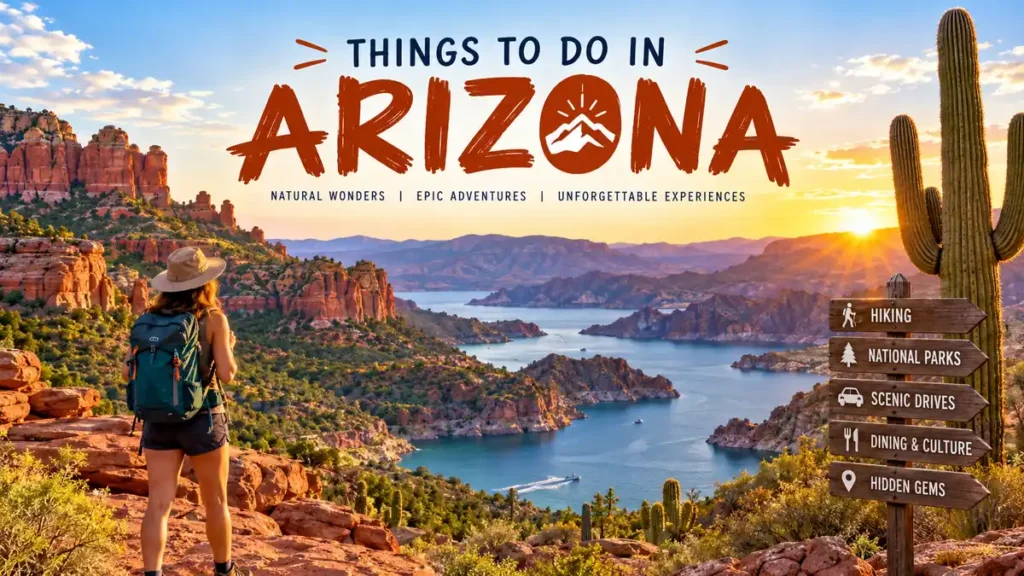
Arizona can feel like several different states packed into one. Drive a few hours and the landscape shifts from giant Sonoran Desert cacti to red-rock canyons, pine forests, volcanic terrain, historic mining towns, and the immense walls of the Grand Canyon.
The best things to do in arizona include exploring Grand Canyon National Park, hiking among Sedona’s red rocks, touring Antelope Canyon with a Navajo guide, seeing Horseshoe Bend, walking among giant saguaros near Tucson, driving historic Route 66, visiting Monument Valley, exploring Phoenix and Scottsdale, and discovering Arizona’s Indigenous and Old West heritage.
Arizona rewards travelers who resist the temptation to treat it as one giant desert. Elevation and geography create dramatically different climates across the state, so choosing where to go—and when—is just as important as building a list of attractions.
1. Experience Grand Canyon National Park
For many travelers, Grand Canyon National Park is the reason to visit Arizona in the first place.
The canyon stretches across an enormous section of northern Arizona, revealing layer after layer of rock shaped by the Colorado River and millions of years of geological history. The scale is difficult to appreciate from photographs; seeing it from the rim is a completely different experience.
Start at the South Rim
The South Rim is the most practical choice for a first visit. It remains open year-round and has developed viewpoints, visitor facilities, shuttle services, trails, and lodging. The North Rim is higher, quieter, and seasonal.
Some worthwhile South Rim viewpoints include:
- Mather Point
- Yavapai Point
- Yaki Point
- Hopi Point
- Mohave Point
- Desert View
Don’t make the common mistake of arriving, photographing the first overlook, and immediately leaving. Walking even a section of the Rim Trail changes the experience because the canyon continually reveals different angles.
More ambitious hikers can descend partway along trails such as Bright Angel or South Kaibab, but hiking down is much easier than climbing back up. Desert heat, elevation, and steep terrain deserve serious respect.
Quick Takeaway: If this is your first Arizona trip, give the Grand Canyon at least one full day rather than treating it as a quick roadside stop.
2. Explore Sedona’s Red-Rock Country
Sedona combines dramatic sandstone formations with hiking, art galleries, wellness experiences, scenic drives, and easy access to northern Arizona.
Cathedral Rock, Bell Rock, Courthouse Butte, and Devil’s Bridge are among its recognizable formations. Oak Creek adds greenery and water to scenery that otherwise looks almost otherworldly.
Popular outdoor experiences include hiking, mountain biking, jeep excursions, sunrise viewpoints, and sunset photography.
Visit the Chapel of the Holy Cross
The Chapel of the Holy Cross is built directly into Sedona’s red-rock landscape. Even travelers who aren’t particularly interested in architecture or religious sites often stop because of its setting.
Sedona is also famous for supposed spiritual “vortex” sites. You don’t need to believe the claims to enjoy the hikes and viewpoints associated with them.
Parking at popular trailheads can become difficult. Starting early generally means cooler temperatures, easier parking, and a quieter trail.
3. Tour Antelope Canyon Near Page
Few places demonstrate the artistic power of erosion as clearly as Antelope Canyon.
Its narrow sandstone walls curve and twist into flowing shapes, with changing sunlight producing shades of orange, gold, purple, and red.
Antelope Canyon is on Navajo land, and visitors enter through authorized guided tours. Current traveler information likewise notes that a Navajo-guided tour is required.
Upper vs. Lower Antelope Canyon
Upper Antelope Canyon is famous for the shafts of sunlight that can penetrate the canyon at certain times and seasons. Its generally easier walking conditions also make it attractive to many visitors.
Lower Antelope Canyon involves stairs and narrower passages and can feel more adventurous.
Both can sell out, so this is one Arizona experience worth planning before arrival.
4. Watch the Colorado River Curve Around Horseshoe Bend
Just outside Page, Horseshoe Bend provides one of the Southwest’s most recognizable views.
The Colorado River makes a huge horseshoe-shaped turn around a sandstone formation far below the overlook. The short approach makes the viewpoint accessible compared with many of Arizona’s more demanding wilderness attractions.
Sunrise and the hours approaching sunset usually provide more interesting light than the middle of the day.
The exposed terrain also means heat can become intense. Carry water even though the walk appears short.
Pairing Horseshoe Bend with Antelope Canyon makes sense because both are near Page.
5. Discover Monument Valley
The isolated sandstone buttes of Monument Valley Navajo Tribal Park have become visual symbols of the American West.
The landscape sits within the Navajo Nation near the Arizona-Utah border. Rather than approaching it simply as a photo stop, travelers should recognize that they are visiting a living Indigenous landscape.
A scenic drive provides views of famous formations, while Navajo-guided experiences can offer access and cultural context that independent sightseeing cannot.
The long distances involved make Monument Valley better suited to a northern Arizona road trip than a quick excursion from Phoenix.
6. Walk Among Giant Cacti at Saguaro National Park
Arizona’s most recognizable desert plant takes center stage at Saguaro National Park.
The park protects forests of giant saguaros around Tucson. The National Park Service describes the saguaro as a universal symbol of the American West and notes that these enormous cacti occur naturally in only a limited part of the United States.
Saguaro National Park is divided into two districts:
Tucson Mountain District
West of Tucson, this side is known for dense cactus scenery and striking sunsets.
Rincon Mountain District
East of Tucson, this district offers longer trails and landscapes that transition upward from desert into higher-elevation environments.
A scenic drive works well for travelers with limited time, but walking even a short trail gives you a much better sense of the Sonoran Desert.
Spring can bring desert wildflowers, while summer requires serious heat precautions.
7. See the Desert Botanical Garden in Phoenix
Travelers who want to understand desert ecology without committing to a long wilderness hike should visit Desert Botanical Garden.
Located near Papago Park, the garden introduces visitors to desert plants through themed trails and carefully interpreted landscapes. It consistently appears among Arizona’s popular visitor attractions.
It is particularly useful early in a trip because learning to recognize saguaros, chollas, agaves, and other desert plants makes later drives and hikes more interesting.
Nearby Papago Park is another easy outdoor stop, with distinctive sandstone formations that look especially striking near sunset.
8. Explore Phoenix Beyond Downtown
Phoenix makes an excellent base for exploring central Arizona, but the state’s capital deserves time of its own.
Outdoor travelers can hike around the city’s mountain preserves, while museum visitors can explore Arizona history, art, science, and Indigenous cultures.
One of the most significant cultural attractions is the Heard Museum, known for its focus on American Indian art and culture.
For hiking, Camelback Mountain is famous but challenging. Travelers looking for something less strenuous have plenty of alternatives in the surrounding preserves.
Phoenix is best explored outdoors during the cooler months. In summer, shift strenuous activities to very early morning and spend the hottest part of the day indoors.
9. Spend a Day in Scottsdale
Neighboring Scottsdale provides a different side of the Phoenix metropolitan area.
Old Town Scottsdale mixes galleries, restaurants, shops, public art, and Southwestern architecture within a relatively walkable district. The wider city is known for resorts, spas, golf, and access to the Sonoran Desert.
Travelers interested in architecture can also investigate the legacy of Frank Lloyd Wright at Taliesin West.
Scottsdale works particularly well when you want to balance Arizona’s rugged outdoor attractions with an easier day of museums, food, shopping, or relaxation.
10. Explore Tucson and Southern Arizona
Tucson is surrounded by mountains and Sonoran Desert, giving the city a distinct identity from Phoenix.
Saguaro National Park sits on both sides of the metropolitan area, while nearby mountain drives provide dramatic changes in elevation and temperature.
Tucson is also an excellent place to explore Arizona’s food traditions. Mexican and Sonoran influences are particularly strong here.
Beyond the city, southern Arizona opens into historic missions, caves, mining communities, wine country, and desert wilderness.
11. Drive Up Mount Lemmon
One of the most surprising things to do in Arizona is drive from Tucson’s desert environment toward the forests around Mount Lemmon.
The Catalina Highway climbs thousands of feet, passing through noticeably different ecological zones.
This elevation change makes Mount Lemmon especially appealing when Tucson is hot. Temperatures near the top can be dramatically cooler than those on the desert floor.
Stop at overlooks along the way rather than treating the summit as the only destination.
12. Explore Petrified Forest National Park
Petrified Forest National Park is sometimes overshadowed by the Grand Canyon, yet it contains one of Arizona’s strangest combinations of geology, archaeology, and desert scenery.
The park protects extensive deposits of petrified wood along with fossils, badlands, mesas, petroglyphs, and broad desert vistas.
The Painted Desert adds bands of muted red, pink, lavender, and gray to the landscape.
Because Interstate 40 passes nearby, the park fits naturally into a Route 66 or northern Arizona road trip.
13. Drive Historic Route 66
Few road trips are more closely associated with American travel culture than U.S. Route 66 in Arizona.
Historic stretches cross northern Arizona through communities including Holbrook, Winslow, Flagstaff, Williams, Seligman, and Kingman.
Classic motels, diners, neon signs, trading posts, and roadside curiosities preserve pieces of the old highway’s character.
Arizona tourism resources continue to promote Route 66 as one of the state’s defining road-trip experiences.
Don’t rush it. Route 66 is most enjoyable when you have enough time to stop at the small towns rather than simply using Interstate 40 to move between destinations.
14. Visit Flagstaff and See Arizona’s High Country
Flagstaff surprises travelers expecting endless desert.
Sitting at high elevation among ponderosa pine forests, Flagstaff experiences four distinct seasons and serves as a useful base for the Grand Canyon, Route 66, volcanic landscapes, and Native American cultural sites.
One of its signature attractions is Lowell Observatory. Stargazing here connects modern visitors with the city’s long astronomical history.
Flagstaff is also an excellent hiking base and a logical overnight stop when temperatures in southern Arizona become oppressive.
15. Explore Sunset Crater and Wupatki
North of Flagstaff, volcanic and archaeological landscapes sit surprisingly close together.
Sunset Crater Volcano National Monument preserves volcanic terrain created by eruptions that transformed the region roughly a thousand years ago.
Nearby Wupatki National Monument protects ancestral Pueblo structures in an open high-desert landscape.
Visiting them together reveals something easy to miss on a conventional Arizona itinerary: natural events and human history here are deeply connected.
16. Learn About Living History at Canyon de Chelly
Canyon de Chelly National Monument is not simply an archaeological attraction.
Diné families continue to live, farm, and raise livestock within the canyon. People have lived in the canyon system for nearly 5,000 years, making it one of North America’s longest continuously inhabited landscapes. The monument is managed through cooperation between the National Park Service and the Navajo Nation.
Rim drives lead to overlooks across the canyon, including views toward Spider Rock.
Guided canyon experiences provide another perspective and help visitors understand the landscape through Navajo history and culture.
Current National Park Service information lists a welcome center, two rim drives and ten overlooks, while private companies provide guided canyon-floor tours.
Treat Canyon de Chelly as a living cultural landscape rather than an abandoned ancient site.
17. Visit Montezuma Castle National Monument
Montezuma Castle National Monument preserves one of Arizona’s most impressive cliff dwellings.
Despite its name, the site has no connection to the Aztec ruler Montezuma. The structure was created by Indigenous people of the region centuries before European settlement.
Its location between Phoenix and northern Arizona makes it an easy addition to a road trip toward Sedona or Flagstaff.
The National Park Service identifies it as one of the best-preserved cliff dwellings in North America.
18. Discover Organ Pipe Cactus National Monument
For quieter Sonoran Desert scenery, head toward Organ Pipe Cactus National Monument near the Mexican border.
The monument protects an extraordinary desert ecosystem and is recognized as an International Biosphere Reserve.
Its namesake organ pipe cactus grows alongside saguaros and other Sonoran Desert vegetation.
This is a better choice for travelers willing to drive farther in exchange for fewer crowds and a more remote desert experience.
19. Visit the Old Mining Town of Bisbee
Built into hills near the Mexican border, Bisbee feels very different from Arizona’s major resort cities.
Its mining-era buildings, steep streets, staircases, galleries, independent shops, and colorful houses have helped transform the former mining center into an arts-oriented destination.
Mining history remains part of its identity, but wandering through the historic district is equally rewarding.
Bisbee works particularly well as part of a southern Arizona loop through Tucson and Tombstone.
20. Step Into Old West History in Tombstone
Tombstone became famous through the events surrounding Wyatt Earp, Doc Holliday, and the 1881 gunfight near the O.K. Corral.
Today, its historic district mixes preserved buildings with reenactments and Old West-themed attractions.
Some parts can feel theatrical, but Tombstone remains useful for understanding how the mythology of the American frontier developed around real mining communities, lawmen, outlaws, and conflicts.
Pairing Tombstone with Bisbee creates one of southern Arizona’s easiest history-focused day trips.
21. See Lake Powell and Glen Canyon
Northern Arizona isn’t all dry desert.
Around Page, Glen Canyon National Recreation Area surrounds the Colorado River and Lake Powell with vast sandstone scenery.
Boating, paddling, scenic overlooks, and shoreline exploration provide a completely different Arizona experience from desert hiking.
Water levels and access conditions can change, so check current National Park Service information before planning activities dependent on specific launch areas.
22. Discover Arizona’s Lakes and Colorado River Country
Western Arizona is often missing from first-time itineraries.
Lake Havasu City provides access to boating, beaches, desert landscapes, and the Colorado River. The city’s London Bridge—relocated from England—is its best-known landmark.
Farther north, river communities provide opportunities for kayaking, fishing, boating, and desert road trips.
This region is particularly useful for travelers looking for water-based activities rather than another canyon hike.
23. Chase Waterfalls—But Plan Carefully
Arizona’s reputation for dry landscapes makes its waterfalls even more striking.
Havasu Falls is the famous example, with blue-green water contrasting against red canyon walls. But this is not a spontaneous roadside attraction.
Access involves tribal regulations and advance planning, and availability can change. Arizona’s official tourism site specifically identifies Havasu Falls among destinations that can require hard-to-obtain advance permits.
The practical lesson is simple: never build a trip around Havasu Falls until you have verified current requirements directly with the responsible tribal authorities.
24. Go Stargazing Under Arizona’s Dark Skies
Arizona’s open landscapes and dry climate make nighttime an attraction in its own right.
Flagstaff is particularly associated with astronomy, and Lowell Observatory is one of the state’s best-known places for visitors interested in the night sky. Sedona and remote areas of northern and southern Arizona can also deliver excellent stargazing.
For the best experience, avoid bright moonlight when possible, move away from major urban areas, and allow your eyes time to adjust to the darkness.
A night outside also reveals one of the pleasures travelers often miss by overpacking their itinerary: Arizona changes completely after sunset.
25. Take an Arizona Road Trip
The state’s enormous distances make road travel one of the best ways to connect its major attractions.
A strong first-time route might look like this:
| Day | Destination | Main Experience |
|---|---|---|
| 1 | Phoenix/Scottsdale | Desert Botanical Garden, Papago Park, Old Town |
| 2 | Sedona | Red-rock hiking and scenic viewpoints |
| 3 | Flagstaff | Route 66 and Lowell Observatory |
| 4 | Grand Canyon | South Rim viewpoints and Rim Trail |
| 5 | Page | Antelope Canyon and Horseshoe Bend |
| 6 | Monument Valley | Navajo Nation landscapes |
| 7 | Petrified Forest | Petrified wood, Painted Desert and Route 66 |
Trying to include Tucson, Bisbee, Tombstone, Lake Havasu, Monument Valley, Page, and the Grand Canyon in the same short trip creates far more driving than most travelers expect.
A better strategy is to choose one region and explore it properly.
Best Things to Do in Arizona by Interest
Arizona’s attractions become easier to choose when you organize them around the type of trip you actually want.
| If You Like… | Consider |
|---|---|
| Iconic scenery | Grand Canyon, Sedona, Monument Valley |
| Photography | Antelope Canyon, Horseshoe Bend, Sedona |
| Hiking | Grand Canyon, Sedona, Saguaro National Park |
| Desert landscapes | Saguaro, Organ Pipe Cactus, Papago Park |
| Indigenous history and culture | Canyon de Chelly, Navajo Nation, Wupatki |
| Archaeology | Montezuma Castle, Wupatki, Canyon de Chelly |
| Road trips | Route 66, northern Arizona, southern Arizona |
| Stargazing | Flagstaff, Sedona, remote desert areas |
| Old West history | Tombstone, Bisbee |
| Family attractions | Phoenix, Tucson, Grand Canyon South Rim |
| Water activities | Lake Powell, Lake Havasu, Colorado River |
| Geology | Grand Canyon, Petrified Forest, Sunset Crater |
What Are the Best Free Things to Do in Arizona?
Some of Arizona’s most memorable experiences cost little or nothing beyond transportation or parking.
Scenic drives, Route 66 towns, desert sunsets, historic districts, and many overlooks can be enjoyed without buying an expensive tour.
Canyon de Chelly, for example, currently has no entrance fee, although guided canyon tours and camping involve separate costs.
Other budget-friendly ideas include walking historic downtown Flagstaff, exploring portions of Route 66, wandering Bisbee, visiting public viewpoints, and planning sunrise or sunset photography sessions.
National parks and certain tribal destinations have their own entrance, permit, or tour requirements, so always check the current official information.
Best Things to Do in Arizona With Kids
Arizona can work extremely well for families if hikes and driving distances are chosen realistically.
The Grand Canyon South Rim provides dramatic scenery without requiring a strenuous backcountry hike. Desert Botanical Garden offers an accessible introduction to desert plants, while Petrified Forest combines colorful geology with fossils and prehistoric landscapes.
Older children may particularly enjoy Antelope Canyon, Route 66, Lowell Observatory, and Arizona’s Old West towns.
The biggest family travel mistake is underestimating heat. A short desert trail that feels easy in winter can become unsafe during extreme summer temperatures.
When Is the Best Time to Visit Arizona?
There isn’t one ideal season for the entire state because elevation changes Arizona’s climate dramatically.
Arizona’s official tourism guidance recommends October through April for Phoenix and southern Arizona, when conditions are generally milder. Northern destinations such as Flagstaff and the Grand Canyon’s rims are generally most attractive from May through October, although the Grand Canyon South Rim itself remains open throughout the year. Arizona’s summer monsoon period generally falls from July through September.
Winter
Winter is excellent for Phoenix, Scottsdale, Tucson, and lower Sonoran Desert destinations.
Northern Arizona can be cold and snowy, which changes both driving conditions and hiking plans.
Spring
Spring offers comfortable temperatures across much of the state and can produce desert wildflowers when conditions cooperate.
It’s one of the easiest seasons for combining northern and southern Arizona.
Summer
Summer is challenging in Phoenix and lower desert areas because extreme heat can make daytime outdoor activities dangerous.
Head toward higher elevations around Flagstaff, the White Mountains, or northern Arizona instead.
Fall
Autumn brings increasingly comfortable desert weather while higher-elevation areas can display seasonal color.
It’s another strong season for road trips involving multiple elevations.
How Many Days Do You Need in Arizona?
Three days: Pick one region. Phoenix plus Sedona, Tucson plus southern Arizona, or Flagstaff plus the Grand Canyon can work.
Five days: You can build a more complete northern Arizona route around Sedona, Flagstaff, the Grand Canyon, and Page.
Seven days: A week gives enough time for a meaningful road trip without turning every day into a long-distance drive.
Ten to fourteen days: This is a better timeframe for combining northern Arizona with Phoenix, Tucson, and southern destinations.
Arizona looks manageable on a map until you start calculating actual driving times. Grand Canyon, Monument Valley, Tucson, Page, and Bisbee are spread across a large state.
Fewer bases and longer stays usually produce a better trip.
Arizona Travel Tips That Actually Matter
Carry More Water Than You Think You Need
Dry conditions can disguise how quickly you’re losing fluids. Keep water in the vehicle and carry enough for hikes rather than relying on finding it at remote trailheads.
Treat Desert Heat Seriously
Don’t use distance alone to judge a trail. A two-mile exposed desert hike can be far more demanding than a longer walk in cool weather.
Watch for Flash-Flood Risk
Slot canyons and desert washes can become dangerous when storms occur upstream, even if conditions appear manageable where you’re standing.
Follow closures, weather forecasts, ranger guidance, and tour-operator instructions.
Understand Tribal Lands
Some of Arizona’s most famous landscapes are on tribal lands rather than ordinary federal or state recreation areas.
Antelope Canyon and Monument Valley are prominent examples associated with the Navajo Nation, while Canyon de Chelly remains home to Diné families.
Rules, permits, access, photography policies, hours, and timekeeping can differ from nearby destinations. Canyon de Chelly’s National Park Service guidance, for example, reminds visitors that the Navajo Nation observes daylight saving time from March through November.
Respect posted rules and remember that these are living communities, not simply scenic attractions.
Don’t Rely Completely on Cell Service
Remote stretches of northern and western Arizona may have limited connectivity. Download maps before leaving populated areas and keep your vehicle fueled.
Check Elevation, Not Just the Statewide Forecast
Phoenix can be hot while Flagstaff is cold. The Grand Canyon rim can experience completely different conditions from the canyon interior.
Pack for the destinations and elevations on your route rather than “Arizona weather” in general.
Leave Fragile Landscapes as You Found Them
Stay on established trails where required, pack out rubbish, don’t carve into sandstone, and never remove archaeological objects or petrified wood.
Arizona tourism authorities encourage visitors to follow Leave No Trace and responsible recreation principles when exploring natural areas.
Which Arizona Attractions Should First-Time Visitors Prioritize?
If you have limited time, prioritize experiences that demonstrate Arizona’s extraordinary variety rather than visiting several places that look similar.
For a first trip, the strongest combination is:
- Grand Canyon National Park for sheer scale.
- Sedona for hiking and red-rock landscapes.
- Antelope Canyon and Horseshoe Bend for northern Arizona’s sculpted sandstone.
- Saguaro National Park for classic Sonoran Desert scenery.
- Phoenix or Tucson for museums, food, and urban Arizona.
- Monument Valley or Canyon de Chelly for a deeper understanding of Navajo landscapes and culture.
- Route 66 and Petrified Forest for an Arizona road-trip experience.
Arizona’s official tourism resources similarly identify the Grand Canyon, Sedona, Antelope Canyon, Monument Valley, Saguaro National Park, Lake Powell and Glen Canyon, Havasu Falls, Petrified Forest, Route 66, Scottsdale, and the state’s wine regions among its major visitor experiences.
Making the Most of the Best things to do in arizona
The most memorable things to do in arizona aren’t confined to a single landscape. The Grand Canyon delivers immense scale, Sedona brings red-rock trails, Page has sculpted slot canyons, Tucson is surrounded by giant saguaros, Flagstaff offers pine forests and dark skies, and historic communities such as Bisbee and Tombstone reveal another side of the state.
Don’t try to see all of it at once.
Choose a region, leave room for scenic stops, plan around elevation and seasonal temperatures, and spend enough time in each place to get beyond the parking lot. Arizona’s greatest attraction is ultimately its variety—and a good itinerary gives that variety enough time to reveal itself.