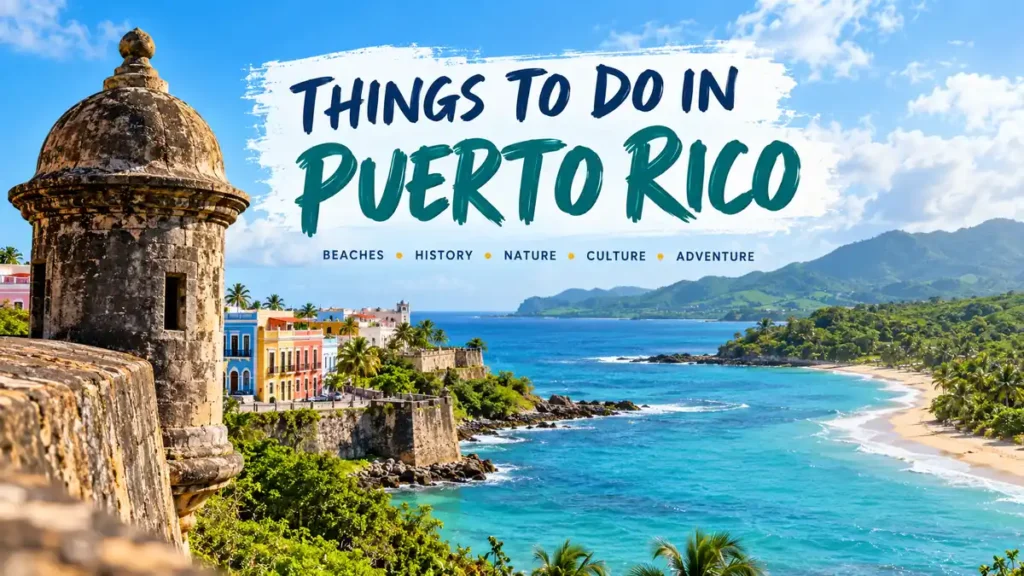
Puerto Rico can look deceptively simple on a map. Then you arrive and realize one trip can include a centuries-old Spanish fortress, a tropical rainforest, turquoise Caribbean beaches, mountain coffee farms, surf towns, caves, and water that literally glows after dark.
The challenge isn’t finding things to do in puerto rico. It’s deciding which experiences deserve your limited vacation time.
The best things to do in Puerto Rico include exploring Old San Juan and its historic forts, hiking in El Yunque National Forest, kayaking a bioluminescent bay, visiting Flamenco Beach, snorkeling around Culebra, exploring Vieques, surfing in Rincón, touring caves, tasting Puerto Rican food, and discovering the central mountains.
This guide goes beyond a simple attractions list. It explains what each experience is actually like, who will enjoy it, and how to combine Puerto Rico’s beaches, history, culture, food, and outdoor adventures into a trip that makes sense.
Best Things to Do in Puerto Rico at a Glance
If this is your first visit, these experiences give you the broadest introduction to the island.
| Experience | Best For | Area | Time Needed |
|---|---|---|---|
| Old San Juan | History, architecture | San Juan | Half/full day |
| El Morro | History, ocean views | Old San Juan | 1–2 hours |
| El Yunque | Hiking, rainforest | Northeast | Half/full day |
| Flamenco Beach | Swimming, scenery | Culebra | Full day |
| Mosquito Bay | Bioluminescence | Vieques | Evening |
| Laguna Grande | Bio bay near San Juan | Fajardo | Evening |
| Rincón | Surfing, sunsets | West coast | 1–2 days |
| Cueva Ventana | Caves, geology | Arecibo | 2–3 hours |
| Ponce | Culture, architecture | South | Full day |
| Central Mountains | Coffee, countryside | Interior | Full day |
| Cabo Rojo | Coastal scenery | Southwest | Full day |
| Luquillo | Beach and local food | Northeast | Half day |
A common mistake is trying to squeeze several distant regions into one day. Puerto Rico is compact compared with many destinations, but mountain roads, traffic, ferry schedules, and stops along the way can make journeys longer than the map suggests.
For exploring beyond metropolitan San Juan, a rental car is usually the most flexible option. Rideshare services are more useful around the metro area.
1. Walk Through Old San Juan


6
Start with Old San Juan if you want to understand Puerto Rico rather than simply see its beaches.
The historic district is compact enough to explore on foot, but rushing through it misses much of the appeal. Its colorful colonial buildings, plazas, stone fortifications, balconies, churches, cafés, and views across San Juan Bay reward wandering.
San Juan has more than 500 years of European history, and construction of its defensive fortifications began during the Spanish colonial period.
Some worthwhile stops include:
- Paseo de la Princesa
- Puerta de San Juan
- Calle Fortaleza
- Plaza de Armas
- Plaza Colón
- Catedral de San Juan Bautista
- Calle San Sebastián
Early morning is excellent for photography and cooler walking temperatures. Late afternoon works well if you want to continue into dinner and evening activities.
Explore Castillo San Felipe del Morro
Castillo San Felipe del Morro, usually called El Morro, dominates the entrance to San Juan Bay.
Construction began in the 16th century, and the fortress evolved for centuries as Spain strengthened San Juan’s defenses. Its massive walls, ramps, sentry boxes, tunnels, lawns, and Atlantic views make it one of Puerto Rico’s essential historic attractions.
Give yourself enough time to walk through the fort rather than treating it as a quick photo stop.
Visit Castillo San Cristóbal
Castillo San Cristóbal protected San Juan primarily against attacks approaching over land, while El Morro guarded the harbor entrance.
Together with other fortifications and La Fortaleza, these defenses form part of a UNESCO World Heritage Site.
Quick takeaway: If you have only one day in San Juan, combine Old San Juan, El Morro, San Cristóbal, and dinner in the historic district.
2. Hike Through El Yunque National Forest
For nature lovers, El Yunque National Forest should be near the top of the itinerary.
At nearly 29,000 acres, El Yunque is the only tropical rainforest in the U.S. National Forest System. The forest stretches across eight municipalities in northeastern Puerto Rico and contains extraordinarily diverse tropical ecosystems.
Expect dense vegetation, mountain rivers, waterfalls, observation points, tropical birds, changing weather, and hiking routes ranging from relatively easy walks to more strenuous trails.
Popular experiences include:
- hiking through rainforest vegetation;
- looking for waterfalls and natural pools where access is permitted;
- stopping at scenic viewpoints;
- learning about the ecosystem at El Portal de El Yunque;
- listening for Puerto Rico’s distinctive coquí frogs;
- photographing tropical plants and mountain landscapes.
Bring shoes with traction. Rain can appear quickly, and wet forest surfaces become slippery.
Visitor access can also change because of weather, construction, parking limits, or recovery work, so checking current Forest Service conditions before driving there is worthwhile.
Combine El Yunque With Luquillo
One practical itinerary is El Yunque in the morning followed by Luquillo in the afternoon.
That gives you two very different sides of northeastern Puerto Rico without spending much of the day driving across the island.
3. See a Bioluminescent Bay at Night


6
Few Puerto Rico activities are as unusual as paddling through water that flashes blue-green when disturbed.
The glow comes from microscopic organisms called dinoflagellates. Puerto Rico has three major bioluminescent locations: Mosquito Bay in Vieques, Laguna Grande in Fajardo, and La Parguera in Lajas.
Which Puerto Rico bio bay should you visit?
| Bio Bay | Location | Best Reason to Choose It |
|---|---|---|
| Mosquito Bay | Vieques | Famous for exceptional brightness |
| Laguna Grande | Fajardo | Most convenient from San Juan |
| La Parguera | Lajas | Best fit for a southwest itinerary |
Mosquito Bay is regarded as one of the world’s brightest bioluminescent bays, making Vieques particularly attractive for travelers who can stay overnight.
Laguna Grande is technically a lagoon rather than a bay and is the closest of the three to San Juan.
Try to schedule the experience around darker moon conditions when possible. Light levels, weather, water conditions, and natural biological variation can affect how dramatic the glow appears.
4. Spend a Day on Flamenco Beach in Culebra
Flamenco Beach regularly appears among Puerto Rico’s most popular beaches, and the attraction is easy to understand.
The broad horseshoe-shaped bay combines pale sand with clear, generally inviting water. It is particularly appealing when you want a classic Caribbean beach day rather than an activity-heavy itinerary.
Culebra itself is worth more than simply arriving, photographing Flamenco, and leaving.
Depending on conditions and your schedule, you can combine beach time with snorkeling, boating, or exploring other parts of the island.
If visiting as a day trip, pay close attention to transportation timing. Missing a ferry or other return connection can turn an easy beach day into a logistical problem.
5. Stay Overnight on Vieques
Vieques deserves its own place on a list of the best places to visit in Puerto Rico.
The island sits roughly seven miles east of Puerto Rico’s main island and offers beaches, wildlife habitat, quieter roads, and the famous Mosquito Bay. Its national wildlife refuge encompasses approximately 17,771 acres.
Vieques National Wildlife Refuge protects dry forest, wetlands, wildlife habitat, historical sites, and archaeological resources.
Not all refuge land is accessible. The U.S. Fish and Wildlife Service notes that a major portion of the eastern refuge remains closed because of unexploded ordnance and ongoing cleanup. Visitors should obey closure signs rather than attempting to reach restricted areas.
Why spend the night?
The answer is Mosquito Bay.
Trying to make Vieques a rushed day trip while also seeing the bio bay complicates transportation. Staying overnight lets you enjoy beaches during daylight, eat locally, experience the bay after dark, and leave the following day at a reasonable pace.
6. Go Snorkeling or Diving
Puerto Rico’s coastline creates plenty of opportunities to get underwater.
Culebra and Vieques are obvious choices, but snorkeling and diving opportunities exist around several parts of the main island as well. Discover Puerto Rico highlights reefs, diving, kayaking, paddleboarding, sailing, and other marine activities as major outdoor experiences.
Good conditions matter more than choosing a beach because it appeared on a “best snorkeling” list.
Wind, waves, currents, rainfall, and visibility can change dramatically. A calm-looking photograph from someone else’s trip says nothing about today’s water.
For beginners, a guided excursion can make sense because local operators know which sites fit current conditions.
7. Surf the Waves in Rincón
If your mental image of Puerto Rico involves surfboards strapped to cars and sunsets over the Atlantic, head west.
Rincón is one of the island’s best-known surf destinations. Popular breaks include Domes, María’s, Tres Palmas, and Sandy Beach.
Peak surf season generally runs from late fall through early spring, when stronger swells reach the north and west coasts. Summer often brings smaller conditions that can be more suitable for learners, though daily conditions always matter.
Don’t surf? Rincón is still worth visiting
Absolutely.
You can:
- watch experienced surfers;
- snorkel or paddleboard when conditions cooperate;
- explore the coastline;
- visit Punta Higüera Lighthouse;
- enjoy waterfront restaurants;
- stay for sunset.
Winter also brings opportunities for spotting migrating whales offshore.
8. Discover Puerto Rico’s Caves and Karst Landscape
Beaches dominate Puerto Rico photography, but the island’s limestone karst region reveals a completely different landscape.
Visit Cueva Ventana
Cueva Ventana is among the best-known caves near Arecibo.
The guided hiking experience passes through limestone formations before reaching a large window-like opening overlooking the Río Grande de Arecibo valley. The area also preserves pre-Columbian Taíno petroglyphs.
This makes the visit more interesting than a simple cave walk: geology, ecology, Indigenous history, and scenery come together in one relatively compact experience.
What about Río Camuy Cave Park?
Río Camuy Cave Park is famous for its extensive cave and underground river system.
However, current official tourism information states that Río Camuy Cave Park is closed until further notice. Do not build an itinerary around it without checking for a reopening first.
That is exactly the kind of Puerto Rico travel detail worth verifying close to departure, because older travel guides may still present the park as normally accessible.
9. Explore Ponce and Southern Puerto Rico


6
San Juan gets much of the attention, but Ponce offers a distinct view of the island’s history and culture.
Known as La Perla del Sur, or Pearl of the South, Ponce is recognized for its architecture, museums, plazas, and cultural traditions.
Start around Plaza Las Delicias.
From there, look for the red-and-black façade of Parque de Bombas, once the city’s main fire station.
Other notable stops include Castillo Serrallés and Hacienda Buena Vista.
The Museo de Arte de Ponce is another major cultural institution, although its main building has been undergoing reconstruction and access is currently limited.
Ponce works particularly well for travelers who want something beyond the standard San Juan–El Yunque–beach route.
10. Explore Cabo Rojo’s Wild Southwest Coast
Puerto Rico’s southwest feels dramatically different from its humid northeast.
Around Cabo Rojo, expect dry coastal landscapes, cliffs, salt flats, beaches, and broad Caribbean views.
La Playuela, often called Playa Sucia, is one of the region’s signature beaches and is known for turquoise water and dramatic coastal scenery.
The southwest is especially rewarding for road trips because the journey can be built around several smaller stops rather than one major attraction.
Bring sun protection and water. Shade can be limited in exposed coastal areas, and the heat can feel much stronger than it does in the mountain interior.
11. Taste Traditional Puerto Rican Food
Some of the most memorable things to do in puerto rico happen at a table.
Puerto Rican cuisine reflects Indigenous Taíno, Spanish, African, Caribbean, and later outside influences. The result is food that changes noticeably depending on where you travel.
Look for dishes and snacks such as:
- mofongo;
- lechón asado;
- arroz con gandules;
- pasteles;
- alcapurrias;
- bacalaítos;
- empanadillas;
- fresh seafood;
- tembleque;
- flan.
Don’t limit yourself to polished restaurants in San Juan.
Coastal kiosks, neighborhood bakeries, mountain restaurants, roadside stands, and town plazas can provide a much broader picture of Puerto Rican food culture. Official tourism guidance specifically highlights slow-roasted pork in the mountains, seafood along the coast, traditional fritters, and street food alongside San Juan’s contemporary dining scene.
12. Visit the Luquillo Kiosks and Beach
Luquillo makes an easy companion to El Yunque.
Spend the morning hiking, change into dry clothes, then head toward the coast for food and beach time.
The attraction here isn’t simply one restaurant or one dish. It’s the combination of casual kiosks, Puerto Rican snacks and meals, tropical drinks, local atmosphere, and nearby coastline.
If you’re searching for fun things to do in Puerto Rico without adding another strenuous activity, this is exactly the kind of low-effort afternoon that balances a busy itinerary.
13. Take a Puerto Rican Coffee Tour
Coffee leads you away from the coast and into Puerto Rico’s mountainous interior.
The Cordillera Central runs across the island’s interior through 14 municipalities. Agriculture has deeply shaped this region, which produces most of Puerto Rico’s coffee.
Several haciendas introduce visitors to coffee cultivation, processing, roasting, and the agricultural history behind the drink.
One example is Hacienda Lealtad in Lares, an estate connected to Puerto Rico’s historic coffee industry. Advance reservations are recommended for its tours.
Why the Central Mountains are worth the drive
The value isn’t just coffee.
Driving inland shows you a side of Puerto Rico that beach-centered itineraries often miss: steep green mountains, agricultural towns, roadside restaurants, cooler elevations, and panoramic views.
Give the drive time. Mountain roads aren’t the place to build an overly tight schedule.
14. Learn About Taíno Heritage
Puerto Rico’s story begins long before Spanish colonization.
The Taíno people left a cultural and archaeological legacy that remains part of Puerto Rican identity. Archaeological sites, petroglyphs, museum collections, caves, foods, vocabulary, and place names provide ways to explore that history.
Cueva Ventana contains preserved Taíno petroglyphs, for example, while the Vieques National Wildlife Refuge contains archaeological resources connected with Indigenous Taíno culture.
Approach these sites as cultural heritage rather than photo props. Guided interpretation can make symbols, landscapes, and archaeological evidence much more meaningful.
15. Experience Puerto Rican Music and Salsa
Puerto Rico’s cultural experience doesn’t end when museums close.
Music is woven into daily life, celebrations, nightlife, and festivals. Salsa is especially associated with Puerto Rican culture, alongside bomba, plena, reggaetón, and other musical traditions.
If you’re staying in San Juan, an evening around Old San Juan can move naturally from dinner into live music or dancing.
Calle San Sebastián is particularly associated with nightlife and social activity, while different neighborhoods around the metro area offer their own atmosphere.
You don’t need to know how to dance. A beginner salsa lesson can be a much more memorable vacation activity than simply watching from the edge of the floor.
16. Tour Puerto Rico’s Rum Heritage
Rum has a long relationship with Puerto Rico’s agricultural and industrial history.
Tours and tastings can explain distillation, aging, blending, and the development of Puerto Rican rum brands. Casa Bacardí across the bay from San Juan is among the island’s best-known visitor experiences and offers tours centered on the brand’s history, tasting, and mixology.
Ponce offers another connection through Castillo Serrallés, the former home of the Serrallés family associated with Don Q rum.
Even travelers who aren’t particularly interested in drinking may find the agricultural and industrial history worthwhile.
17. Search for Puerto Rico’s Best Beaches
There is no single “best beach in Puerto Rico” because the right answer depends on what you want to do.
For postcard scenery, Flamenco Beach is difficult to beat.
For surfing, look west toward Rincón and the northwest coast.
For combining rainforest and beach in one day, Luquillo is convenient.
For an offshore escape, investigate Culebra and Vieques.
For lively local atmosphere, Crash Boat Beach in Aguadilla is another well-known option.
Check the ocean, not just the weather
A sunny forecast doesn’t guarantee safe swimming.
Atlantic swells, rip currents, wind, and local conditions can make a beautiful beach hazardous. Always check current ocean conditions and pay attention to posted warnings before entering the water.
That matters especially on northern and western beaches during periods of stronger surf.
18. Watch the Sunset on the West Coast
This sounds simple, but it deserves a place in a Puerto Rico itinerary.
Rincón sits on the westernmost side of the island and is particularly celebrated for its sunsets.
Instead of scheduling every hour, leave one evening open.
Find a beach or coastal viewpoint before sunset, grab something to eat afterward, and let the day end without another attraction to reach.
That slower pace often produces better travel memories than adding one more stop.
19. Go Kayaking or Paddleboarding
You don’t have to wait until nighttime to kayak in Puerto Rico.
Calmer coastal areas, lagoons, mangrove environments, and sheltered waters can work for kayaking and stand-up paddleboarding.
Rincón offers paddleboarding alongside surfing and snorkeling, while kayaking is also integral to many bioluminescent bay experiences.
Beginners should choose protected water and reputable local instruction rather than assuming Caribbean water is always calm.
Conditions can change rapidly.
20. Try a Zipline or Mountain Adventure
The mountainous interior isn’t just for coffee.
Puerto Rico also offers ziplining, horseback riding, hiking, climbing, and other outdoor activities. Official tourism resources highlight adventure parks and guided outdoor experiences throughout the island.
These activities can be useful if your group has mixed interests.
One person may want beaches every day; another may be ready for something faster. Spending a day inland breaks up a beach-heavy itinerary without sacrificing scenery.
21. Explore Puerto Rico Beyond San Juan
One of the biggest travel mistakes is treating San Juan as if it represents the entire island.
It doesn’t.
Puerto Rico’s regions feel noticeably different:
| Region | What It Does Best |
|---|---|
| San Juan | History, dining, nightlife |
| Northeast | El Yunque, Luquillo, Fajardo |
| East islands | Vieques, Culebra, beaches, bio bays |
| North | Karst landscapes and caves |
| West | Surfing, sunsets, beaches |
| Southwest | Cabo Rojo, dry coast, La Parguera |
| South | Ponce, architecture, culture |
| Central Mountains | Coffee, agriculture, mountain scenery |
Official tourism guidance makes a similar distinction: San Juan for history and dining, the east for rainforest and boating, the west for surfing, the central mountains for food and adventure, and Vieques or Culebra for island escapes.
If you have five days or more, spending at least part of the trip outside San Juan makes a substantial difference.
22. Visit Local Festivals and Cultural Celebrations
Puerto Rico’s calendar includes patron-saint festivals, music events, food celebrations, carnivals, and holiday traditions.
Ponce’s Carnaval Ponceño is one example. Held around the period before Ash Wednesday, it brings music, parades, dancing, masks, and the colorful folkloric characters known as vejigantes into the streets.
Festival dates vary from year to year.
If your trip overlaps with a major celebration, check schedules before finalizing your itinerary. Festivals can be wonderful experiences, but they can also change traffic, accommodation availability, opening hours, and parking.
23. Look for Wildlife Responsibly
Puerto Rico’s forests, wetlands, reefs, beaches, and offshore islands support varied wildlife.
Birdwatching is particularly rewarding, while marine excursions may reveal turtles and other sea life depending on location and season.
Vieques National Wildlife Refuge supports native, migratory, rare, threatened, and endangered species; the refuge and surrounding waters are home to federally listed plants and animals.
Wildlife viewing works best when you don’t interfere with the wildlife.
Keep appropriate distance, follow refuge regulations, avoid touching marine animals, and never cross barriers to get a better photograph.
24. Build a Road Trip Through the Island
If you have enough time, a road trip is one of the most rewarding ways to experience Puerto Rico.
A strong route might look like:
San Juan → El Yunque → Luquillo → Fajardo → Rincón → Cabo Rojo → Ponce → Central Mountains → San Juan
You don’t need to follow that exact sequence. The principle matters more: group nearby attractions rather than repeatedly returning to San Juan after every excursion.
Travelers with three days should stay more focused. With five to seven days, adding the west, south, or offshore islands becomes much more realistic.
How many days do you need in Puerto Rico?
Three days can cover major highlights around San Juan and northeastern Puerto Rico.
Five days gives you enough room to add an offshore island or western/southern destination.
Seven days allows a much better mix of Old San Juan, El Yunque, beaches, bioluminescence, food, mountains, and another region without making every day feel like a race.
25. Leave Time for Unplanned Puerto Rico
One of the best things to do in Puerto Rico isn’t really an attraction.
Leave some space.
Stop at a roadside food stand because it smells good. Walk around a town plaza. Drink coffee without checking the time. Pull over at a legitimate viewpoint. Spend another hour at the beach because the water is perfect.
The island rewards curiosity.
A schedule containing 15 “must-see” attractions in three days may look impressive on paper but usually means experiencing most of them through a windshield.
What Are the Best Things to Do in Puerto Rico for First-Time Visitors?
For a first trip, prioritize variety rather than simply collecting famous attractions.
A balanced itinerary should include:
- Old San Juan and its forts for history.
- El Yunque National Forest for rainforest scenery.
- A Puerto Rican beach for swimming and relaxation.
- A bioluminescent bay for a distinctive nighttime experience.
- Local Puerto Rican food rather than eating only in tourist areas.
- One destination outside metropolitan San Juan, such as Vieques, Culebra, Rincón, Ponce, or the Central Mountains.
That combination reveals far more about Puerto Rico than spending the entire vacation at a resort.
Are There Free Things to Do in Puerto Rico?
Yes. Many memorable Puerto Rico experiences require little or no admission cost, although transportation and parking can still add expenses.
Walking around Old San Juan, watching the sunset in Rincón, visiting public beaches, exploring town plazas, photographing coastal scenery, and enjoying accessible viewpoints can all keep costs down.
Mixing paid attractions with free activities is one of the easiest ways to control a Puerto Rico vacation budget without making the trip feel limited.
What Are the Best Things to Do in Puerto Rico With Kids?
Puerto Rico can work very well for families because activities aren’t limited to museums or nightlife.
Depending on children’s ages and swimming abilities, consider beaches with suitable current conditions, Old San Juan, El Morro, El Yunque, easy nature walks, guided cave experiences, snorkeling, kayaking, and cultural attractions in Ponce.
The biggest consideration is heat.
Young children can tire quickly while walking through Old San Juan or exposed coastal areas. Start earlier, schedule shade and water breaks, and avoid packing too many attractions into the hottest part of the afternoon.
When Is the Best Time to Visit Puerto Rico?
Puerto Rico is a year-round destination, but your preferred activities should influence timing.
December through April is popular for relatively drier weather, while summer brings heat and humidity along with generally smaller surf on the north and west coasts. The Atlantic hurricane season runs during part of the warmer half of the year, so travelers visiting then should monitor forecasts and understand their booking policies.
Surfers often favor late fall through early spring because stronger swells reach the north and west coasts.
For bioluminescence, moon phase can matter almost as much as season. Darker nights generally provide better viewing conditions.
Do You Need a Car in Puerto Rico?
Not necessarily if you’re staying around San Juan.
Rideshare services can handle many journeys within the metropolitan area, and Old San Juan itself is best explored largely on foot.
A car becomes much more useful when you want to explore El Yunque, the west coast, central mountains, Ponce, Cabo Rojo, or smaller towns independently. Official tourism guidance likewise recommends considering a rental car for travel beyond the metro area.
Don’t underestimate driving times. Traffic around San Juan and slower mountain roads can turn apparently short distances into longer journeys.
Practical Tips Before Exploring Puerto Rico
A little preparation prevents many common problems.
Reserve high-demand experiences early. Bioluminescent bay tours, sailing trips, guided excursions, and some popular attractions can fill ahead of time.
Check attraction status shortly before visiting. Closures happen. Río Camuy Cave Park, for example, is currently listed as closed until further notice.
Treat the ocean seriously. Check surf and current conditions instead of judging safety by sunshine alone.
Expect tropical rain. A brief downpour doesn’t necessarily ruin the day, particularly around El Yunque.
Don’t overpack your itinerary. Puerto Rico is much more enjoyable when each region gets enough time.
Protect natural areas. Stay on authorized trails, respect wildlife refuge closures, and follow rules around beaches, reefs, caves, and forests.
Final Thoughts on things to do in puerto rico
The best things to do in puerto rico reveal how much variety fits into one Caribbean destination.
Walk Old San Juan’s historic streets and explore El Morro. Hike through El Yunque. Swim at Flamenco Beach. Paddle across glowing water after sunset. Spend time in Vieques or Culebra. Watch surfers in Rincón, explore Ponce, drive through Cabo Rojo, and follow the smell of coffee into the Central Mountains.
But don’t try to do all of it.
Choose a few regions, combine famous attractions with smaller local experiences, and leave enough unscheduled time to actually enjoy where you are. Puerto Rico’s beaches may get you there, but its history, food, landscapes, music, towns, and people are what turn a beach vacation into a much richer trip.