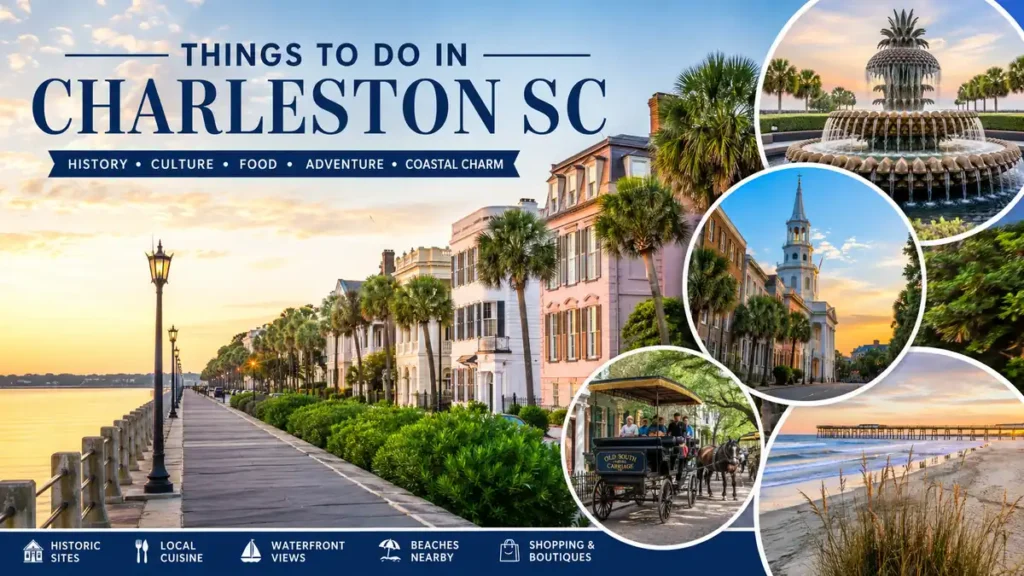
Charleston can look deceptively simple on a map. Then you arrive and realize the city combines more than three centuries of history, waterfront neighborhoods, museums, barrier-island beaches, marshland, historic homes, gardens, and one of the South’s most distinctive food cultures.
For first-time visitors searching for things to do in charleston sc, the smartest approach is to divide your time between the historic peninsula, Charleston Harbor, cultural attractions, and at least one coastal or Lowcountry experience. Charleston is especially rewarding on foot, but some of its best beaches, gardens, forts, and natural landscapes require a short drive or boat ride.
The best things to do in Charleston include walking the Historic District, seeing Rainbow Row and The Battery, visiting Fort Sumter, exploring Charleston City Market, learning African American history, touring historic homes, experiencing Lowcountry cuisine, and spending time at nearby beaches such as Sullivan’s Island or Folly Beach.
1. Explore Charleston’s Historic District on Foot
If you only have a few hours in Charleston, spend them walking the historic peninsula.
Charleston’s streets reward slow exploration. Church steeples rise above neighborhoods filled with Georgian, Federal, Greek Revival, Italianate, and Victorian architecture. Iron gates reveal private gardens, while narrow lanes lead toward the harbor.
The Historic District is also one of the easiest places to understand why Charleston feels different from many other Southern cities. Much of its appeal comes not from a single monument but from the concentration of historic buildings, streetscapes, churches, graveyards, gardens, and waterfront views within a compact area.
Lonely Planet recommends the Historic District as a starting point and highlights The Battery and White Point Garden among its most recognizable landmarks.
A useful walking route begins near Charleston City Market, continues through the French Quarter toward Waterfront Park and Rainbow Row, then heads south to The Battery and White Point Garden.
Give yourself at least two or three hours. Rushing from photo stop to photo stop misses the detail that makes this part of Charleston memorable.
Walk the French Quarter
The French Quarter sits within the historic peninsula and contains galleries, churches, historic buildings, cobblestone streets, and some of Charleston’s most atmospheric blocks.
Look beyond the major landmarks. Alleys, churchyards, old brick walls, wrought-iron gates, and architectural details are often as interesting as the attractions marked on a map.
2. See Rainbow Row, The Battery and Waterfront Park
These three landmarks form an easy introduction to Charleston’s waterfront.
Rainbow Row
Rainbow Row is the famous stretch of pastel-colored historic houses along East Bay Street. It is among Charleston’s most photographed sights, but it is worth viewing as more than a quick photo opportunity.
Walk slowly along East Bay Street and examine the architectural differences between the houses. Early morning is particularly pleasant because temperatures are usually cooler and pedestrian traffic tends to be lighter.
The Battery and White Point Garden
Continue south toward The Battery, the seawall promenade overlooking Charleston Harbor.
White Point Garden occupies the southern end of the peninsula beneath mature live oaks. From this area, you can appreciate Charleston’s relationship with the Ashley River, Cooper River, harbor, and Atlantic coast.
The combination of grand historic residences on one side and water on the other makes this one of Charleston’s best walks.
Waterfront Park and the Pineapple Fountain
Waterfront Park offers a different atmosphere. Its lawns, shaded areas, harbor views, fountains, and benches provide a convenient break during a day of sightseeing.
The Pineapple Fountain has become one of the city’s recognizable symbols, but the park itself is equally worthwhile for watching boats move through Charleston Harbor.
3. Visit Fort Sumter National Historical Park
Few attractions connect Charleston so directly with nationally significant history as Fort Sumter.
Confederate forces opened fire on the United States garrison at Fort Sumter on April 12, 1861, beginning the American Civil War. The fort occupies an island in Charleston Harbor and can only be reached by boat.
That boat journey is part of the experience. It provides wide views of the harbor and helps visitors understand Fort Sumter’s strategic position.
Once there, exhibits and surviving fortifications provide context for the events of 1861 and the larger political conflict surrounding secession and slavery.
Charleston’s history should not be reduced to architecture and romanticized antebellum imagery. Sites such as Fort Sumter are most valuable when their stories are considered within the wider histories of slavery, war, emancipation, citizenship, and American freedom.
Don’t overlook Fort Moultrie
Visitors interested in military history can go deeper at Fort Moultrie on Sullivan’s Island.
The site represents a far longer span of coastal defense history. The National Park Service traces Fort Moultrie’s story from the American Revolution through 1947, including the 1776 battle in which American defenders in a palmetto-log fort resisted a British naval attack.
4. Browse Charleston City Market
Charleston City Market is one of the easiest attractions to combine with a downtown walking day.
Its vendors sell artwork, crafts, food products, souvenirs, and other locally associated goods. More significant culturally is the presence of traditional sweetgrass basket makers.
Sweetgrass basketry reflects a craft tradition with deep connections to West African knowledge and the Gullah Geechee people of the South Carolina Lowcountry.
The market itself can become crowded, especially during busy visitor periods. Instead of treating it as a simple souvenir stop, spend time learning about the craftsmanship behind the baskets and other locally made work.
The Charleston Area Convention and Visitors Bureau lists the City Market among the city’s most popular visitor activities.
5. Learn Charleston’s African American History
Any serious exploration of Charleston needs to include African American history.
The city’s development, wealth, architecture, agriculture, cuisine, language, and cultural identity are inseparable from the experiences and contributions of enslaved and free Black people.
One of the most significant places to explore that history is the International African American Museum.
The museum stands at Gadsden’s Wharf, a site connected to the forced arrival of enslaved Africans. Exhibits explore African American history through Charleston, the Lowcountry, the broader United States, and the African diaspora.
The City of Charleston includes the International African American Museum among its major cultural attractions for visitors.
A good Charleston itinerary should pair sites such as the museum with historic homes, plantations, churches, cemeteries, and walking tours that address slavery directly rather than treating the city’s antebellum period solely as an architectural story.
6. Visit Historic Charleston Homes
Charleston contains an exceptional collection of preserved historic residences.
Visiting at least one house museum adds context that you cannot get by simply admiring buildings from the sidewalk.
Different properties emphasize different periods, architectural styles, owners, decorative arts, preservation efforts, and stories of the enslaved people whose labor supported wealthy households.
Rather than trying to visit every historic home, choose one or two and spend enough time to absorb the interpretation.
The contrast between elegant interiors and the social systems that financed and maintained them is central to understanding historic Charleston.
7. Explore the Old Exchange and Provost Dungeon
The Old Exchange and Provost Dungeon gives visitors another perspective on Charleston’s colonial and Revolutionary history.
The building has connections with commerce, politics, imprisonment, and major events in the city’s early development. Today, visitors can explore the structure and learn how Charleston’s role as a colonial port shaped both South Carolina and the emerging United States.
It pairs particularly well with a walking route through the French Quarter because several other major historic landmarks are nearby.
The City of Charleston identifies the Old Exchange and Provost Dungeon among its notable visitor attractions.
8. Experience the International African American Museum and Charleston Museum
Charleston’s museums help connect the landmarks you see outside with the people and events behind them.
The Charleston Museum traces regional history through collections covering natural history, material culture, textiles, decorative arts, and life in the Lowcountry.
The Charleston Area CVB describes it as America’s first museum, an institution founded in Charleston in 1773.
The International African American Museum offers a different but complementary perspective, particularly on African diaspora history, slavery, resistance, community, and the lasting cultural influence of African Americans.
Together, these museums give visitors a considerably deeper understanding of the city than architecture alone can provide.
9. See Lowcountry Art at the Gibbes Museum of Art
Charleston is not only a history destination.
The Gibbes Museum of Art focuses strongly on American art with connections to Charleston and the South. Its collection provides another way to understand the Lowcountry through portraiture, landscapes, changing artistic traditions, and cultural identity.
The museum is particularly useful on very hot, rainy, or humid days when several hours outdoors may be uncomfortable.
The City of Charleston describes the Gibbes as a center for Lowcountry art with roots dating to the nineteenth century.
10. Spend Time Around King Street
King Street shows Charleston’s more contemporary side.
Historic architecture remains part of the setting, but the street is now associated with shops, restaurants, cafés, nightlife, galleries, and local businesses.
Walking King Street also helps balance a trip dominated by museums and historical landmarks.
The Charleston Area CVB lists King Street shopping among the city’s popular visitor activities.
Expect the atmosphere to change as you move along the street. Some sections feel polished and retail-oriented, while others lean more heavily toward dining and nightlife.
11. Understand Lowcountry Cuisine
Food is not a side activity in Charleston. It is one of the clearest expressions of the region’s history.
Lowcountry cooking reflects African, European, Indigenous, Caribbean, and coastal influences. Rice cultivation, seafood, local vegetables, spices, and techniques carried through generations all shaped Charleston’s culinary identity.
Common dishes and ingredients you may encounter include shrimp and grits, oysters, crab, Carolina Gold rice, okra, benne seeds, red rice, local fish, and she-crab soup.
Instead of trying to check off every famous dish, learn why certain ingredients became important.
Rice is especially significant. The wealth generated by South Carolina’s historic rice economy depended heavily on the agricultural expertise and forced labor of enslaved Africans. That history adds essential context to the food traditions celebrated in Charleston today.
Charleston’s current visitor guides continue to treat its culinary scene as one of the defining parts of a trip to the city.
12. Take a Charleston Harbor Cruise
Seeing Charleston from the water changes your sense of the city.
A harbor cruise can provide views of the peninsula, Fort Sumter, waterfront homes, bridges, islands, and working harbor areas that are difficult to appreciate from land.
The Charleston Area CVB specifically identifies harbor cruises among the city’s popular guided experiences.
For travelers already planning to visit Fort Sumter, the ferry provides some of that perspective. A separate harbor cruise makes more sense if maritime history, photography, or relaxed sightseeing is a priority.
13. Choose a Walking Tour, Carriage Tour or Ghost Tour
Guided tours are popular in Charleston because so much of the city’s history is hidden behind ordinary-looking walls, houses, alleys, graveyards, and streets.
A historical walking tour generally gives the most detailed interpretation. A carriage tour covers ground with less physical effort, while ghost tours focus on graveyards, folklore, historic crimes, legends, and darker episodes from Charleston’s past.
The official Charleston tourism site highlights both walking tours and traditional horse- or mule-drawn carriage tours as prominent ways to explore the city’s historic streets.
If historical accuracy matters most, look for tours led by guides who distinguish documented events from folklore.
14. Visit the South Carolina Aquarium
Families searching for things to do in charleston sc with kids should consider the South Carolina Aquarium.
Its location on Charleston Harbor connects indoor exhibits with the region’s coastal environment. Exhibits introduce visitors to wildlife and ecosystems found across South Carolina, from mountains and rivers to salt marshes and the Atlantic Ocean.
It is a particularly useful option during summer heat or rainy weather.
The City of Charleston lists the South Carolina Aquarium among its major visitor attractions and describes it as a way to experience the harbor and regional marine life up close.
15. See Angel Oak on Johns Island
Angel Oak provides a dramatic change from downtown Charleston.
The enormous Southern live oak on Johns Island has sprawling limbs that extend outward and downward, forming an almost architectural canopy.
The tree is often described as several centuries old, though precise age estimates vary. Its appeal is less about a specific number and more about its extraordinary size and form.
Angel Oak is also useful geographically because it introduces visitors to the broader Lowcountry landscape beyond downtown.
The City of Charleston includes Angel Oak among the signature attractions it recommends to visitors.
16. Explore Charleston’s Gardens and Historic Plantations Thoughtfully
Several major historic estates lie outside central Charleston, particularly along the Ashley River corridor.
Magnolia Plantation and Gardens and Middleton Place are among the best known.
The gardens, wetlands, historic structures, and landscapes can be beautiful, but these properties were also sites of slavery. A responsible visit means paying attention to both the landscape and the lives of the enslaved people whose labor sustained the plantations.
Some older travel content treats plantations primarily as romantic gardens or grand houses. Modern visitors should expect more complete historical interpretation.
This is one area where choosing the right tour matters. Prioritize experiences that discuss enslaved communities, labor, agriculture, family life, resistance, and emancipation alongside architecture and horticulture.
17. Spend a Day at Folly Beach
You do not need to choose between a historic city break and a beach vacation in Charleston.
Folly Beach is one of the area’s most recognizable beach communities and has a more casual, energetic atmosphere than downtown Charleston. Visitors come for swimming, surfing, beach walks, fishing, and time near the Atlantic.
It works well for travelers who want restaurants and activity close to the beach rather than a completely secluded coastal experience.
Because traffic and parking can change dramatically by season and time of day, leaving downtown early is usually the easier approach during popular beach periods.
18. Visit Sullivan’s Island
Sullivan’s Island combines beach time with significant history.
It sits near the entrance to Charleston Harbor and is home to Fort Moultrie, making it possible to combine a coastal afternoon with a historical visit.
Recent regional coverage identifies Sullivan’s Island as one of the beaches closest to Charleston.
The atmosphere is generally quieter and more residential than Folly Beach, which can make Sullivan’s Island particularly appealing for walking and a slower beach day.
The island’s history also includes connections to the transatlantic slave trade and quarantine practices, adding another important layer to Charleston’s wider story.
19. Consider Isle of Palms for a Family Beach Day
Isle of Palms is another popular coastal option.
Compared with the more bohemian atmosphere of Folly Beach, Isle of Palms is often associated with a traditional family beach experience, including broad stretches of sand and recreational activities.
It sits northeast of Sullivan’s Island, so travelers with a car can explore both areas, although trying to fit two beaches into a short afternoon usually creates unnecessary driving.
Choose one and enjoy it properly.
Regional travel coverage continues to distinguish Isle of Palms for family-friendly beach amenities and water activities.
20. Explore Shem Creek and the Lowcountry Marshes
One of the most overlooked things to do in charleston sc is spending time in the tidal landscape surrounding the city.
The Lowcountry is defined by salt marshes, tidal creeks, estuaries, barrier islands, oyster beds, and waterways as much as it is by downtown architecture.
Shem Creek in nearby Mount Pleasant is an accessible introduction to that environment. Walking areas overlook the creek, while boating, paddling, and wildlife excursions provide opportunities to experience the water directly.
Kayaking through tidal creeks can reveal marsh birds, dolphins, oyster beds, and landscapes that feel far removed from downtown even though they are relatively close.
Local Charleston guides increasingly emphasize these marsh and barrier-island experiences because they show a side of the region that short weekend visits often miss.
What Are the Best Free Things to Do in Charleston?
Charleston can become expensive once museums, tours, parking, and meals accumulate, but many signature experiences cost nothing.
Walking Rainbow Row, The Battery, White Point Garden, Waterfront Park, the French Quarter, residential streets south of Broad, and sections of King Street can fill much of a day without an admission fee.
Beach access itself may also be free, although parking rules and charges vary by location.
Angel Oak is another appealing stop for travelers more interested in nature than ticketed attractions.
A carefully planned walking day can therefore cover several of Charleston’s most recognizable sights without paying for a conventional sightseeing tour.
What Are the Best Things to Do in Charleston With Kids?
Charleston works surprisingly well as a family destination when the itinerary alternates history with outdoor activities.
The South Carolina Aquarium is an obvious starting point. Waterfront Park offers open space and harbor views, while a Fort Sumter boat trip combines transportation with history in a format many children find more engaging than a traditional museum.
Beach days at Isle of Palms, Sullivan’s Island, or Folly Beach can provide a break after several hours of historic sightseeing.
Families with younger children can also consider the Children’s Museum of the Lowcountry, which the City of Charleston includes among its visitor attractions.
Avoid scheduling several historic houses consecutively. Charleston becomes much more enjoyable for children when indoor museums, walking, boats, parks, and beaches are mixed throughout the trip.
What Are the Best Things to Do in Charleston for Couples?
Charleston’s walkability and waterfront setting make it naturally suited to couples.
An early walk around South of Broad, sunset near The Battery, a harbor excursion, an afternoon at Sullivan’s Island, or an evening exploring King Street can create a full day without requiring an elaborate schedule.
Gardens and historic properties outside the peninsula can also work well for travelers who prefer quieter surroundings.
The biggest mistake is overplanning. Charleston’s atmosphere is part of the attraction, and leaving an hour for an unplanned walk through side streets and waterfront neighborhoods often produces the most memorable part of the day.
How Many Days Do You Need in Charleston?
Three days is a strong minimum for a first visit.
Lonely Planet similarly recommends spending at least three days to experience Charleston’s main attractions.
A practical breakdown looks like this:
| Time Available | Best Focus |
|---|---|
| 1 day | Historic District, Rainbow Row, Waterfront Park, The Battery |
| 2 days | Add Fort Sumter, museums, food and King Street |
| 3 days | Add Sullivan’s Island, Folly Beach or Shem Creek |
| 4 days | Add gardens, historic plantations or more museums |
| 5+ days | Explore beaches, Lowcountry waterways and nearby communities at a slower pace |
Three days works because Charleston is essentially several experiences combined: a historic walking city, a harbor destination, a center of Lowcountry culture, and a gateway to barrier-island beaches.
When Is the Best Time to Visit Charleston?
Spring and fall are generally the easiest seasons for extended walking because conditions tend to be more comfortable than during the hottest part of summer.
Spring also brings gardens and flowering landscapes to life, although it can be a popular time to visit.
Summer suits travelers who prioritize beaches and water activities but brings heat and humidity. Plan outdoor Historic District walks for mornings and save museums, shaded attractions, or indoor stops for the hottest part of the afternoon.
Winter is typically quieter and can be excellent for sightseeing, though beach swimming is less central to the experience.
Regardless of season, Charleston’s coastal location means conditions can change. Checking forecasts and any attraction-specific alerts before heading out is sensible.
Do You Need a Car in Charleston?
Not for the historic peninsula.
Much of downtown Charleston can be explored effectively on foot, and walking is often preferable because many attractions sit relatively close together. Charleston’s Historic District is regularly highlighted for its walkability.
A car becomes considerably more useful if your plans include Angel Oak, Ashley River historic properties, Folly Beach, Sullivan’s Island, Isle of Palms, or other places outside downtown.
A practical approach is to group attractions geographically rather than repeatedly driving between the peninsula and surrounding islands.
A Better Way to Plan Your Charleston Trip
Instead of building an itinerary around a long checklist, organize each day around one part of Charleston’s identity.
Spend one day understanding the historic peninsula. Walk the French Quarter, Waterfront Park, Rainbow Row, The Battery, and White Point Garden, adding a museum or historic house when you want a break from walking.
Use another day for Charleston Harbor and the city’s larger American story. Fort Sumter, the International African American Museum, and other historic sites provide essential context.
Then devote at least part of your remaining time to the Lowcountry itself. Visit Sullivan’s Island, Folly Beach, Shem Creek, Angel Oak, or the marshes and tidal waterways outside downtown.
That balance matters. Charleston is beautiful, but its significance goes much deeper than pastel houses and cobblestone streets. Its history includes colonial trade, revolution, slavery, the Civil War, emancipation, Gullah Geechee traditions, African American culture, maritime commerce, and generations of preservation and change. Current official tourism resources likewise frame Charleston around history, coastal culture, beaches, food, arts, recreation, and outdoor experiences rather than any single attraction.
For travelers deciding which things to do in charleston sc deserve priority, start with the Historic District, Waterfront Park, Rainbow Row, The Battery, Fort Sumter, and one museum that deepens your understanding of the city. Then leave downtown for a beach, tidal creek, garden, or barrier island. That combination gives you something far more valuable than a collection of photographs: a genuine sense of Charleston and the Lowcountry surrounding it.