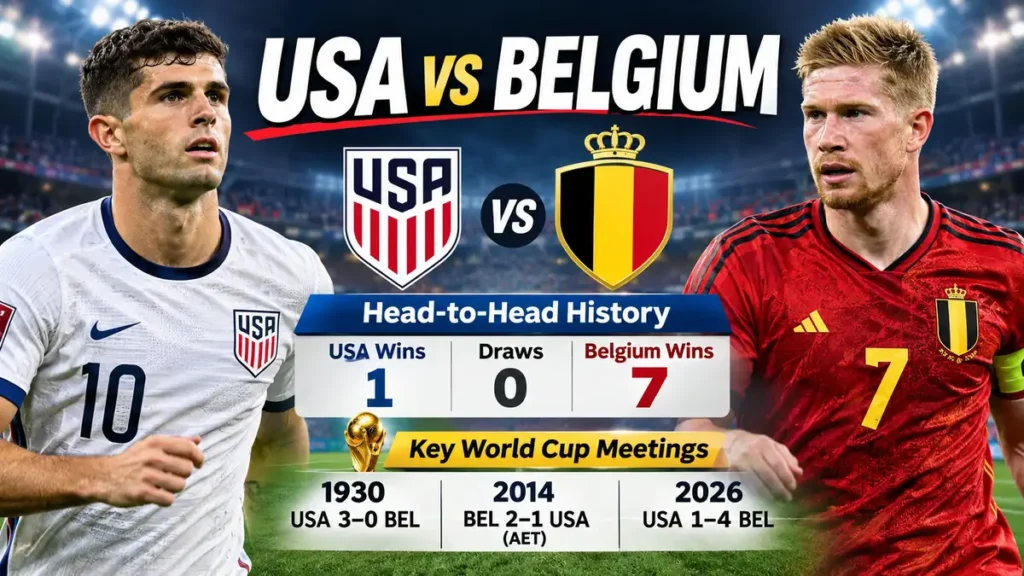
The football history between the United States and Belgium features one of the most memorable matches in modern FIFA World Cup history. Although the two national teams have met relatively few times, their encounters include dramatic goals, outstanding goalkeeping performances, and important moments in international football.
The usa vs belgium rivalry is best remembered for Belgium’s 2–1 extra-time victory over the United States in the 2014 FIFA World Cup Round of 16. However, their history stretches back to the inaugural World Cup in 1930, when the Americans defeated Belgium 3–0.
usa vs belgium Head-to-Head Record
The United States men’s national soccer team (USMNT) and Belgium’s national football team have faced each other in both competitive and friendly matches.
Their meetings demonstrate how international football has changed across generations. The United States was successful in the teams’ first World Cup encounter, while Belgium dominated several more recent meetings.
Historical match results
| Date | Competition | Result |
|---|---|---|
| July 13, 1930 | FIFA World Cup | USA 3–0 Belgium |
| April 22, 1998 | International friendly | Belgium 2–0 USA |
| September 6, 2011 | International friendly | Belgium 1–0 USA |
| May 29, 2013 | International friendly | USA 2–4 Belgium |
| July 1, 2014 | FIFA World Cup | Belgium 2–1 USA (after extra time) |
These are the five widely documented meetings through the 2014 World Cup. The table is a historical summary rather than a verified up-to-date record of every subsequent fixture.
What does the head-to-head history reveal?
Belgium won four of those five matches, while the United States won the other. Across those encounters, Belgium scored nine goals and the United States scored six.
The results show Belgium’s advantage during the modern era, but the margins and match circumstances reveal a more nuanced picture.
The 2014 World Cup meeting, for example, remained goalless throughout regulation time despite Belgium creating numerous scoring opportunities.
usa vs belgium at the 2014 FIFA World Cup
Human wall Tim Howard sets World Cup save record in U.S. loss to Belgium – Yahoo Sports
Lukaku lifts Belgium into last eight with extra-time victory over US – MaltaToday.com.mt
11
The most famous encounter between the two countries took place on July 1, 2014, at Arena Fonte Nova in Salvador, Brazil.
The United States entered the knockout stage after finishing second in Group G, behind Germany and ahead of Portugal and Ghana.
Belgium had topped Group H with victories against Algeria, Russia, and South Korea. Its squad included an emerging generation of players who would become prominent figures in European football.
First half: Belgium creates opportunities
Belgium started aggressively, using its technical midfielders and attacking players to put pressure on the American defense.
Kevin De Bruyne, Eden Hazard, and Divock Origi contributed to Belgium’s attacking movement, while the United States relied heavily on defensive organization and counterattacking opportunities.
American goalkeeper Tim Howard repeatedly prevented Belgium from taking the lead.
Despite Belgium’s territorial advantage and numerous attempts, the first half ended 0–0.
Second half: Tim Howard’s extraordinary performance
The second half continued in a similar pattern.
Belgium generated chances through wide attacks, combinations around the penalty area, and shots from distance.
Howard delivered one of the most celebrated goalkeeping performances in World Cup history.
He finished the match with 16 saves, a figure widely recognized as a World Cup record since detailed save statistics began being recorded in 1966.
The United States also had opportunities to win the match. Substitute Chris Wondolowski missed a late chance during stoppage time, although the assistant referee had raised the flag for offside.
The score remained 0–0 after 90 minutes, sending the match into extra time.
Extra time: Belgium finally breaks through
Belgium introduced Romelu Lukaku late in regulation time, and his physical presence and attacking movement proved decisive.
In the 93rd minute, Lukaku helped create an opportunity for Kevin De Bruyne, who scored to give Belgium a 1–0 lead.
De Bruyne then assisted Lukaku, who doubled Belgium’s advantage in the 105th minute.
The United States responded when 19-year-old Julian Green scored in the 107th minute after coming on as a substitute.
His volley, assisted by Michael Bradley, reduced the deficit to 2–1.
The Americans continued pushing for an equalizer, including a cleverly worked free-kick opportunity, but Belgium maintained its lead.
2014 World Cup final score
United States
1
Julian Green, 107′
Belgium
2
De Bruyne 93′, Lukaku 105′
Round of 16 · July 1, 2014 · After extra time
Belgium advanced to the quarterfinals, where it lost 1–0 to Argentina.
For the United States, the defeat ended a tournament remembered for its determined performances against difficult opposition.
Why Tim Howard’s 2014 Performance Became Historic
Tim Howard’s performance remains one of the defining individual displays in American men’s World Cup history.
Belgium’s attack repeatedly tested him with shots from inside and outside the penalty area. Howard responded with strong positioning, quick reactions, and several close-range saves.
His 16-save performance attracted international attention and became a major talking point among football supporters.
What made his performance exceptional?
The significance of Howard’s display extends beyond the number of saves.
Belgium created chances through different attacking approaches, requiring Howard to respond to low shots, powerful attempts, and close-range opportunities.
He also maintained his concentration for 120 minutes, even as Belgium continued applying pressure.
Although the United States lost, Howard’s performance demonstrated how an outstanding goalkeeper can keep a team competitive against technically superior opposition.
The role of the American defense
Howard was not the only American player contributing defensively.
Matt Besler, Omar Gonzalez, DaMarcus Beasley, and Fabian Johnson were involved in the team’s defensive efforts, although Johnson left the match injured and was replaced by DeAndre Yedlin.
Jermaine Jones also provided midfield protection and helped disrupt Belgian attacks.
The American defensive structure was frequently stretched, but individual interventions prevented Belgium from establishing an early lead.
The First World Cup Meeting in 1930
The rivalry began during the inaugural FIFA World Cup in Uruguay.
On July 13, 1930, the United States defeated Belgium 3–0 at the Estadio Parque Central in Montevideo.
Bart McGhee, Tom Florie, and Bert Patenaude scored for the Americans.
The result helped the United States begin an impressive tournament campaign.
How far did the United States progress?
The Americans followed their opening victory with another 3–0 win against Paraguay.
They advanced to the semifinals, where Argentina defeated them 6–1.
The United States is historically credited with a third-place finish at the 1930 tournament, which remains its best result at a men’s FIFA World Cup.
Belgium, meanwhile, lost both of its group matches and was eliminated.
The 1930 result provides an interesting contrast with the teams’ modern encounters, when Belgium generally enjoyed the stronger competitive record.
usa vs belgium in the 2026 FIFA World Cup
The rivalry gained another major chapter when the United States and Belgium met in the Round of 16 at the 2026 FIFA World Cup.
Belgium defeated the United States 4–1 in Seattle, eliminating the tournament co-hosts and advancing to the quarterfinals. The result reinforced Belgium’s dominance in the modern head-to-head series. FBref+1
The 2026 World Cup rematch
The knockout match took place at Lumen Field in Seattle on July 6, 2026, local time. Some international listings record July 7 because of time-zone differences.
Belgium’s four-goal performance contrasted sharply with the closely contested 2014 encounter. The Americans were unable to reproduce the defensive resistance that had kept Belgium scoreless for 90 minutes in Brazil.
The result was particularly disappointing for the USMNT because the 2026 tournament was hosted by the United States, Canada, and Mexico.
It also marked Belgium’s third World Cup victory over the Americans in neither chronological nor overall terms: the teams had met at the tournament in 1930, 2014, and 2026, with Belgium winning the latter two.
The March 2026 friendly: USA 2–5 Belgium
Before their World Cup rematch, the countries played an international friendly on March 28, 2026, at Mercedes-Benz Stadium in Atlanta.
Weston McKennie opened the scoring for the United States in the 39th minute, but Zeno Debast equalized shortly before halftime.
Belgium then took control of the second half.
Amadou Onana scored in the 53rd minute, Charles De Ketelaere converted a penalty in the 59th, and Dodi Lukebakio scored twice.
Patrick Agyemang added a late American goal, producing a final score of 5–2. KBVB+1
The match exposed difficulties in the American defensive transition, particularly when Belgium moved the ball quickly through midfield and attacked open spaces.
Complete Historical Head-to-Head Record Through 2026
The full documented senior men’s international record includes eight matches, rather than the five shown in the earlier historical overview.
| Date | Competition | Result |
|---|---|---|
| July 13, 1930 | World Cup | USA 3–0 Belgium |
| April 22, 1995 | Friendly | Belgium 1–0 USA |
| February 25, 1998 | Friendly | Belgium 2–0 USA |
| September 6, 2011 | Friendly | Belgium 1–0 USA |
| May 29, 2013 | Friendly | USA 2–4 Belgium |
| July 1, 2014 | World Cup | Belgium 2–1 USA (AET) |
| March 28, 2026 | Friendly | USA 2–5 Belgium |
| July 6, 2026 | World Cup | USA 1–4 Belgium |
Sources: historical international match records and U.S. Soccer’s official opponent profile. 11v11+1
1
USA wins
0
Draws
7
Belgium wins
Across these eight matches, Belgium scored 20 goals and the United States scored 11.
The United States’ only victory came in 1930. Belgium has won all seven subsequent encounters.
An additional historical detail is that Bert Patenaude is officially credited with all three American goals in the 1930 meeting, making his performance the first hat trick in FIFA World Cup history. U.S. Soccer
Comparing the United States and Belgium National Teams
The two countries have developed different football identities, influenced by their domestic leagues, player-development systems, and international experiences.
United States: Athleticism, transition play and a growing talent pool
The USMNT has traditionally been associated with physical conditioning, defensive discipline, and quick transitions.
American soccer has evolved considerably as more players have joined European clubs and experienced high-level continental competitions.
Players such as Christian Pulisic, Weston McKennie, Tyler Adams, Timothy Weah, and Antonee Robinson represent the increasingly international nature of the American player pool.
The United States also benefits from the development of Major League Soccer (MLS), youth academies, and expanded professional pathways.
However, competing against elite international opponents still requires greater consistency in possession, defensive organization, and decision-making under pressure.
Belgium: Technical quality and attacking creativity
Belgium’s international reputation grew substantially during the 2010s.
Its celebrated golden generation featured Eden Hazard, Kevin De Bruyne, Romelu Lukaku, Thibaut Courtois, Vincent Kompany, and several other established European stars.
The team combined creative midfield play with strong attacking options and technically accomplished defenders.
Belgium reached the semifinals of the 2018 World Cup and ultimately finished third, its best men’s World Cup result.
The country’s player-development system and the experience of Belgian players in major European leagues have been important factors in its international competitiveness.
Playing-style comparison
| Aspect | United States | Belgium |
|---|---|---|
| Traditional strengths | Athleticism, pressing, transitions | Technical quality, passing, creativity |
| Attacking approach | Direct runs and counterattacks | Combination play and individual skill |
| Player-development base | MLS academies, colleges, European clubs | Belgian academies and European clubs |
| Best men’s World Cup finish | Third place, 1930 | Third place, 2018 |
| Major historical challenge | Consistency against elite opposition | Translating talented squads into major trophies |
These descriptions reflect broad historical tendencies rather than fixed tactical systems. Both teams have changed approaches under different coaches.
Key Players Who Shaped the Rivalry
Several footballers have played important roles in the history of these encounters.
Human wall Tim Howard sets World Cup save record in U.S. loss to Belgium – Yahoo Sports
Tim Howard — United States
His 16 saves against Belgium in 2014 made him the defining American performer of that match. His reflexes and positioning kept the United States competitive until extra time.
Belgium v USA: Round of 16 – 2014 FIFA World Cup Brazil
Kevin De Bruyne — Belgium
De Bruyne scored Belgium’s opening goal in extra time in 2014 and assisted Romelu Lukaku’s decisive second goal. His creativity and passing have been central to Belgium’s attacking identity.
Belgium Portraits – FIFA World Cup Qatar 2022
Romelu Lukaku — Belgium
Lukaku’s introduction during the 2014 match changed Belgium’s attacking dynamics. He assisted the first goal and scored the second, helping secure qualification for the quarterfinals.
Christian Pulisic — United States
Pulisic represents the generation of American footballers who developed at major European clubs. His technical ability and attacking movement have helped shape the modern USMNT.
What the usa vs belgium Rivalry Reveals About International Football
The matches between the United States and Belgium offer several lessons about the demands of international competition.
Goalkeeping can change the course of a match
The 2014 encounter showed how a goalkeeper can prevent an otherwise dominant opponent from scoring for an extended period.
However, even an exceptional individual performance cannot always compensate for repeated defensive pressure.
Squad depth matters in knockout football
Belgium’s introduction of Lukaku in 2014 demonstrated the value of having high-quality attacking substitutes.
His fresh energy and physical presence helped Belgium create the breakthrough after 90 minutes.
International tournaments often depend on these tactical decisions, especially when matches extend into extra time.
Technical quality and defensive organization must work together
The United States has produced competitive performances against elite opponents through disciplined defensive structures and effective counterattacks.
Belgium’s victories, particularly in 2026, illustrated how dangerous technically skilled attackers can become when opponents leave space between defensive lines.
For both countries, success against strong international opposition requires balancing attacking ambition with defensive stability.
World Cup Achievements and Historical Context
The United States and Belgium have both experienced important periods of international success, although neither has won the men’s FIFA World Cup.
The Americans’ third-place finish in 1930 remains a landmark achievement. They later reached the quarterfinals in 2002, defeating Mexico in the Round of 16 before losing narrowly to Germany.
Belgium’s strongest World Cup campaign came in 2018, when it defeated Japan and Brazil in the knockout rounds before losing to eventual champion France in the semifinals.
Belgium then defeated England in the third-place match.
The 2018 tournament demonstrated the potential of Belgium’s golden generation and established the team among the leading international sides of that period.
For the United States, the 2026 World Cup provided another opportunity to compete on home soil, although its campaign ended against Belgium in the Round of 16.
Why the Rivalry Matters to Football Fans
The United States and Belgium are not traditional geographic or regional rivals. Their rivalry is primarily based on memorable international matches rather than frequent annual competition.
Nevertheless, their World Cup encounters have created a recognizable football history.
The 1930 meeting connects the rivalry to the origins of the World Cup. The 2014 match is remembered for Howard’s extraordinary goalkeeping and Belgium’s extra-time breakthrough. The 2026 matches added another chapter, with Belgium demonstrating its attacking strength.
For American supporters, these encounters provide a measure of the national team’s progress against established European opposition.
For Belgian supporters, the results reflect a sustained period of success against an increasingly competitive American side.
Final Thoughts on usa vs belgium
The usa vs belgium football rivalry spans nearly a century, from the inaugural 1930 FIFA World Cup to the teams’ latest World Cup encounter in 2026.
Belgium leads the documented head-to-head record with seven victories, compared with one for the United States and no draws.
The 2014 World Cup match remains particularly memorable because of Tim Howard’s 16 saves, Kevin De Bruyne’s breakthrough goal, and Romelu Lukaku’s decisive contribution.
The 2026 encounters further strengthened Belgium’s historical advantage, including a 5–2 friendly victory and a 4–1 World Cup knockout win.
Together, these matches illustrate the importance of technical quality, defensive organization, squad depth, and individual brilliance in international football.