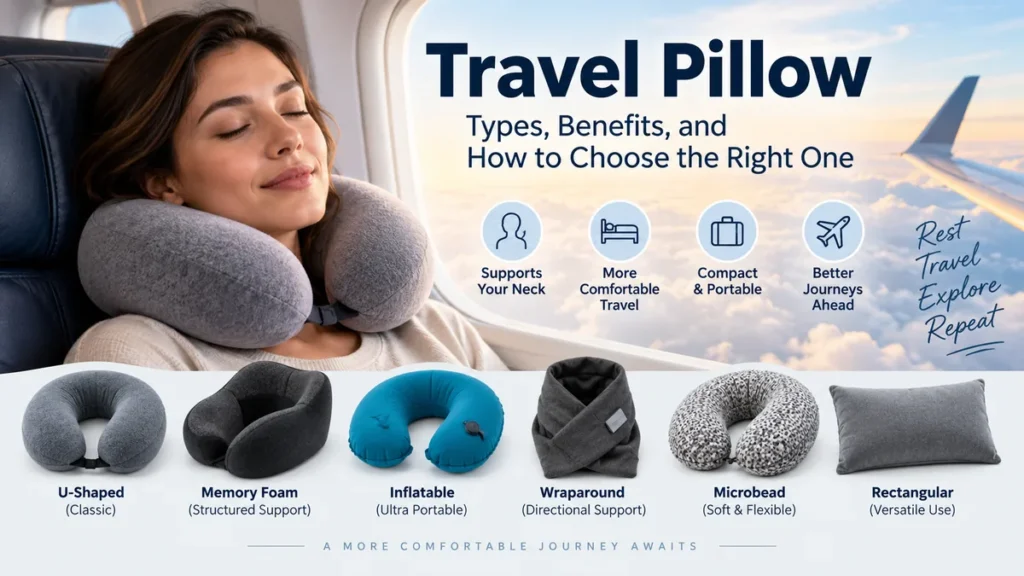
Trying to sleep in an airplane seat can turn a peaceful journey into hours of head bobbing, awkward neck angles, and repeated wake-ups. A travel pillow is designed to solve a simple problem: your head needs support when your body is resting in a mostly upright position.
A travel pillow is a compact cushion that supports the head, neck, or both while you rest on planes, trains, buses, and car journeys. The right design limits uncomfortable forward and sideways head movement, improves seated comfort, and helps maintain a more neutral neck position. Common options include U-shaped, memory foam, inflatable, wraparound, microbead, and rectangular pillows.
The familiar horseshoe-shaped cushion is only one version. Modern designs range from inflatable pillows that disappear into a small pouch to structured neck supports, chin-support models, scarf-style wraps, and compact pillows that resemble the one on your bed.
The key isn’t simply owning one. It is choosing a shape, height, firmness, and material that actually work with your body and the way you sleep.
What Is a Travel Pillow?
A travel pillow is a portable support designed primarily for resting while traveling. Unlike a standard bed pillow, many models are made for people sitting upright or partially reclined rather than lying flat.
When you become sleepy in an airplane or bus seat, your neck muscles relax. Without adequate support, your head may fall forward or lean heavily toward one shoulder. A suitable pillow fills some of the space around the neck and head, limiting that movement.
This is particularly useful during:
- Long-haul flights
- Red-eye flights
- Train journeys
- Overnight buses
- Road trips as a passenger
- Airport layovers
- Camping
- Hotel stays
Travel pillows can also have uses away from transportation. Some people use compact rectangular models for camping or hotels, while certain neck pillows can provide additional support when sitting at home.
A pillow shouldn’t force your neck into an unnatural position. Its job is support, not immobilization.
Travel pillow vs. ordinary pillow
The biggest differences are shape and portability.
| Feature | Travel Pillow | Standard Bed Pillow |
|---|---|---|
| Primary position | Upright or partly reclined | Lying down |
| Typical size | Compact | Larger |
| Neck support | Often targeted | Depends on sleeping position |
| Portability | High | Low |
| Common shapes | U, wraparound, J, rectangular | Rectangular |
| Common fills | Memory foam, air, microbeads, fiber | Foam, fiber, down, latex |
| Packing | Often compressible or inflatable | Usually bulky |
A small rectangular pillow can still be useful for travel, particularly when you can lean against a window or lie down. For upright economy seating, however, a design that limits head movement is usually more practical.
Why Use a Travel Pillow?
The main benefit is straightforward: support.
Sleeping upright is very different from sleeping in bed. Your mattress and pillow normally support much of your body. In an airplane seat, your head remains relatively free to move even when the seat is reclined.
A supportive travel pillow can reduce unwanted movement and make resting more comfortable. Sleep Foundation notes that upright sleep can allow the head to tilt or slump, potentially straining the neck; an appropriate travel pillow can provide extra support.
It can reduce head bobbing
That familiar cycle—fall asleep, head drops, wake up, reposition, repeat—is one of the main reasons people use neck pillows.
Support at the front and sides can limit the distance your head travels after your muscles relax.
It may help maintain a more comfortable neck position
Good posture matters during long periods of sitting. Mayo Clinic recommends keeping the head centered over the spine and taking regular movement breaks during long-distance travel.
A pillow can’t create perfect posture by itself, but the right one can make an unsupported position easier to avoid.
It provides somewhere to lean
Side sleepers often struggle in upright seats because their natural instinct is to lean.
A window seat provides a surface, but leaning directly against the aircraft wall isn’t always comfortable. A pillow can provide cushioning between the head and window or support the side of the neck.
It can make long journeys easier
Comfort becomes increasingly noticeable as travel time increases.
On a short flight, carrying an extra accessory may feel unnecessary. During an overnight flight, eight-hour bus trip, or long train ride, a compact source of head support becomes considerably more useful.
Quick Takeaway: A travel pillow is primarily a comfort and support accessory. It can limit awkward head movement, but it isn’t a treatment for chronic neck problems or a guarantee that you’ll sleep well.
Travel Pillow Types and How They Differ
There is no universally superior shape. Different designs solve different problems.
Current travel-pillow designs commonly include U-shaped, wraparound, inflatable, J-shaped or chin-support, and compact rectangular styles, with memory foam, air, microbeads, and fiber among the common filling choices.
U-shaped travel pillow
The classic U-shaped pillow wraps around the back and sides of the neck.
Its popularity comes from simplicity. Put it around your neck, adjust it, and you’re ready to rest.
Advantages:
- Widely available
- Simple to use
- Provides side cushioning
- Available in many materials
- Often relatively affordable
Limitations:
- Some models are bulky
- A thick rear section can push the head forward
- Open-front designs may provide limited chin support
- Poorly sized models can leave gaps around the neck
One mistake is assuming that every U-shaped pillow should automatically sit with the opening facing forward. Depending on the design and the direction your head falls, another orientation may feel better.
Memory foam travel pillow
Memory foam contours under pressure and generally provides more structured support than loose microbeads.
Dense foam can be particularly helpful for people who dislike extremely soft neck pillows.
The trade-off is portability and temperature. Memory foam usually occupies more luggage space than an inflatable pillow and some dense foams can feel warm during extended use. Travel + Leisure’s 2026 testing similarly noted differences between models in firmness, breathability, portability, and cooling.
Inflatable travel pillow
Instead of foam or fiber, an inflatable pillow uses air.
Its greatest advantage is packing size. Deflate it after your journey and it can fit into a small pouch.
Air pressure also gives you some control over firmness. If the pillow feels too rigid, releasing a small amount of air can make it more forgiving.
Best suited to: minimalist travelers, backpackers, and people with limited carry-on space.
The downsides are equally practical. Inflation requires an extra step, the sensation is different from foam, and an air-filled cushion may not contour as naturally around the body.
Microbead travel pillow
Microbead pillows contain thousands of tiny beads that shift as pressure is applied.
They tend to feel soft and flexible rather than firmly structured. That can be comfortable if you dislike rigid foam.
The compromise is support. Loose filling can move away from the area where you need it, and many microbead models don’t compress as efficiently as inflatable alternatives.
Wraparound or scarf-style pillow
Wraparound designs surround more of the neck instead of relying on the traditional horseshoe shape.
Some use cushioning, while others combine fabric with an internal structural support.
A well-known example of this approach is the Trtl Travel Pillow, which uses a wrap-style design rather than conventional bulky foam. Condé Nast Traveler has highlighted Trtl among neck-support options in its travel-pillow testing.
These designs can be useful when your head consistently falls to one side.
Chin-support and J-shaped pillows
Some travelers don’t lean sideways—they drop forward.
That matters because side support alone may not solve their problem.
Chin-support and J-shaped designs attempt to provide cushioning around the front or lower side of the face, helping reduce the distance the chin can fall toward the chest.
They can feel unusual initially, but the concept addresses a weakness of many basic open-front U-shaped pillows.
Infinity pillow
An infinity pillow resembles a large loop of padded fabric.
Rather than having one fixed position, it can be wrapped, twisted, doubled, or placed against different areas.
That versatility allows the same cushion to provide head, neck, side, or even lumbar support. The compromise is bulk: more material generally means more space in your luggage.
Rectangular travel pillow
A rectangular travel pillow is essentially a compact version of a home pillow.
It isn’t always ideal for unsupported upright sleeping, but it works well when you have something to lean against.
Consider one for:
- Window seats
- Road trips
- Camping
- Hotel rooms
- Train cabins
- Layovers where you can lie down
It can also be more familiar for people who simply don’t like having something wrapped around their neck.
Memory Foam vs. Inflatable vs. Microbead Travel Pillows
Material influences almost every part of the experience: firmness, temperature, weight, support, durability, and packing size.
| Material | Support | Packability | Firmness | Temperature | Best For |
|---|---|---|---|---|---|
| Memory foam | High | Medium | Medium–firm | Can feel warm | Structured support |
| Inflatable | Adjustable | Excellent | Adjustable | Varies | Minimal packing |
| Microbead | Light–medium | Low–medium | Soft | Usually moderate | Flexible cushioning |
| Fiber/polyester | Medium | Medium | Soft–medium | Varies | Pillow-like comfort |
| Hybrid | Medium–high | Varies | Varies | Design dependent | Balanced performance |
Don’t choose purely by material.
A beautifully made memory foam pillow can still be uncomfortable if its dimensions push your head forward. Likewise, a basic inflatable model can work extremely well when its shape happens to match your neck and seat.
Fit comes before filling.
How to Choose the Right Travel Pillow
Choosing a travel pillow becomes easier when you stop asking, “Which pillow is best?” and instead ask, “What happens to my head when I fall asleep?”
That’s the problem your pillow needs to solve.
1. Identify where your head falls
Think about previous journeys.
Does your head:
- Fall forward?
- Tilt left or right?
- Lean naturally toward the window?
- Stay relatively straight but leave your neck unsupported?
For forward movement, prioritize chin or front support.
For sideways movement, look for higher side walls or a wraparound design.
For a window sleeper, cushioning between your head and the wall may matter more than 360-degree support.
2. Check the height
More padding doesn’t automatically mean more support.
If a pillow is too tall, it can push your head away from neutral alignment. If it’s too low, your head may still tilt considerably before reaching the cushion.
Your neck length and shoulder shape affect the ideal height.
Try the pillow while sitting upright rather than judging it while standing in a shop.
3. Look at the back thickness
This feature is often overlooked.
Airplane seats already have headrests. Placing a thick mass of foam between the back of your neck and the seat can move your head forward.
A thinner rear section may therefore be more comfortable for certain travelers.
4. Decide how much firmness you need
Softness and support aren’t the same thing.
A very soft pillow may feel luxurious for the first few minutes but collapse once your head rests against it. Firmer foam usually resists movement better but may create pressure if the fit is wrong.
The ideal firmness should support your resting head without making you consciously hold your neck in position.
5. Consider breathability
Cabin temperature changes throughout a flight, and thick material wrapped around the neck can trap heat.
Hot sleepers should look for:
- Breathable covers
- Ventilation channels
- Moisture-managing fabrics
- Less neck coverage
- Removable lightweight covers
Cooling features matter more on a 12-hour flight than during a short commute.
6. Check portability
A comfortable pillow you refuse to pack isn’t useful.
Consider its:
- Packed dimensions
- Weight
- Compression ability
- Storage pouch
- Carrying strap
- Carabiner or luggage attachment
Inflatable pillows usually win on absolute packing efficiency. Compressible foam provides a middle ground between portability and a more conventional cushion feel.
7. Look for a washable cover
Travel accessories encounter airplane seats, airport floors, luggage compartments, buses, trains, and hotel rooms.
A removable machine-washable cover makes regular cleaning far easier.
Always follow the manufacturer’s care instructions because foam inserts and air chambers may require different cleaning methods.
8. Check adjustability
Features such as Velcro closures, drawstrings, buckles, straps, or adjustable air pressure can make a large difference.
They let you change how closely the pillow sits around your neck rather than accepting one fixed position.
Quick Takeaway: Prioritize support direction, fit, rear thickness, firmness, breathability, washability, and packing size—in roughly that order. A fashionable design means little if it doesn’t support the direction your head naturally moves.
How to Use a Travel Pillow Correctly
There isn’t one correct orientation for every pillow.
The manufacturer’s design should come first, but the fundamental objective remains the same: support your relaxed head without forcing it significantly forward or sideways.
Step 1: Sit in your normal travel position
Settle into the seat first.
Place your hips toward the back of the seat and use the headrest if it can be adjusted. Avoid testing the pillow while sitting unusually straight just because you’re conscious of your posture.
Step 2: Put the pillow around or beside the neck
Position it according to its intended design.
For a U-shaped model, test whether the conventional orientation actually supports you. Some travelers find that rotating a pillow provides better forward support. Cleveland Clinic has specifically noted that a neck pillow can be helpful during travel and describes an opening-at-the-back orientation as one possible way to gain more support when leaning forward.
Step 3: Let your head relax
This is the real test.
Close your eyes and stop deliberately holding your head straight.
Where does it move?
If your head travels a considerable distance before reaching the pillow, you may have too much empty space. If the pillow immediately pushes your head away from its natural position, it may be too thick.
Step 4: Adjust straps or inflation
A closure should generally keep the cushion in position without feeling restrictive.
With inflatable models, don’t assume maximum inflation is best. Slightly reducing air pressure can sometimes create a more comfortable contour.
Step 5: Recline when permitted
A small amount of recline can change the direction gravity pulls your head.
Once reclined, reassess your pillow. A configuration that worked while fully upright may need adjustment.
Step 6: Keep your seat belt properly positioned
A pillow shouldn’t interfere with the seat belt or other required safety equipment.
Follow crew instructions during a flight and keep your travel accessories clear of safety restraints.
Using a Travel Pillow on Long Flights
A travel pillow works best as one part of a broader comfort strategy.
Even an excellent neck support can’t compensate for spending an entire long-haul flight twisted in an awkward position.
Use the headrest
Many aircraft headrests have adjustable side wings.
If available, combine those wings with your pillow rather than expecting the pillow to do everything.
Support your lower back if needed
Neck position is connected to the rest of your seated posture.
If your pelvis slides forward and your upper body slumps, your head naturally moves forward as well. A small lumbar cushion or rolled garment can sometimes make the entire seated position more comfortable.
Cleveland Clinic recommends maintaining the spine’s natural curve while traveling and notes that a pillow or rolled towel behind the back can help travelers find a comfortable posture.
Get up periodically
A travel pillow shouldn’t become an excuse to remain motionless for an entire journey.
Mayo Clinic advises people traveling long distances to get up regularly and move and stretch their neck and shoulders.
Follow any relevant medical advice and airline safety instructions regarding movement during a flight.
Think about your seat
Different seats change how useful different pillow styles are.
Window seat: A side or rectangular pillow can take advantage of the wall.
Middle seat: 360-degree or wraparound support becomes more valuable because you have fewer places to lean.
Aisle seat: Self-contained head and neck support can help because leaning outward isn’t practical.
Your ideal pillow may therefore depend partly on where you usually sit.
Common Travel Pillow Mistakes
A surprising number of disappointing pillow experiences are actually fit or usage problems.
Buying the biggest pillow for “maximum support”
More material can mean more bulk without improving alignment.
The goal isn’t to surround your head with the greatest amount of foam. It is to place enough support in the locations where your head moves.
Ignoring forward head drop
Traditional side cushioning works only if sideways movement is your primary issue.
If your chin repeatedly drops toward your chest, consider a design with front support or experiment with an appropriate orientation of your existing pillow.
Overinflating an inflatable pillow
Harder isn’t always better.
Too much air can make the cushion rigid and increase pressure around the neck. Adjust it until it supports rather than pushes.
Choosing softness instead of stability
That plush airport pillow may feel wonderful when squeezed by hand.
What matters is how it behaves after your head has rested against it for 30 minutes.
Forgetting about the aircraft headrest
Your pillow and seat need to work together.
A thick rear cushion against an already prominent headrest can push your head forward and create exactly the posture you’re trying to avoid.
Never washing the cover
A frequently used travel pillow should be cleaned according to its care label.
Removable covers make this considerably easier.
Expecting a pillow to cure neck pain
A travel pillow is a comfort accessory—not medical treatment.
Neck pain can have many causes, and persistent or severe symptoms deserve appropriate medical assessment. Mayo Clinic notes that neck pain may result from posture and strain but can also have other causes.
Is a Travel Pillow Worth It?
For frequent travelers or anyone who regularly sleeps during long journeys, a well-fitting travel pillow can be genuinely useful.
The important phrase is well-fitting.
People sometimes conclude that travel pillows don’t work after trying one bulky horseshoe model. In reality, the category includes dramatically different approaches.
Recent travel publications test everything from traditional memory foam neck cushions to inflatable models, wraparound designs, compact rectangular pillows, and highly adjustable supports. Travel + Leisure’s 2026 evaluation, for example, tested 50 pillows across factors including comfort, portability, ease of use, quality, and value.
You are most likely to appreciate one if you:
- Frequently take flights lasting several hours
- Travel overnight
- Naturally fall asleep while seated
- Have difficulty finding a comfortable head position
- Regularly use buses or trains
- Want a portable cushion for hotels or camping
You may need one less if you rarely sleep in transit, mostly take short journeys, or find neck-enclosing accessories uncomfortable.
How to Pack and Care for a Travel Pillow
Portability is part of the product’s usefulness.
A pillow should not consume so much carry-on space that you routinely leave it behind.
Compress memory foam carefully
Many memory foam models can be compressed into a storage bag.
Avoid storing compressed foam permanently unless the manufacturer specifically says it is suitable. Letting the pillow return to its normal shape between journeys may help preserve its structure.
Deflate inflatable models completely
Release the air before folding.
Trying to force a partially inflated cushion into a small storage pouch can place unnecessary stress on seams and valves.
Attach bulky pillows securely
If your pillow doesn’t compress, a carrying loop or carabiner can keep it outside your backpack or carry-on.
Make sure it doesn’t drag against floors or obstruct you while walking through the airport.
Keep it clean between trips
Check the care label before washing.
A typical cleaning routine might involve:
- Removing the outer cover.
- Washing it according to the manufacturer’s instructions.
- Cleaning the insert only as directed.
- Allowing every component to dry fully.
- Storing the pillow in a clean, dry location.
Don’t automatically put memory foam in a washing machine or dryer. Care requirements vary significantly by construction.
Travel Pillow Features That Actually Matter
Marketing descriptions can make a simple cushion sound extremely complicated.
Focus on features that solve real travel problems.
| Feature | Why It Matters |
|---|---|
| Side support | Limits sideways head tilt |
| Chin support | Helps with forward head movement |
| Thin rear profile | Reduces the chance of pushing the head forward |
| Adjustable closure | Helps create a closer fit |
| Breathable fabric | Reduces heat around the neck |
| Removable cover | Simplifies cleaning |
| Compression bag | Saves luggage space |
| Adjustable inflation | Lets you change firmness |
| Low weight | Easier for frequent travelers |
| Secure attachment | Makes carrying easier |
Accessories such as an eye mask and earplugs can make resting easier, but they don’t compensate for poor pillow fit.
Start with neck and head support. Everything else is secondary.
Can a Travel Pillow Prevent Neck Pain?
It is better to think in terms of support and comfort rather than prevention or treatment.
Poor posture can contribute to neck discomfort. Mayo Clinic advises keeping the head centered over the spine, while Cleveland Clinic recommends supporting the head so that the head and neck remain aligned with the rest of the body during sleep.
A suitable travel pillow may help you maintain a more comfortable position when resting upright. But individual anatomy, existing neck conditions, seat geometry, sleeping position, and journey length all matter.
Stop using a pillow if it creates pain, numbness, tingling, breathing difficulty, unusual pressure, or clearly worsens your symptoms.
Persistent neck pain shouldn’t simply be blamed on a bad travel pillow.
How to Find the Best Travel Pillow for Your Needs
Ignore the idea that one model can be “best” for everyone.
Instead, match the design to your specific situation.
For long flights: Prioritize sustained head support, breathability, and a washable cover.
For light packing: Choose an inflatable or highly compressible model.
For forward head drop: Look for front or chin support rather than side cushioning alone.
For sideways sleepers: Higher side walls, wraparound supports, or J-shaped designs may work better.
For hot sleepers: Choose breathable fabrics, ventilation, and less bulky construction.
For window seats: Consider a pillow that works well between your head and the cabin wall.
For camping and hotels: A compressible rectangular pillow may be more versatile than a neck-only design.
For frequent travelers: Durability, washable components, packing size, and easy adjustment become particularly important.
The simplest test is also the most useful: sit in a chair, put the pillow into position, relax your neck completely, and see where your head goes.
If your head stays comfortably supported without being forced into an awkward angle, the design is doing its job.
Final Thoughts on Choosing a Travel Pillow
A travel pillow won’t turn an economy seat into a bed, but the right design can make upright rest considerably more comfortable.
Choose according to how your head actually moves when you fall asleep. Memory foam provides structured cushioning, inflatable designs prioritize portability, microbeads feel softer, wraparound pillows target directional support, and rectangular models work particularly well when you have a surface to lean against.
Above all, pay attention to fit. The pillow should support your relaxed head without pushing it forward, creating uncomfortable pressure, restricting movement, or interfering with safety equipment.
Combine that support with sensible seated posture, periodic movement on long journeys, and the aircraft’s headrest when available. That’s a much more reliable approach than simply buying the thickest pillow you can find.