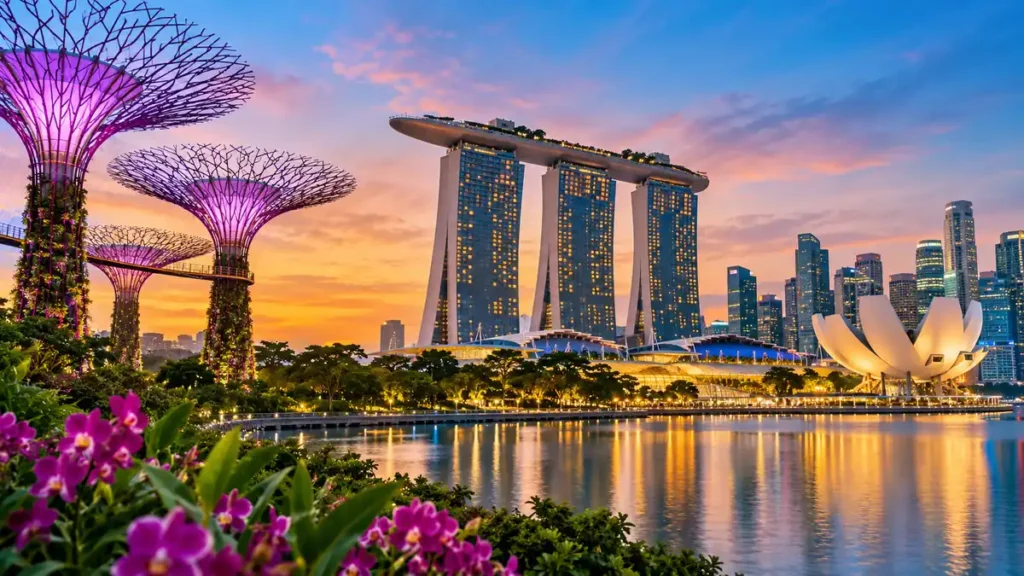
Singapore packs an unusual amount into a small island: futuristic gardens, centuries-old places of worship, tropical rainforest, beaches, museums, wildlife parks and some of Southeast Asia’s most memorable food. The challenge is rarely finding something to do. It is deciding what deserves your limited time.
The best things to do in singapore include exploring Gardens by the Bay and Marina Bay, eating at traditional hawker centres, walking through Chinatown, Little India and Kampong Gelam, visiting Sentosa, discovering Singapore Botanic Gardens, experiencing Night Safari and escaping into MacRitchie’s rainforest trails. The city works especially well when you mix famous landmarks with local neighbourhoods and nature.
Best things to do in singapore for first-time visitors
For a first trip, resist the temptation to race between attractions simply because Singapore’s transport system makes it possible. The city is much more rewarding when you explore it by area.
A good first-time itinerary combines Marina Bay, Gardens by the Bay, Chinatown, Kampong Gelam, Little India, the Civic District and at least one major nature or wildlife experience.
Here are the experiences worth prioritising:
| Experience | Best for | Suggested time |
|---|---|---|
| Gardens by the Bay | Iconic Singapore scenery | 3–4 hours |
| Marina Bay | Skyline and evening walks | 2–3 hours |
| Singapore Botanic Gardens | Nature and gardens | 2–3 hours |
| Chinatown | Heritage and food | 2–3 hours |
| Kampong Gelam | Culture and street life | 2 hours |
| Little India | Temples, markets and food | 2 hours |
| Hawker centres | Local cuisine | 1–2 hours |
| National Gallery Singapore | Art and history | 2–3 hours |
| Sentosa | Families and entertainment | Half/full day |
| Singapore Oceanarium | Marine life | 2–4 hours |
| Night Safari | Wildlife after dark | About 3 hours |
| MacRitchie | Hiking and rainforest | 2–5 hours |
| Jewel Changi Airport | Architecture and airport stopover | 1–3 hours |
The exact mix depends on whether you have two days or a week, but these places reveal very different sides of Singapore.
1. Explore Gardens by the Bay


7
Start with one of the landmarks that changed Singapore’s skyline: Gardens by the Bay.
The gardens contain more than 1.5 million plants from around the world. The headline attractions are the Cloud Forest, Flower Dome, Supertree Grove, OCBC Skyway, Floral Fantasy and Supertree Observatory.
Cloud Forest is particularly useful during the hottest part of the day because it is a cooled conservatory. Flower Dome focuses on plants from different regions, while the outdoor Supertree Grove provides the classic Singapore photo.
Do not leave immediately after sunset. Garden Rhapsody currently takes place daily at 7:45pm and 8:45pm at Supertree Grove.
Quick takeaway: Visit the conservatories during the afternoon, have a break around Marina Bay, then return to the Supertrees after dark.
2. Walk around Marina Bay
If you have seen only one photograph of Singapore, there is a good chance it showed Marina Bay.
The waterfront brings several major landmarks into a relatively compact area, including Marina Bay Sands, Gardens by the Bay, the Esplanade, Helix Bridge and the Merlion.
Merlion Park is free and open 24 hours. The 8.6-metre Merlion combines a lion’s head with a fish-like body: the fish references Singapore’s earlier identity as Temasek, while the lion relates to Singapura, or “lion city.”
The waterfront is especially enjoyable after sunset when temperatures drop and the skyline lights come on.
Rather than treating Merlion Park as a destination by itself, make it one stop on a longer waterfront walk.
3. See Singapore Botanic Gardens
Singapore’s greenery is not confined to futuristic architecture.
Singapore Botanic Gardens offers a calmer experience of the city’s tropical landscape. The gardens are also Singapore’s UNESCO World Heritage Site.
You can explore much of the grounds without paying, making this one of the better free things to do in Singapore.
Inside is the National Orchid Garden, home to more than 1,500 orchid species and 3,000 hybrids. Its Tropical Montane Orchidetum recreates cooler tropical highland environments through specialised display houses.
The National Orchid Garden requires admission, while children below 12 currently enter it free.
Go early in the morning if possible. Singapore’s heat and humidity become considerably more noticeable during a long midday walk.
4. Eat your way through Singapore’s hawker centres
Food should be treated as an attraction here rather than something squeezed between sightseeing stops.
Singapore’s hawker culture was inscribed on UNESCO’s Representative List of the Intangible Cultural Heritage of Humanity in 2020. Hawker centres developed from street-food traditions and function as shared community dining spaces where influences from Chinese, Malay, Indian and other cultures meet.
Depending on where you are staying, look for dishes such as:
- Hainanese chicken rice
- laksa
- char kway teow
- satay
- roti prata
- nasi lemak
- kaya toast
- chilli crab
- carrot cake, which in Singapore usually refers to a savoury radish-cake dish
- ice kacang
The useful approach is not to chase every famous stall on social media. Choose a busy hawker centre, walk around once before ordering, see what specialists are cooking repeatedly, and order several smaller dishes if you are travelling with others.
That provides a much better introduction to Singaporean food culture than eating only in shopping malls or hotel restaurants.
5. Wander through Chinatown


6
Chinatown combines religious landmarks, conserved architecture, shops, food and the everyday rhythms of a central neighbourhood.
One of its most striking buildings is Buddha Tooth Relic Temple and Museum. Built in 2007, the Tang-style Buddhist temple contains museums as well as the sacred relic from which it takes its name.
Give yourself time to walk beyond the main tourist streets. Historic shophouses, temples and food stalls make Chinatown more interesting on foot than as a quick photo stop.
It also pairs naturally with the Singapore River and Civic District.
6. Discover Kampong Gelam and Haji Lane
Kampong Gelam offers a different side of Singapore’s cultural history.
Its defining landmark is Sultan Mosque, recognisable by its large golden dome. The mosque traces its history to 1824 and remains an important focal point for Singapore’s Muslim community.
Walk around the surrounding streets before moving toward Haji Lane, where murals, small boutiques, cafés and colourful facades create a noticeably different atmosphere.
The nearest major MRT station is Bugis, making Kampong Gelam straightforward to combine with central Singapore.
Remember that Sultan Mosque is an active place of worship, not simply a sightseeing attraction. Dress respectfully and follow visitor guidance.
7. Experience Little India
Little India is one of the best places to understand how dramatically Singapore can change within a few MRT stops.
Explore markets, restaurants, spice shops and religious sites before visiting Sri Veeramakaliamman Temple.
Its history reaches back to a shrine established by Indian pioneers in the 19th century. The elaborate gopuram is covered with colourful figures of Hindu deities.
Other worthwhile stops include the Indian Heritage Centre and the colourful Tan Teng Niah house.
Come hungry. South Indian meals, biryani, dosa, sweets and teh tarik make food an essential part of exploring the neighbourhood.
8. Explore Katong and Joo Chiat
Many visitors see Chinatown and Little India but miss the Peranakan heritage of eastern Singapore.
Katong-Joo Chiat is known for pastel-coloured shophouses, traditional food, decorative architecture and Peranakan culture. The conserved houses around Koon Seng Road date to the 1920s and are among the area’s most photographed sights.
Try local dishes such as Katong laksa and explore traditional businesses selling Nyonya kueh, rice dumplings, beadwork and other crafts.
This area is particularly worthwhile for travellers who have already covered the headline attractions and want to see more residential neighbourhood life.
9. Visit National Gallery Singapore
For understanding Singapore and Southeast Asia beyond landmarks, spend a few hours at National Gallery Singapore.
The Gallery occupies the restored former Supreme Court and City Hall, two national monuments in the Civic District. It oversees more than 8,000 works and describes its holdings as the world’s largest collection of modern and contemporary Southeast Asian art.
That makes it much more than an indoor escape from tropical weather.
The collection gives context to Singapore’s development while introducing artists and visual traditions from Malaysia, Indonesia, Vietnam, the Philippines, Thailand, Myanmar, Cambodia, Laos, Brunei and elsewhere in the region.
10. Visit the Asian Civilisations Museum
Another worthwhile cultural stop is the Asian Civilisations Museum.
Located in the historic Empress Place Building beside the Singapore River, the museum explores the artistic heritage of Asia.
It works especially well as part of a walking day that includes the Civic District, National Gallery, Merlion Park and Singapore River.
If you only have time for one major museum, choose according to interest: National Gallery for modern Singaporean and Southeast Asian art; Asian Civilisations Museum for broader Asian cultural history.
11. Spend a day on Sentosa


5
Sentosa is where Singapore shifts firmly into holiday mode.
You can build an entire day around beaches, attractions and Resorts World Sentosa, or simply spend a few hours around the coastline.
Siloso Beach is the more energetic beach area, with restaurants and recreational activities including kayaking and cycling.
For something historical, visit Fort Siloso. It is Singapore’s only preserved coastal fort and contains original coastal guns, wartime tunnels, the Surrender Chambers and a 181-metre elevated Skywalk.
This contrast—beach resort beside military history—is precisely why Sentosa works for very different travellers.
12. Spend a day at Universal Studios Singapore
Families and theme-park fans can dedicate much of a day to Universal Studios Singapore.
The park remains one of Sentosa’s major attractions, with rides and themed entertainment ranging from family-oriented experiences to large roller coasters.
This is one attraction where advance planning genuinely helps. Theme parks consume more time than they appear to on a map, particularly when queues are long.
Avoid trying to combine a full theme-park day with half a dozen central Singapore landmarks.
13. Discover the Singapore Oceanarium
The former S.E.A. Aquarium has evolved into the much larger Singapore Oceanarium, so older Singapore itineraries may now be outdated.
Singapore Oceanarium combines marine habitats with interactive technology, conservation, research and educational experiences. It also includes a dedicated Research and Learning Centre.
It is particularly suitable for families, marine-life enthusiasts and rainy afternoons.
One practical warning: operating hours can change, and time-entry tickets may apply during peak periods. Check the current schedule before travelling to Sentosa.
14. Experience Singapore Zoo
Singapore Zoo remains one of Singapore’s major family attractions and can easily occupy most of a day.
The larger Mandai Wildlife Reserve now includes Singapore Zoo, River Wonders, Bird Paradise, Night Safari and Rainforest Wild Adventure, along with newer indoor and public spaces.
That creates a common planning mistake: assuming you can meaningfully experience all the Mandai parks in a single day.
You cannot do them justice that way.
Pick the experiences that matter most to you and leave enough time for walking, animal encounters and presentations rather than simply collecting entrances.
15. Stay after dark for Night Safari
Night Safari deserves separate attention because it provides an experience unlike a daytime zoo.
Night Safari is the world’s first nocturnal wildlife park and houses more than 900 nocturnal animals. Visitors can explore four walking trails and ride the Safari Adventure Tram.
Current hours are 6pm to midnight, with last entry at 11:15pm, while the trails and tram begin operating at 7pm.
The best strategy is to combine the tram with walking. The tram gives you an overview; the trails slow the experience down and reveal animals you might otherwise miss.
The popular Creatures of the Night presentation currently requires seat booking, available from two hours before each show.
Allow roughly three hours rather than treating Night Safari as a quick evening stop.
16. Hike around MacRitchie Reservoir
One of the most surprising things to do in singapore is to leave the skyscrapers behind and walk through genuine tropical forest.
MacRitchie Reservoir sits beside the Central Catchment Nature Reserve, Singapore’s largest nature reserve.
Its network contains more than 20km of trails through over 2,000 hectares of forest. Routes range from an easy 3km Prunus Trail to longer walks involving the TreeTop Walk.
The TreeTop Walk is a 250-metre suspension bridge reaching about 25 metres above the forest floor.
Bring water and proper walking shoes, and start early.
The biggest mistake here is underestimating distance. The TreeTop Walk itself may be short, but reaching it requires a substantial hike.
17. Walk the Southern Ridges and Henderson Waves
For greenery without committing to a deep forest hike, try the Southern Ridges.
The interconnected green corridor stretches roughly 10km through Mount Faber Park, Telok Blangah Hill Park, HortPark and Kent Ridge Park.
Its architectural highlight is Henderson Waves, a 274-metre pedestrian bridge with a distinctive wave-shaped design. It is Singapore’s tallest pedestrian bridge.
Visit in the morning when temperatures are lower or after sunset, when the bridge is illuminated.
You do not need to complete the entire Southern Ridges route. Choose a section based on your available time.
18. Go birdwatching at Sungei Buloh Wetland Reserve
For a side of Singapore that feels far removed from Marina Bay, head northwest.
Sungei Buloh Wetland Reserve covers 202 hectares and protects mangroves, mudflats, ponds and forest. It became Singapore’s first ASEAN Heritage Park in 2003.
The reserve supports resident wildlife including monitor lizards, kingfishers and smooth-coated otters, while migratory birds arrive in large numbers between August and April. Estuarine crocodiles also occur here, so wildlife should always be viewed from a safe distance.
The 1.95km Migratory Bird Trail is an easy introduction and includes hides and shelters for observing birds.
This is one of Singapore’s strongest alternatives to conventional sightseeing.
19. Escape to Pulau Ubin
Pulau Ubin provides an even greater change of pace.
The small island off Singapore’s northeastern coast retains forests, wetlands and traces of traditional kampong life. Boats leave from Changi Point Ferry Terminal, with the crossing taking around 15 minutes.
Cycling is a popular way to explore, while nature-focused visitors should make time for Chek Jawa.
Do not plan Pulau Ubin like a polished city attraction. Its appeal comes from slowing down, following quiet roads and experiencing landscapes that contrast sharply with downtown Singapore.
Bring insect repellent, water and sun protection.
20. See Jewel Changi Airport’s Rain Vortex
Do not assume the airport is only relevant when you are leaving.
Jewel Changi Airport has become a destination in its own right, centred on the Rain Vortex.
The waterfall drops about 40 metres through seven storeys and is described by Jewel as the world’s tallest indoor waterfall. It operates from 10am to 10pm, with evening Light & Music showcases.
The smartest way to visit is often on your arrival or departure day rather than making a separate cross-island journey.
Just leave enough time for airport procedures if you are visiting before a flight.
21. Explore the Singapore River on foot
Singapore’s history is closely tied to its river.
Walk sections around Boat Quay, Clarke Quay, Fullerton and the Civic District to see how former trading areas have evolved into some of the city’s busiest leisure districts.
The river is especially atmospheric around sunset.
If you have spent the afternoon around National Gallery Singapore or the Asian Civilisations Museum, continue toward the waterfront rather than immediately taking the MRT elsewhere.
A river cruise can provide another perspective, but walking lets you stop at historic buildings, bridges and waterfront viewpoints whenever something catches your attention.
22. Find free things to do in Singapore
Singapore has a reputation for being expensive, but sightseeing does not have to be.
Some of the most enjoyable experiences cost nothing:
| Free experience | Why go |
|---|---|
| Merlion Park | Classic Marina Bay views |
| Supertree Grove | Futuristic architecture |
| Singapore Botanic Gardens | Tropical greenery |
| Southern Ridges | Hiking and skyline views |
| Henderson Waves | Architecture and evening walk |
| Kampong Gelam | Heritage streets |
| Chinatown | Temples and shophouses |
| Little India | Markets and street atmosphere |
| MacRitchie trails | Rainforest hiking |
| Sungei Buloh | Wetlands and wildlife |
The key distinction is that many larger destinations combine free public spaces with ticketed attractions. Gardens by the Bay, for example, can still be enjoyable without entering every paid conservatory.
That flexibility makes it much easier to control your daily budget.
23. Experience Singapore after dark
Do not stop sightseeing when the sun goes down.
Singapore often becomes more comfortable after sunset because the temperature eases and many central areas are designed around evening activity.
Start with Marina Bay or Garden Rhapsody, continue along the waterfront, then explore a neighbourhood or hawker centre.
For wildlife, choose Night Safari. For city views, stay around Marina Bay. For food and atmosphere, head toward Chinatown, Kampong Gelam or one of the city’s hawker centres.
This is also when Singapore’s illuminated skyline delivers the version of the city many first-time visitors imagine before arriving.
24. Try Singapore’s less obvious experiences
Once the essential sights are covered, stop treating Singapore like a checklist.
Spend an afternoon photographing Peranakan houses in Joo Chiat. Take a long walk through East Coast Park. Visit Fort Canning Park. Explore a wet market. Ride the MRT into a residential neighbourhood and eat at its hawker centre.
Contemporary Singapore also changes quickly. Time Out’s 2026 coverage points to new nature experiences, creative spaces and expanding attractions around Mandai as part of the city’s current leisure scene.
These smaller experiences often become more memorable than squeezing another major ticketed attraction into an already crowded day.
25. Build your Singapore itinerary by area
The easiest way to waste time in Singapore is unnecessary cross-island travel.
Despite excellent public transport, attractions that look close on a map can involve considerable walking, especially in the heat.
A more efficient approach is to group places geographically.
If you have one day
Spend the morning around Chinatown and the Civic District. Continue to Marina Bay in the afternoon, visit Gardens by the Bay, then stay for the evening light displays.
If you have two days
Use day one for central Singapore and Marina Bay.
On day two, choose between Sentosa for entertainment or Mandai for wildlife.
If you have three days
Add Little India and Kampong Gelam, then spend the evening exploring hawker food.
If you have four or five days
Add Singapore Botanic Gardens, Joo Chiat, MacRitchie, the Southern Ridges or Sungei Buloh.
If you have a week
You can slow down substantially and include Pulau Ubin, museums, neighbourhood food trips and less-touristed parks without sacrificing the major attractions.
How many days do you need in Singapore?
Three to four full days is enough for a strong first visit.
Three days lets you cover Marina Bay, Gardens by the Bay, major heritage districts and either Sentosa or Mandai. Four or five days gives you room for museums, nature reserves and neighbourhoods without rushing.
A one-day stopover is still worthwhile, but keep your route compact.
For longer trips, Singapore rewards exploration beyond downtown far more than many visitors expect.
What is the best time to explore Singapore?
Singapore’s tropical climate means heat, humidity and rain are possible throughout the year.
Instead of planning your entire trip around finding a perfectly dry month, plan each day around the climate.
Outdoor attractions work best early in the morning and later in the afternoon. Use the hottest or wettest periods for museums, conservatories, shopping areas and indoor attractions.
Carry water and a compact umbrella.
Also avoid creating an itinerary in which every hour is accounted for. Tropical downpours, meal queues and the simple need for an air-conditioned break can easily disrupt an overly rigid schedule.
Is Singapore good for families?
Yes. Families have an unusually wide range of options.
Gardens by the Bay, Singapore Zoo, Bird Paradise, River Wonders, Singapore Oceanarium, Universal Studios Singapore and Singapore Botanic Gardens can all work with children.
Mandai Wildlife Reserve alone now contains five wildlife attractions—Singapore Zoo, River Wonders, Night Safari, Bird Paradise and Rainforest Wild Adventure—plus indoor attractions and public areas.
The mistake families should avoid is trying to see too much in one day. Singapore may look geographically small, but large attractions require considerable walking.
Is Singapore worth visiting if you prefer nature?
Absolutely.
The futuristic city image tells only part of the story.
Central Catchment Nature Reserve protects more than 2,000 hectares of forest. Sungei Buloh protects significant wetland habitats. The Southern Ridges connect 10km of green spaces, while Pulau Ubin provides access to a more rural island landscape.
Then there are Singapore Botanic Gardens, neighbourhood parks, reservoirs and coastal areas.
A nature-focused traveller could spend several days here without making shopping malls or theme parks the centre of the trip.
Practical tips for sightseeing in Singapore
A few decisions make exploring Singapore noticeably easier.
Use the MRT for most city journeys and buses when they provide a more direct connection. Wear breathable clothing and comfortable shoes because walking distances accumulate quickly.
Keep religious etiquette in mind when entering mosques, Hindu temples and Buddhist temples. These are active places of worship.
Check official opening hours before visiting ticketed attractions. This matters particularly for venues with maintenance closures, timed admission or changing schedules. Gardens by the Bay’s conservatories, for example, periodically close for maintenance, while Singapore Oceanarium notes that its operating hours can change.
For nature reserves, stay on designated trails, respect wildlife and follow closure notices. Singapore’s parks are recreational spaces, but some also protect sensitive ecosystems.
Most importantly, leave room for food. A hawker-centre meal should not be treated as dead time between attractions—it is part of experiencing the city.
Making the most of things to do in singapore
The best things to do in singapore reveal how many versions of the city exist side by side.
You can start a morning beneath tropical trees at Singapore Botanic Gardens, eat lunch in a hawker centre, walk past historic shophouses in Chinatown, stand among the Supertrees at sunset and finish the night watching nocturnal wildlife at Mandai.
But the strongest trip is not necessarily the one that includes the most attractions.
Choose one or two major experiences each day, group them by neighbourhood, and leave time to walk, eat and explore places you did not plan in advance. Singapore’s famous skyline deserves attention, but its heritage districts, food culture, museums, wetlands, rainforest and neighbourhoods are what turn a sightseeing stop into a much fuller picture of the city-state.