Montréal is the kind of city where a morning can begin on a cobblestone street beside a centuries-old church and end with poutine, live music, contemporary art, or a sunset over the Saint Lawrence River. The challenge isn’t finding things to do in montreal. It’s deciding what deserves your limited time.
For a first visit, focus on Old Montréal and the Old Port, Mount Royal, Notre-Dame Basilica, Plateau-Mont-Royal and Mile End, the city’s food culture, and at least one major museum or Espace pour la vie attraction. Add markets, festivals, neighborhoods, and seasonal activities according to your interests and the time of year.
Montréal rewards travelers who explore it slowly. Walk rather than rushing between attractions, use the Metro for longer distances, and leave room for discoveries that were never on your itinerary.
Best things to do in montreal for first-time visitors
If this is your first trip, don’t try to cover the entire island. Montréal’s character comes from distinct neighborhoods, and several of its essential sights naturally fit together.
A strong first-time itinerary combines history, architecture, green space, local food and neighborhood wandering.
1. Walk through Old Montréal
Old Montréal (Vieux-Montréal) is the natural starting point.
The neighborhood preserves some of the city’s most recognizable historic streets and architecture while also functioning as a lively district of museums, restaurants, galleries and public spaces. Time Out describes it as an exceptionally walkable area and one of the city’s most visited districts.
Start around Place d’Armes, then walk toward Notre-Dame Basilica. Continue through narrow streets toward Place Jacques-Cartier, Rue Saint-Paul and the waterfront.
Don’t treat Old Montréal as a checklist. Its appeal is partly in details: stone façades, courtyards, side streets, cafés and the contrast between heritage buildings and the modern skyline.
Quick takeaway: Give Old Montréal at least half a day if you’re also visiting the Basilica or Pointe-à-Callière.
2. Step inside Notre-Dame Basilica
The Notre-Dame Basilica of Montréal is one of the city’s signature architectural landmarks.
The present church was designed after Irish-born New York architect James O’Donnell submitted plans for a Gothic-style building in 1823; construction began the following year. Today, the Basilica remains both an active place of worship and an important heritage attraction.
Inside, the dramatic sanctuary, deep colors, carved ornamentation and stained glass make the building considerably more impressive than its exterior alone suggests.
Sightseeing visits are currently offered during specified hours, while the evening AURA Experience uses light, projection and music inside the Basilica. Because schedules can change for religious services and events, check the official timetable before visiting.
3. Explore the Old Port
Walk downhill from Old Montréal and you reach the Old Port of Montréal, where the historic city meets the Saint Lawrence River.
The waterfront offers a completely different atmosphere from the narrow streets nearby. Depending on the season, visitors come for walking, cycling, cruises, events and waterfront activities.
One recognizable feature is La Grande Roue de Montréal, the observation wheel overlooking the waterfront and city. Tourisme Montréal also highlights it among the city’s notable contemporary attractions.
A simple route works particularly well: explore Old Montréal during the afternoon, reach the Old Port later in the day, and stay around the waterfront toward sunset.
4. Learn how Montréal began at Pointe-à-Callière
For historical context, visit Pointe-à-Callière, Montréal Archaeology and History Complex.
The museum stands at Montréal’s birthplace and incorporates archaeological remains into its exhibitions. The site has been occupied by people for more than a thousand years, and its interpretation connects First Peoples, colonial settlement and the development of modern Montréal.
This is especially useful early in a trip. After learning why Old Montréal developed where it did, the surrounding streets become much easier to understand.
Pointe-à-Callière also hosts temporary exhibitions alongside its permanent archaeological and historical displays.
Outdoor things to do in montreal
Despite its dense urban neighborhoods, Montréal has substantial green space. Mount Royal dominates the list, but parks, waterfront areas and islands give you plenty of opportunities to get outdoors.
5. Climb Mount Royal
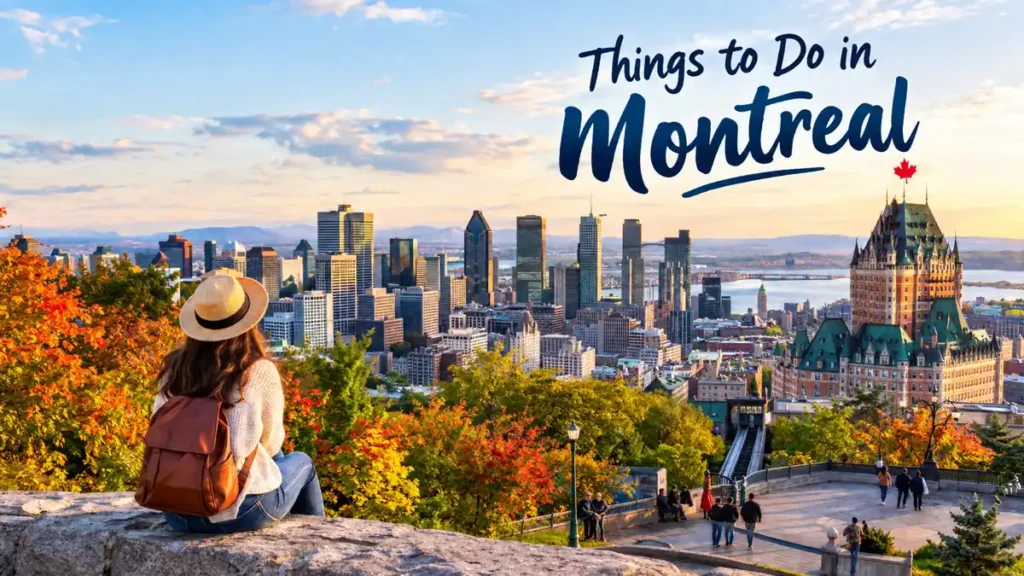
If you only choose one outdoor experience, make it Mount Royal Park (Parc du Mont-Royal).
The park was designed by landscape architect Frederick Law Olmsted, also associated with New York’s Central Park. Tourisme Montréal considers climbing Mount Royal one of the essential experiences for first-time visitors.
Follow the paths upward to the Kondiaronk lookout, where a broad terrace provides one of the city’s classic skyline views. The lookout includes amenities such as washrooms, a picnic area and drinking water, and the City of Montréal currently lists it as open daily from early morning until midnight.
The park isn’t limited to the lookout. You can follow the Chemin Olmsted walking trail, visit Beaver Lake (Lac aux Castors) and explore quieter wooded sections.
In autumn, changing foliage makes the park particularly photogenic. Winter transforms it again, with seasonal snow activities when conditions permit.
6. Spend time at Parc Jean-Drapeau
Located on islands in the Saint Lawrence River, Parc Jean-Drapeau gives visitors a mix of recreation, cultural attractions and Montréal history.
The area played an important role in Expo 67, and traces of that era remain part of Montréal’s identity. Lonely Planet includes Parc Jean-Drapeau among its recommended city experiences.
The park is also home to the Biosphère, an environmental museum housed within the striking geodesic structure associated with Expo 67.
In warmer months, the islands become especially appealing for cycling, picnics and events.
7. Walk or cycle along the Lachine Canal
Travelers who prefer everyday city life to major landmarks should spend some time around the Lachine Canal.
Paths alongside the water provide an easy setting for walking and cycling, while neighborhoods along the route introduce you to a less tourist-focused side of Montréal.
It works particularly well on a sunny afternoon when you’ve already spent a day or two sightseeing downtown.
Explore Montréal’s most interesting neighborhoods
One of the biggest mistakes first-time visitors make is spending almost all their time in Old Montréal and downtown.
The city’s personality becomes clearer when you explore its residential and commercial neighborhoods.
8. Wander through Plateau-Mont-Royal
Plateau-Mont-Royal is where many visitors begin seeing the Montréal they imagined before arriving: colorful façades, exterior staircases, neighborhood cafés, murals, small shops and tree-lined residential streets.
Walk along Saint-Denis Street and Saint-Laurent Boulevard, then turn onto residential streets rather than staying exclusively on the commercial strips.
This is not a neighborhood that needs a rigid itinerary. Give yourself time to walk, stop for coffee and explore.
9. Eat your way through Mile End
Just beyond the Plateau, Mile End combines Montréal’s artistic culture with some of its best-known food traditions.
Two names dominate any discussion of Montréal bagels: St-Viateur Bagel and Fairmount Bagel.
Montréal-style bagels are smaller and denser than the classic New York version, with a distinctive chewy texture and wood-fired character.
Mile End also has cafés, bakeries, independent stores and creative spaces. Lonely Planet specifically recommends exploring the Plateau and Mile End while sampling local bagels.
10. Discover Little Italy and Jean-Talon Market
Continue north toward Little Italy, where Jean-Talon Market provides one of the best opportunities to experience Montréal through food.
Rather than treating the market as a quick attraction, browse the produce, specialty foods, cheeses, baked goods and prepared dishes.
It’s particularly enjoyable around lunchtime because you can build a meal from whatever looks interesting instead of committing immediately to one restaurant.
11. See Montréal’s street art
Street art is woven into the visual identity of neighborhoods around Boulevard Saint-Laurent and the Plateau.
Large murals appear on building walls throughout the area, turning an ordinary walk into an informal outdoor gallery.
This is one of the easiest free things to do in montreal: start around Saint-Laurent Boulevard and explore side streets on foot.
Things to do in montreal for food lovers
Food isn’t an optional extra here. It’s part of understanding the city.
Montréal’s culinary identity draws on Québécois traditions alongside Jewish, French, Italian and many other immigrant communities.
12. Try authentic Montréal poutine
At its simplest, poutine combines French fries, cheese curds and gravy.
Simple does not mean subtle.
You will find traditional versions as well as elaborate variations topped with meats, vegetables and sauces. La Banquise is among the city’s widely known poutine destinations and appears alongside bagel shops and smoked-meat institutions in current travel guides.
For a first taste, order a classic version before experimenting with toppings.
13. Eat a Montréal smoked-meat sandwich
Another local staple is the Montréal smoked-meat sandwich.
Schwartz’s Deli on Saint-Laurent Boulevard is the name most visitors encounter first. Its smoked meat is traditionally piled onto rye bread with mustard, producing a meal that is uncomplicated and distinctly Montréal.
Lines can be part of the experience, particularly at busy times.
14. Compare Montréal’s famous bagels
The St-Viateur versus Fairmount debate is one you don’t actually need to settle.
Try both.
A fresh Montréal bagel is often best eaten almost immediately. Sesame is the classic starting point, though both bakeries offer multiple varieties.
Combining a Mile End walk with bagel tasting is far more enjoyable than making a special trip only to photograph the storefront.
15. Browse local public markets
Jean-Talon Market may be the most famous, but Atwater Market is another worthwhile food stop.
Public markets allow you to sample the city’s culinary culture without turning every meal into a formal restaurant reservation. They’re also useful places to find Québec cheeses, produce, pastries and regional specialties.
Museums and cultural attractions in Montréal
Rain, snow or extreme temperatures don’t ruin a Montréal trip. The city has enough museums and indoor attractions to fill several days.
16. Visit the Montreal Museum of Fine Arts
The Montreal Museum of Fine Arts (MMFA) is a strong choice for travelers interested in visual culture, decorative arts and Canadian and international art.
Located around the historic Golden Square Mile on Sherbrooke Street, it is regularly included among Montréal’s essential museums and cultural attractions.
Give yourself enough time to focus on the collections that interest you rather than trying to see everything.
17. Experience the Montréal Biodôme
Families—and plenty of adults traveling without children—should consider the Montréal Biodôme.
The attraction recreates five ecosystems of the Americas, including a Tropical Rainforest, Gulf of St. Lawrence, Laurentian Maple Forest, Labrador Coast and Sub-Antarctic Islands. Its collections include around 150 animal species and hundreds of plant species.
The building itself has Olympic history: the Biodôme occupies the former velodrome created for the 1976 Summer Olympic Games.
Most visitors should allow roughly one to one-and-a-half hours, according to Espace pour la vie.
18. Slow down at the Montréal Botanical Garden
Next to the Olympic Park area, the Montréal Botanical Garden (Jardin botanique) is much larger than many first-time visitors expect.
Its 75 hectares contain around 20 outdoor gardens and 10 exhibition greenhouses. Highlights include the Chinese Garden, Japanese Garden, First Nations Garden, Alpine Garden, Rose Garden and Arboretum.
The experience changes substantially with the seasons. Spring brings flowering collections, summer fills the outdoor gardens, autumn adds dramatic foliage, and greenhouses remain valuable during colder weather.
The First Nations Garden is particularly meaningful in 2026, which marks its 25th anniversary.
19. Explore Montréal’s Espace pour la vie attractions
The Botanical Garden and Biodôme belong to Espace pour la vie, a group of five nature-focused institutions that also includes the Insectarium, Biosphère and Planétarium.
That concentration makes the Olympic Park area especially useful for families. Instead of crossing the city repeatedly, choose two nearby attractions and make a day of them.
Trying to fit all five into a single day would sacrifice the relaxed pace that makes them enjoyable.
Free things to do in montreal
You can experience a surprising amount of Montréal without paying admission.
20. Explore the Underground City
Montréal’s Underground City, commonly called RESO, becomes particularly useful during winter, rain or hot summer days.
This isn’t literally a second city beneath Montréal. It is an interconnected pedestrian network linking Metro stations, shopping areas, office buildings, hotels, universities and cultural destinations.
According to the City of Montréal, the network covers roughly 32 kilometers of pedestrian corridors and connects thousands of shops, restaurants and services.
The best way to understand RESO is to use it practically. Enter downtown, follow the signs and see how far you can travel without returning to street level.
21. Relax in Montréal’s parks
Beyond Mount Royal, neighborhood parks provide a glimpse of local life.
La Fontaine Park is an easy addition to a Plateau itinerary. In warmer weather, green spaces across Montréal fill with people walking, reading, exercising and meeting friends.
A park break is particularly useful between restaurant stops and museum visits. Montréal is best experienced with some unstructured time.
22. Experience Quartier des Spectacles
The Quartier des Spectacles is Montréal’s central arts and entertainment district.
Its core includes Place des Arts and Place des Festivals, with museums, performance venues, installations and event spaces nearby. The district becomes especially active during major festivals.
Even without a ticketed event, it’s worth walking through in the evening to see what’s happening in the public spaces.
Seasonal things to do in montreal
There is no single “best” Montréal because the experience changes dramatically with the seasons.
Montréal in summer
Summer brings the city’s most energetic outdoor atmosphere.
Terraces open, parks fill up and festival programming spreads through downtown and surrounding neighborhoods. Montréal is internationally associated with major cultural events, including its jazz scene, while Parc Jean-Drapeau and waterfront areas become much busier.
This is an excellent season for cycling, markets, Old Port activities and long evenings outdoors.
Montréal in fall
Autumn is ideal if you want comfortable walking weather and colorful foliage.
Mount Royal is the obvious place to see fall color, but the Botanical Garden, neighborhood streets and parks also change dramatically.
Temperatures can shift quickly, so layers are useful.
Montréal in winter
Winter doesn’t shut Montréal down—it changes how the city works.
RESO becomes genuinely useful, indoor museums become more appealing, and seasonal skating and snow activities appear when weather conditions cooperate.
The city’s winter calendar also includes major events such as Igloofest, which Time Out notes as one of the activities associated with the Old Port area.
Good winter footwear matters more than trying to look fashionable. Sidewalk conditions can change throughout the day.
Montréal in spring
Spring is less predictable but can be rewarding.
As temperatures rise, parks, terraces and gardens gradually return to life. The Botanical Garden’s bloom calendar is particularly useful if plants and photography are priorities.
Things to do in montreal with kids
Families have plenty of options beyond conventional sightseeing.
The Biodôme is one of the strongest choices because children move through five dramatically different ecosystems rather than simply looking at display cases. It is accessible to strollers and visitors with reduced mobility, according to its visitor information.
Pair it with the Insectarium, Planétarium or Botanical Garden depending on your children’s interests.
Other family-friendly ideas include the Old Port, Mount Royal, public parks and interactive exhibitions at Pointe-à-Callière.
The key with children is not overloading the day. Montréal involves plenty of walking even when using public transportation.
What is Montréal best known for?
Montréal is best known for combining French-speaking Québécois culture with a distinctly North American city environment.
Visitors commonly associate it with Old Montréal, Mount Royal, Notre-Dame Basilica, Expo 67, the 1976 Olympics, festivals, poutine, smoked meat and Montréal-style bagels.
Yet those famous attractions only tell part of the story.
The city is equally defined by neighborhoods such as Plateau-Mont-Royal and Mile End, its multilingual population, independent cafés, murals, markets, music and everyday street life.
That’s why simply moving from attraction to attraction can feel less satisfying than combining major landmarks with neighborhood exploration.
How many days do you need in Montréal?
Three days is enough for a strong introduction, while four or five days gives you more room for neighborhoods, museums and slower meals.
A practical three-day plan looks like this:
| Day | Morning | Afternoon | Evening |
|---|---|---|---|
| 1 | Old Montréal | Notre-Dame Basilica and Old Port | Waterfront and dinner |
| 2 | Mount Royal | Plateau and Mile End | Local food and Quartier des Spectacles |
| 3 | Botanical Garden or Biodôme | Museum or Jean-Talon Market | Downtown or neighborhood dinner |
Tourisme Montréal similarly structures its long-weekend recommendations around Old Montréal, Old Port, Plateau-Mont-Royal, Mile End, gastronomy and other signature city experiences.
With a fourth day, explore Parc Jean-Drapeau, the Lachine Canal or additional museums. With five days, you can slow down considerably and spend more time outside the central tourist districts.
Is Montréal a walkable city?
Yes—particularly within individual neighborhoods.
Old Montréal, downtown, Plateau-Mont-Royal and Mile End are rewarding on foot, but Montréal is too large to walk everywhere efficiently.
The smarter approach is to combine walking with the Metro. Use public transportation to move between districts, then explore each neighborhood on foot.
Comfortable shoes are essential. Cobblestones in Old Montréal, hills around Mount Royal and long neighborhood walks add up quickly.
Cycling can also be an excellent warm-weather option.
What to know before exploring Montréal
Montréal is relatively straightforward for visitors, but a few practical choices can improve the trip.
French is Québec’s official language and is prominent throughout Montréal, though visitors will encounter plenty of English in major tourism areas. Starting an interaction with a simple bonjour is an easy courtesy.
Weather deserves more attention than many visitors give it. Summer can be hot and humid; winter can be seriously cold; spring and fall can change quickly within the same day.
Reserve timed or high-demand attractions in advance when appropriate. The Biodôme, for example, recommends purchasing timed tickets online to reduce the risk of waits or disappointment.
For Notre-Dame Basilica, schedules can vary around services, so check current visiting hours rather than assuming it operates like a conventional museum.
Most importantly, group activities geographically. Don’t visit Mile End, return to Old Montréal, and then head back north to Jean-Talon Market. Montréal becomes much easier when each day focuses on one or two neighboring districts.
How to make the most of the best things to do in montreal
A memorable Montréal trip isn’t built by squeezing 20 attractions into two days.
Start with the essentials: walk Old Montréal, enter Notre-Dame Basilica, see the skyline from Mount Royal and taste at least a few of the city’s defining foods. Then choose experiences that match your interests.
For history, spend more time at Pointe-à-Callière and Old Montréal. For nature and families, prioritize the Biodôme and Botanical Garden. Food travelers should devote extra time to Mile End, Jean-Talon Market and neighborhood restaurants. Art and culture fans can focus on museums, murals and the Quartier des Spectacles.
And leave at least one afternoon partially empty.
Among all the things to do in montreal, wandering without a strict plan is one of the experiences most likely to reveal why the city is so enjoyable: a bakery you didn’t know about, a mural hidden on a side street, a neighborhood park full of local life, or a café that turns a planned 20-minute break into an hour.