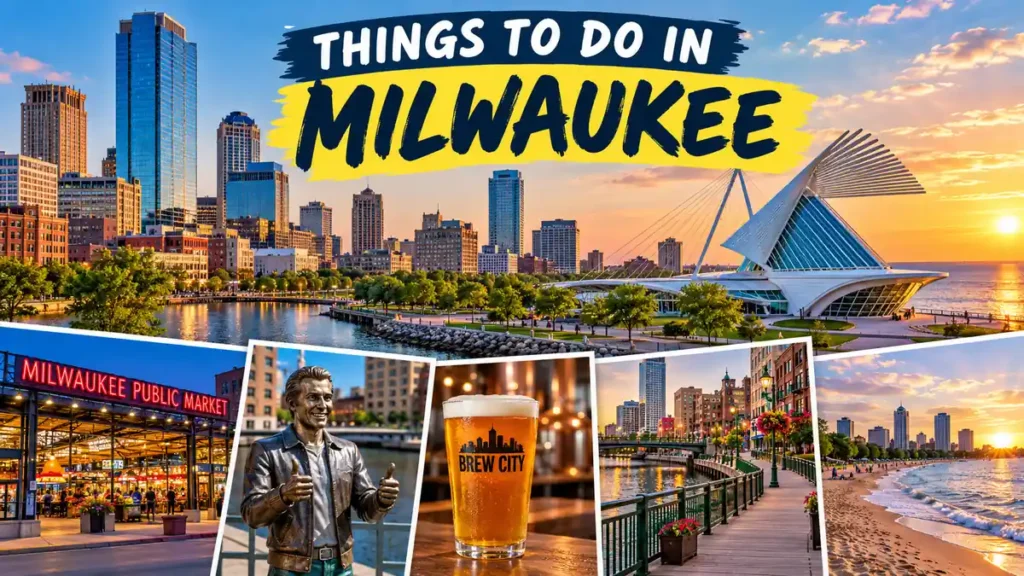
Milwaukee is the kind of city that can surprise you. Its famous brewing heritage is still part of the experience, but Wisconsin’s largest city also offers striking architecture, major museums, Lake Michigan beaches, historic neighborhoods, public markets, professional sports, gardens, festivals, and an increasingly diverse food scene.
If you are looking for things to do in milwaukee, start with the Milwaukee Art Museum and lakefront, explore the Historic Third Ward and Milwaukee Public Market, walk the Milwaukee RiverWalk, visit the Harley-Davidson Museum, and experience the city’s brewing history. Families can add Discovery World, the Milwaukee County Zoo, and Mitchell Park Domes to the itinerary.
Milwaukee works particularly well for a weekend because many of its signature attractions are concentrated around Downtown, the Historic Third Ward, and the Lake Michigan waterfront. Once you understand those areas, building an itinerary becomes much easier.
1. Visit the Milwaukee Art Museum
The Milwaukee Art Museum is both an art destination and an architectural landmark.
Its lakefront Quadracci Pavilion was designed by Spanish architect Santiago Calatrava. The building’s enormous movable Burke Brise Soleil—often described as wings—has become one of the defining images of Milwaukee.
The wings normally open with the museum, move at noon, and close later in the evening, although operation depends on weather conditions. In 2026, the museum is also celebrating the Quadracci Pavilion’s 25th anniversary.
Inside, visitors can explore permanent collections and changing exhibitions covering centuries of artistic production. Even travelers who are not serious museum-goers may find the combination of architecture, art, and lake views worth the visit.
A practical approach is to allow two or three hours rather than trying to rush through every gallery.
The museum is generally closed Monday and Tuesday, while Thursday has extended evening hours. Current admission, exhibitions, and opening times should be checked before visiting because schedules can change.
Best for: Art, architecture, photography, couples, and first-time visitors.
2. Walk Along the Lake Michigan Waterfront
You do not need to spend your entire Milwaukee trip indoors.
Lake Michigan gives the city a waterfront that feels surprisingly expansive, and several major attractions sit close enough together to combine into one long walk.
Start around the Milwaukee Art Museum and continue toward Veterans Park and the surrounding lakefront paths. Depending on your route, you can extend the walk toward Lakeshore State Park and the Historic Third Ward.
Walking or cycling here is particularly enjoyable during warmer weather.
Lakefront activities range from beaches and trails to boating and paddling, making the water much more than a backdrop to the city.
For photographers, early morning and the hour before sunset usually provide the most interesting light over the lake and skyline.
3. Explore the Historic Third Ward
If you only have time to explore one Milwaukee neighborhood on foot, make it the Historic Third Ward.
The former warehouse district sits immediately south of Downtown and has evolved into one of Milwaukee’s most walkable areas. Historic industrial buildings now contain restaurants, galleries, boutiques, cafés, offices, and apartments.
The neighborhood is also convenient because several attractions can be combined without repeatedly driving across the city.
The Milwaukee Public Market anchors the district, while the RiverWalk, Henry Maier Festival Park, Lakeshore State Park, and the lakefront are nearby.
Rather than treating the Third Ward as a single attraction, give yourself time to wander.
Walk the side streets, browse independent stores, stop for coffee, and then continue toward the river or lake.
Quick takeaway: The Third Ward is especially useful for visitors who want food, shopping, architecture, and sightseeing within one compact area.
4. Eat Your Way Through Milwaukee Public Market
Food is one of the easiest ways to understand Milwaukee, and the Milwaukee Public Market provides a convenient introduction.
Located at 400 N. Water Street in the Historic Third Ward, the market brings numerous independent food merchants together under one roof.
Current vendors offer prepared meals, Wisconsin specialties, artisan groceries, sweets, coffee, international dishes, beverages, and local merchandise. The market currently lists 19 independently owned merchants.
Instead of ordering everything from one counter, consider sharing several smaller items if you are visiting with other people.
That lets you sample more of the market.
The second-level Palm Garden provides seating after you have chosen your food.
The market is also useful when Milwaukee weather turns cold or rainy because you can eat, browse, and relax indoors before continuing through the Third Ward.
5. Walk the Milwaukee RiverWalk
The Milwaukee RiverWalk offers a different perspective on Downtown.
The walkway follows both sides of the Milwaukee River for approximately 3.1 miles, connecting areas including Downtown and the Historic Third Ward before reaching toward Lake Michigan.
Along the route, you will encounter restaurants, patios, public art, bridges, bars, and river views.
One of its best-known landmarks is the Bronze Fonz, a sculpture honoring Arthur “Fonzie” Fonzarelli from the television series Happy Days.
You do not necessarily need to walk the entire route.
A shorter stretch through Downtown and into the Third Ward can easily be combined with lunch at the Public Market.
In summer, outdoor patios make this area especially lively. In fall, cooler temperatures can make a longer walk more comfortable.
6. Discover the Harley-Davidson Museum
Milwaukee and Harley-Davidson have been connected since the motorcycle company was founded in the city in 1903.
The Harley-Davidson Museum explores that history through motorcycles, memorabilia, engineering, design, interactive exhibits, and stories about motorcycle culture.
One particularly significant exhibit is Serial Number One, the oldest known Harley-Davidson motorcycle.
The museum covers more than just motorcycles as machines. Exhibits also examine the company’s influence on design, manufacturing, popular culture, and the idea of the American open road.
That makes it more accessible to visitors who are interested in industrial history but are not motorcycle enthusiasts.
Allow roughly two to three hours for a relaxed visit.
Best for: Motorcycle enthusiasts, engineering fans, history lovers, and families with older children.
7. Experience Milwaukee’s Brewing Heritage
Milwaukee’s nickname “Brew City” is not simply a marketing invention.
Beer production played a major role in the city’s economic and cultural development, particularly through historic names such as Pabst, Schlitz, Blatz, and Miller.
Today, you can explore both that industrial history and Milwaukee’s modern craft-brewing culture.
Tour options include historic brewing-related sites as well as operating breweries. Visit Milwaukee highlights experiences associated with Miller, the historic Pabst complex, Lakefront Brewery, Sprecher Brewing Company, and smaller modern breweries.
If you take a brewery tour, pay attention to the history rather than treating it simply as a tasting session. The stories of German immigration, manufacturing, distribution, and neighborhood development explain a surprising amount about Milwaukee.
Non-drinkers can still enjoy many brewery tours for their architecture and history, although individual tour policies vary.
8. Tour the Pabst Mansion
For a more intimate look at Milwaukee’s beer-era wealth, visit the Pabst Mansion.
Built for Captain Frederick Pabst and his wife Maria, the mansion provides a window into Milwaukee’s Gilded Age and the family behind one of America’s most recognizable brewing names.
Guided classic tours generally last about 60 minutes and cover the mansion’s architecture, furnishings, family history, and several floors. Self-guided and specialty experiences are also offered.
Seasonal tours can explore subjects ranging from architecture to Milwaukee’s German heritage and holiday traditions.
The house is at 2000 W. Wisconsin Avenue.
Advance reservations are recommended even though same-day admission may be available.
This is one of the best things to do in Milwaukee when you want to understand the connection between beer, immigration, architecture, and the city’s economic rise.
9. Step Inside Mitchell Park Domes
Three enormous glass domes rise above Mitchell Park, each containing a different plant environment.
The Mitchell Park Horticultural Conservatory—usually called “The Domes”—includes the Desert Dome, Tropical Dome, and Floral Show Dome.
The Tropical Dome contains roughly 1,200 plant species, while the Desert Dome focuses on plants adapted to dry environments. The Floral Show Dome changes displays seasonally.
That variety makes the attraction especially useful during Wisconsin’s colder months.
You can walk from a winter day outside into tropical humidity within minutes.
The attraction also works well for photography, families, plant enthusiasts, and anyone who wants a slower break between larger museums.
Allow about 60 to 90 minutes for most visits.
10. Spend Time at Discovery World
Families searching for things to do in Milwaukee on a rainy or cold day should put Discovery World near the top of the list.
This lakefront science and technology center is designed around interactive learning rather than simply looking at objects behind glass.
Exhibits commonly explore science, technology, engineering, freshwater ecosystems, innovation, and the Great Lakes.
Its location also makes itinerary planning easy.
You can pair Discovery World with the Milwaukee Art Museum, lakefront paths, and nearby Downtown attractions instead of dedicating an entire day to a single part of the city.
Young children tend to appreciate the hands-on elements, while older visitors can learn more about Milwaukee’s connection to freshwater science and technology.
11. Visit the Milwaukee County Zoo
The Milwaukee County Zoo is one of the city’s major family attractions.
Visit Milwaukee describes a 190-acre site with more than 2,200 animals, along with additional experiences such as animal encounters and seasonal activities.
Because the grounds are extensive, comfortable shoes matter.
Instead of trying to race through every habitat, choose the animals or sections that interest your group most and build your route around them.
Families with young children should also allow extra time for breaks.
Spring and fall can be particularly comfortable because temperatures are usually better suited to extended outdoor walking than the hottest summer afternoons.
12. See the Basilica of St. Josaphat
The Basilica of St. Josaphat is one of Milwaukee’s most impressive historic interiors.
Its story is closely tied to the Polish immigrant community that developed on Milwaukee’s south side during the nineteenth century.
Construction began in 1896, and the completed church incorporated salvaged materials from Chicago’s former Post Office and Custom House. The interior combines monumental scale, stained glass, murals, and elaborate decorative work.
The basilica was formally recognized as a minor basilica in 1929.
Visitors can explore through guided or self-guided experiences outside scheduled religious services and private events.
Remember that this remains an active place of worship rather than simply a tourist attraction. Dress and behave accordingly, particularly if a service is taking place.
13. Relax at Bradford Beach
Yes, Milwaukee has a beach.
Bradford Beach sits along Lake Michigan and becomes one of the city’s most popular outdoor gathering places when summer arrives.
Visitors come for swimming conditions when appropriate, beach volleyball, walking, relaxing on the sand, and lake views.
Visit Milwaukee also highlights accessibility features, including wheelchair-accessible paths and rentals.
Lake Michigan can remain surprisingly cold even when the air temperature feels warm, so check current conditions before planning a swimming-focused visit.
Outside summer, Bradford Beach is still worth considering.
The waterfront can be dramatic in fall and winter, although strong wind and cold temperatures require appropriate clothing.
14. Explore Lakeshore State Park
Lakeshore State Park provides an unusual combination: natural space almost directly beside Downtown Milwaukee.
The park occupies a waterfront setting near the Milwaukee Art Museum and Henry Maier Festival Park.
Its paths are suitable for walking, jogging, cycling, photography, and simply getting a clear view of Lake Michigan and Milwaukee’s skyline.
Because of its location, you do not have to treat the park as a separate excursion.
Combine it with the Third Ward and lakefront attractions to create a mostly car-free sightseeing day.
For a simple Milwaukee afternoon, try this sequence:
- Explore the Milwaukee Public Market.
- Walk through the Historic Third Ward.
- Continue toward Lakeshore State Park.
- Follow the waterfront toward the Milwaukee Art Museum.
- Finish around sunset near the lake.
That route combines food, architecture, urban scenery, and nature without excessive travel between stops.
15. Look for the Bronze Fonz
Some attractions require hours.
The Bronze Fonz requires only a few minutes—but it is one of Milwaukee’s classic photo stops.
The bronze sculpture depicts Fonzie, the character played by Henry Winkler in Happy Days, which was set in Milwaukee.
You will find it along the Milwaukee RiverWalk.
It makes the most sense as part of a RiverWalk outing rather than as a destination by itself.
After taking a photo, continue toward Downtown restaurants or south toward the Third Ward.
16. Experience Milwaukee’s Professional Sports Scene
Sports can completely change the atmosphere of a Milwaukee weekend.
Depending on the season, visitors may be able to see the Milwaukee Brewers play baseball at American Family Field or attend a Milwaukee Bucks basketball game.
Even travelers who are not dedicated sports fans can enjoy the local atmosphere surrounding a major game.
Visit Milwaukee lists professional sports alongside museums, festivals, dining, and brewing as part of the city’s core visitor experience.
If attending a game is important, check the official schedule before deciding your travel dates.
Game days can also affect restaurant demand, traffic, and accommodation prices.
17. Explore Milwaukee’s Food Traditions
Milwaukee’s food culture reflects generations of immigration and Midwestern traditions.
A first visit might include Wisconsin cheese curds, frozen custard, bratwurst, locally made sausages, and a traditional Friday fish fry.
But stopping there would give you an incomplete picture.
Milwaukee’s neighborhoods also offer Mexican, Polish, German, Italian, Middle Eastern, Asian, African, and contemporary American cooking, among many other influences.
The Milwaukee Public Market is an easy introduction, but neighborhood restaurants provide a better reason to venture beyond Downtown.
For an especially Milwaukee experience, plan one meal around a Friday fish fry. The tradition remains closely associated with Wisconsin dining culture and appears throughout the city at restaurants, taverns, and other gathering places.
18. Attend a Milwaukee Festival
Milwaukee takes festivals seriously.
Visit Milwaukee says the city hosts more than 100 festivals annually, ranging from major lakefront events to celebrations centered on food, music, culture, and individual neighborhoods.
Summer is the busiest season.
Henry Maier Festival Park on the Lake Michigan waterfront hosts some of the largest events, including Summerfest.
Smaller neighborhood festivals can be equally interesting because they provide a more local perspective.
Before your trip, check the current event calendar rather than assuming the same festival occurs on identical dates each year.
A festival can be worth rearranging your itinerary for, but it can also mean larger crowds and limited parking around the lakefront.
19. Take a Boat Tour
Once you have walked along Milwaukee’s waterways, see them from the water.
Boat tours provide views of the city’s riverfront architecture, bridges, Downtown buildings, and Lake Michigan that you cannot get from the street.
Available excursions can include sightseeing, architecture-focused outings, cruises, and other themed experiences.
Boat tours are naturally more appealing during warm weather, and schedules can be seasonal.
Bring an extra layer even on pleasant days. Temperatures and wind on Lake Michigan can feel very different from conditions several blocks inland.
20. Explore Milwaukee Beyond Downtown
One of the biggest mistakes first-time visitors make is spending every hour Downtown.
Milwaukee is a city of distinct neighborhoods, and exploring at least one or two beyond the central tourist area gives you a better sense of local life.
Depending on your interests, look toward areas known for independent restaurants, murals, historic architecture, cafés, boutiques, nightlife, and cultural institutions.
Visit Milwaukee notes that the city’s broader visitor experience is shaped by its many neighborhoods rather than a single entertainment district.
You do not need to visit a dozen neighborhoods.
Pick one that matches your interests and spend several hours there rather than racing from place to place.
Best Free Things to Do in Milwaukee
Milwaukee can be explored without paying admission at every stop.
Walking the RiverWalk costs nothing, and you can combine it with Downtown architecture, public art, the Bronze Fonz, and portions of the Historic Third Ward.
The Lake Michigan shoreline is another major free attraction. Walk through lakefront parks, visit Bradford Beach, photograph the Milwaukee Art Museum exterior, or watch the skyline change around sunset.
Some museums and institutions also run occasional free or reduced-admission periods. For example, the Milwaukee Art Museum currently offers pay-what-you-wish admission on Thursday evenings from 4 to 8 p.m., although visitors should verify the program before planning around it.
Free seasonal festivals, concerts, markets, and neighborhood events can add even more options.
Things to Do in Milwaukee With Kids
For families, the trick is mixing educational attractions with places where children can move around.
The Milwaukee County Zoo works well for a longer outdoor outing, while Discovery World provides hands-on indoor activities.
Mitchell Park Domes is easier to fit into a shorter itinerary and provides three dramatically different environments without requiring a full day.
The lakefront adds plenty of room to walk, cycle, or relax, and Milwaukee Public Market lets family members choose different foods instead of agreeing on one restaurant.
A balanced family day could include Discovery World in the morning, lunch around the Third Ward, and a lakefront walk in the afternoon.
Save the zoo for another day rather than trying to squeeze every major attraction into a single schedule.
Romantic Things to Do in Milwaukee for Couples
Milwaukee offers plenty of date ideas that do not revolve exclusively around nightlife.
Start with the Milwaukee Art Museum, walk along Lake Michigan, and have dinner in the Historic Third Ward.
Another option is an afternoon on the RiverWalk followed by drinks or dinner overlooking the water.
Couples interested in history may prefer a Pabst Mansion tour followed by a brewery experience, while warmer weather opens up beaches, boat cruises, patios, parks, and outdoor festivals.
For a quieter outing, the Mitchell Park Domes provide a relaxed alternative to the city’s busier attractions.
What to Do in Milwaukee When It Rains
Bad weather does not have to ruin a Milwaukee trip.
The Milwaukee Art Museum, Harley-Davidson Museum, Discovery World, Pabst Mansion, Milwaukee Public Market, and Mitchell Park Domes all provide substantial indoor experiences.
This is where Milwaukee’s museum variety becomes particularly useful.
Instead of building an itinerary that depends entirely on Lake Michigan weather, keep one or two indoor attractions flexible.
If rain appears in the forecast, move your museum day forward and save Bradford Beach, the RiverWalk, and lakefront parks for clearer conditions.
Best Things to Do in Milwaukee by Season
Spring
Spring is a good time for museums, neighborhood exploration, parks, and lakefront walks.
Temperatures can change quickly near Lake Michigan, so layers are useful.
As the weather improves, patios and outdoor activities gradually return.
Summer
Summer offers the largest variety of outdoor things to do in Milwaukee.
This is the season for Bradford Beach, boat tours, biking, patios, outdoor concerts, festivals, and long evenings along the lakefront.
It is also one of the busiest periods, so reserve popular tours and accommodation early when major events are scheduled.
Fall
Fall is ideal for travelers who prefer cooler walking weather.
Explore the RiverWalk, Third Ward, historic neighborhoods, breweries, and parks before spending the evening indoors at a restaurant, theater, or sporting event.
Seasonal programming at attractions such as Mitchell Park Domes and Pabst Mansion can provide additional reasons to visit.
Winter
Wisconsin winters can be cold, but Milwaukee remains a viable city-break destination.
Focus on indoor attractions such as the Milwaukee Art Museum, Discovery World, Harley-Davidson Museum, Milwaukee Public Market, Mitchell Park Domes, and Pabst Mansion.
Add basketball, theater, restaurants, breweries, and other indoor entertainment to create an itinerary that does not depend heavily on weather.
How Many Days Do You Need in Milwaukee?
Two days is enough for the highlights, while three days gives you a much better balance.
With one day, concentrate on the lakefront, Milwaukee Art Museum, Historic Third Ward, Milwaukee Public Market, and RiverWalk.
With two days, add the Harley-Davidson Museum, a brewery experience, Pabst Mansion, or Discovery World.
A three-day stay gives you room for Milwaukee County Zoo, Mitchell Park Domes, neighborhood exploration, a sporting event, or a slower lakefront afternoon.
Visitors attending a festival or major sporting event may want another day because the event itself can consume a large portion of the itinerary.
A Simple 2-Day Milwaukee Itinerary
Day 1: Downtown, Third Ward, and Lake Michigan
Begin at the Milwaukee Art Museum and spend the morning exploring the galleries and architecture.
Walk along the lakefront afterward before continuing toward Lakeshore State Park and the Historic Third Ward.
Have lunch at Milwaukee Public Market, explore Third Ward shops and streets, and finish with a walk along the Milwaukee RiverWalk.
Have dinner Downtown or return to the Third Ward.
Day 2: Milwaukee History and Local Culture
Start at the Harley-Davidson Museum.
Afterward, choose either Pabst Mansion or Mitchell Park Domes depending on whether you are more interested in history and architecture or plants and photography.
Spend the late afternoon exploring another neighborhood or taking a brewery tour.
Finish with a Milwaukee-style dinner, a sporting event, live entertainment, or a seasonal festival.
Practical Tips for Visiting Milwaukee
Milwaukee is easier to explore when you group attractions geographically.
The Milwaukee Art Museum, lakefront, Historic Third Ward, Milwaukee Public Market, RiverWalk, Lakeshore State Park, and Downtown can be combined without repeatedly crossing the city.
Save attractions farther from the center for separate blocks of time.
Weather deserves attention too. Conditions beside Lake Michigan can feel cooler and windier than expected, particularly in spring and fall. Carrying a light extra layer can make a waterfront walk much more comfortable.
For museums, tours, festivals, and sports, always check the official schedule shortly before your visit. Hours, ticket prices, exhibitions, and seasonal programs can change.
Finally, avoid overscheduling.
Milwaukee rewards wandering. Leaving an hour unplanned may lead you to a riverfront patio, neighborhood café, local shop, mural, or lake view that never appeared on your original itinerary.
Final Thoughts on Things to Do in Milwaukee
The best things to do in milwaukee show how many identities the city manages to fit along one stretch of Lake Michigan.
You can admire the architecture of the Milwaukee Art Museum in the morning, eat your way through Milwaukee Public Market at lunch, walk the Historic Third Ward and RiverWalk in the afternoon, and finish the day with a brewery, sporting event, festival, or waterfront dinner.
First-time visitors should prioritize the lakefront, Milwaukee Art Museum, Historic Third Ward, Milwaukee Public Market, RiverWalk, and at least one attraction connected to Milwaukee’s brewing or industrial history. Families can add Discovery World, Milwaukee County Zoo, and Mitchell Park Domes.
Most importantly, leave enough time to explore beyond a checklist of attractions. Milwaukee’s museums may get you there, but its neighborhoods, food traditions, waterfront, architecture, and everyday local character are often what make the city memorable.