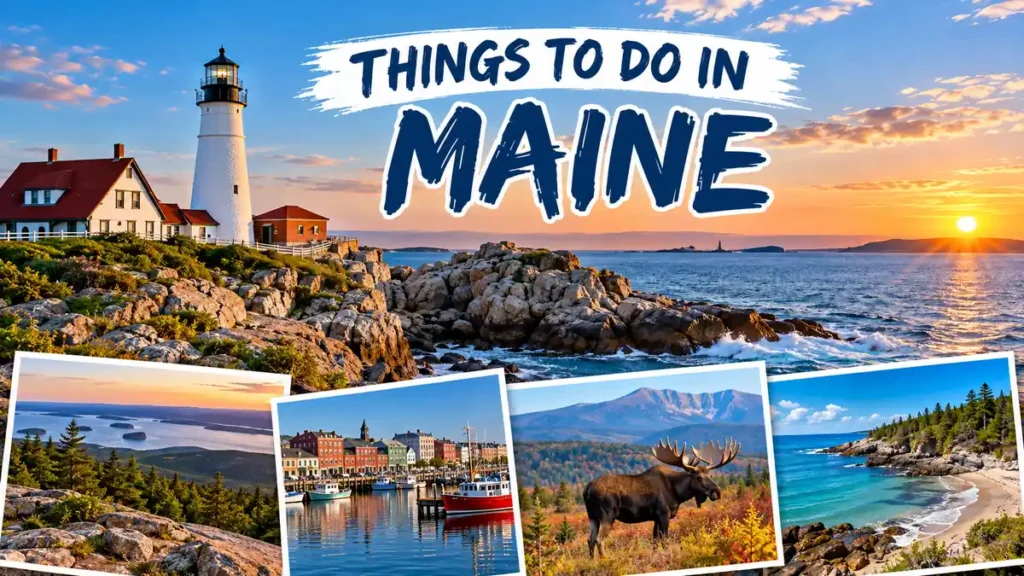
Maine has a way of making a simple road trip feel like an adventure. One hour you can be walking beside a working harbor, and a few hours later you could be hiking a granite mountain, watching for moose, or standing beside a lighthouse above the Atlantic.
The best things to do in maine include exploring Acadia National Park, visiting Portland and Bar Harbor, touring historic lighthouses, eating fresh Maine lobster, sailing the coast, spotting wildlife, hiking Mount Katahdin, relaxing on southern beaches, and driving through colorful mountain landscapes. The state offers worthwhile experiences in every season. Visit Maine
Maine is much bigger and more varied than its famous rocky coastline suggests. A good trip combines coastal scenery with at least one inland experience, whether that means hiking, paddling, visiting a lake, or heading into Maine’s North Woods.
1. Explore Acadia National Park
For first-time visitors, Acadia National Park is an obvious place to begin.
The park brings together granite mountains, rocky Atlantic shoreline, forests, ponds, historic carriage roads, and scenic overlooks on and around Mount Desert Island. Hiking is only part of the experience. Visitors can bike the carriage roads, watch birds, explore tide pools, go boating, swim in designated areas, and join ranger programs. National Park Service
Popular stops include Cadillac Mountain, Jordan Pond, Sand Beach, Thunder Hole, and Ocean Path. The National Park Service also highlights 45 miles of historic carriage roads, making cycling one of the best alternatives to driving around the park. National Park Service
Take the Park Loop Road
If you have limited time, the Park Loop Road connects many of Acadia’s signature landscapes. Stop frequently rather than treating it simply as a scenic drive.
Ocean Path is particularly useful for travelers who want impressive coastal views without committing to a strenuous mountain hike.
See Cadillac Mountain
Cadillac Mountain is one of Acadia’s best-known landmarks and offers expansive views across Mount Desert Island and the surrounding coastline.
Access arrangements can change seasonally, so check current National Park Service information before planning your visit.
Quick Takeaway: Give Acadia at least one full day. Two or three days are better if you want to combine hiking, carriage-road cycling, coastal sightseeing, and time in Bar Harbor.
2. Spend a Day in Bar Harbor
Bar Harbor sits on Mount Desert Island and serves as the principal gateway community for Acadia National Park. Visit Maine
The town works particularly well as a base because you can spend the morning hiking and return for restaurants, shops, galleries, and waterfront views later in the day.
Walk around downtown, explore the waterfront, browse independent shops, and look across Frenchman Bay. Boat trips departing from the area can add wildlife watching or coastal sightseeing to an Acadia itinerary.
Bar Harbor becomes especially busy during peak summer and fall periods. Starting your sightseeing early can make both parking and popular trails easier to manage.
3. Discover Portland’s Old Port and Waterfront
Maine’s biggest city offers a completely different experience from Acadia.
Portland combines a working waterfront with historic architecture, museums, restaurants, breweries, galleries, shops, and easy access to Casco Bay.
The Old Port is the natural starting point. Its cobblestone streets and historic buildings make it pleasant to explore on foot, while the waterfront keeps Portland’s maritime identity visible even in the center of the city. The wider region also offers beaches, islands, cruises, historic sites, and outdoor recreation. Visit Portland
Consider combining a walk through the Old Port with the Portland Museum of Art and a trip onto Casco Bay.
4. Visit Portland Head Light
A Maine trip without seeing at least one lighthouse feels incomplete.
Portland Head Light in Cape Elizabeth is among the state’s most recognizable coastal landmarks. Its location within Fort Williams Park makes it easy to combine lighthouse photography with ocean views and a walk along the coast.
Maine has more than 60 historic lighthouses scattered along its coast, according to the Maine Office of Tourism. Many cannot normally be entered, so checking access conditions before traveling specifically to climb a tower is worthwhile. Visit Maine
Other notable lights include Pemaquid Point, Marshall Point, Bass Harbor Head, and West Quoddy Head.
5. Follow a Maine Lighthouse Route
Instead of seeing one lighthouse, turn several into a coastal road trip.
Maine’s unusual shoreline means its lighthouses appear in very different settings. Some overlook rocky headlands, others mark harbor entrances, and still others sit offshore.
A lighthouse-focused trip can include:
- Portland Head Light near Portland
- Cape Neddick “Nubble” Light in York
- Pemaquid Point Lighthouse in Bristol
- Marshall Point Light in Port Clyde
- Owls Head Light near Rockland
- Bass Harbor Head Light on Mount Desert Island
- West Quoddy Head Light near Lubec
The Maine Office of Tourism notes that some lighthouse sites include museums, while Maine Open Lighthouse Day provides special access to a number of locations each September. Visit Maine
Allow extra time between stops. Coastal Maine roads can be slow, and the villages, harbors, and viewpoints encountered along the way are often as enjoyable as the lighthouses themselves.
6. Eat Maine Lobster
Few foods are as closely associated with a state as lobster is with Maine.
You can eat it steamed with butter, tucked into a lobster roll, incorporated into chowder, or served at an informal waterfront lobster shack.
For a classic experience, look for a restaurant or lobster pound near a working harbor. The atmosphere is part of the attraction: picnic tables, salt air, fishing boats, and a straightforward meal.
Maine’s food scene goes well beyond lobster. Clams, oysters, haddock, blueberries, whoopie pies, maple products, and craft beverages all have strong regional connections.
The official tourism site even highlights oyster-farm tours and lobster-boat tours among its signature experiences. Visit Maine
7. Take a Lobster Boat Tour
If eating lobster tells you something about Maine’s cuisine, a lobster boat trip explains part of the culture behind it.
Some coastal tours demonstrate how traps are hauled and how the lobster fishery operates. They can be especially entertaining for families because the experience mixes sightseeing with practical information about Maine’s working waterfront.
Portland is one place where lobster-boat excursions are promoted as a visitor experience. Visit Maine
Bring an extra layer even during summer. Temperatures on the water can feel considerably cooler than they do downtown.
8. Sail on a Traditional Maine Windjammer
A windjammer cruise offers a slower way to experience the coast.
Traditional tall-masted schooners sail through bays dotted with islands, fishing communities, and wooded shorelines. Maine’s tourism office identifies windjammer sailing as one of the state’s signature experiences. Visit Maine
Trips range from shorter excursions to multi-day voyages.
If you enjoy scenery more than speed, sailing can provide a very different perspective on the Maine coast than driving from town to town.
9. Ride a Ferry Across Casco Bay
You do not necessarily need an organized sightseeing cruise to get onto the water.
From Portland, ferries connect the mainland with island communities across Casco Bay. Even a simple round trip provides harbor views, ocean air, islands, and a different perspective on Portland’s waterfront.
The Greater Portland tourism organization specifically recommends Casco Bay ferry trips as a way to explore the region. Visit Portland
For travelers spending only a weekend in Portland, this is one of the easiest ways to add a genuine coastal experience without driving far from the city.
10. Explore Maine’s Midcoast Towns
The Midcoast rewards travelers who resist the temptation to drive directly from Portland to Acadia.
Towns such as Camden, Rockland, Rockport, Bath, Belfast, and Boothbay Harbor provide a mix of maritime history, galleries, restaurants, sailing, museums, and classic New England streetscapes.
Camden is particularly memorable because mountains rise close to the harbor.
This region works well for a relaxed road trip. Rather than building a rigid attraction-by-attraction schedule, leave time to stop at small harbors, roadside seafood stands, antique shops, and coastal viewpoints.
11. Walk Marginal Way in Ogunquit
For accessible coastal scenery in southern Maine, head to Ogunquit.
Marginal Way is a roughly 1.5-mile coastal walkway between the Shore Road area and Perkins Cove. The route follows the rocky Atlantic shoreline and has become one of the area’s best-known attractions. Tripadvisor
Because the walk is relatively short, it fits easily into a southern Maine day trip.
Afterward, explore Perkins Cove or spend time on Ogunquit’s beach.
12. Enjoy Maine’s Southern Beaches
Maine is famous for cliffs and rocky shorelines, but it also has broad sandy beaches.
Ogunquit, Old Orchard Beach, York, Wells, and Kennebunk-area beaches are popular choices in southern Maine. The region is especially practical for families who want traditional beach time alongside the state’s lighthouses and seafood.
Summer brings the warmest beach weather and the biggest crowds.
The Atlantic remains cool compared with many southern U.S. beach destinations, so the Maine beach experience is often as much about walking, scenery, and relaxing on the sand as swimming.
13. Visit Kennebunkport
Kennebunkport combines historic New England character with beaches, coastal scenery, galleries, boutiques, and restaurants.
Dock Square is the center of activity for many visitors. From there, you can explore nearby coastal roads, visit beaches, take a boat trip, or simply spend an afternoon walking around town.
Kennebunkport also fits naturally into a southern Maine itinerary with Ogunquit and York.
For travelers arriving from Boston or elsewhere in southern New England, these communities can provide an appealing introduction before continuing north toward Portland.
14. See Mount Katahdin and Baxter State Park
Coastal Maine receives most of the travel attention, but the state’s interior can feel dramatically wilder.
Baxter State Park is home to Katahdin, Maine’s highest mountain and the northern terminus of the Appalachian Trail.
This is serious mountain country rather than a casual roadside attraction. Hiking Katahdin requires preparation, appropriate fitness, weather awareness, and advance planning.
Even travelers who do not attempt the summit can enjoy wilderness scenery and other outdoor opportunities in the region. Greater Portland’s tourism site notes that Baxter offers more than 200 miles of trails as well as fishing and paddling opportunities. Visit Portland
If your idea of Maine involves forests and mountains rather than restaurants and coastal villages, put the Katahdin region high on your itinerary.
15. Look for Moose
Maine is one of the places where travelers often hope to see a moose in the wild.
Sightings are more likely in appropriate inland habitat than around the busiest coastal destinations. The Maine Office of Tourism promotes guided moose safaris into the state’s forested interior as one of its signature visitor experiences. Visit Maine
A Registered Maine Guide can be particularly useful because local guides understand habitat, seasonal behavior, and suitable viewing locations.
Never approach a moose. They are large wild animals, and viewing them from a safe distance protects both visitors and wildlife.
16. Take a Puffin Cruise
Puffins add another dimension to Maine wildlife watching.
Boat excursions can take visitors toward offshore nesting areas where viewing is possible from the water. The official tourism site highlights puffin cruises and references the National Audubon Society’s restoration area. Visit Maine
These trips are seasonal, so check operating dates before building your itinerary around one.
Bring binoculars if you have them. Wildlife encounters are far more satisfying when you are prepared to observe animals from a respectful distance.
17. Explore Maine’s Lakes
Maine’s coastline gets the postcards, but its lakes define a huge part of the state’s outdoor culture.
The inland landscape is filled with freshwater opportunities for canoeing, kayaking, fishing, swimming, boating, and camping. Travel + Discover Maine
Moosehead Lake is one of the best-known destinations for travelers seeking a more remote Maine experience.
The Rangeley Lakes region is another excellent option, particularly when scenic drives, hiking, wildlife, and fall foliage are priorities.
If your trip lasts a week or longer, spending a few days on the coast and a few days in lake country reveals how different Maine’s regions can feel.
18. Go Whitewater Rafting
Maine’s rivers provide a more energetic alternative to quiet lake paddling.
Whitewater rafting is available in the state’s interior, where outfitters run trips suited to different experience levels and conditions. Maine tourism resources consistently feature rafting among the state’s major outdoor activities. Travel + Discover Maine
For beginners, booking with an established guide is the sensible approach.
A rafting day also pairs naturally with camping, hiking, or a longer North Woods trip.
19. Shop and Explore Freeport
Freeport is best known as the home of the L.L.Bean flagship store, which the Maine Office of Tourism lists among notable visitor experiences. Visit Maine
Shopping is only part of the reason to stop.
Nearby outdoor areas allow you to combine downtown browsing with walking, birdwatching, or coastal scenery. Wolfe’s Neck Woods State Park, for example, is close to downtown Freeport and is known for its natural setting and birdlife. Visit Portland
That combination makes Freeport an easy stop between Portland and Midcoast Maine.
20. Visit Maine’s Museums
Bad weather does not mean losing a vacation day.
Portland Museum of Art is one of the major cultural attractions in Portland, while maritime and local-history museums around the state provide context for Maine’s fishing, shipbuilding, lighthouse, and seafaring traditions.
Portland also has the historic Portland Observatory, a maritime signal tower dating to 1807. Travel + Discover Maine
Rockland has become another strong arts destination, making it easy to pair galleries and museums with a Midcoast road trip.
Museums are especially useful in spring and late fall when outdoor conditions can change quickly.
21. See Maine’s Fall Foliage
Autumn transforms Maine’s forests into one of the state’s biggest seasonal attractions.
Scenic driving is often the easiest way to experience it. Inland routes around Rangeley, the western mountains, Moosehead Lake, and the Katahdin region can be particularly rewarding, while Acadia and Camden provide the unusual combination of autumn color and ocean scenery.
Do not assume the entire state reaches peak color simultaneously. Maine stretches hundreds of miles from south to north, and conditions vary by location, elevation, and weather.
If fall color is the main purpose of your trip, check current foliage reports close to your travel dates.
22. Go Stargazing
Maine’s less-developed landscapes create excellent opportunities for viewing dark night skies.
Acadia includes stargazing among its visitor activities, and the Maine Office of Tourism specifically promotes night-sky viewing as a distinctive experience. Visit Maine
For the best experience, move away from artificial lights and give your eyes time to adjust.
A clear, moonless night can transform a rural Maine trip, especially if you normally live in a brightly illuminated city.
23. Experience Maine in Winter
Maine does not shut down after fall.
Winter simply changes the activities.
Depending on the destination and conditions, visitors can ski, snowboard, cross-country ski, snowshoe, snowmobile, or simply enjoy a quiet cabin surrounded by snow. Maine tourism resources identify skiing, snowshoeing, snowmobiling, and other cold-weather recreation as major seasonal activities. Travel + Discover Maine
Sugarloaf and Sunday River are among the state’s prominent ski destinations. National Geographic notes that both can sometimes continue operating into spring. National Geographic
Winter trips require more planning than summer ones, particularly when driving into rural areas. Check road and weather conditions and carry appropriate clothing.
24. Take a Scenic Maine Road Trip
One of the best things to do in Maine is not a single attraction at all: drive.
The state rewards slow travel.
A classic coastal itinerary can begin around York and Ogunquit, continue through Portland and Freeport, cross the Midcoast through towns such as Rockland and Camden, and finish at Bar Harbor and Acadia.
For a more ambitious trip, turn inland toward Baxter State Park, Moosehead Lake, or the western mountains.
A Simple 7-Day Maine Itinerary
| Day | Area | Main Experiences |
|---|---|---|
| 1 | Ogunquit & York | Beach, Marginal Way, Nubble Light |
| 2 | Portland | Old Port, food, museums, waterfront |
| 3 | Greater Portland & Freeport | Portland Head Light, Casco Bay, Freeport |
| 4 | Midcoast | Rockland, Camden, harbor scenery |
| 5 | Bar Harbor | Downtown, waterfront, boat excursion |
| 6 | Acadia | Park Loop Road, hiking, Jordan Pond |
| 7 | Acadia | Cadillac Mountain, carriage roads, coastline |
Trying to cover both the far northern interior and the entire coast in a short visit can turn a vacation into hours of driving. Maine is a long state, so concentrating on two or three regions usually produces a better trip.
25. Leave Time for Small-Town Maine
The famous attractions may get you to Maine, but unplanned stops often provide the strongest sense of place.
Take the road that follows the coast. Stop at a small harbor. Walk into an independent bookstore. Visit a farm stand. Try a roadside lobster shack. Spend an hour in a town you had not planned to visit.
This works particularly well in Midcoast and DownEast Maine, where communities are separated by forests, bays, peninsulas, and working waterfronts.
You do not need every hour scheduled.
Maine is particularly well suited to wandering.
Best Things to Do in Maine by Interest
Choosing among so many things to do in maine becomes easier when you decide what kind of trip you want.
| If You Like… | Consider… |
|---|---|
| Hiking | Acadia, Baxter State Park, Camden Hills |
| Coastal scenery | Acadia, Ogunquit, Midcoast Maine |
| Food | Portland, lobster shacks, oyster experiences |
| Wildlife | Moose safaris, puffin cruises, birdwatching |
| Beaches | Ogunquit, York, Wells, Old Orchard Beach |
| History | Lighthouses, maritime museums, Portland |
| Sailing | Casco Bay, Midcoast windjammer trips |
| Fall foliage | Rangeley, western mountains, Acadia |
| Winter sports | Sugarloaf, Sunday River |
| Quiet wilderness | Katahdin region, Moosehead Lake |
| Family activities | Acadia, beaches, boat tours, Portland |
| Photography | Lighthouses, harbors, mountains, fall foliage |
When Is the Best Time to Visit Maine?
There is no single best month because the experience changes dramatically with the seasons.
Summer offers the broadest range of activities. Hiking trails, beaches, boat tours, coastal towns, and restaurants are generally at their liveliest. It is also the busiest period in many famous destinations.
Fall brings foliage, crisp temperatures, and excellent road-trip conditions. It can be an ideal season for hiking and photography.
Winter is best for skiing, snowshoeing, snowmobiling, and quieter escapes.
Spring is a transitional season. Crowds can be lighter, but conditions are less predictable and some seasonal businesses or activities may not yet be operating.
Always verify current hours, reservations, road access, and seasonal operating schedules directly with parks and attractions before traveling.
How Many Days Do You Need in Maine?
Three days is enough for one concentrated region.
For example, a long weekend could focus on Portland and the southern coast or Bar Harbor and Acadia.
Five to seven days gives you considerably more flexibility. You can combine Portland, Midcoast Maine, and Acadia without making every day primarily about driving.
With 10 days or more, adding western or northern Maine becomes much more practical.
The mistake first-time visitors commonly make is underestimating travel distances. Maine stretches far beyond its southern coast, and coastal roads are rarely designed for getting somewhere quickly.
What Are the Best Free Things to Do in Maine?
Many of Maine’s memorable experiences require little or no spending beyond transportation or applicable park fees.
Walking through historic coastal towns, exploring beaches, photographing lighthouses from public viewpoints, watching fishing boats in a harbor, driving scenic roads, and enjoying fall foliage can fill an itinerary without expensive attractions.
Hiking and walking are especially good choices, although individual parks may charge entrance or parking fees.
For an inexpensive Portland experience, walk the Old Port and waterfront before exploring the Eastern Promenade or taking an affordable ferry ride across Casco Bay.
What Are the Best Things to Do in Maine With Kids?
Families can build a Maine trip around nature without requiring children to complete difficult hikes.
Short Acadia walks, beaches, tide pools, boat rides, lighthouse stops, wildlife watching, and hands-on museums provide plenty of variety. Acadia also offers a Junior Ranger Program for younger visitors. Maine Tourism
A good family itinerary alternates active days with slower ones. A morning hike followed by ice cream and harbor time, for example, is often more successful than trying to fit several major attractions into one day.
What Should You Not Miss on Your First Trip to Maine?
If time is limited, prioritize experiences that show different sides of the state rather than visiting several similar attractions.
Start with Acadia National Park for Maine’s mountain-meets-ocean landscape. Spend time in Portland for food, culture, and the working waterfront. Visit at least one lighthouse, eat local seafood, explore a smaller coastal community, and get onto the water if conditions allow.
Then add an inland experience if your schedule permits.
That combination explains why Maine is more than a collection of postcard views. Its character comes from the relationship between ocean, forests, mountains, lakes, working communities, wildlife, and food.
Planning Your Maine Experience
The biggest challenge when choosing things to do in maine is accepting that you probably cannot do everything in one trip.
That is not a bad problem to have.
For a first visit, build the itinerary around two or three anchor destinations and leave room between them. Acadia and Bar Harbor deliver the dramatic landscapes; Portland provides food and culture; Midcoast Maine supplies small harbors and maritime character; the southern coast brings beaches; and the interior opens into lakes, mountains, rivers, and wilderness.
Maine is at its best when you do not rush it. Pick a coastline to follow, a mountain to climb, a harbor to explore, and something local to eat. Then leave enough unscheduled time to discover the places you did not know you were looking for.