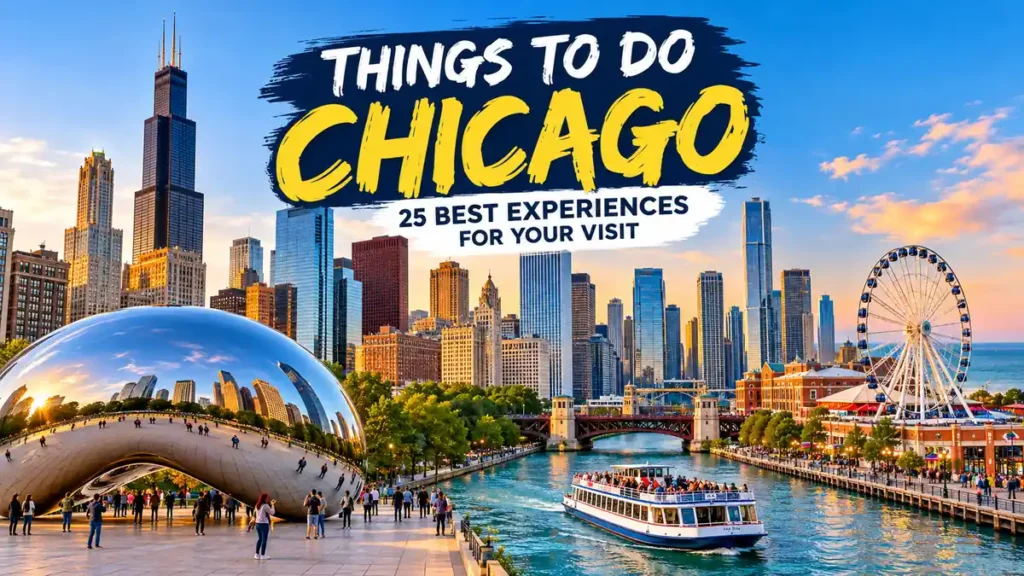
Chicago rewards visitors who do more than rush from one landmark to another. The city combines dramatic architecture, Lake Michigan beaches, major museums, public art, distinctive neighborhoods, comedy, blues, baseball, and one of America’s most varied food scenes. The challenge is not finding something to do—it is deciding what deserves your time.
If you are searching for things to do chicago, start with Millennium Park, an architecture river cruise, the Art Institute of Chicago, the Chicago Riverwalk, and the lakefront. Then explore beyond downtown in neighborhoods such as Hyde Park, Chinatown, Wicker Park, Lincoln Park, and the West Loop. Choose Chicago
This guide covers Chicago’s essential attractions, free experiences, museums, food, neighborhoods, family activities, and practical ways to organize a first visit.
Best Things to Do Chicago for First-Time Visitors
First-time visitors do not need to see everything. A better approach is to experience the features that make Chicago distinctive: architecture, art, the waterfront, neighborhoods, and food.
For a short trip, prioritize these experiences:
| Experience | Best For | Area | Time to Allow |
|---|---|---|---|
| Millennium Park | First-time sightseeing | Loop | 1–2 hours |
| Architecture river cruise | Architecture and history | Chicago River | 1.5–2 hours |
| Art Institute of Chicago | Art and culture | Loop | 2–4 hours |
| Chicago Riverwalk | Walking and views | Downtown | 1–2 hours |
| Museum Campus | Families and museums | Near South Side | Half/full day |
| Navy Pier | Families and lake views | Streeterville | 2–3 hours |
| Skydeck Chicago | Skyline views | Loop | 1–2 hours |
| Lincoln Park | Parks and zoo | North Side | Half day |
| Hyde Park | History and museums | South Side | Half/full day |
| West Loop | Dining | West Side | Evening |
Chicago’s official tourism organization similarly highlights Millennium Park, Navy Pier, Museum Campus, observation decks, architecture tours, neighborhoods, live entertainment, and the dining scene as core first-visit experiences. Choose Chicago
1. Start at Millennium Park and Cloud Gate
Millennium Park is one of the easiest places to begin exploring Chicago because several famous sights are concentrated within a relatively small downtown area.
The best-known attraction is Cloud Gate, Anish Kapoor’s reflective sculpture commonly called “The Bean.” Its curved stainless-steel surface reflects Chicago’s skyline and the people walking around it, creating a different perspective from almost every position.
But stopping at Cloud Gate and immediately leaving means missing much of the park.
Explore Crown Fountain, the landscaped Lurie Garden, and the Frank Gehry-designed Jay Pritzker Pavilion. The pavilion hosts outdoor programming during warmer months, while seasonal activities change throughout the year.
Millennium Park is free, making it one of the best options for travelers trying to keep sightseeing costs under control. Choose Chicago
Quick takeaway: Visit early in the morning for a quieter look at Cloud Gate, then continue south toward the Art Institute.
2. Take a Chicago Architecture River Cruise
Few experiences explain Chicago as efficiently as an architecture cruise.
From the Chicago River, you can see how different periods of architecture shaped the downtown skyline while learning why Chicago became so influential in modern building design. Instead of simply looking at skyscrapers from the sidewalk, a narrated cruise provides historical context for what you are seeing.
Architecture cruises consistently appear among Chicago’s signature visitor experiences, and they are especially useful near the beginning of a trip because they help you understand the layout of downtown. Tripadvisor
You will encounter buildings representing different architectural eras and styles along the river corridor.
For photography, daytime departures usually provide clearer building details. An evening cruise offers a different experience as downtown begins to light up.
Book ahead when visiting during busy weekends or peak tourism periods because popular departures can fill.
3. Explore the Art Institute of Chicago
The Art Institute of Chicago deserves more than a quick walk through its galleries.
Located beside Millennium Park, the museum contains a vast collection spanning centuries, cultures, and artistic movements. Its strengths include Impressionist and Post-Impressionist works, American art, modern art, photography, decorative arts, and works from around the world.
The museum is routinely placed among Chicago’s top attractions by major travel guides and visitor rankings. Tripadvisor
Trying to see every gallery can become exhausting. If you have only a few hours, choose several collections that interest you most and explore them properly.
The Art Institute pairs naturally with Millennium Park because the two attractions are within easy walking distance.
4. Walk the Chicago Riverwalk
The Chicago Riverwalk gives you a ground-level perspective of the same architecture seen on river cruises.
The pedestrian waterfront runs through the heart of downtown, passing skyscrapers, bridges, public spaces, restaurants, and places to sit beside the river.
It is particularly enjoyable when the weather is comfortable.
Instead of treating the Riverwalk as another attraction to check off a list, use it as a route between downtown destinations. Walking beside the river lets you experience the changing skyline without adding another ticket to your budget.
For photographers, late afternoon and early evening can be especially rewarding as the light changes on the surrounding buildings.
5. See Chicago from Skydeck
Chicago looks completely different from above.
Skydeck Chicago, located in Willis Tower, provides sweeping views over the city and surrounding region. Its best-known feature is The Ledge, a series of glass boxes extending beyond the building.
For some visitors, stepping onto transparent glass high above the streets is exhilarating. For others, simply approaching it is enough.
If skyline photography matters to you, consider timing your visit around sunset. Remember that sunset periods are popular, so advance planning can help.
Skydeck and 360 CHICAGO are both commonly recommended observation experiences for first-time visitors. Choose Chicago
You generally do not need both on a short trip. Choose one observation deck and spend the saved time exploring another part of the city.
6. Visit Navy Pier
Stretching into Lake Michigan, Navy Pier combines waterfront scenery with entertainment, public spaces, dining, cruises, and family activities.
One of its recognizable features is the Centennial Wheel, which provides elevated views across the lake and skyline.
But you do not have to pay for rides to enjoy the pier.
Walking the public areas, looking across Lake Michigan, viewing public art, and enjoying the atmosphere can fill an hour or two without turning the visit into an expensive outing. Navy Pier also serves as a departure point for various sightseeing cruises. Choose Chicago
Families can spend significantly longer here, particularly when combining the pier with nearby attractions.
7. Spend a Day at Museum Campus
Chicago’s Museum Campus places three major institutions near the Lake Michigan shoreline:
- Field Museum
- Shedd Aquarium
- Adler Planetarium
Trying to explore all three properly in a single day can feel rushed. Pick one major museum if you only have a weekend, or spread them across multiple days during a longer trip.
The Field Museum is particularly strong for natural history, while Shedd Aquarium focuses on aquatic life. The Adler Planetarium explores astronomy and space science.
Museum Campus also offers excellent views back toward Chicago’s skyline. Even visitors who do not enter a museum can enjoy walking along the lakefront.
Chicago’s official visitor guide identifies these institutions as key parts of the city’s museum experience. Choose Chicago
8. Discover the Griffin Museum of Science and Industry
For interactive exhibits, head south to Hyde Park and the Griffin Museum of Science and Industry.
The museum is especially appealing to families because many exhibits are designed around exploration rather than simply observing objects behind glass.
Science, technology, transportation, engineering, and human innovation are major themes.
The museum’s location also provides a reason to explore Hyde Park rather than spending your entire trip downtown.
Allow several hours. This is not a museum that works particularly well as a 30-minute stop.
9. Explore the Obama Presidential Center
Hyde Park has become even more significant for visitors with the Obama Presidential Center, which is among the major Chicago attractions highlighted in 2026 visitor guidance. Choose Chicago
The center adds another major cultural and civic destination to Chicago’s South Side and can be incorporated into a broader Hyde Park day.
Rather than traveling south for one attraction and immediately returning downtown, combine your visit with the Griffin Museum of Science and Industry, Jackson Park, local restaurants, and other neighborhood sights.
That approach gives you a more complete view of Chicago beyond the Loop.
10. Visit Lincoln Park Zoo
Traveling with children—or simply looking for a budget-friendly activity?
Lincoln Park Zoo is one of the city’s classic attractions and fits naturally into a day exploring the North Side.
The surrounding Lincoln Park area gives the visit additional value. You can combine the zoo with green spaces, lakefront walks, nearby restaurants, and neighborhood streets.
This is also a useful alternative when you have already spent a day inside museums and want more time outdoors.
11. Walk or Bike Along Lake Michigan
Chicago’s relationship with Lake Michigan is one of the defining features of the city.
The Lakefront Trail stretches for approximately 18 miles and connects numerous parks, beaches, and neighborhoods. It provides space for walking, running, and cycling while offering constantly changing views of the water and skyline. Chicago Park District
You do not need to complete the entire route.
Pick a section close to the attractions you are already visiting and spend an hour walking or cycling.
As of September 2026, the Chicago Park District has announced repairs affecting sections of the Lakefront Trail, so checking current trail conditions before a long ride is sensible. Chicago Park District
12. Relax on a Chicago Beach
Yes, Chicago has real beaches.
During warmer months, Lake Michigan gives the city an experience that can feel surprisingly far removed from a dense urban center.
Popular lakefront areas let visitors swim when conditions permit, relax on the sand, play volleyball, cycle, or simply enjoy the skyline.
Beach conditions are seasonal, so always check local information regarding swimming status and lifeguard coverage.
If you visit during summer, adding a beach afternoon can provide a welcome break between museum and architecture-heavy sightseeing days.
13. Step Inside the Chicago Cultural Center
One of Chicago’s best free indoor attractions is the Chicago Cultural Center.
The historic building is known for ornate interiors, including its Tiffany glass dome, while its cultural programming includes exhibitions, performances, and events.
Admission and many programs are free. City of Chicago
Its downtown location makes it easy to combine with Millennium Park.
This is particularly useful on a rainy or cold day when you want an indoor activity without buying another museum ticket.
14. Explore the Magnificent Mile
Michigan Avenue’s Magnificent Mile is Chicago’s best-known shopping corridor.
Even if shopping is not part of your plans, walking the area gives you access to historic buildings, modern skyscrapers, restaurants, hotels, and nearby attractions.
The neighborhood also puts you near 360 CHICAGO and the historic Water Tower.
Rather than setting aside an entire day for the Magnificent Mile, work it into a route connecting downtown and Streeterville.
15. See the Skyline from 360 CHICAGO
Located high above Michigan Avenue, 360 CHICAGO provides another major skyline-viewing experience.
The key difference from Skydeck is perspective.
Where Willis Tower gives you a view from the Loop, 360 CHICAGO’s position closer to the lake provides a striking look at Lake Michigan and the city stretching along its shoreline.
If you only want one observation deck, choose based on location and itinerary rather than trying to determine which is universally “better.”
Skydeck is convenient when exploring the Loop. 360 CHICAGO works naturally with the Magnificent Mile and North Side.
16. Explore Chicago’s Neighborhoods
One of the biggest mistakes first-time visitors make is treating downtown Chicago as the entire city.
It isn’t.
Chicago’s neighborhoods reveal different combinations of architecture, immigrant history, food, nightlife, independent businesses, parks, and local culture.
Consider exploring areas such as:
- Hyde Park for museums, history, and architecture
- Chinatown for food and cultural experiences
- Pilsen for Mexican-American culture and murals
- Wicker Park for independent shops and nightlife
- Logan Square for restaurants, bars, and neighborhood atmosphere
- Lincoln Park for parks and family attractions
- Andersonville for local businesses and a more relaxed neighborhood feel
- West Loop for restaurants and nightlife
Major travel guides increasingly recommend neighborhood exploration alongside traditional downtown attractions. Lonely Planet
Pick one or two neighborhoods rather than racing through five.
17. Eat Classic Chicago Food
Sightseeing is only half the Chicago experience.
The city has an extensive dining culture ranging from neighborhood counters to celebrated fine-dining restaurants. Choose Chicago notes that Chicago has more than 7,000 restaurants and a strong history of James Beard-recognized dining. Choose Chicago
For a first visit, try a few foods associated with the city.
Deep-dish pizza
Deep dish is probably Chicago’s most internationally recognized food. Its thick crust and layered construction make it very different from a typical thin pizza.
Chicago-style hot dog
The classic version usually combines a beef hot dog with a distinctive selection of toppings. Ordering one gives you an inexpensive taste of Chicago food culture.
Italian beef
Thinly sliced beef, bread, jus, and peppers create one of the city’s essential sandwiches.
Jibarito
The jibarito uses fried plantains instead of conventional bread and represents another side of Chicago’s food identity. Choose Chicago includes it among the city’s iconic dishes. Choose Chicago
Do not spend your entire trip eating only famous tourist foods, though. Chicago’s neighborhoods provide an enormous range of Mexican, Chinese, Polish, Indian, Middle Eastern, Italian, Korean, Puerto Rican, and other cuisines.
18. Spend an Evening in the West Loop
The West Loop and Fulton Market are strong choices when food is a major part of your trip.
Former industrial spaces now sit alongside busy restaurants, bars, hotels, and modern developments.
Randolph Street has long been associated with the area’s dining scene, while Fulton Market has evolved into one of Chicago’s major entertainment and restaurant districts. Choose Chicago
Reservations are useful for popular restaurants, particularly on Friday and Saturday nights.
If you are more interested in casual food than destination dining, explore before deciding where to eat instead of planning the evening around one famous restaurant.
19. Experience Chicago Blues and Jazz
Chicago’s influence on American music makes live music more than just nighttime entertainment.
The city has deep connections to Chicago blues and a long jazz tradition. Smaller clubs can often provide a more memorable experience than large concert venues because the audience is closer to the musicians.
Check current schedules before choosing a venue, especially if you are interested in a particular style or performer.
A live music night works particularly well after a daytime itinerary focused on museums or architecture.
20. See Chicago Comedy and Improv
Chicago’s comedy scene has helped develop generations of performers, writers, and improvisers.
An improv or comedy performance gives you something distinctly different from daytime sightseeing.
Shows vary from accessible mainstream performances to experimental productions in smaller venues, so check the format before booking.
For visitors with only two or three nights in Chicago, choosing either live blues, jazz, theatre, or improv gives the trip a cultural dimension that another evening of sightseeing cannot replace.
Chicago’s official first-time visitor guide specifically recommends experiencing the city’s theatre, improv, and music scenes. Choose Chicago
21. Catch a Chicago Sports Game
Chicago takes sports seriously.
Depending on the season, visitors may be able to see:
- Chicago Cubs at Wrigley Field
- Chicago White Sox
- Chicago Bulls
- Chicago Blackhawks
- Chicago Bears
- Chicago Fire FC
Even travelers who are not devoted sports fans may enjoy the atmosphere around a live game.
Wrigley Field is particularly notable because of its long baseball history and its location within a lively neighborhood. The surrounding Wrigleyville area becomes part of the experience on game days.
Check schedules well before your trip if attending a specific game is important.
22. Visit Garfield Park Conservatory
When the weather turns cold, rainy, or simply unpleasant, the Garfield Park Conservatory provides a welcome change.
The conservatory houses extensive plant collections in large indoor spaces and is frequently included among Chicago attractions worth exploring beyond the downtown core. Choose Chicago
It works particularly well for travelers interested in gardens, plants, photography, or quieter attractions.
Allow enough transportation time because it is west of the main downtown sightseeing zone.
23. Explore Chinatown
Chicago’s Chinatown is worth visiting for more than one meal.
Walk around the neighborhood, explore local shops, visit cultural landmarks, and sample dishes from restaurants and bakeries.
Ping Tom Memorial Park also provides an appealing outdoor space with views toward the Chicago skyline.
The neighborhood is relatively easy to incorporate into a multi-day trip and gives visitors another perspective on the city’s cultural diversity.
Come hungry rather than eating downtown immediately beforehand.
24. Find Chicago’s Public Art
You do not need a museum ticket to see significant art in Chicago.
Downtown and surrounding neighborhoods contain sculptures, murals, monuments, and architectural works in public spaces.
Cloud Gate is the obvious starting point, but it should not be the end.
Walking through the Loop reveals large-scale works and distinctive plazas, while neighborhoods such as Pilsen are known for murals and community art.
A public-art walk is one of the easiest ways to turn transportation between attractions into sightseeing itself.
25. Experience Chicago After Dark
Chicago does not shut down when museums close.
An evening can include a theatre performance, comedy show, blues club, rooftop view, sporting event, neighborhood restaurant, or a simple walk through illuminated downtown streets.
The Riverwalk and skyline feel noticeably different after sunset.
If your days are already packed, resist scheduling several nighttime attractions. One well-chosen evening experience usually feels better than rushing from dinner to an observation deck to a show.
Best Free Things to Do Chicago
Chicago can become expensive once museum admissions, cruises, meals, and observation decks start accumulating. Fortunately, several memorable experiences cost little or nothing.
Good free options include:
- Walking through Millennium Park
- Seeing Cloud Gate
- Exploring Crown Fountain and Lurie Garden
- Walking the Chicago Riverwalk
- Visiting the Chicago Cultural Center
- Exploring sections of the lakefront
- Walking through different neighborhoods
- Seeing public art
- Relaxing in city parks
- Visiting lakefront beaches when seasonally appropriate
- Exploring Navy Pier’s public areas
The Chicago Cultural Center is particularly valuable because it offers free exhibitions, events, and performances throughout the year. City of Chicago
A smart budget itinerary alternates paid attractions with free experiences instead of buying admission everywhere.
Things to Do Chicago With Kids
Families have plenty of choices, but children’s ages and interests should guide the itinerary.
For younger visitors, consider Lincoln Park Zoo, Navy Pier, Maggie Daley Park, Shedd Aquarium, and interactive museum experiences.
Older children and teenagers may enjoy Skydeck, an architecture cruise, the Griffin Museum of Science and Industry, sporting events, or cycling along the lakefront.
Maggie Daley Park, next to Millennium Park, is particularly convenient for families because it can break up a day otherwise dominated by museums and adult-oriented sightseeing. Seasonal offerings change, including winter activities. Choose Chicago
Avoid scheduling multiple large museums back-to-back with young children. Mixing one structured attraction with outdoor time usually makes the day easier.
What to Do in Chicago When It Rains
Rain does not have to ruin a Chicago itinerary.
Move toward indoor attractions such as:
- Art Institute of Chicago
- Field Museum
- Shedd Aquarium
- Adler Planetarium
- Griffin Museum of Science and Industry
- Chicago Cultural Center
- Indoor theatre or comedy performances
Keep at least one indoor attraction flexible rather than booking every hour of the trip.
Chicago weather can change quickly, and having an alternative plan prevents you from wasting half a day deciding what to do.
What Is the Best Time to Visit Chicago?
There is no universally perfect month because the city changes significantly with the seasons.
Spring
Spring can offer comfortable sightseeing temperatures, though conditions can be unpredictable. It is a good period for museums, architecture, parks, and neighborhoods.
Summer
Summer brings extensive outdoor activity, lakefront recreation, festivals, concerts, beaches, and longer daylight hours. It is also a busy visitor season.
Fall
Early fall is excellent for walking and neighborhood exploration. Cooler weather can make long days outside more comfortable.
Winter
Chicago winters can be cold, but museums, restaurants, theatre, comedy, conservatories, and indoor attractions keep the city active.
Seasonal activities also create experiences you cannot get during summer.
The right time depends less on finding “perfect” weather and more on choosing activities that suit the season.
How Many Days Do You Need in Chicago?
For most first-time visitors, three days provides a good introduction.
A one-day trip can cover Millennium Park, the Art Institute, Riverwalk, and an architecture cruise or observation deck. Choose Chicago recommends a similar concentration of central attractions for short first visits. Choose Chicago
With two days, add Museum Campus, Navy Pier, live entertainment, or the Magnificent Mile.
With three days, move beyond downtown and spend meaningful time in Hyde Park or another neighborhood.
Four or five days gives you much more freedom to explore the city rather than simply completing a sightseeing checklist.
A simple three-day Chicago itinerary
Day 1: Millennium Park → Art Institute → Chicago Riverwalk → architecture cruise.
Day 2: Museum Campus → lakefront → Navy Pier → evening entertainment.
Day 3: Hyde Park and the South Side, or Lincoln Park and a North Side neighborhood → dinner in the West Loop.
The important part is geographic grouping. Chicago is large, so jumping repeatedly between distant neighborhoods wastes time.
How to Get Around Chicago
Most visitors do not need a rental car for a sightseeing-focused stay.
The Chicago Transit Authority (CTA) operates the city’s train and bus network, while walking works well for attractions concentrated in the Loop and nearby downtown districts.
Ride-hailing services and taxis can help when destinations are poorly connected or when traveling late.
Cycling is another option, especially around the lakefront.
Before starting a long lakefront ride in late 2026, check current Chicago Park District notices because maintenance and temporary closures may affect parts of the Lakefront Trail. Chicago Park District
The simplest planning rule is to organize each day around one geographic area.
How to Make the Most of Your Chicago Visit
Do not measure a successful trip by the number of attractions you complete.
Chicago works best when you leave room to walk.
Take the architecture cruise, but also spend time beside the river. Visit a famous museum, but also see public art outside. Eat deep-dish pizza, but try a neighborhood restaurant that was never on your original list.
For major ticketed attractions, check official opening hours, admission policies, and reservation requirements shortly before visiting. Seasonal schedules can change.
Most importantly, do not stay exclusively around Michigan Avenue and the Loop. Downtown contains many of Chicago’s landmarks, but the neighborhoods provide much of the city’s personality.
For anyone researching things to do chicago, the strongest first trip combines five elements: architecture, Lake Michigan, art and museums, neighborhood exploration, and local food. Start with Millennium Park and the Chicago River, choose the museums that genuinely interest you, then give yourself enough unscheduled time to experience the city rather than simply checking it off a list.