What time will the sun set today? The answer depends on where you are, the date, and your local time zone. Even neighboring cities can experience sunset at slightly different times, while locations hundreds of miles apart may have significantly different schedules.
Sunset today is the local time when the Sun’s upper edge disappears below the horizon. The exact time varies by geographic location and season. To find an accurate sunset time, check a location-specific solar calendar that accounts for latitude, longitude, time zone, and atmospheric refraction.
What Time Is sunset today?
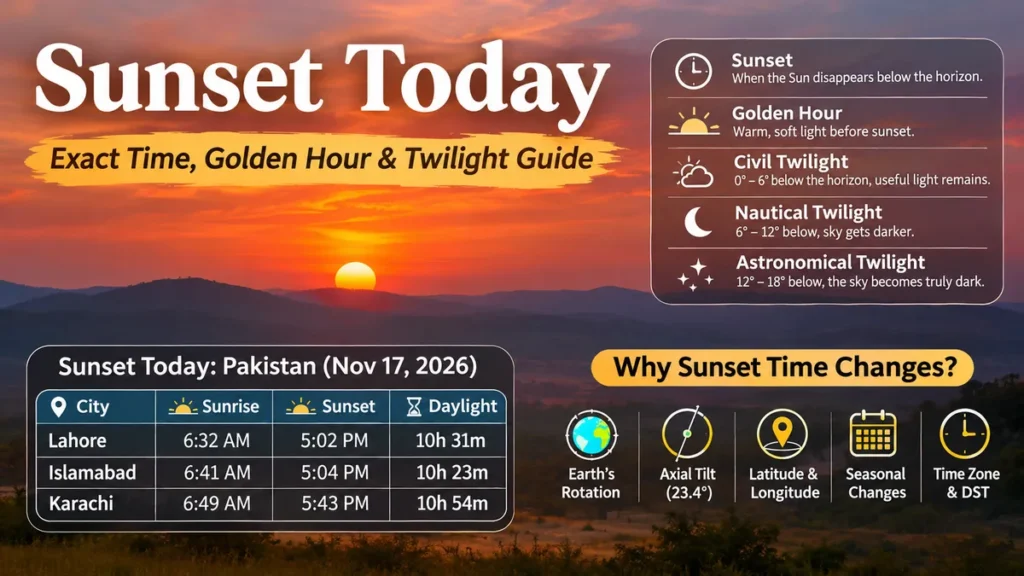
For Tuesday, November 17, 2026, sunset times vary across Pakistan and around the world.
Here are verified examples from major Pakistani cities.
| City | Sunset Today | Sunrise Today | Daylight Duration |
|---|---|---|---|
| Lahore | 5:02 PM | 6:32 AM | 10 hours 31 minutes |
| Islamabad/Rawalpindi area | 5:04 PM | 6:41 AM | 10 hours 23 minutes |
| Karachi | 5:43 PM | 6:49 AM | 10 hours 54 minutes |
All times are Pakistan Standard Time (PKT, UTC+5), November 17, 2026. Values are rounded to the nearest minute. Sources: Timeanddate solar calendars. Time and Date+2
These differences demonstrate why a nationwide sunset estimate cannot replace a city-specific calculation.
Karachi, for example, experiences sunset considerably later by the clock than Lahore on this date. Its more westerly longitude and lower latitude both contribute to the difference.
For the most reliable result, use your exact city rather than a country’s average sunset time.
How to Find the Exact Sunset Time for Your Location
Checking sunset time is straightforward, but choosing the correct location and date matters.
1. Search for Your City
Enter your city or town into a reliable sunrise and sunset calculator.
For example:
- Sunset time in Lahore today
- Sunset time in London today
- Sunset time in New York today
- Sunset time in Dubai today
A location-specific result is generally more useful than a broad regional estimate.
2. Check the Date and Time Zone
Make sure the displayed date matches your local calendar date.
This is particularly important when comparing countries across different time zones.
A sunset time listed as 18:30 means 6:30 PM in the location’s specified time zone, not necessarily your own.
3. Use an Astronomical Calculator
Reliable resources include:
- Timeanddate Sun Calculator — daily sunrise, sunset, solar noon, and twilight.
- NOAA Solar Calculator — astronomical calculations and solar position information.
- Sunrise-Sunset.org — sunrise and sunset calendars for selected locations.
These resources use astronomical calculations rather than weather forecasts to estimate when the Sun crosses the horizon.
4. Confirm the Local Horizon
Published sunset times usually assume a standard astronomical horizon.
If you are surrounded by mountains, tall buildings, or other obstacles, the Sun may disappear from your view earlier than the calculated sunset.
An elevated observation point with a clear western horizon may provide a different visible sunset experience.
Why Does sunset today Change by Location?
Sunset does not happen simultaneously everywhere on Earth.
Its timing is controlled primarily by Earth’s rotation, axial tilt, geographic coordinates, and the date.
Latitude and Longitude
Longitude helps determine when the Sun reaches a particular position in the sky relative to local clock time.
Places farther west within the same time zone generally experience solar events later by the clock, although latitude and seasonal effects also matter.
Latitude influences the Sun’s apparent path across the sky and the length of daylight.
Locations near the equator usually experience relatively consistent day lengths throughout the year. Higher-latitude locations have much greater seasonal variation.
Earth’s Axial Tilt
Earth’s rotational axis is tilted approximately 23.4 degrees relative to its orbital plane.
This tilt creates seasonal changes in daylight duration.
During summer, the Sun follows a longer apparent path above the horizon in the corresponding hemisphere. During winter, that path becomes shorter.
Consequently, sunset generally occurs later during summer and earlier during winter, although the exact timing of the earliest and latest sunsets does not necessarily coincide with the solstices.
Time Zones and Daylight Saving Time
Official clock time is influenced by political time-zone boundaries.
Two places with similar solar conditions may report different sunset times because they use different time zones.
Daylight saving time can also shift the displayed sunset by one hour without changing the Sun’s actual position.
For example, when clocks move forward in spring, sunset appears one hour later on the clock even though the underlying astronomical event changes only gradually.
Understanding Sunset, Golden Hour, and Twilight
Sunset is a specific astronomical event, but daylight does not disappear immediately afterward.
The period around sunset includes several distinct lighting conditions.
Stages of evening light
Illustrative sequence
Какво да правим през най-дългия ден в годината?
Golden hour
The sun is setting over the ocean on a cloudy day photo – Free Moon Image on Unsplash
Sunset
Civil twilight
Late twilight
Golden Hour Before Sunset
Golden hour describes the period when the Sun is low in the sky and produces warm, relatively soft natural light.
It is especially popular for landscape photography, outdoor portraits, and scenic observation.
Despite its name, golden hour does not always last exactly 60 minutes.
Its duration depends on latitude, season, atmospheric conditions, and the definition being used.
For practical photography planning, arriving 30–60 minutes before sunset is a useful starting point.
Civil Twilight
Civil twilight begins immediately after sunset and ends when the Sun’s center reaches approximately 6 degrees below the horizon.
During this period, enough natural light may remain for many outdoor activities, depending on weather and surroundings.
Streetlights may begin turning on, but the sky is not yet completely dark.
Nautical Twilight
Nautical twilight follows civil twilight.
It occurs while the Sun’s center is between 6 and 12 degrees below the horizon.
The horizon becomes increasingly difficult to distinguish, and brighter stars become more visible.
Historically, this period was important for marine navigation using celestial observations.
Astronomical Twilight
Astronomical twilight occurs when the Sun’s center is between 12 and 18 degrees below the horizon.
After evening astronomical twilight ends, the Sun contributes very little direct illumination to the night sky.
Under suitable conditions, this marks the beginning of astronomical night, when faint celestial objects can be observed more effectively.
The National Oceanic and Atmospheric Administration (NOAA) uses these solar-angle definitions in its astronomical terminology. NOAA Global Monitoring Laboratory+1
Sunset vs. Twilight: Key Differences
| Event | Sun’s Position | What You Observe |
|---|---|---|
| Sunset | Upper edge disappears below horizon | Sun vanishes from view |
| Civil twilight | Center 0° to 6° below horizon | Noticeable natural light |
| Nautical twilight | Center 6° to 12° below horizon | Darker sky, brighter stars |
| Astronomical twilight | Center 12° to 18° below horizon | Faint remaining sunlight |
| Astronomical night | Center more than 18° below horizon | Minimal solar sky illumination |
The angles in the twilight rows are conventional solar-center depression angles. At apparent sunset, the Sun’s center is already slightly below the geometric horizon.
How Long After sunset today Does It Get Dark?
One of the most common misconceptions is that darkness begins immediately when the Sun disappears.
In reality, the sky remains illuminated during twilight.
The time between sunset and full astronomical darkness depends heavily on latitude, season, and atmospheric conditions.
At many tropical and subtropical locations, civil twilight lasts approximately 20–35 minutes. Farther from the equator, it may last considerably longer.
Near the Arctic and Antarctic Circles, twilight can continue for hours during certain seasons.
When Does It Become Completely Dark?
There are two useful definitions of darkness.
Practical darkness occurs when there is no longer enough natural light for ordinary outdoor activities without artificial illumination.
Astronomical darkness begins when the Sun is at least 18 degrees below the horizon, assuming astronomical night occurs at that location and date.
These are not necessarily the same moment.
For example, if sunset occurs at 5:30 PM, the sky may look fairly dark by approximately 6:00 PM, while astronomical darkness may begin later.
Cloud cover, moonlight, artificial lighting, and local geography also affect how dark the surroundings appear.
Why Does the Sunset Time Change Every Day?
Sunset generally shifts by small amounts from one day to the next.
These changes are caused by the combined effects of Earth’s axial tilt, its elliptical orbit around the Sun, and the observer’s latitude.
Seasonal Changes in Sunset Time
In the Northern Hemisphere, daylight generally increases between the December and June solstices and decreases between the June and December solstices.
The opposite seasonal pattern occurs in the Southern Hemisphere.
| Season | Northern Hemisphere Sunset Pattern |
|---|---|
| Spring | Generally becomes later |
| Summer | Usually remains relatively late |
| Autumn | Generally becomes earlier |
| Winter | Usually remains relatively early |
The exact dates of the earliest and latest sunsets vary by location.
Why Isn’t the Earliest Sunset on the Shortest Day?
The shortest day of the year occurs around the winter solstice, but the earliest sunset often happens before it.
This difference is connected to the equation of time, which describes the changing relationship between apparent solar time and mean clock time.
Earth’s axial tilt and elliptical orbit cause solar noon to shift relative to the clock throughout the year.
As a result, sunrise and sunset do not move symmetrically around a fixed clock time.
The latest sunrise can occur after the winter solstice, even as total daylight begins increasing.
This is a useful distinction when interpreting a monthly sunrise and sunset calendar.
How Accurate Are Today’s Sunset Predictions?
Modern astronomical calculations can predict standard sunset times very accurately when the date, coordinates, and time zone are known.
However, calculated sunset and the moment you personally see the Sun disappear may differ.
Atmospheric Refraction
Earth’s atmosphere bends sunlight as it passes through layers of air with different densities.
This phenomenon is called atmospheric refraction.
Near the horizon, refraction makes the Sun appear slightly higher than its geometric position.
Consequently, apparent sunset occurs a little later than it would without atmospheric refraction.
NOAA explains that standard solar calculations account for approximate refraction, but actual atmospheric conditions can introduce differences. NOAA Global Monitoring Laboratory+1
Elevation and Horizon Obstructions
An observer standing on a hill may see the Sun for longer than someone at ground level because the visible horizon is farther away.
Conversely, mountains or tall buildings can block the Sun before the published astronomical sunset time.
Weather and Visibility
Clouds, haze, smoke, dust, and fog can prevent direct observation of the solar disk.
These conditions do not substantially change the calculated astronomical sunset, but they affect the visible experience.
A cloudy evening may become dim well before the official sunset.
Quick takeaway: Astronomical sunset predictions are generally reliable, but the visible sunset depends on atmospheric conditions and the local horizon.
Best Time to Watch and Photograph sunset today
Watching sunset requires little preparation, but timing can make a significant difference.
The best viewing period usually begins before the official sunset and continues into twilight.
Arrive Before the Golden Hour Ends
For casual viewing, aim to reach your location at least 20–30 minutes before sunset.
Photographers may benefit from arriving 45–60 minutes early to examine the lighting and composition.
This provides time to find an unobstructed view of the western horizon.
Understand Sunset Direction
The Sun generally sets toward the west, but its exact position changes throughout the year.
Around the equinoxes, sunset occurs approximately due west for many locations.
In the Northern Hemisphere, sunset shifts north of west during part of the year and south of west during the other part.
The precise compass direction is called the sunset azimuth.
Azimuth is measured clockwise from true north:
- 0° represents north.
- 90° represents east.
- 180° represents south.
- 270° represents west.
A solar-position calculator can help determine where the Sun will disappear on a particular date.
Use the Right Camera Settings
Sunset photography often involves a bright sky and a comparatively dark foreground.
To manage that contrast:
- Reduce exposure slightly to preserve bright sky details.
- Use HDR or exposure bracketing when the scene has a wide brightness range.
- Keep the horizon level unless a tilted composition is intentional.
- Use a tripod when shutter speeds become slow.
- Continue photographing after sunset to capture changing twilight colors.
Smartphone cameras can produce excellent sunset photographs, particularly when the exposure is adjusted for the sky.
Why Are Some Sunsets Red, Orange, or Pink?
Sunset colors result primarily from the scattering of sunlight through Earth’s atmosphere.
When the Sun is low on the horizon, its light travels through a longer atmospheric path.
Shorter wavelengths, including blue and violet light, are scattered more strongly by air molecules. This process is called Rayleigh scattering.
Longer wavelengths, such as orange and red, can become more prominent in the light reaching the observer.
Aerosols, clouds, dust, and water droplets also influence the appearance of the sky.
The most colorful sunsets often occur when clouds are positioned to reflect or scatter sunlight while parts of the western sky remain clear.
However, a dramatic sunset cannot be guaranteed simply because clouds are present.
How Sunset Times Affect Daily Activities
Sunset information has practical uses beyond photography.
Outdoor Exercise and Travel
Knowing the sunset time helps walkers, runners, hikers, and cyclists estimate how much daylight remains.
For unfamiliar terrain, plan to finish before sunset rather than relying on twilight.
Weather, tree cover, and uneven ground can reduce visibility earlier than expected.
Religious Observances
Sunset is relevant to several religious calendars and daily observances.
For example, Maghrib prayer in Islam is associated with sunset, while Jewish calendar days traditionally begin at sunset.
Religious schedules may use specific calculation conventions or local observations, so an astronomical sunset estimate should not automatically replace an established local religious timetable.
Astronomy and Stargazing
Sunset is the starting reference point for evening twilight calculations.
Astronomers frequently plan observations around the end of astronomical twilight, when the Sun’s contribution to sky brightness becomes minimal.
Moon phase, moonrise, light pollution, and cloud cover also influence observing conditions.
Solar Energy and Daylight Planning
Sunrise, sunset, solar noon, and daylight duration are useful for understanding seasonal sunlight availability.
However, daylight duration alone does not determine solar electricity production.
Solar-panel output also depends on cloud cover, solar elevation, panel orientation, shading, and system efficiency.
Common Mistakes When Checking Sunset Times
Even reliable astronomical information can be misunderstood.
Confusing Sunset With Last Light
Sunset marks the disappearance of the solar disk below the horizon. It does not mean the sky immediately becomes dark.
For outdoor planning, check the end of civil twilight as well as sunset.
Using the Wrong Time Zone
A sunset time displayed for another country may be accurate for that location but incorrect for your clock.
Always confirm the time-zone abbreviation and whether daylight saving time applies.
Assuming Sunset Is Always at 6 PM
There is no universal 6 PM sunset.
Sunset time varies by location, season, and civil time conventions.
Near the equator, sunset may remain relatively consistent throughout the year, but it does not necessarily occur at exactly 6 PM.
Ignoring the Local Landscape
A calculated sunset assumes a standardized horizon.
A mountain ridge, nearby building, or elevated viewing position can change the time when the Sun becomes invisible to you.
Confusing Solar Noon With 12 PM
Solar noon occurs when the Sun reaches its highest position in the sky for that day.
It does not always happen at 12:00 PM on the clock.
Longitude, time-zone boundaries, daylight saving time, and the equation of time can shift solar noon noticeably.
sunset today: Final Takeaway
Finding the correct sunset time starts with three details: your location, the date, and the local time zone.
A reliable astronomical calculator can provide the predicted sunset, sunrise, solar noon, daylight duration, and twilight times.
For photography or scenic viewing, arrive before sunset to enjoy golden-hour lighting. For outdoor safety, consider when civil twilight ends rather than assuming useful daylight continues throughout the evening.
The most useful next step is to check your city’s current solar calendar and compare the official sunset with the expected twilight period. This gives you a clearer picture of how much daylight remains and when evening darkness will begin.