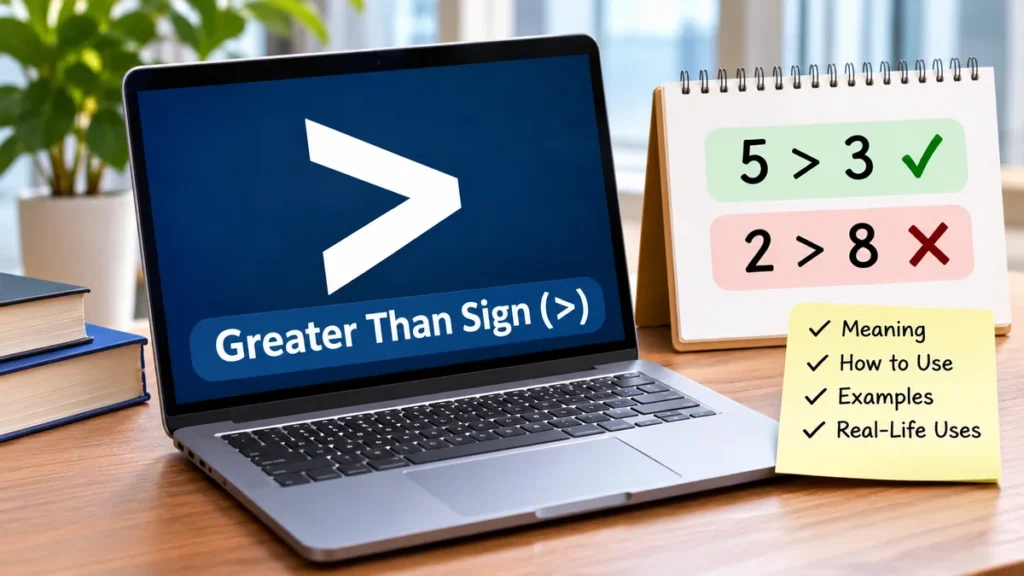
Have you ever looked at the symbols > and < and wondered which one means greater than? These two mathematical signs look similar, but they communicate opposite relationships between numbers.
The greater than sign (>) is a mathematical symbol used to show that one number or quantity is larger than another. For example, 8 > 5 means “eight is greater than five.” The symbol’s wide opening faces the larger number, while its pointed end faces the smaller number.
GREATER THAN SYMBOL
8 > 5
8 is greater than 5The wide opening faces 8, the larger number.
Understanding this simple symbol helps students compare numbers, solve inequalities, interpret number lines, and work with algebraic expressions.
What Is the greater than sign in Math?
The greater than sign is a comparison symbol that indicates one value is strictly larger than another.
Its mathematical notation is:
\[ a>b \]
This expression is read as “a is greater than b.”
For the statement to be true, the value of a must be larger than the value of b.
Consider these examples:
| Mathematical expression | How to read it |
|---|---|
| 10 > 6 | Ten is greater than six |
| 25 > 15 | Twenty-five is greater than fifteen |
| 100 > 50 | One hundred is greater than fifty |
| 0.9 > 0.5 | Zero point nine is greater than zero point five |
| −2 > −7 | Negative two is greater than negative seven |
The greater than symbol represents a strict inequality, meaning the two values cannot be equal.
For example, 5 > 5 is false because both numbers have the same value.
In formal mathematics, for real numbers a and b, the statement a > b is true exactly when a − b is positive.
How to Remember the greater than sign
One of the most common difficulties when learning comparison symbols is remembering which direction they should face.
Fortunately, there are several easy ways to recognize the correct symbol.
1. The hungry alligator trick
Imagine that the comparison symbol is an alligator’s mouth.
The alligator always wants to eat the bigger number, so its mouth opens toward the larger value.
9 > 3
CorrectOpens toward 9
3 < 9
CorrectOpens toward 9
Both comparisons are correct because the open side faces the larger number.
This visual technique is particularly helpful for elementary school students learning inequality symbols.
2. The wide-side and narrow-side rule
Another reliable method is to examine the shape of the symbol.
- The wide side faces the greater value.
- The narrow, pointed side faces the smaller value.
For example:
\[ 15>8 \]
The open side faces 15 because 15 is larger than 8.
3. Remember the number line
On a standard horizontal number line, numbers increase as you move to the right.
Therefore, a number positioned farther right is greater than a number positioned farther left.
For instance, 7 is greater than 4 because 7 appears to the right of 4.
Greater Than vs. Less Than vs. Equal To
The three basic comparison symbols in mathematics are greater than (>), less than (<), and equal to (=).
Although they are closely related, each expresses a different relationship between values.
| Symbol | Name | Meaning | Example |
|---|---|---|---|
| > | Greater than | Left value is larger | 8 > 3 |
| < | Less than | Left value is smaller | 3 < 8 |
| = | Equal to | Both values are equal | 8 = 8 |
| ≥ | Greater than or equal to | Left value is larger or equal | 8 ≥ 8 |
| ≤ | Less than or equal to | Left value is smaller or equal | 3 ≤ 8 |
| ≠ | Not equal to | Values are different | 8 ≠ 3 |
These symbols are fundamental to arithmetic, algebra, and mathematical reasoning. Math is Fun+1
What is the difference between > and <?
The greater than symbol (>) opens toward the left, while the less than symbol (<) opens toward the right.
Compare:
\[ 12>5 \]
This means twelve is greater than five.
\[ 5<12 \]
This means five is less than twelve.
Both statements describe the same numerical relationship from opposite directions.
What does ≥ mean?
The symbol ≥ means greater than or equal to.
Unlike the standard greater than sign, it allows the two values to be equal.
For example:
\[ x\geq10 \]
Possible values include 10, 11, 12, 15.5, and every other real number greater than 10.
By contrast:
\[ x>10 \]
The value 10 is excluded.
This distinction is essential when solving algebraic inequalities or interpreting minimum requirements.
Greater Than Symbol Examples With Different Numbers
The greater than sign works with whole numbers, decimals, fractions, negative numbers, and mathematical expressions.
The comparison method changes slightly depending on the types of numbers involved.
Comparing whole numbers
Whole numbers include 0, 1, 2, 3, and so on.
Examples:
- 15 > 10
- 45 > 32
- 100 > 99
- 1,000 > 750
When comparing large numbers, begin by examining their place values.
For example, compare 5,281 and 5,218.
Both numbers have the same thousands and hundreds digits. At the tens place, however, 8 is greater than 1.
Therefore:
\[ 5281>5218 \]
Comparing decimal numbers
Decimals can be compared by examining digits from left to right, aligning the decimal points.
For example:
\[ 4.75>4.50 \]
Both numbers have the same whole-number part, but 0.75 is greater than 0.50.
Other examples include:
- 0.9 > 0.6
- 3.25 > 3.20
- 7.08 > 7.007
A common mistake is assuming that a decimal with more digits must be larger.
For example, 0.8 > 0.75 because 0.80 is greater than 0.75.
Comparing fractions
Fractions represent parts of a whole.
To compare fractions with the same denominator, compare their numerators.
For example:
\[ \frac{5}{8}>\frac{3}{8} \]
Both fractions have a denominator of 8, but 5 is greater than 3.
When denominators differ, you can convert fractions to a common denominator or use cross-multiplication when the denominators are positive.
Consider:
\[ \frac34>\frac23 \]
Using a common denominator:
\[ \frac9{12}>\frac8{12} \]
Therefore, three-fourths is greater than two-thirds.
Comparing negative numbers
Negative numbers can be confusing because their order is different from what beginners sometimes expect.
For example:
\[ -3>-8 \]
Although 8 is larger than 3 as a positive number, negative three is greater than negative eight.
The reason is simple: −3 appears to the right of −8 on a standard number line.
Other examples:
- −1 > −5
- −4 > −10
- 0 > −7
- 2 > −100
For two negative numbers, the one closer to zero is greater.
However, this shortcut does not apply to comparisons involving a positive and a negative number. Every positive number is greater than every negative number.
Comparing mathematical expressions
The symbol can also compare the results of calculations.
For example:
\[ 5+7>3+4 \]
Evaluating both sides gives:
\[ 12>7 \]
Another example:
\[ 6\times4>20 \]
Since 6 × 4 = 24, the statement is true.
Always evaluate the expressions using the correct order of operations before deciding whether an inequality is true.
Using the greater than sign in Algebra
In algebra, the greater than sign is used to write inequalities involving variables such as x, y, and z.
A variable represents an unknown or changing value.
For example:
\[ x>5 \]
This means x can be any real number greater than 5.
Possible solutions include 6, 7, 10, 5.5, and 100. The number 5 itself is not a solution.
How to solve greater than inequalities
Consider the inequality:
\[ x+4>10 \]
Step 1: Subtract 4 from both sides.
\[ x+4-4>10-4 \]
Step 2: Simplify the expression.
\[ x>6 \]
The solution is every real number greater than 6.
Now consider a multiplication example:
\[ 3x>15 \]
Divide both sides by positive 3:
\[ x>5 \]
The direction of the inequality remains unchanged because both sides were divided by a positive number.
When do you reverse the inequality sign?
An important algebra rule states that multiplying or dividing both sides of an inequality by a negative number reverses the inequality symbol.
For example:
\[ -2x>8 \]
Divide both sides by −2:
\[ x<-4 \]
The greater than symbol changes to a less than symbol.
You can verify the result by choosing x = −5:
\[ -2(-5)>8 \]
\[ 10>8 \]
The statement is true.
This reversal rule is one of the most important concepts when solving inequalities with negative coefficients. Khan Academy+1
How to graph greater than inequalities on a number line
A number line helps visualize the solution set of an inequality.
For example:
\[ x>3 \]
To graph this inequality:
- Locate 3 on the number line.
- Draw an open circle at 3.
- Shade or draw an arrow toward the right.
- Include every number greater than 3.
An open circle excludes 3. The arrow points toward greater values.
If the inequality were x ≥ 3, the graph would use a filled circle at 3 because the endpoint would be included.
In interval notation, the solution x > 3 is written as:
\[ (3,\infty) \]
The parenthesis indicates that 3 is excluded, while infinity indicates that the solution continues without an upper bound.
Real-Life Uses of the Greater Than Symbol
The greater than symbol is useful beyond school mathematics. It helps express comparisons, thresholds, and measurable conditions in everyday situations.
Comparing money and prices
Suppose one product costs $45 and another costs $30.
The comparison is:
\[ 45>30 \]
This shows that the first product is more expensive.
The same principle applies to comparing salaries, savings, expenses, and budgets.
Comparing temperatures
Suppose the temperature in one city is 32°C and another city is 25°C.
We can write:
\[ 32^\circ C>25^\circ C \]
The first city has a higher temperature.
Temperature comparisons also work with negative values:
\[ -2^\circ C>-8^\circ C \]
Negative two degrees is warmer than negative eight degrees.
Comparing ages
Imagine an activity is available only to people older than 18.
The condition is:
\[ \text{Age}>18 \]
Someone who is exactly 18 does not satisfy this strict condition.
If the requirement is “18 or older,” the correct expression is:
\[ \text{Age}\geq18 \]
The difference between these symbols matters whenever a boundary value is included or excluded.
Comparing measurements
The symbol is also used in science, engineering, and measurement.
For example:
\[ 150\text{ cm}>120\text{ cm} \]
This indicates that a measurement of 150 centimeters is greater than 120 centimeters.
Similar comparisons can be made with distance, mass, speed, and volume, provided the measurements use compatible units.
How to Type or Copy the greater than sign
The greater than symbol is available on standard computer keyboards and can also be copied into documents, spreadsheets, and mathematical expressions.
>
Greater than symbol
Copy symbol
Typing the symbol on Windows and Mac
On most English-language Windows and Mac keyboard layouts, press Shift + . (period) to type >.
The symbol shares a key with the period, usually near the bottom-right portion of the letter keys.
Keyboard layouts can vary by language and region.
Greater than sign in Microsoft Excel
In Microsoft Excel, the symbol can compare numeric values in cells.
For example:
=A1>B1If cell A1 contains 20 and cell B1 contains 15, the formula returns TRUE.
If A1 contains 10 and B1 contains 15, the formula returns FALSE.
The greater than symbol can also be used inside an IF formula:
=IF(A1>50,"Pass","Review")This formula displays “Pass” when A1 is greater than 50 and “Review” otherwise.
Greater than sign in programming
Programming languages such as Python and JavaScript use > as a comparison operator.
For example, in Python:
score = 85if score > 80: print("Above 80")The condition checks whether the score exceeds 80.
In JavaScript:
console.log(10 > 5); // true
console.log(5 > 10); // false
These comparisons return Boolean values: true or false. MDN+1
Greater than sign in HTML and Unicode
The symbol has the Unicode code point U+003E, and its HTML character reference is >.
For example:
<p>10 > 5</p>This displays the comparison 10 > 5 in a web browser.
The character reference is useful when writing HTML because angle brackets also appear in HTML markup. GitHub+1
Common Mistakes When Using the greater than sign
Even students who understand basic number comparisons can make mistakes with inequalities.
Mistake 1: Reversing the symbol
Incorrect:
\[ 4>9 \]
Correct:
\[ 9>4 \]
The wide opening must face the larger value.
Mistake 2: Assuming a negative number with a larger digit is greater
Incorrect:
\[ -10>-3 \]
Correct:
\[ -3>-10 \]
On the number line, −3 lies to the right of −10.
Mistake 3: Confusing > with ≥
The expressions x > 5 and x ≥ 5 are not equivalent.
The first excludes 5, while the second includes it.
Mistake 4: Forgetting to reverse the sign
When dividing both sides by a negative number, the inequality direction must reverse.
For example:
\[ -3x>12 \]
The correct solution is:
\[ x<-4 \]
Mistake 5: Comparing values with different units
Consider the statement:
\[ 2\text{ meters}>150\text{ centimeters} \]
This statement is true, but converting to the same unit makes the comparison clearer.
Since 2 meters equals 200 centimeters:
\[ 200\text{ cm}>150\text{ cm} \]
Using consistent units reduces errors.
Practice Greater Than and Less Than Comparisons
Try these questions to check your understanding.
Knowledge check
0 of 5 answered
1. Which comparison is correct?6 > 99 > 66 = 9
2. Which statement about negative numbers is true?−8 > −2−2 > −8−2 = −8
3. Which symbol includes the value 10?x > 10x < 10x ≥ 10
4. What is the solution to x + 3 > 8?x > 5x > 11x < 5
5. What is the solution to −2x > 6?x > −3x < −3x > 3
Check answersReset
Practicing comparisons with positive numbers, negative numbers, fractions, and variables is one of the most effective ways to become comfortable with inequality symbols.
Final Thoughts on the greater than sign
The greater than sign (>) is a fundamental mathematical symbol that shows one value is larger than another. Its wide side faces the larger number, and its pointed side faces the smaller number.
Remember these three essential rules: 8 > 5 means eight is greater than five; x > 5 excludes 5 itself; and multiplying or dividing an inequality by a negative number reverses its direction.
Once these principles become familiar, comparing numbers, solving algebraic inequalities, reading number lines, and interpreting mathematical statements becomes much easier.