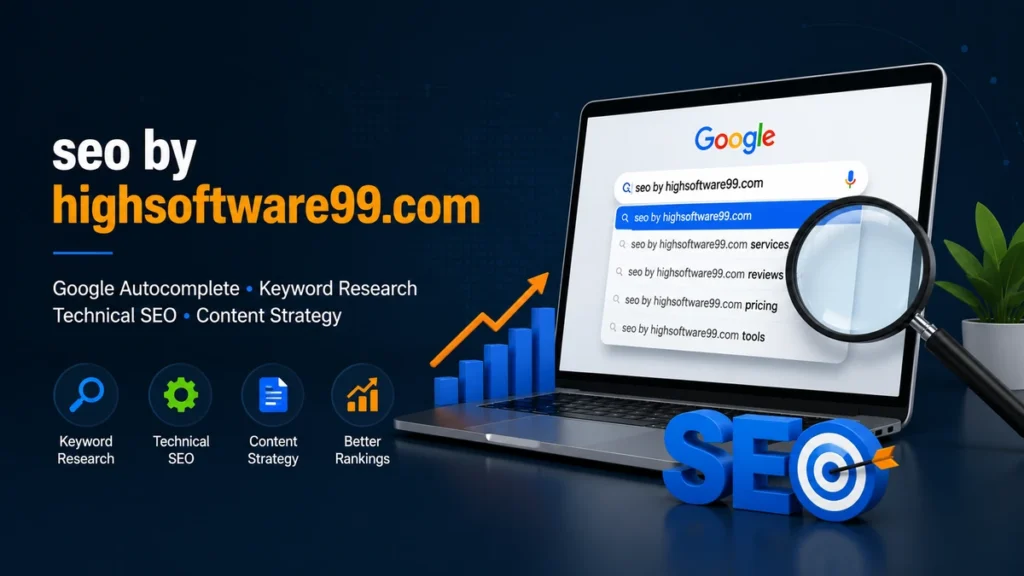
Search visibility is no longer limited to getting a webpage into Google’s ten blue links. A brand can appear while someone is still typing a query, before the search results page even loads. That distinction is central to understanding seo by highsoftware99.com.
HighSoftware99.com publicly promotes Google Autocomplete, also called autocomplete or predictive search, as a major part of its service. Its website claims that targeted keywords can gain autocomplete visibility within roughly 3–12 hours. That is a very different proposition from conventional SEO, where crawling, indexing, relevance, authority, competition, and many other factors influence organic rankings.
Quick answer: seo by highsoftware99.com is associated primarily with Google Autocomplete visibility, alongside familiar SEO concepts such as keyword research, content optimization, technical SEO, and site structure. Autocomplete visibility and normal organic rankings should not be treated as the same thing because Google describes autocomplete predictions as a separate search feature generated from search activity and contextual signals.
Understanding that difference makes the service much easier to evaluate.
What Is seo by highsoftware99.com?
The phrase seo by highsoftware99.com refers to the search optimization services and visibility methods promoted under the HighSoftware99.com name.
The clearest differentiator on the company’s current website is its emphasis on Google Autocomplete. HighSoftware99.com describes its offering as an autocomplete or “ATC” service and presents examples of its brand appearing when users begin typing SEO-related searches.
This puts the service at the intersection of two related but distinct areas:
- traditional search engine optimization;
- Google Autocomplete visibility.
Several third-party pages currently ranking for the phrase describe broader elements such as semantic content, keyword research, technical optimization, crawlability, indexing, internal linking, and content architecture.
Those techniques are recognizable parts of modern SEO. Google itself defines SEO as improving a website so search engines can understand its content and relevant users can discover it.
The unusual part is the autocomplete emphasis.
How Google Autocomplete Actually Works
To assess seo by highsoftware99.com, you first need to understand what autocomplete is.
When you begin typing into Google, predictions appear beneath the search box. Google explains that these predictions are generated automatically to help people complete searches faster. They are not the same thing as organic search results.
Google says its systems consider factors including:
- real searches people have performed;
- common queries matching the characters being typed;
- the searcher’s language;
- geographic location;
- trending interest;
- previous searches in personalized situations.
Autocomplete can therefore change depending on where, when, and how a search is performed.
That last point matters.
A prediction visible to one person is not necessarily guaranteed to appear identically to every searcher worldwide.
Autocomplete Is Not a Google Ranking Position
This is probably the most important distinction in the entire topic.
Suppose someone types:
seo
and a particular phrase appears underneath it.
That means the phrase is appearing as an autocomplete prediction. It does not automatically mean a webpage occupies position one for the query “seo.”
Google explicitly distinguishes predictions from search results.
Traditional organic SEO concerns what happens after the user submits the query. Autocomplete concerns what Google predicts while the query is being entered.
Think of the search journey like this:
| Stage | What Happens |
|---|---|
| User starts typing | Google may display autocomplete predictions |
| User selects or finishes a query | Google processes the search |
| Results load | Organic listings and other search features appear |
| User chooses a result | The website may receive a visit |
Autocomplete operates near the beginning of that journey.
Organic SEO operates heavily around the later stages.
The two can interact through user discovery and search behavior, but they should not be measured as though they were identical.
Why Autocomplete Visibility Can Be Attractive
The appeal is easy to understand.
Normal SEO can involve months of technical work, content development, link earning, updates, and measurement. Autocomplete visibility offers a different opportunity: exposing a phrase or brand while a searcher is deciding exactly what to search.
That can potentially affect discovery.
Imagine a user knows they need an SEO solution but has not selected a company. They begin typing a general query and encounter a branded prediction. Even before visiting a result, they have been exposed to that brand.
This creates several possible benefits.
Earlier Brand Exposure
Organic listings compete for attention after the results page appears.
Autocomplete can introduce a name before that stage.
For unfamiliar brands, repeated exposure may help people recognize a name when they encounter it again.
Query Discovery
People do not always arrive at Google with a perfectly formed query.
Autocomplete helps them finish searches. Google describes the feature specifically as a way to save users time while completing intended queries.
A relevant prediction can therefore influence which complete query a user ultimately submits.
Visibility for Brand-Keyword Combinations
Autocomplete can be particularly noticeable when a brand becomes associated with a relevant topic.
For example, a user may start with a generic service term and encounter a longer prediction containing a company or product name.
That visibility has marketing value even though it is not equivalent to ranking first organically.
The 3–12 Hour Claim Needs the Right Context
HighSoftware99.com’s homepage currently advertises an ability to boost keywords through autocomplete within approximately 3–12 hours.
This claim needs to be interpreted carefully.
It concerns autocomplete visibility, not a guarantee that a conventional webpage will jump to Google’s number-one organic position within that period.
Google’s own SEO Starter Guide takes a much more cautious view of organic search performance. It explicitly states that there is no secret technique that automatically ranks a website first.
So there are two separate ideas:
Autocomplete visibility: potentially changing or gaining visibility in predictive queries.
Organic ranking: earning a position in Google’s actual search results.
Any evaluation of seo by highsoftware99.com should keep those outcomes separate.
Traditional SEO vs. seo by highsoftware99.com
The easiest way to understand the difference is through comparison.
| Area | Traditional SEO | HighSoftware99.com Autocomplete Focus |
|---|---|---|
| Primary target | Organic search results | Search-box predictions |
| User stage | After submitting search | While typing |
| Main objective | Rank relevant webpages | Increase predictive-query visibility |
| Typical measurement | Rankings, clicks, impressions, conversions | Prediction presence and consistency |
| Location effects | Yes | Particularly relevant |
| Personalization | Can affect search experience | Can affect predictions |
| Long-term content value | Usually central | Depends on broader SEO work |
This does not mean a website has to choose one or the other.
Autocomplete visibility can be considered a supplementary discovery channel, while conventional SEO continues building organic visibility.
The key mistake is assuming that success in one automatically proves success in the other.
The Traditional SEO Foundation Still Matters
Even if autocomplete is the feature that attracts attention, a website still needs a solid SEO foundation.
Google recommends making sites secure, fast, accessible, mobile-friendly, understandable, and technically available to its crawlers.
Several fundamental areas deserve attention.
Keyword Research Based on Search Intent
Good keyword research is not simply finding phrases with large search volumes.
A useful keyword should connect three things:
- what the searcher wants;
- what your page genuinely provides;
- what type of content Google tends to return for that query.
A small but highly relevant query can be far more valuable than a huge keyword attracting the wrong audience.
Search intent also determines page format. A person asking “how does technical SEO work?” needs educational content. Someone searching for a particular company’s login page has an entirely different objective.
Strong SEO starts by understanding that difference.
Helpful Content and Topical Depth
Publishing hundreds of shallow articles is not a substitute for expertise.
A better approach is to build meaningful topical coverage.
If a website specializes in technical SEO, for example, its content could logically cover crawling, indexing, XML sitemaps, canonicalization, robots directives, Core Web Vitals, structured data, redirects, internal architecture, JavaScript rendering, and Search Console diagnostics.
Each page should solve a real problem instead of existing merely because a keyword was available.
Google’s current spam policies specifically warn against scaled content created mainly to manipulate rankings without adding meaningful value for users.
On-Page Optimization
On-page SEO helps users and search engines understand a webpage quickly.
Useful elements include:
- descriptive page titles;
- a clear H1;
- logical H2 and H3 headings;
- readable URLs;
- relevant internal links;
- descriptive image alt text where appropriate;
- concise introductions;
- useful supporting examples;
- accurate and original information.
The goal is clarity rather than keyword repetition.
If the target phrase has to be inserted awkwardly into every paragraph, the optimization has gone too far.
Technical SEO
Great content cannot perform properly if search engines struggle to access the site.
Technical SEO commonly includes checking:
- crawl accessibility;
- indexing status;
- canonical URLs;
- duplicate pages;
- redirects;
- XML sitemaps;
- mobile usability;
- HTTPS;
- page performance;
- structured data;
- broken internal links;
- server errors.
Google recommends using tools such as URL Inspection to understand how it sees individual pages.
Technical improvements are particularly valuable because they support every content page rather than a single keyword.
Semantic SEO and Entity Clarity
Modern content optimization goes beyond exact-match keywords.
A comprehensive page naturally discusses the concepts and entities required to explain its subject.
An article about Google Autocomplete, for example, might logically mention predictions, search queries, location, language, trending searches, personalization, search intent, Google Search, organic results, and user behavior.
Those terms help establish context because they belong to the topic.
But semantic SEO should not become another version of keyword stuffing.
The objective is not to collect a giant list of “NLP keywords” and force every term into the article. The objective is to cover the subject thoroughly enough that the necessary vocabulary appears because it genuinely belongs there.
Internal Linking and Site Architecture
A strong website should resemble a well-organized library rather than a pile of unrelated pages.
Important pages should be reachable through logical navigation and contextual internal links.
For example:
SEO → Technical SEO → Crawling → XML Sitemaps
creates an understandable relationship between broad and specific topics.
Internal links can help visitors continue learning and help crawlers discover and contextualize pages.
Descriptive anchors are normally more useful than repeatedly linking vague text such as “click here.”
Authority and Backlinks Still Require Care
Links remain an important part of how the web connects information, but not every backlink is valuable.
A sustainable link strategy focuses on earning genuine references through useful resources, research, tools, original insights, relationships, digital PR, or content worth citing.
Buying or manufacturing large quantities of manipulative links is a different matter.
Google’s spam policies address link manipulation and other tactics intended primarily to influence rankings.
For website owners evaluating an SEO provider, the right question is therefore not simply:
“How many backlinks will I get?”
Ask where those links come from, why those sites would link to you, whether the placements are editorially relevant, and what happens if the links disappear.
Does seo by highsoftware99.com Guarantee Google Rankings?
No SEO provider can credibly guarantee a specific permanent organic position simply by applying a formula.
Google itself states that following SEO best practices does not guarantee that a particular website will be indexed or achieve a particular position.
This is especially important when discussing rapid-visibility services.
Autocomplete appearance should be measured as autocomplete appearance.
Organic ranking should be measured separately through appropriate search-performance data.
Traffic should be measured separately again.
Ultimately, business impact should be evaluated through meaningful outcomes such as qualified visitors, leads, enquiries, sales, subscriptions, or whatever objective the website exists to achieve.
A visibility metric becomes much more useful when it connects to a real outcome.
How to Evaluate the Service Objectively
Website owners researching seo by highsoftware99.com do not need to accept enthusiastic claims or dismiss the concept automatically.
Test what can be tested.
1. Define the Exact Deliverable
Determine whether you are purchasing:
- autocomplete visibility;
- traditional organic SEO;
- technical optimization;
- content services;
- link building;
- or a combination.
Do not let “SEO” serve as a vague label for several completely different outcomes.
2. Record a Baseline
Before work starts, document current conditions.
Record target queries, organic rankings, Google Search Console impressions, clicks, indexed pages, organic sessions, conversions, and the autocomplete predictions you can independently observe.
Without a baseline, improvement becomes difficult to prove.
3. Test Across Clean Environments
Because Google says autocomplete predictions can depend on location, language, trends, and previous searches, a single screenshot is weak evidence of universal visibility.
Test the prediction from relevant locations and devices where practical, and account for personalization.
4. Separate Autocomplete From Organic Rankings
This is essential.
If a prediction appears but the corresponding website remains unchanged in organic results, report those as two different outcomes.
The autocomplete campaign may have achieved its stated objective without improving conventional rankings.
5. Measure Actual Search Performance
Use Search Console and analytics data to examine whether visibility translates into behavior.
Watch:
- impressions;
- organic clicks;
- click-through rate;
- branded searches;
- non-branded search visibility;
- landing-page traffic;
- conversions.
Google describes Search Console as a resource for understanding how a website performs in Search.
6. Review the Results Over Time
A prediction appearing once is less meaningful than repeatable visibility among the audience you actually want to reach.
Track persistence rather than relying on one successful check.
Potential Benefits
When approached with realistic expectations, the model associated with seo by highsoftware99.com has several interesting characteristics.
Autocomplete visibility can expose a brand early in the search journey. It can create an additional discovery touchpoint, support branded-query awareness, and complement conventional SEO campaigns.
The wider SEO concepts commonly associated with the service—technical health, structured content, keyword research, crawlability, and semantic relevance—are also legitimate areas for website optimization.
The strongest use case is therefore not necessarily replacing SEO.
It is adding another search-visibility layer while maintaining a sound organic strategy.
Limitations and Risks to Understand
The same distinction creates limitations.
Predictions Can Vary
Autocomplete is dynamic.
Google says factors such as location, language, trending interest, and previous searches can influence predictions.
A prediction should therefore not be treated as a permanently fixed asset.
Autocomplete Does Not Equal Organic Authority
A company appearing in predictive search does not prove that its website is Google’s most authoritative organic result for the underlying topic.
These are different search surfaces.
Fast Visibility Does Not Replace Long-Term SEO
A technically weak website with thin content, poor navigation, and little authority still has those problems even if a branded prediction becomes visible.
Long-term organic performance requires ongoing work.
Search Manipulation Carries Risk
Any SEO technique should be evaluated against Google’s published policies.
Google warns against practices such as scaled content abuse, scraping, link spam, and other methods designed primarily to manipulate Search rather than help users.
Before adopting any aggressive tactic, ask how it works and whether it depends on artificial behavior that could conflict with platform policies.
Who May Find This Approach Useful?
Autocomplete-focused visibility may be most interesting to brands that already understand the difference between predictive-search exposure and organic ranking.
It can be relevant for:
- businesses building brand awareness around specific queries;
- marketers experimenting with additional search touchpoints;
- agencies measuring branded-search behavior;
- established websites adding autocomplete testing to broader SEO;
- companies operating in markets where search-box visibility matters.
It is less appropriate as a substitute for fixing fundamental SEO problems.
If a website cannot be crawled properly, publishes weak content, loads poorly, or fails to answer its audience’s questions, those problems deserve attention first.
What Actually Builds Sustainable Search Visibility?
The most durable strategy combines several layers.
Start with a technically accessible website. Research what your audience genuinely searches for. Build useful pages around those needs. Organize related content logically. Strengthen internal linking. Earn relevant mentions and links. Monitor Search Console. Update pages when information changes.
Then experiment with supplementary visibility channels where they make sense.
That order matters.
Google’s SEO documentation consistently frames optimization around helping search engines understand content while helping users discover useful pages.
There is no single shortcut that replaces those fundamentals.
Final Thoughts on seo by highsoftware99.com
The most useful way to understand seo by highsoftware99.com is to separate the interesting part from the familiar part.
The familiar part includes keyword research, content structure, technical SEO, crawlability, internal linking, and other established optimization practices frequently discussed around the brand.
The distinctive part is its emphasis on Google Autocomplete visibility and the company’s claim that targeted autocomplete results can appear rapidly.
That can be an interesting visibility tactic, but autocomplete predictions are not organic rankings. Google describes them as automated predictions influenced by real searches and contextual factors such as location, language, trends, and previous activity.
So evaluate the approach with precise metrics.
Check whether the targeted prediction appears. Test whether it persists. Measure whether branded searches change. Track organic rankings independently. Monitor clicks and conversions. And keep conventional, people-first SEO working underneath everything.
That gives seo by highsoftware99.com the right context: not a replacement for the fundamentals of search optimization, but a search-visibility approach whose value should be judged through transparent, repeatable evidence.