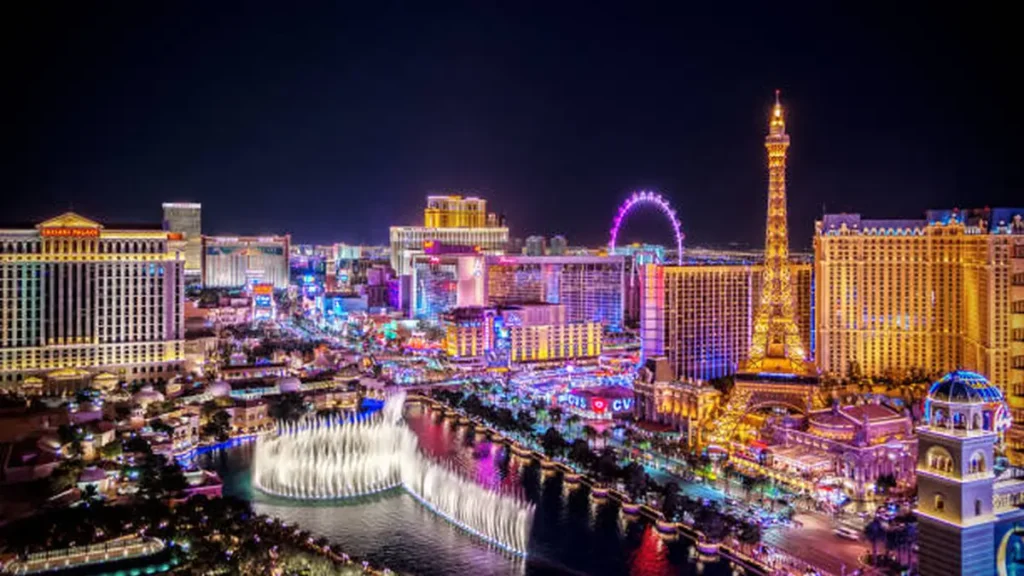
Stand at the north end of the Las Vegas Strip and look south, and you’ll swear the Bellagio is a ten-minute stroll away. It isn’t. Distances here are deceptive, the heat is relentless, and picking the wrong hotel can quietly wreck your trip before you’ve even hit a casino floor. This guide breaks down what the Strip actually is, how it’s laid out in 2026, and how to avoid the mistakes that trip up most first-time visitors.
The Las Vegas Strip is a roughly 4.2-mile stretch of Las Vegas Boulevard in Nevada, packed with the city’s largest casino resorts, from Mandalay Bay in the south to the Sahara area in the north. It’s split into three practical zones — South, Center, and North — each with a different pace, price point, and walking reality.
What Is the Las Vegas Strip, Exactly?
The Strip refers to the section of Las Vegas Boulevard South that runs through unincorporated Clark County, not the city of Las Vegas itself — a quirk that surprises a lot of visitors. It’s where nearly every mega-resort you’ve seen in photos actually sits: Caesars Palace, Bellagio, The Venetian, ARIA, and dozens more, all lined up along one boulevard.
The name has a specific origin worth knowing, because it comes up constantly in local trivia and travel writing. <cite index=”5-1″>The name “The Strip” was coined by police officer and businessman Guy McAfee, who named it after the Sunset Strip in his hometown of Hollywood.</cite> These days it’s less a single street you casually wander and more a chain of self-contained resort compounds connected by long sidewalks, skybridges, and the occasional escalator maze.
Here’s the mistake almost everyone makes: they look at a map, see two hotels next to each other, and assume it’s a quick walk. In reality, resort footprints are enormous. A “neighboring” hotel can genuinely be a 15-to-20-minute walk once you account for the length of the property itself, security checkpoints, and pedestrian bridges over the Boulevard.
North vs. Center vs. South Strip — Which Part Should You Base Yourself In?
By 2026, the Strip functions less like one continuous street and more like three separate neighborhoods, each with its own character and its own logistics.
Center Strip is the postcard version of Vegas — Bellagio Fountains, Caesars Palace, and the Linq Promenade all sit here, and it’s genuinely the one stretch where you can walk between major landmarks in fifteen minutes or less. If you want to be able to step outside and be near everything, this is the zone to book.
North Strip has become the quieter, more upscale option, especially with Wynn and Encore anchoring it. Cutting through Wynn Plaza is a useful shortcut here — it’s climate-controlled and avoids some of the street-level construction that’s lingered near the old Mirage site while Hard Rock’s rebuild (complete with a guitar-shaped tower) moves forward. This area also sits closest to the Las Vegas Festival Grounds, which matters if you’re in town for a concert or event there.
South Strip is where the mega-resort energy lives — Mandalay Bay, Luxor, Excalibur, New York-New York — and it’s also the zone most affected by the Formula 1 Las Vegas Grand Prix circuit, which reshapes traffic patterns and pedestrian access for race weekend and the buildout period around it.
Quick takeaway: Want maximum walkability and zero regrets? Center Strip. Want quieter and more polished? North Strip. Want big, brash, and classic Vegas energy? South Strip.
Best Hotels on the Strip by Budget and Vibe
Hotel choice on the Strip isn’t just about price — it determines how much of your trip you spend walking, waiting for rideshares, or stuck in a “pedestrian gap” between properties.
| Budget Tier | Example Hotels | What You’re Getting |
|---|---|---|
| Budget | Excalibur, Luxor, The LINQ, Circus Circus | Entry-level pricing, dated finishes, solid Strip location |
| Mid-Range | Paris Las Vegas, Horseshoe Las Vegas, Park MGM | Central position, decent rooms, good value-to-location ratio |
| Luxury | Bellagio, Wynn/Encore, The Cosmopolitan, ARIA | High-end finishes, better service, prime real estate |
| Ultra-Luxury / Newest | Four Seasons Las Vegas, Fontainebleau, Resorts World | Top-tier amenities, some of the newest builds on the Boulevard |
| Non-Gaming | Vdara, The Signature at MGM, Trump Tower, Palms Place | Smoke-free, casino-free, quieter atmosphere |
Pricing swings hard depending on when you book. During quieter midweek stretches, budget-tier rooms can dip below $100 a night, while weekends and convention or event dates can push even mid-range rooms into the $150–$250 range.
If you’re chasing a specific view or experience, get specific about it before booking — hotels near the Sphere and hotels with F1 track-view balconies are now marketed as their own category, and not every “Strip-adjacent” hotel actually delivers either.
Getting Around the Strip Without Losing a Day to It
This is the part most guides gloss over, and it’s the part that actually determines how good your trip feels.
Walking the full Strip end-to-end is not a casual activity — treat it as a genuine outing, not a shortcut between two hotels. A few practical options:
- Walking within one zone (especially Center Strip) works well and is often faster than a car for short hops.
- The Las Vegas Monorail connects several North and Center Strip properties and can shave a car ride down to a few minutes — useful when you’re trying to get from a North Strip hotel toward the Center Strip core.
- The Vegas Loop (Tesla Tunnels) offers an underground alternative for longer hops, particularly useful around events at Allegiant Stadium or the North Strip.
- Rideshare is often the default choice, but expect long queues during peak weekend hours and around major events — a “40-minute wait” isn’t an exaggeration during a busy Saturday night or race weekend.
Common mistake: assuming you can walk from the airport-adjacent South Strip to a North Strip hotel in under 30 minutes. Budget an hour, or use the monorail/rideshare instead.
Things to Actually Do on the Strip
You don’t need a packed itinerary here — a handful of well-chosen stops covers most of what makes the Strip worth visiting.
- The Sphere — now firmly established as a global landmark, worth building an evening around regardless of which zone you’re staying in.
- Bellagio Fountains — still free, still worth timing your walk around, especially at dusk.
- The Linq Promenade — a solid stop for food, people-watching, and the High Roller observation wheel.
- Grand Canal Shoppes at The Venetian — the painted-sky ceilings and gondola rides make it worth a slower walk-through rather than a quick pass.
- Formula 1 Las Vegas Grand Prix — if your dates overlap with race weekend, expect both a spectacle and serious disruption to South Strip walkability and pricing.
What’s New on the Strip in 2026
The Strip’s skyline keeps shifting, and a few changes are worth knowing before you plan around outdated information.
Fontainebleau Las Vegas and Resorts World Las Vegas remain two of the most prominent additions of recent years, both aiming squarely at the luxury and modern-amenity crowd. Meanwhile, <cite index=”4-1″>Hard Rock International acquired the Mirage at the end of 2022 with plans to overhaul the resort, and remodeling has since begun in earnest.</cite> The rebuild includes a distinctive guitar-shaped tower that will reshape the North-Center skyline once complete — but expect construction noise and detours near that site in the meantime.
Beyond individual properties, the F1 Grand Prix has become a recurring fixture that reshapes South Strip logistics annually, and boutique-style renovations at older North Strip properties have made that zone a more appealing (and quieter) alternative to the traditional mega-resort stay.
Strip vs. Fremont Street — Don’t Mix These Up
This trips up more first-time visitors than almost anything else: the Strip and Fremont Street are not the same place. The Strip is the modern resort corridor on Las Vegas Boulevard South. Fremont Street is Downtown Las Vegas, several miles north, home to older-school casinos, the Fremont Street Experience light canopy, and a noticeably different, more retro atmosphere. If your itinerary includes both, plan them as separate outings — not a walkable add-on to each other.
Best Time to Visit and What It’ll Cost You
Shoulder seasons (spring and fall) tend to bring milder desert heat and steadier pricing. Summer brings extreme heat that makes outdoor walking between properties genuinely uncomfortable by midday. Major conventions, holiday weekends, and race weekend around the F1 Grand Prix will spike both crowds and hotel rates — if you’re price-sensitive, check the event calendar for your travel dates before you book.
Getting the Las Vegas Strip right comes down to matching your hotel zone to your trip style, planning transportation instead of assuming you’ll walk it all, and knowing what’s genuinely new versus what’s just repackaged marketing. Book your base in the zone that fits how you actually want to spend your days, and the rest of the trip tends to fall into place.
Ready to book? Compare hotels by zone before you commit — where you stay on the Strip will shape more of your trip than almost any other decision you’ll make.
If you’re planning another destination too, check out our Southwest USA travel guides for more trip ideas.
FAQ Section
How long is the Las Vegas Strip?
The Strip runs approximately 4.2 miles along Las Vegas Boulevard South, though most visitors only spend meaningful time in the Center Strip’s denser, more walkable core.
Is the Las Vegas Strip walkable?
Center Strip is genuinely walkable between major landmarks. North and South Strip involve longer, less predictable walks, especially in summer heat.
What’s the difference between the Strip and Fremont Street?
The Strip is the modern resort corridor on Las Vegas Boulevard; Fremont Street is in Downtown Las Vegas, several miles north, with an older-school casino atmosphere.
What’s the best area of the Strip to stay in for first-timers?
Center Strip, since it puts you within walking distance of the most landmarks and reduces reliance on rideshares.
How do you get around the Strip without a car?
Walking within one zone, the Las Vegas Monorail for North-to-Center hops, the Vegas Loop for longer underground trips, and rideshare as a backup.
What’s new on the Strip in 2026?
Fontainebleau and Resorts World remain major additions, the Mirage site is under Hard Rock’s guitar-tower redevelopment, and the F1 Grand Prix continues to reshape South Strip logistics annually.
Is the Las Vegas Strip safe at night?
It’s generally well-lit and heavily trafficked, though standard city precautions apply, especially around late-night pedestrian areas.
Why is it called “the Strip”?
It’s credited to Guy McAfee, who named it after the Sunset Strip in his hometown of Hollywood.