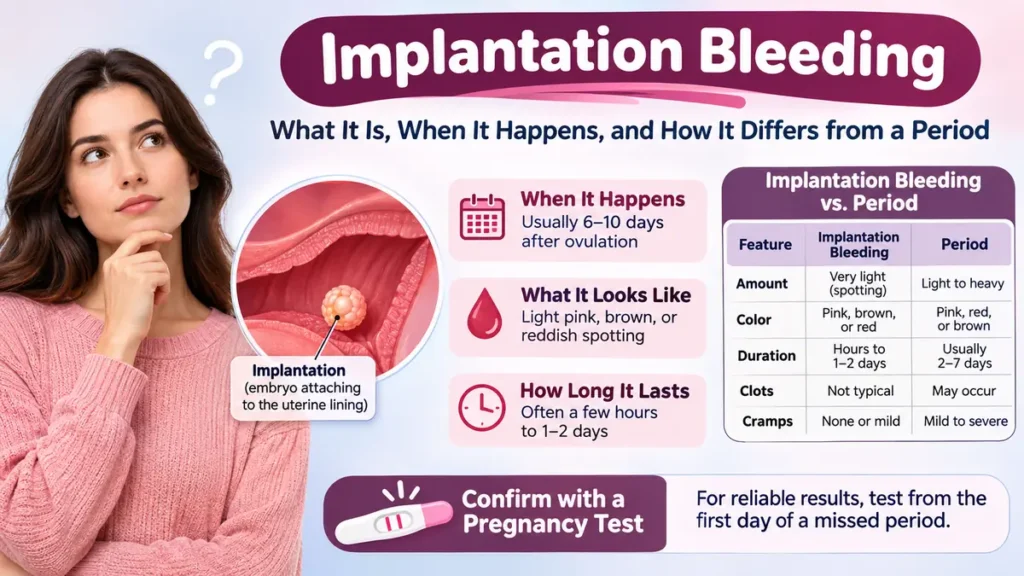
Light spotting before your expected period can leave you wondering whether pregnancy has begun or menstruation is approaching. The timing, color, and amount of blood may offer clues, but they cannot confirm the cause.
Implantation bleeding is a term for light vaginal spotting sometimes reported around the time a fertilized egg attaches to the uterine lining. It is typically described as pink or brown spotting rather than menstrual flow. However, implantation bleeding is not a reliable medical sign of pregnancy, and a pregnancy test is needed to determine whether conception occurred.
Understanding what early pregnancy spotting can look like, when it might happen, and which symptoms require medical attention can help you decide what to do next.
What Is Implantation Bleeding?
Implantation is an early step in pregnancy when a developing embryo attaches to and begins embedding in the endometrium, the lining of the uterus.
After fertilization, the developing embryo travels through the fallopian tube toward the uterus. It becomes a blastocyst, which can begin attaching to the uterine lining several days later.
Some people notice light vaginal spotting around this stage and refer to it as implantation bleeding.
However, there is an important distinction between the popular explanation and the scientific evidence.
Although spotting can occur in early pregnancy, research has not established that the implantation process itself routinely causes visible bleeding. Studies tracking early pregnancies have found that bleeding does not consistently occur on the day of implantation.
Therefore, spotting around an expected period should not automatically be attributed to implantation.
Does Everyone Experience Implantation Bleeding?
No. Many people have no spotting during early pregnancy.
You may experience a completely normal pregnancy without noticing any bleeding before or after a positive pregnancy test.
Conversely, light spotting does not necessarily mean pregnancy has occurred.
Early vaginal bleeding can have several explanations, including hormonal fluctuations, cervical irritation, infection, and the beginning of menstruation.
When Does Implantation Bleeding Occur?
Implantation generally begins approximately 6–10 days after ovulation, although individual timing varies.
For someone with a 28-day menstrual cycle who ovulates around day 14, implantation may begin roughly between cycle days 20 and 24.
This places it near the days leading up to an expected menstrual period.
But not everyone ovulates on day 14, and menstrual cycles can vary considerably.
Implantation and Early Pregnancy Timeline
| Stage | Approximate timing |
|---|---|
| Ovulation | Around day 14 in an illustrative 28-day cycle |
| Fertilization | Usually within 12–24 hours after ovulation |
| Embryo development and travel | First several days after fertilization |
| Implantation begins | Approximately 6–10 days after ovulation |
| Pregnancy hormone production increases | After implantation begins |
| Home pregnancy testing | Most reliable from the first day of a missed period |
These are approximate biological timelines, not a method for identifying the cause of spotting.
Can Implantation Bleeding Happen After a Missed Period?
Spotting can occur after a missed period, including during an established early pregnancy.
However, bleeding after a missed period should not automatically be labeled implantation bleeding.
A positive pregnancy test accompanied by bleeding may have several causes, some harmless and others requiring medical evaluation.
What Does Implantation Bleeding Look Like?
People commonly describe suspected implantation bleeding as very light pink, brown, or reddish spotting.
It may appear as a few marks on underwear, a small amount of blood on toilet paper, or light staining on a panty liner.
However, appearance alone cannot distinguish implantation-related spotting from menstrual bleeding or other causes.
Color of the Blood
Light pink spotting: Small amounts of blood mixed with vaginal or cervical fluid may appear pale pink.
Brown spotting: Blood that has remained in the reproductive tract longer may appear brown as it undergoes oxidation.
Red spotting: Fresh blood may appear red, but color alone does not establish whether bleeding is menstrual or pregnancy-related.
These color variations can occur for multiple reasons.
How Much Bleeding Is Typical?
Spotting means a small amount of blood that generally does not require a regular menstrual pad.
If bleeding becomes heavy, contains substantial clots, or resembles a full menstrual flow, it should not be assumed to be implantation bleeding.
Heavy bleeding during a known or suspected pregnancy requires prompt medical assessment.
Can Implantation Bleeding Have Clots?
Small clots are not a typical feature of the light spotting commonly described as implantation bleeding.
Clots may occur during menstruation or other types of uterine bleeding.
Passing clots during pregnancy, particularly with cramping or increasing blood loss, warrants medical advice.
Implantation Bleeding vs. Period: Key Differences
One of the most common questions is how to tell implantation bleeding apart from a menstrual period.
Unfortunately, there is no dependable visual test.
Although light spotting differs from a typical menstrual flow, periods can also begin with pink or brown spotting.
Commonly described differences
| Feature | Suspected implantation spotting | Menstrual period |
|---|---|---|
| Amount | Usually very light | Light to heavy |
| Color | Pink, brown, or red | Pink, red, or brown |
| Duration | Often described as brief | Commonly 2–7 days |
| Flow pattern | Spotting without sustained flow | May increase before decreasing |
| Clots | Not typical | May occur |
| Cramps | None or mild | Mild to severe |
| Pregnancy confirmation | Cannot confirm pregnancy | Cannot reliably exclude pregnancy |
These are general descriptions rather than diagnostic criteria. The evidence does not support identifying implantation as the cause of bleeding from its appearance or duration.
Can Implantation Bleeding Be Mistaken for a Period?
Yes.
A very light menstrual period can resemble spotting associated with early pregnancy.
Hormonal contraception, stress, illness, and natural cycle variation may also change menstrual bleeding patterns.
If pregnancy is possible, testing is more useful than attempting to identify bleeding by its color or amount.
Does Implantation Bleeding Fill a Pad?
The spotting commonly called implantation bleeding is generally described as too light to soak a menstrual pad.
Bleeding that saturates a pad, becomes progressively heavier, or is accompanied by significant pain should not be dismissed as implantation spotting.
How Long Does Implantation Bleeding Last?
Suspected implantation spotting is often described as lasting a few hours to one or two days.
However, there is no scientifically established duration that proves bleeding is caused by implantation.
Some people experience a single episode of spotting, while others notice intermittent light bleeding.
The pattern alone does not identify its cause.
Is Three Days of Spotting Normal?
Three days of light spotting can occur for several reasons, including the beginning or end of menstruation, hormonal changes, and early pregnancy.
Duration does not establish whether implantation occurred.
If spotting persists, recurs, or follows a positive pregnancy test, contact a healthcare professional for guidance.
Symptoms That May Accompany Early Pregnancy Spotting
Spotting may occur alongside symptoms that people associate with early pregnancy.
These include breast tenderness, fatigue, mild pelvic discomfort, bloating, and changes in vaginal discharge.
However, many of these symptoms also occur before menstruation because of normal hormonal changes.
Mild Cramping
Some people report mild lower abdominal cramps around the time they notice spotting.
Such discomfort can resemble premenstrual cramps.
There is no reliable way to determine from cramping alone whether implantation has occurred.
Severe abdominal pain, particularly on one side, is not a typical symptom to attribute to implantation and requires urgent evaluation if pregnancy is possible.
Breast Tenderness and Fatigue
Changes in progesterone and estrogen can contribute to breast tenderness and tiredness.
These symptoms occur during the luteal phase of the menstrual cycle and may also appear in early pregnancy.
They are not reliable indicators of pregnancy without testing.
Nausea and Other Pregnancy Symptoms
Pregnancy-related nausea typically becomes more noticeable later, often around weeks five or six of pregnancy when counted from the last menstrual period.
Nausea immediately after intercourse or fertilization is unlikely to result from pregnancy hormone changes.
The timing of symptoms matters, but symptoms cannot replace a pregnancy test.
When to Take a Pregnancy Test After Implantation Bleeding
A home pregnancy test is the most practical way to determine whether pregnancy has occurred.
These tests detect human chorionic gonadotropin (hCG), a hormone produced after implantation begins.
The amount of hCG increases during early pregnancy, but testing too soon can produce a false-negative result.
Best Time to Test
For reliable results:
- Take a home pregnancy test from the first day of your missed period.
- If you do not know when your period is due, test at least 21 days after unprotected sex.
- Follow the manufacturer’s instructions and check the expiration date.
- If the result is negative but your period remains absent, repeat the test after a few days.
- Contact a healthcare professional if results remain unclear or you have concerning symptoms.
The NHS recommends testing from the first day of a missed period, with the 21-day rule when menstrual timing is uncertain. NHS+1
Can You Get a Positive Test During Implantation Bleeding?
A positive test is possible around the time someone notices spotting, but the result depends on when implantation occurred and whether hCG has reached a detectable level.
A negative test taken very early does not necessarily exclude pregnancy.
Some highly sensitive urine tests detect pregnancy before a missed period, but testing later reduces the chance of a false-negative result.
Blood Pregnancy Tests
Healthcare professionals may use quantitative serum hCG testing when pregnancy status or early pregnancy progression needs further evaluation.
Unlike a standard home test, a quantitative blood test measures the concentration of hCG.
When clinically indicated, repeated measurements approximately 48 hours apart may help assess early pregnancy.
However, hCG levels alone cannot always determine whether a pregnancy is viable or located inside the uterus. Ultrasound examination may also be necessary.
Other Causes of Spotting Before or During Early Pregnancy
Not every episode of spotting around an expected period is related to implantation.
Several conditions can produce similar symptoms, and some require treatment.
Hormonal Changes and Ovulation Spotting
Fluctuations in estrogen and progesterone can influence the endometrium and menstrual bleeding patterns.
Some people experience light spotting around ovulation, while others notice bleeding shortly before menstruation.
Hormonal contraception, including certain birth control pills and intrauterine devices, can also cause breakthrough bleeding.
Cervical Irritation and Infection
During pregnancy, increased blood flow to the cervix can make it more likely to bleed after sexual intercourse or a pelvic examination.
Cervical polyps, inflammation, and certain sexually transmitted infections may also cause spotting.
Bleeding accompanied by unusual vaginal discharge, unpleasant odor, fever, or pelvic discomfort should be assessed by a healthcare professional.
Early Pregnancy Loss
Miscarriage, also called early pregnancy loss, can cause vaginal bleeding and abdominal cramping.
Bleeding does not always mean miscarriage, and some pregnancies continue normally after spotting.
The American College of Obstetricians and Gynecologists (ACOG) reports that first-trimester bleeding occurs in approximately 15–25% of pregnancies. ACOG
The amount and appearance of blood cannot reliably determine whether a pregnancy is continuing normally.
Ectopic Pregnancy
An ectopic pregnancy develops outside the uterine cavity, most commonly within a fallopian tube.
It may initially cause light bleeding that resembles menstrual spotting.
Other symptoms can include one-sided pelvic pain, abdominal discomfort, dizziness, and shoulder-tip pain.
An ectopic pregnancy can become life-threatening if internal bleeding develops.
Anyone who may be pregnant and experiences severe abdominal pain, fainting, or shoulder pain should seek emergency medical care, even without a positive pregnancy test. ACOG+1
When Should You See a Doctor for Implantation Bleeding?
Light spotting without other symptoms is not always a sign of a serious condition.
Nevertheless, if pregnancy is confirmed, any vaginal bleeding should be discussed with a healthcare professional.
Clinical assessment may involve a medical history, pelvic examination, ultrasound, or laboratory tests depending on the circumstances.
Symptoms That Need Emergency Attention
Seek immediate emergency medical care if bleeding occurs alongside:
- Severe or worsening abdominal or pelvic pain
- Sharp pain concentrated on one side
- Shoulder-tip pain
- Fainting, severe dizziness, or marked weakness
- Heavy bleeding that rapidly soaks a menstrual pad
These symptoms may indicate significant blood loss, ectopic pregnancy, or another urgent complication. RCOG+1
What If the Bleeding Is Light and Painless?
If pregnancy is possible but not yet confirmed, record when the spotting began and arrange testing at the appropriate time.
If you already have a positive pregnancy test, contact your pregnancy care provider for advice even when the spotting is minimal.
A clinician may recommend observation or further testing based on gestational age, symptoms, medical history, and previous pregnancy complications.
What to Do If You Think You Have Implantation Bleeding
When unexpected spotting occurs, the most useful approach is to monitor symptoms, test for pregnancy at the appropriate time, and avoid assuming the cause.
Track Your Bleeding
Record the date, approximate amount, color, and duration of bleeding.
Also note associated symptoms such as cramps, pelvic pain, dizziness, or changes in vaginal discharge.
This information can help a healthcare professional assess what may be happening.
Avoid Relying on Symptoms Alone
Pregnancy symptoms overlap considerably with premenstrual symptoms.
Breast tenderness, bloating, fatigue, and mild cramping cannot distinguish early pregnancy from an approaching period.
Similarly, the absence of symptoms does not rule out pregnancy.
Use Appropriate Menstrual Products
A panty liner or sanitary pad can help monitor light spotting.
If bleeding becomes heavier, note how quickly pads are becoming saturated.
Avoid attempting to diagnose the cause through photographs, blood color, or comparisons with other people’s experiences.
Understand What Treatment Is Needed
There is no specific treatment required for the brief, uncomplicated spotting commonly described as implantation bleeding.
However, treatment depends on the actual cause when bleeding results from infection, hormonal problems, miscarriage, or another condition.
Do not use medications or supplements intended to stop bleeding without appropriate medical advice, particularly if pregnancy is possible.
Common Misconceptions About Implantation Bleeding
Confusion surrounding early pregnancy spotting often comes from treating implantation bleeding as a definitive pregnancy symptom.
Several common assumptions deserve clarification.
Does Implantation Bleeding Confirm Pregnancy?
No. Spotting cannot confirm pregnancy.
Even when bleeding occurs at a time consistent with implantation, its underlying cause remains uncertain without further evaluation.
A properly timed pregnancy test is the first practical step.
Can You Be Pregnant Without Implantation Bleeding?
Yes. Many pregnancies progress without any noticeable spotting.
The absence of bleeding has no negative implication for implantation or pregnancy development.
Does Implantation Bleeding Mean the Pregnancy Is Healthy?
No. Light spotting does not establish that a pregnancy is viable or progressing normally.
Likewise, spotting does not automatically mean something is wrong.
Clinical evaluation, including ultrasound when appropriate, is more informative than bleeding patterns.
Can Implantation Bleeding Occur With Twins?
Spotting can occur in pregnancies involving twins, but there is no reliable evidence that implantation bleeding is consistently heavier or more common because two embryos are present.
Bleeding amount cannot identify a twin pregnancy.
Ultrasound is the appropriate method for confirming the number of developing embryos.
Can Implantation Bleeding Occur After IVF?
Light spotting can occur after in vitro fertilization (IVF) and embryo transfer.
Possible causes include cervical irritation from the procedure, hormonal medication, and early pregnancy-related changes.
Spotting does not reliably indicate whether embryo transfer was successful.
Patients undergoing assisted reproductive technology should follow their fertility clinic’s scheduled hCG testing instructions and report unexpected bleeding.
How Medical Professionals Evaluate Early Pregnancy Bleeding
When spotting occurs during a confirmed or suspected pregnancy, the goal is to determine whether urgent treatment is needed and, when possible, identify the source of bleeding.
A clinician may ask about the last menstrual period, pregnancy test results, previous pregnancies, contraception, and the timing and severity of symptoms.
Ultrasound Examination
Transvaginal ultrasound can help determine whether a pregnancy is located inside the uterus and assess its development.
Very early pregnancies may not yet be visible on ultrasound.
When a pregnancy test is positive but ultrasound cannot establish the location, clinicians may describe the situation as a pregnancy of unknown location.
Follow-up testing is essential because an ectopic pregnancy may still be present.
hCG Monitoring
Serial quantitative hCG measurements may provide information about early pregnancy progression.
A single result is often insufficient to determine pregnancy viability.
Healthcare professionals interpret trends alongside symptoms, ultrasound findings, and estimated gestational age.
Additional Tests
Depending on the clinical situation, evaluation may include blood count testing, blood group and Rh status, and testing for infection.
Some Rh-negative patients experiencing pregnancy bleeding may require assessment for anti-D immune globulin according to gestational age and local clinical guidelines.
The Royal College of Obstetricians and Gynaecologists emphasizes that determining the cause of early pregnancy bleeding can require follow-up blood tests and ultrasound examinations. RCOG
Final Thoughts on implantation bleeding
Implantation bleeding is a commonly used term for light spotting noticed around the time an embryo attaches to the uterine lining. It is generally described as brief, light bleeding, but its appearance and timing cannot prove that implantation caused it.
The most useful distinction is between spotting that may accompany early pregnancy and a confirmed pregnancy established through testing.
If pregnancy is possible, take a home pregnancy test from the first day of a missed period or at least 21 days after unprotected sex when cycle timing is uncertain.
If you receive a positive result and experience bleeding, seek medical guidance. Heavy bleeding, severe abdominal pain, shoulder pain, or fainting requires emergency assessment.
Understanding these differences can help you interpret unexpected spotting without overlooking symptoms that need professional care.