The Great Dane is one of the world’s tallest dog breeds, yet its imposing appearance often hides a calm, affectionate companion. Known as the “gentle giant,” this breed combines extraordinary size with a strong attachment to its family.
Living with a Great Dane can be rewarding, but its size creates responsibilities that owners should understand before bringing one home.
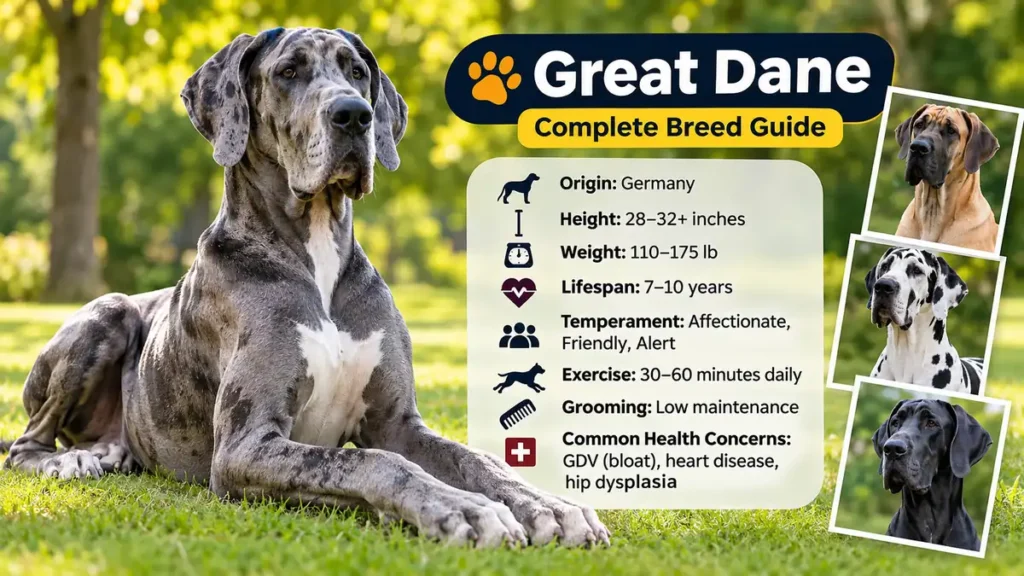
The Great Dane is a giant working dog breed originally developed in Germany for hunting large game, particularly wild boar. Modern Great Danes are generally friendly, affectionate, and people-oriented. Adults commonly weigh 110–175 pounds, although some fall outside that range. They typically live around 7–10 years and need appropriate exercise, early socialization, careful nutrition, and regular veterinary care.
Great Dane Breed Overview
Hund zieht Spaziergang in die Länge – was dahinter steckt
Deutsche Dogge – Rasseportrait | DAS FUTTERHAUS
11
The Great Dane belongs to the giant working-dog category and is recognized by major kennel organizations, including the American Kennel Club (AKC) and Fédération Cynologique Internationale (FCI).
Despite the name, the breed’s development is closely associated with Germany rather than Denmark.
| Characteristic | Typical details |
|---|---|
| Breed origin | Germany |
| Breed group | Working (AKC) |
| Male height | Approximately 30–32 inches or more at the shoulder |
| Female height | Approximately 28–30 inches or more |
| Adult weight | Commonly 110–175 pounds |
| Life expectancy | Approximately 7–10 years |
| Coat | Short, smooth, glossy |
| Temperament | Affectionate, friendly, alert |
| Exercise needs | Moderate, with individual variation |
| Grooming | Relatively low maintenance |
| Trainability | Generally responsive to positive reinforcement |
| Common health concerns | GDV/bloat, cardiomyopathy, orthopedic disease |
| Suitable environment | A home with enough space and committed supervision |
These figures describe typical adults rather than strict limits. Individual dogs vary by genetics, sex, body condition, and development.
History and Origin of the Great Dane
Why Is It Called a Great Dane?
The name can be misleading. The breed developed primarily in Germany, where large hunting dogs were selectively bred for strength, endurance, and the ability to confront dangerous game.
Its ancestors included powerful mastiff-type dogs and other large European hunting dogs.
The French naturalist Georges-Louis Leclerc, Comte de Buffon, helped popularize the term Grand Danois, meaning “Great Danish Dog.” English-language naming eventually adopted Great Dane, although the breed’s modern development remained strongly German.
In Germany, the breed is called the Deutsche Dogge.
From Boar Hunter to Family Companion
Historically, these dogs helped hunt wild boar, an activity demanding strength, speed, and courage.
As hunting practices changed, breeders increasingly emphasized a balanced appearance, stable temperament, and companionship.
The modern Great Dane retains its athletic structure and protective instincts but is primarily kept as a companion rather than a hunting dog.
The AKC recognized the breed in 1887.
Great Dane Size, Weight, and Physical Appearance
The Great Dane’s height is its most recognizable physical characteristic.
Its body should appear powerful, well-proportioned, and athletic rather than excessively heavy.
How Big Does a Great Dane Get?
Adult males typically stand at least 30 inches at the shoulder, while females generally reach at least 28 inches under the AKC breed standard.
| Measurement | Male | Female |
|---|---|---|
| Typical height | 30–32+ inches | 28–30+ inches |
| Typical weight | 140–175 lb | 110–140 lb |
| Physical build | Larger, more substantial | Often slightly lighter |
| Maturity | Commonly 18–24+ months | Commonly 18–24+ months |
These are approximate ranges. Some healthy dogs are larger or smaller.
A dog’s ideal weight depends more on body condition and skeletal structure than on reaching a particular number.
How Fast Do Great Dane Puppies Grow?
Great Dane puppies experience rapid physical growth during their first year.
A puppy that initially fits comfortably in someone’s arms can become an exceptionally large adolescent within months.
However, height and weight do not develop at exactly the same rate.
Many Great Danes approach their adult height by 12–18 months but continue filling out afterward.
Because giant-breed puppies have developing bones and joints, excessive exercise and inappropriate nutrition can create unnecessary physical stress.
Owners should monitor growth with their veterinarian rather than trying to maximize size.
Great Dane Coat Colors
The breed has a short, smooth coat that comes in several recognized colors and patterns.
Fawn
Brindle
Black
Blue
Harlequin
Merle
Other recognized patterns include mantle. Breed standards distinguish specific color combinations and markings.
Harlequin dogs have a predominantly white background with irregular black patches, while merle dogs display a mottled gray-and-black pattern.
Coat color does not reliably predict personality.
However, certain pigmentation genetics, particularly merle-to-merle breeding, can increase the risk of hearing and vision abnormalities in offspring.
Great Dane Temperament and Personality
Great Danes are widely appreciated for their affectionate nature and close relationships with people.
Their temperament often surprises those unfamiliar with giant breeds.
Are Great Danes Good Family Dogs?
A well-socialized Great Dane can be an excellent family companion.
Many enjoy relaxing near their owners, following family members between rooms, and participating in everyday activities.
Common personality traits include:
- Affectionate: Often seeks close physical contact with familiar people.
- Friendly: Usually sociable when appropriately introduced.
- Alert: Notices unfamiliar activity around the home.
- Patient: Can be calm around respectful children.
- Sensitive: Often responds better to encouragement than harsh correction.
- Playful: May retain puppy-like enthusiasm well into adolescence.
Temperament varies among individuals. Genetics, early experiences, training, and living conditions all influence behavior.
Are Great Danes Aggressive?
Great Danes are not inherently aggressive because of their size.
Most well-bred, properly socialized individuals are friendly or reserved rather than unnecessarily confrontational.
Nevertheless, any dog can develop fearful, defensive, or aggressive behavior.
Because a Great Dane is exceptionally powerful, unwanted behavior carries greater consequences than it might with a smaller breed.
Early socialization, reward-based training, and responsible supervision are essential.
Are Great Danes Good With Children?
Many Great Danes live successfully with children and form strong family bonds.
Their size, however, presents practical challenges.
An excited adult can accidentally knock over a young child while turning, running, or playing.
Interactions between dogs and young children should always be supervised.
Children should also learn to respect the dog’s resting space, avoid climbing on it, and recognize signs of discomfort.
Can Great Danes Live With Other Pets?
Danes can coexist peacefully with other dogs and cats, particularly when introductions are gradual and positive.
Their historical hunting background means prey drive varies between individuals.
A large, enthusiastic puppy may also overwhelm a smaller animal without intending harm.
Supervised introductions and separate resting areas help establish safe relationships.
Great Dane Exercise and Daily Activity Needs
Danes need regular physical activity, but they are not typically as demanding as highly energetic working breeds.
Their exercise routine should balance cardiovascular fitness, muscle development, mental stimulation, and joint protection.
How Much Exercise Does a Great Dane Need?
Many healthy adult Great Danes do well with approximately 30–60 minutes of moderate activity daily, divided into manageable sessions.
Individual requirements depend on age, fitness, weather, and veterinary advice.
Suitable activities include:
- Relaxed neighborhood walks
- Supervised play in a secure yard
- Gentle games involving toys
- Scent-based enrichment activities
- Basic obedience exercises
- Leisurely hikes on appropriate terrain
Puppies require shorter, self-paced activities rather than forced exercise.
Long-distance running, repetitive jumping, and strenuous activity should be avoided while their joints are developing.
The AKC advises waiting until approximately two years of age before introducing demanding jogging or hiking routines. American Kennel Club+1
Can Great Danes Live in Apartments?
Surprisingly, some Danes adapt well to apartment living.
Their relatively calm indoor behavior can make them more manageable than smaller, extremely energetic dogs.
However, the apartment must provide enough room for comfortable movement, sleeping, and turning around.
Practical considerations include:
- Access to safe walking areas
- Sufficient indoor floor space
- Suitable flooring that reduces slipping
- Reliable elevator access where necessary
- Building rules concerning large dogs
- A comfortable, appropriately sized resting area
A yard is helpful but does not replace daily walks, training, and interaction.
Great Dane Training and Socialization
Training is especially important for a dog capable of outweighing its owner.
A poorly trained small dog may be inconvenient. A poorly trained Great Dane can be physically difficult to control.
Are Great Danes Easy to Train?
Great Danes are generally intelligent and capable of learning commands quickly.
Many respond enthusiastically to positive reinforcement, including treats, praise, and play.
However, adolescence can bring distraction, excitement, and occasional stubbornness.
Successful training depends on consistency rather than force.
Essential Commands for Great Dane Puppies
Start with practical behaviors that improve everyday safety.
- Sit: Helps establish calm behavior before greetings and meals.
- Stay: Encourages impulse control.
- Come: Builds reliable recall.
- Leave it: Helps prevent dangerous interactions with objects.
- Loose-leash walking: Reduces pulling as the puppy grows.
- Settle: Teaches relaxation in busy environments.
- Wait: Improves control at doorways and crossings.
Short, frequent training sessions are usually more effective than lengthy drills.
Why Early Socialization Matters
Socialization involves introducing a puppy to different people, environments, sounds, surfaces, and situations in a controlled, positive manner.
A giant dog that becomes frightened of ordinary experiences may be difficult to manage safely.
Puppies should gradually become comfortable with veterinary examinations, grooming, transportation, and household visitors.
Avoid forcing interactions when a puppy shows fear.
Instead, provide distance, reassurance, and positive experiences.
Puppy classes can be valuable when they use reward-based methods and appropriate disease-prevention precautions.
Preventing Jumping and Leash Pulling
Behaviors that seem harmless in a small puppy become significant when the dog reaches adult size.
Teach calm greetings before jumping becomes habitual.
Reward the dog for keeping all four paws on the ground.
For leash training, use suitable equipment and reinforce walking beside the handler without tension.
Physical punishment and intimidation can increase fear and damage trust.
Great Dane Diet and Nutrition
Nutrition plays a central role in healthy growth, weight management, and long-term joint health.
Because Great Danes develop rapidly, their dietary requirements differ from those of many smaller breeds.
What Should a Great Dane Eat?
A Great Dane should receive a complete and balanced diet appropriate for its age, size, and health.
Growing puppies benefit from food specifically formulated for large- or giant-breed growth.
Such diets control energy intake and mineral balance to support steady skeletal development.
Excessive calories and inappropriate calcium supplementation can contribute to developmental orthopedic problems.
The Association of American Feed Control Officials (AAFCO) provides nutritional adequacy standards used in labeling many commercial dog foods.
Owners should choose a diet that meets the appropriate growth or adult-maintenance nutritional profile.
Veterinary guidance is particularly valuable when evaluating homemade diets, supplements, or special medical requirements. PetMD+1
How Much Food Does a Great Dane Need?
Food requirements vary considerably.
A growing puppy, a sedentary adult, and an active adult may need very different calorie intakes.
Factors influencing portion sizes include:
- Current weight and body condition
- Age and growth stage
- Activity level
- Calorie density of the food
- Neutering status
- Existing medical conditions
Feeding instructions on the food packaging provide a starting point, not an absolute prescription.
Monitor body condition and adjust portions with veterinary guidance.
A healthy Great Dane should have a visible waist when viewed from above and ribs that can be felt beneath a thin layer of tissue.
How Often Should You Feed a Great Dane?
Puppies generally benefit from several smaller meals throughout the day.
As they mature, feeding schedules can gradually transition toward two or more meals daily.
Avoid providing the entire daily food allowance in one unusually large meal.
Large meals and rapid eating are among the factors considered when managing gastric dilatation-volvulus risk.
Slow-feeding bowls may help dogs that gulp food, although they have not been proven to prevent GDV.
Great Dane Health Problems and Common Diseases
Studie zeigt’s: Ab diesem Alter ist Ihr Hund offiziell alt | Leben & Wissen | BILD.de
Great Danes are predisposed to several serious medical conditions.
Understanding these risks helps owners recognize warning signs and discuss appropriate preventive care with their veterinarians.
Gastric Dilatation-Volvulus (GDV) and Bloat
Gastric dilatation-volvulus is one of the most urgent health concerns affecting Great Danes.
GDV occurs when the stomach becomes distended and twists, potentially interrupting blood circulation.
This is a life-threatening emergency requiring immediate veterinary treatment.
Warning signs include:
- Unproductive attempts to vomit
- A swollen or painful abdomen
- Excessive drooling
- Restlessness or repeated pacing
- Weakness or collapse
- Rapid breathing
If GDV is suspected, seek emergency veterinary care immediately. Do not wait for symptoms to resolve or attempt home treatment.
A preventive procedure called gastropexy surgically secures the stomach to reduce the risk of twisting.
It does not eliminate all forms of stomach distension, but it can substantially reduce the likelihood of volvulus.
Owners should discuss preventive gastropexy with their veterinarian, particularly when planning another surgical procedure. PetMD+1
Dilated Cardiomyopathy (DCM)
Dilated cardiomyopathy affects the heart muscle, reducing its ability to pump blood effectively.
Great Danes have an increased predisposition to this condition.
Possible symptoms include coughing, reduced exercise tolerance, difficulty breathing, fainting, and weakness.
Some affected dogs may show few obvious signs during early disease.
Veterinarians may recommend cardiac examinations, echocardiography, or other testing based on the dog’s age, family history, and clinical findings.
Hip Dysplasia
Hip dysplasia occurs when the hip joint develops abnormally.
The resulting instability may contribute to inflammation, arthritis, and reduced mobility.
Symptoms can include stiffness, difficulty rising, reluctance to jump, and an altered gait.
Genetics, body weight, growth rate, and environmental factors can influence the condition.
Responsible breeding programs use orthopedic screening to help reduce inherited risk.
Wobbler Syndrome
Wobbler syndrome, also known as cervical spondylomyelopathy, affects the cervical spine and spinal cord.
It may cause an unsteady gait, weakness, neck discomfort, and coordination problems.
A dog showing progressive neurological symptoms should receive veterinary evaluation.
Treatment depends on the severity and underlying spinal abnormalities.
Other Health Concerns
Additional conditions that may affect Great Danes include osteosarcoma, hypothyroidism, degenerative myelopathy, elbow problems, and tail injuries.
Not every Great Dane develops these conditions.
Regular examinations and early investigation of unusual symptoms are more useful than assuming every change is a normal consequence of aging.
Recommended Health Screening
The Great Dane Club of America emphasizes inherited health concerns and the importance of appropriate screening before breeding. gdca.org
| Health area | Possible assessment |
|---|---|
| Heart | Veterinary cardiac examination and echocardiography when indicated |
| Hips | Radiographic evaluation through an established screening program |
| Eyes | Ophthalmic examination |
| Thyroid | Blood testing when recommended |
| General health | Routine examinations, body condition and mobility checks |
Screening requirements and recommended intervals should be discussed with a veterinarian familiar with the breed.
Great Dane Lifespan and Senior Care
How Long Do Great Danes Live?
The typical Great Dane lifespan is approximately 7–10 years.
Some individuals live longer, but giant breeds generally have shorter life expectancies than smaller dogs.
This difference reflects multiple biological factors, including rapid growth, body size, and susceptibility to certain diseases. American Kennel Club+1
How Can You Help a Great Dane Live Longer?
No routine guarantees a longer lifespan, but several practices support overall health:
- Maintain a lean body condition.
- Provide balanced, age-appropriate nutrition.
- Schedule regular veterinary examinations.
- Monitor for heart and orthopedic problems.
- Discuss GDV prevention and emergency planning.
- Provide appropriate daily exercise.
- Maintain dental hygiene.
- Investigate unexplained weight loss or behavioral changes.
Preventive healthcare becomes especially valuable as a Great Dane approaches its senior years.
When Is a Great Dane Considered a Senior?
Great Danes may begin showing age-related changes around five or six years old, although aging varies.
Senior dogs may require adjustments to exercise, bedding, nutrition, and veterinary monitoring.
Slower movement should not automatically be dismissed as old age.
Pain, arthritis, heart disease, and other treatable conditions may contribute to reduced activity.
Great Dane Grooming and Hygiene
The Great Dane’s short coat makes routine grooming relatively straightforward.
However, its large body means even simple tasks require suitable equipment and patience.
Do Great Danes Shed?
Yes. Great Danes shed throughout the year, with seasonal increases in some dogs.
Their coat is short, but the total amount of loose hair can still be noticeable because of their size.
Weekly brushing with a soft brush or rubber grooming mitt generally helps remove loose hair.
More frequent brushing may be useful during heavier shedding periods.
Bathing and Skin Care
Great Danes usually need bathing when dirty or noticeably odorous rather than on an unnecessarily frequent schedule.
Use a gentle shampoo formulated for dogs.
Rinse thoroughly and dry the coat carefully, particularly during colder weather.
Persistent itching, redness, or skin irritation should be evaluated by a veterinarian.
Nail, Ear, and Dental Care
Nails should be checked regularly and trimmed before they become excessively long.
Overgrown nails can affect comfort and movement.
Inspect the ears for redness, unusual discharge, or odor. Clean them only as appropriate using veterinary guidance.
Dental care should include regular brushing with dog-safe toothpaste and professional examinations.
Natural Ears Versus Cropped Ears
Great Danes naturally have floppy ears.
Some are seen with surgically cropped ears, but ear cropping is not medically necessary for routine breed health.
The American Veterinary Medical Association opposes cosmetic ear cropping and tail docking.
Natural ears are fully compatible with a healthy, active life.
Living With a Great Dane: Space, Costs, and Lifestyle
Shop Large Dog Beds, Harnesses & Toys – BigDog Accessories™
Owning a giant breed affects everyday routines in ways that are easy to underestimate.
Furniture, transportation, veterinary care, and household safety all require additional planning.
How Much Space Does a Great Dane Need?
A Great Dane does not necessarily require an enormous house.
It does, however, need sufficient space to move comfortably without constantly bumping into furniture.
A large supportive dog bed is especially helpful for protecting pressure points and providing comfortable rest.
Slippery floors can make movement difficult, particularly for puppies and senior dogs.
Rugs or nonslip surfaces can improve traction.
Can Great Danes Be Left Alone?
Many Great Danes develop strong attachments to their families.
Some tolerate reasonable periods alone, while others may experience separation-related distress.
Gradual alone-time training, enrichment, and predictable routines can help.
Dogs should not routinely be left alone for extended periods without appropriate care, exercise, and opportunities for toileting.
Are Great Danes Expensive to Maintain?
Their size increases many ordinary expenses.
| Expense | Why it may be higher |
|---|---|
| Food | Larger daily nutritional requirements |
| Veterinary treatment | Size-dependent medication and anesthesia needs |
| Bedding | Oversized supportive beds |
| Transportation | More space and appropriate restraints |
| Preventive medication | Some products are dosed by weight |
| Boarding | Giant-breed accommodation may be limited |
| Emergency care | Complex conditions can require substantial treatment |
The financial commitment extends beyond the initial acquisition of the dog.
Emergency veterinary expenses deserve particular consideration because of the breed’s health risks.
Do Great Danes Drool?
Some Great Danes drool noticeably, especially around meals, after drinking, or when anticipating food.
The amount varies by individual facial structure.
Keeping towels nearby is a practical solution.
Sudden excessive drooling accompanied by retching, abdominal swelling, or distress, however, may signal a medical emergency.
Great Dane Puppies: Growth and Early Care
Great Dane Puppy Checklist – Wooffy
A Great Dane puppy requires thoughtful care from the beginning.
Its rapid growth makes nutrition, training, and physical development particularly important.
Preparing for a Great Dane Puppy
Before bringing a puppy home, prepare an environment suited to a rapidly growing dog.
Useful essentials include a properly sized crate with room to stand and turn, comfortable bedding, durable toys, suitable feeding equipment, and secure barriers.
Avoid allowing young puppies to repeatedly jump from furniture or navigate slippery surfaces at speed.
Introduce handling exercises early so the puppy becomes comfortable with nail trimming, ear inspection, and veterinary examinations.
Understanding Great Dane Puppy Development
| Life stage | General development |
|---|---|
| 8–12 weeks | Early bonding, socialization, basic routines |
| 3–6 months | Rapid growth, teething, foundational training |
| 6–12 months | Adolescence, increasing strength, continued growth |
| 12–18 months | Approaching adult height, ongoing physical development |
| 18–24+ months | Continued muscular and skeletal maturity |
Development varies substantially between individuals.
Puppy growth charts are useful for observing trends, but they should not be used to force a dog toward a predetermined weight.
Choosing a Responsible Breeder or Rescue
Responsible breeding involves more than producing large or visually impressive puppies.
A reputable breeder should discuss family health history, temperament, relevant screening results, and the long-term responsibilities of ownership.
The Orthopedic Foundation for Animals (OFA) maintains health-testing information that can help prospective owners evaluate documented results.
Adoption through a reputable rescue organization is another option.
Adult rescue dogs may already have established temperaments, making some lifestyle considerations easier to assess.
Great Dane Compared With Other Giant Dog Breeds
Great Danes are sometimes confused with other exceptionally large breeds.
However, giant dogs differ significantly in coat type, build, exercise requirements, and temperament.
| Breed | Typical distinction | General characteristics |
|---|---|---|
| Great Dane | Very tall, athletic, short coat | Affectionate, alert, sociable |
| English Mastiff | Heavier, broader body | Often calm and protective |
| Irish Wolfhound | Extremely tall, rough coat | Generally gentle and reserved |
| Saint Bernard | Massive build, dense coat | Typically patient and friendly |
| Newfoundland | Heavy, water-resistant coat | Often gentle and water-oriented |
Individual temperament matters more than breed stereotypes.
Great Dane vs. English Mastiff
The English Mastiff is generally heavier and more heavily built.
The Great Dane has a taller, leaner, more athletic appearance.
Both require careful weight management and early training because of their size.
Great Dane vs. Irish Wolfhound
The Irish Wolfhound is another exceptionally tall breed, historically associated with hunting large animals.
Its rough coat and sighthound background distinguish it from the smooth-coated Great Dane.
Both have relatively short average lifespans compared with smaller breeds.
Is the Great Dane the Tallest Dog Breed?
The Great Dane is among the tallest breeds and has produced several record-holding individual dogs.
However, the Irish Wolfhound is also widely recognized for exceptional average height.
A record-breaking individual does not necessarily mean its breed has the highest average height.
Common Great Dane Myths and Misconceptions
Myth: Great Danes Need Enormous Amounts of Exercise
Their size does not automatically mean they need hours of strenuous activity.
Many adults are comfortable with moderate daily exercise and plenty of relaxation.
Myth: Great Danes Are Naturally Dangerous
Size alone does not determine aggression.
Temperament, genetics, socialization, and training all matter.
The breed standard emphasizes a friendly, dependable disposition rather than aggression. cdn.akc.org
Myth: Great Danes Should Grow as Quickly as Possible
Rapid weight gain is not a desirable goal.
Controlled growth and balanced nutrition support healthy skeletal development.
Myth: Great Danes Cannot Live Indoors
Great Danes generally benefit from living close to their families.
Their short coats and social nature make them poorly suited to being isolated outdoors for long periods.
Myth: A Larger Great Dane Is Always a Better Great Dane
Excessive height or weight does not guarantee better health, structure, or temperament.
Balanced proportions, sound movement, and appropriate body condition are more meaningful measures.
Is a Great Dane the Right Dog for You?
A Great Dane can be a wonderful companion for someone who appreciates giant breeds and understands their responsibilities.
Its affectionate personality, striking appearance, and relatively calm indoor behavior appeal to many households.
However, prospective owners should evaluate the practical demands of living with such a large animal.
A Great Dane may be a suitable choice if you have enough space, time for training, the ability to manage a powerful dog, and the financial resources for giant-breed veterinary care.
It may be less suitable if your living arrangements prohibit large dogs, you cannot safely handle its strength, or you need a companion with a typically longer lifespan and lower healthcare costs.
The most successful ownership experience begins with realistic expectations.
Final Thoughts on the great dane
The great dane combines remarkable height, an athletic build, and a frequently affectionate temperament. Its reputation as a gentle giant is well deserved in many households, but responsible ownership requires more than admiration for its appearance.
Balanced nutrition, early training, appropriate exercise, regular grooming, and preventive veterinary care are central to maintaining its well-being.
Understanding health risks such as gastric dilatation-volvulus, dilated cardiomyopathy, and orthopedic disease is particularly important.
For families prepared to accommodate its physical needs and relatively short lifespan, the Great Dane can become a deeply rewarding companion.
Before welcoming one into your home, evaluate your lifestyle, discuss breed-specific healthcare with a veterinarian, and prioritize temperament and health over exceptional size.