Hardwood floors in busy homes, restaurants, hotels, and commercial buildings face constant wear. Foot traffic, moving furniture, spills, and everyday cleaning can gradually damage their protective finish.
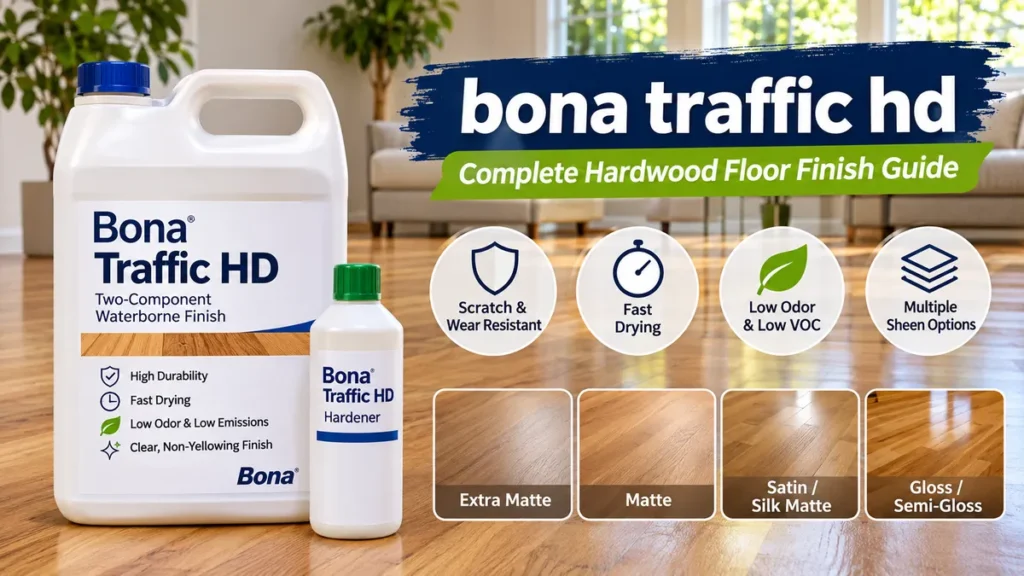
bona traffic hd is a professional-grade, two-component waterborne polyurethane finish designed to protect wooden floors against scratches, scuff marks, chemical exposure, and heavy use. It combines strong wear resistance with relatively fast drying, low odor, and several sheen options, making it suitable for demanding residential and commercial environments.
Understanding how this coating works, how long it takes to cure, and how it should be applied helps homeowners and flooring professionals achieve better results.
What Is bona traffic hd?
Bona Traffic HD is a high-performance hardwood floor coating manufactured by Bona. It belongs to the company’s professional range of water-based polyurethane finishes.
Unlike conventional single-component floor finishes, it uses two components: a polyurethane coating and a separate hardener. When combined, these form a durable protective film over the wooden surface.
The product is formulated for environments where floors experience substantial wear and where minimizing downtime is important.
Bona Traffic HD 1-Gallon – High-Durability Floor Finish – Ground Floor Supply
Commercial Hardwood Service in Clarksville, MD | Germantown Floors
Libertyville 2 and 1/4 white oak natural finish Bona Traffic HD satin
10
How the two-component system works
The coating consists of a waterborne polyurethane base and a hardener that initiates chemical crosslinking.
As water evaporates and the coating cures, the polymer network develops its protective properties. The resulting finish is designed to resist abrasion, scratching, scuffing, and household chemicals.
This distinguishes two-component finishes from products that rely primarily on evaporation and film formation.
The manufacturer’s specifications emphasize strong resistance after full curing, rather than simply after the surface becomes dry to the touch. Bona+1
Key Features and Benefits of bona traffic hd
High resistance to scratches and wear
One of the primary advantages of Bona Traffic HD is its resistance to everyday abrasion.
Busy hallways, living rooms, restaurants, and commercial corridors regularly experience dirt, footwear friction, and moving objects. A durable coating helps reduce visible surface damage under these conditions.
Its protective properties include:
- Resistance to scratches and scuff marks
- Protection against frequent foot traffic
- Resistance to common chemical exposure
- A clear finish that helps preserve the wood’s appearance
- Strong wear resistance after curing
However, scratch resistance does not mean scratchproof performance. Sand, grit, furniture legs, and sharp objects can still damage the surface.
Fast drying and curing
Bona Traffic HD is designed to return floors to service relatively quickly.
Some international technical data sheets permit light use after approximately six hours and full traffic after twelve hours under specified conditions. The US product information separately identifies a three-day full-cure period.
These figures describe different stages and can vary by product version, climate, and regional instructions. Manuals++1
Low odor and low emissions
Because Bona Traffic HD is waterborne, it generally produces less solvent odor than traditional solvent-heavy floor finishes.
Manufacturer documentation also identifies low indoor emissions and certifications such as GREENGUARD Gold or EMICODE for applicable product versions.
Low emissions do not eliminate the need for ventilation, appropriate protective equipment, or compliance with the safety data sheet.
Clear, non-yellowing appearance
Bona Traffic HD is formulated to provide a clear protective coating with reduced yellowing compared with many traditional oil-based polyurethane finishes.
This is particularly useful for light-colored hardwood, including oak, maple, and ash.
The final appearance still depends on the wood species, stain, primer, lighting, and selected sheen.
bona traffic hd Technical Specifications
The following figures reflect published technical information for an international formulation. Always verify the technical data sheet for the exact product sold in your market.
| Specification | Typical published value |
|---|---|
| Product type | Two-component waterborne polyurethane |
| Primary application | Interior wooden floors |
| Solids content | Approximately 32% |
| Hardener ratio | Approximately 8% by volume |
| Mixed pot life | Up to 4 hours at 20°C |
| Recoating interval | Approximately 2–3 hours |
| Light foot traffic | Approximately 6 hours |
| Full traffic | As early as 12 hours |
| Floor covering | Wait at least 3 days |
| Application rate | Approximately 8–10 m²/L |
These values come from Bona’s published international technical documentation. US and other regional formulations may have different mixing ratios, coverage rates, and return-to-use instructions. EPD-Traffic HD-Bona-10.24-Updated.docx+1
Understanding coverage rates
The coverage rate determines how much finish is required for a given floor area.
For example, at a theoretical application rate of 8–10 square meters per liter, a 50-square-meter floor requires approximately 5–6.25 liters for one coat.
Actual consumption depends on the floor’s texture, application equipment, and surface condition.
Additional coats require additional material, and the calculated quantity should allow for normal application losses.
Bona Traffic HD Finish Options
The sheen level affects how much light reflects from the floor. It changes the appearance but does not necessarily indicate a difference in durability.
Natural Oak Extra Matt – CASCADA | CASC6032 – NATURE | QUICK-STEP
Extra Matte
Creates a subtle, low-reflection appearance that emphasizes the wood’s natural character.
Parquet massif PALACE 120 CHENE AUTHENTIQUE, chêne naturel, verni, larg. 12.00 cm | Saint Maclou
Matte
Provides a soft appearance with limited shine, suitable for modern interiors.
Libertyville 2 and 1/4 white oak natural finish Bona Traffic HD satin
Satin / Silk Matte
Offers a gentle sheen that highlights grain patterns without looking excessively glossy.
Water-Based vs Oil-Based Polyurethane : Why Choosing Water is the Safer Option for Your Home
Gloss / Semi-Gloss
Produces stronger reflections and a more polished visual effect.
The available finishes vary by market. Bona’s US range includes commercial extra matte, satin, semi-gloss, and gloss options, while international product sheets commonly list extra matte, matte, and silk matte. Bona+1
Which sheen is best for hardwood floors?
For a natural, understated appearance, extra matte or matte is often suitable. Satin offers a balance between reflection and a traditional finished-wood appearance.
Higher-gloss coatings reflect more light, which can make scratches, dust, and unevenness more noticeable.
The right choice depends on the room’s lighting, wood species, interior design, and maintenance expectations.
How to Apply Bona Traffic HD Correctly
Applying a two-component polyurethane finish requires careful preparation, accurate mixing, and consistent application.
Professional installation is generally preferable for large areas, demanding commercial projects, or floors requiring extensive sanding.
Step 1: Prepare the wooden floor
The floor should be clean, dry, properly sanded, and free from contaminants.
Remove sanding dust, oil, wax, grease, and residues that could interfere with adhesion.
Previously coated floors require particular attention because the existing finish may not be compatible with a new coating.
Inspect the surface for loose boards, deep scratches, cracks, and damaged areas before continuing.
Step 2: Check environmental conditions
Temperature and humidity influence drying, leveling, and film formation.
An international Bona technical sheet recommends approximately 18–25°C and 30–60% relative humidity for optimal application.
Cold, humid conditions can delay drying. Excessive heat or low humidity can shorten working time and increase the risk of visible application marks.
Maintain suitable ventilation without allowing strong airflow to dry the coating unevenly.
Step 3: Mix the coating and hardener
Bona Traffic HD requires its specified hardener to develop the intended protective properties.
For the international formulation cited earlier, the mixing ratio is approximately 8% hardener by volume.
Shake the coating as instructed, add the correct quantity of hardener, and mix thoroughly.
The mixed product has a limited working life. Some international formulations specify a maximum pot life of four hours at 20°C.
Never assume that the same mixing ratio applies to every regional version.
Step 4: Apply the first coat
Use an applicator approved for the product, such as a Bona roller or swivel-head applicator.
Distribute the coating evenly and maintain a wet edge to reduce lap marks.
Avoid puddles, excessive film thickness, and repeated rolling over partially dried areas.
Work systematically across the room, allowing the applicator to maintain consistent coverage.
Step 5: Allow the finish to dry
Follow the manufacturer’s minimum recoating interval.
For some international formulations, the next coat can be applied after approximately two to three hours under normal conditions.
If the previous coat has dried beyond the interval specified in the technical data sheet, intermediate abrasion may be required.
Step 6: Apply additional coats
The appropriate coating system depends on whether the floor is bare wood, stained wood, or an existing finished surface.
One published international system specifies a compatible Bona primer followed by two coats of Traffic HD.
Other approved systems may differ. Avoid applying excessive coats in one day because additional moisture can affect wooden flooring.
Step 7: Protect the floor during curing
Even when the floor feels dry, the protective coating may still be developing its final properties.
Avoid heavy furniture, rugs, damp mopping, and unnecessary traffic until the applicable waiting periods have passed.
These preparation and application principles are consistent with Bona’s technical and recoating guidance. Manuals++1
bona traffic hd Drying Time vs. Curing Time
Drying and curing are different processes.
Drying describes the point at which the coating has lost enough moisture to permit a particular activity. Curing refers to the continued development of the protective film’s properties.
| Stage | Published international guidance |
|---|---|
| Recoating | 2–3 hours |
| Light walking | Around 6 hours |
| Normal traffic | As early as 12 hours |
| Rugs and floor coverings | At least 3 days |
| Full cure | US product specifies 3 days |
These are not universal guarantees. The applicable product formulation, temperature, humidity, airflow, and coating thickness can change the schedule. Manuals++1
Can you walk on Bona Traffic HD after 24 hours?
In many properly controlled applications, the floor can accommodate walking within 24 hours.
However, the exact waiting period must follow the product’s regional technical instructions.
Walking on a floor is not equivalent to moving heavy furniture across it or placing rugs over the coating.
When can furniture go back on the floor?
Furniture should be returned only when the relevant technical guidance permits it.
Avoid dragging heavy objects, and use appropriate protective pads beneath furniture legs.
For international formulations that specify a three-day waiting period before heavy objects or floor coverings, follow that longer restriction even when ordinary foot traffic is already permitted.
What happens if the coating is exposed to moisture too early?
Premature wet cleaning or moisture exposure can interfere with the developing finish.
Potential problems include discoloration, surface marking, or reduced appearance quality.
Keeping the floor dry during the specified curing period is an important part of achieving consistent results.
Bona Traffic HD vs. Other Hardwood Floor Finishes
Not every polyurethane coating is intended for the same environment.
Differences in formulation, curing mechanism, appearance, and maintenance requirements influence which product is appropriate.
| Finish type | Main characteristics | Typical considerations |
|---|---|---|
| Bona Traffic HD | Two-component waterborne polyurethane | High wear resistance, requires hardener |
| Bona Mega | Waterborne polyurethane finish | Different performance and application requirements |
| Bona Traffic GO | Waterborne finish with a different curing system | Designed to simplify application |
| Conventional oil-based polyurethane | Solvent-based protective coating | Often longer drying and stronger amber coloration |
| Hardwax oil | Penetrating and surface-protective treatment | Different appearance and repair procedures |
Bona Traffic HD vs. Bona Mega
Both belong to Bona’s professional hardwood floor finish portfolio, but they are not identical products.
Traffic HD is specifically positioned for demanding wear conditions and rapid development of protective properties.
Bona Mega products have different formulation and application characteristics. The appropriate comparison should use the exact Mega variant, rather than treating the entire range as one formulation.
Bona Traffic HD vs. traditional oil-based polyurethane
Traditional oil-based polyurethane often adds a warm amber tone to wooden flooring.
Bona Traffic HD is designed to provide a clearer appearance with reduced yellowing.
Waterborne products also tend to have lower solvent odor, although actual emissions and safety requirements depend on the specific formulation.
Neither finish can prevent physical dents in the underlying wood.
Bona Traffic HD vs. Bona Traffic HD Raw
Bona Traffic HD Raw is intended to create an especially natural, low-sheen appearance.
It is useful when the design goal is to preserve the visual impression of untreated wood while adding a protective coating.
Standard Traffic HD offers different sheen options and may create a more visibly finished appearance.
The choice is primarily about the desired appearance and the relevant product specifications, not an assumption that one version is universally better.
Common Application Problems and How to Avoid Them
Even a high-quality finish can perform poorly when applied incorrectly.
Visible roller marks or lap lines
These may occur when the applicator overlaps an area that has already started drying.
Maintaining a wet edge, using suitable equipment, and working within the recommended environmental conditions can reduce the problem.
Bubbles in the finish
Bubbles can result from unsuitable application technique, excessive agitation, or other conditions that introduce or trap air.
Use the mixing and application methods specified by the manufacturer.
Avoid trying to repair partially dried coating by repeatedly rolling over it.
Poor adhesion or peeling
Adhesion problems may arise when the surface contains wax, polish, grease, or incompatible coatings.
Proper cleaning and abrasion are especially important when recoating existing floors.
Bona recommends testing adhesion and compatibility in a small area before treating the entire floor. Bona
Uneven sheen
Uneven sheen can result from inconsistent coating thickness, incomplete mixing, or irregular surface preparation.
Consistent application rates and appropriate mixing help reduce variation.
For major appearance defects, professional assessment may be necessary before another coat is applied.
Scratches after curing
A cured polyurethane coating can still be scratched.
Furniture movement, abrasive particles, pet claws, and sharp objects may damage the finish or even indent the wood beneath it.
The coating protects the surface, but it does not increase the physical hardness of the timber itself.
How to Clean and Maintain Bona Traffic HD Floors
Regular maintenance is essential because even durable finishes can deteriorate when exposed to accumulated grit and improper cleaning products.
Daily and weekly maintenance
Remove dust and abrasive particles using a soft broom, microfiber dust mop, or suitable vacuum attachment.
For routine cleaning, use a wood-floor cleaner approved for polyurethane-coated flooring.
Apply cleaner according to its instructions rather than soaking the surface.
Clean spills promptly and avoid leaving standing water on the floor.
Protecting against furniture damage
Use suitable protective pads under chairs, tables, and other movable furniture.
Check the pads periodically because accumulated grit can turn them into abrasive surfaces.
Place appropriate entrance mats where outdoor dirt is likely to enter.
Avoid rubber-backed mats or other materials that may discolor or interact with the coating unless the manufacturer confirms compatibility.
Products and practices to avoid
Avoid steam cleaning, excessive water, aggressive abrasive pads, and unapproved polishing products.
Wax or polish residues can complicate future recoating and may require extensive removal.
Bona’s maintenance documentation also warns that certain rubber, plasticizers, and chemical substances can cause softening or discoloration. Manuals+
Can Bona Traffic HD Be Recoated Without Sanding to Bare Wood?
Yes. In suitable circumstances, an existing lacquered wooden floor can receive a new protective coat without completely sanding away the original finish.
However, this does not mean that the floor can simply be cleaned and coated without surface preparation.
Bona’s recoating process involves cleaning, superficial abrasion, dust removal, and application.
When recoating is appropriate
Recoating may be suitable when the existing coating is generally intact and the floor has superficial wear, minor scratches, or a dull appearance.
The surface must be structurally sound and compatible with the new finish.
When full refinishing is more appropriate
Deep scratches, extensive coating failure, major water damage, or exposed and damaged wood may require more extensive restoration.
Recoating cannot correct serious defects beneath the protective film.
Typical recoating process
- Inspect the floor and perform an adhesion test.
- Remove dust, polish, wax, and other contamination.
- Deep-clean the surface using an appropriate system.
- Abrade the existing coating with the recommended equipment.
- Remove all dust and allow the floor to dry.
- Apply the specified number of Traffic HD coats.
- Observe the required drying and curing periods.
Bona’s published recoating guidance recommends one or two coats for suitable previously lacquered floors, with preparation adjusted to the surface type. Bona
Environmental and Indoor Air Quality Considerations
Waterborne polyurethane finishes are often selected when indoor odor and solvent exposure are significant considerations.
Bona Traffic HD has documented low-emission characteristics, but environmental performance should be assessed using actual certifications and technical data rather than broad claims.
VOC emissions
Volatile organic compounds, or VOCs, are substances that can evaporate from coating materials.
Waterborne finishes generally use water as a major carrier, reducing reliance on some conventional organic solvents.
Nevertheless, the VOC content and emissions of a particular formulation must be checked separately.
GREENGUARD Gold and EMICODE
Some Bona Traffic HD formulations carry GREENGUARD Gold certification, while international product documentation also references EMICODE EC1 classifications.
These programs address chemical emissions under specified testing requirements.
Certification does not mean that the wet coating or hardener can be handled without precautions.
Environmental Product Declaration
Bona has published an Environmental Product Declaration for Traffic HD covering aspects of its production and environmental impacts.
The declaration identifies manufacturing in Sweden and includes life-cycle assessment information.
An EPD provides standardized environmental data; it does not establish that a product has no environmental impact. EPD-Traffic HD-Bona-10.24-Updated.docx
Is Bona Traffic HD Suitable for Every Wooden Floor?
Bona Traffic HD is intended for compatible interior wooden floors, but suitability depends on the material and existing surface treatment.
It can be considered for hardwood floors in residential and commercial settings, including oak, maple, and other appropriate timber species.
Compatibility should be verified for engineered wood, factory-finished flooring, previously oiled surfaces, and specialty flooring systems.
The product should not automatically be used on laminate, vinyl, tile, or other non-wood surfaces simply because Bona manufactures maintenance products for those materials.
Sports flooring also has specialized requirements involving friction and performance standards. A finish used for sports applications must meet the relevant specifications for the particular installation.
How Long Does Bona Traffic HD Last?
There is no single guaranteed lifespan for every floor coated with Bona Traffic HD.
Actual service life depends on traffic intensity, cleaning habits, grit exposure, wood condition, coating thickness, and maintenance.
A lightly used residential room may retain an attractive finish much longer than a busy commercial entrance.
The Environmental Product Declaration uses a 15-year reference service life for its assessment. This is a life-cycle modeling assumption, not a promise that every application will remain undamaged for fifteen years. EPD-Traffic HD-Bona-10.24-Updated.docx
Signs that maintenance or recoating may be needed
Look for increasing dullness in walking paths, widespread superficial scratching, uneven appearance, or signs that the protective coating is wearing thin.
Addressing wear before the bare wood becomes exposed can reduce the extent of future refinishing work.
A professional inspection can help determine whether cleaning, recoating, or complete sanding is appropriate.
Final Thoughts on bona traffic hd
bona traffic hd is a durable, two-component waterborne polyurethane finish developed for hardwood floors exposed to demanding use. Its main advantages include scratch and scuff resistance, relatively fast return-to-service times, low-emission formulations, and a selection of sheen levels.
Successful results depend just as much on preparation and application as on the coating itself. Accurate hardener mixing, correct application thickness, appropriate environmental conditions, and proper curing all affect the finished floor.
For an existing wooden floor, the most useful next step is to assess the condition of its current coating and consult the technical data sheet for the exact Bona Traffic HD formulation being used.