Radha and Krishna are among the most beloved figures in Hindu devotional art. Their images appear in temples, homes, paintings, calendars, and digital wallpapers, often depicting moments of affection, music, devotion, and spiritual harmony.
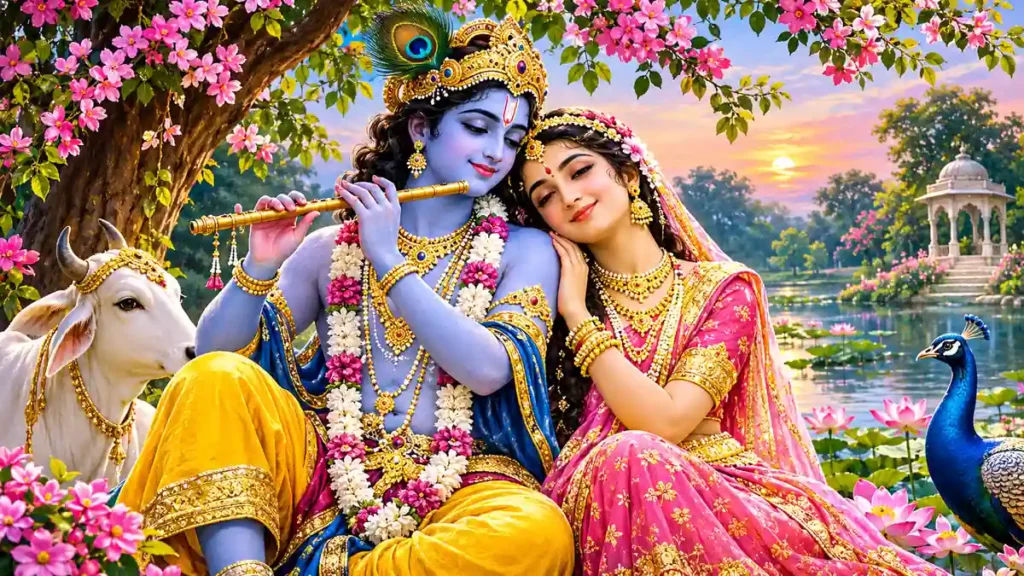
radha krishna images portray the divine relationship between Radha and Lord Krishna, symbolizing unconditional love, devotion (bhakti), and the soul’s longing for the divine. Popular depictions include Krishna playing the flute beside Radha, the couple standing in Vrindavan, and colorful scenes inspired by Hindu religious traditions.
These pictures are more than decorative artwork. Their colors, gestures, surroundings, and sacred symbols communicate ideas that have shaped devotional poetry, music, and visual culture for centuries.
The Spiritual Meaning Behind radha krishna images
In many Vaishnava traditions, Radha and Krishna represent the highest expression of divine love. Krishna is worshipped as the Supreme Lord, while Radha embodies profound devotion and, particularly in Gaudiya Vaishnavism, his divine pleasure potency.
Their relationship is often understood spiritually rather than simply as a romantic story. Radha’s love for Krishna illustrates complete dedication, while Krishna’s presence represents divine beauty, compassion, and bliss.
Radha as a Symbol of Devotion
Radha holds a central place in Krishna-centered devotional traditions. Her love is often described as selfless because it seeks Krishna’s happiness rather than personal reward.
In religious paintings, Radha may appear wearing a colorful sari, adorned with jewelry, and standing beside Krishna with an expression of affection or contemplation.
These details communicate emotional intimacy, reverence, and devotion.
Krishna as a Symbol of Divine Love
Lord Krishna is commonly depicted with blue or dark-colored skin, a peacock feather in his crown, and a bamboo flute.
His blue complexion is frequently interpreted as suggesting the vastness and mystery of the divine. The flute symbolizes the captivating call of divine love, inviting devotees to turn their attention toward Krishna.
Together, Radha and Krishna express the connection between the devotee and the divine.
Popular Types of radha krishna images
Radha Krishna Playing Flute in Divine Garden – Wallpaper
Radha Krishna Love Images
These portray Radha and Krishna together, often exchanging affectionate glances or standing beneath flowering trees. They emphasize tenderness, emotional closeness, and spiritual unity.
Radha Krishna: Divine Love in Artistic Representation | AI Art Generator | Easy-Peasy.AI
Radha Krishna Flute Images
Krishna plays the bansuri, or bamboo flute, while Radha listens nearby. The flute is associated with the attraction of the divine and the awakening of devotion.
Radha Krishna Nature Paintings
Forests, lotus ponds, peacocks, flowering gardens, and riverbanks form the background. These scenes evoke the sacred landscape of Braj, especially Vrindavan.
Radha Krishna Miniature Painting: Traditional Indian Art, Golden Jewel Work – Etsy
Traditional Radha Krishna Portraits
Rich garments, ornate crowns, detailed jewelry, and decorative backgrounds reflect Indian painting traditions and temple-inspired iconography.
Other popular formats include black-background portraits, minimalist illustrations, pencil sketches, festive artwork, and high-definition digital wallpapers.
Sacred Symbols Commonly Found in Radha Krishna Pictures
Traditional devotional imagery frequently contains recognizable symbols. Understanding them makes the artwork more meaningful.
| Symbol | Common interpretation |
|---|---|
| Peacock feather | Beauty, divine play, and Krishna’s distinctive identity |
| Flute (Bansuri) | Divine attraction and spiritual calling |
| Lotus flower | Purity, beauty, and spiritual awakening |
| Cow | Krishna’s pastoral childhood and protective relationship with cows |
| Yamuna River | Sacred geography and Krishna’s childhood pastimes |
| Kadamba tree | A setting associated with Krishna’s activities in Braj |
| Garland of flowers | Affection, devotion, and celebration |
| Yellow garments | A traditional feature of Krishna’s appearance |
These interpretations are not universal rules. Their significance can vary according to religious tradition, artistic context, and regional custom.
Why Krishna Wears a Peacock Feather
The peacock feather, or mor pankh, is one of Krishna’s most recognizable attributes.
It connects his image with the natural beauty of Vrindavan and his playful, pastoral identity. Artists frequently place a feather in his crown so viewers can immediately recognize him.
Why Radha and Krishna Are Often Shown Near Flowers
Flowers and gardens are recurring elements in devotional poetry about Radha and Krishna.
They create a setting of beauty, intimacy, and spiritual delight. The blooming landscape often reflects the emotional richness of divine love.
Traditional Indian Art Styles Featuring Radha and Krishna
Radha Krishna artwork has developed across several centuries, reflecting India’s diverse regional painting traditions.
Kangra and Pahari Miniature Paintings
‘How to love in Sanskrit’: Love in a Dead Language
Kangra painting is particularly celebrated for its delicate landscapes, expressive faces, flowing garments, and romantic devotional subjects.
These paintings often place Radha and Krishna among hills, flowering trees, and rivers. Soft colors and subtle gestures create an atmosphere of serenity.
The Allahabad Museum preserves a 19th-century Kangra miniature showing Krishna holding his flute while Radha holds his hand. Museums of India+1
Rajasthani and Jaipur Paintings
Rajasthani paintings frequently use bold colors, decorative architecture, intricate clothing, and carefully arranged compositions.
A late-18th-century Jaipur painting in the National Museum collection depicts Krishna conversing with Radha while holding a rose and flute. Museums of India
Such works demonstrate how artists communicated relationships through small details rather than elaborate action.
Madhubani and Mithila Art
Madhubani paintings, associated with the Mithila region, use strong outlines, patterned clothing, decorative borders, and stylized natural forms.
Radha and Krishna may appear surrounded by birds, flowers, trees, and geometric patterns. Rather than attempting photographic realism, these paintings emphasize rhythm, symbolism, and ornamentation.
Bengal Folk and Devotional Art
Bengal’s visual traditions also feature Radha and Krishna in musical and pastoral settings.
A 19th-century folk painting in the National Museum, New Delhi, shows Krishna playing his flute while Radha turns toward eight gopis playing musical instruments. Museums of India
These regional variations illustrate how the same devotional subject can inspire distinctly different artistic expressions.
radha krishna images for Mobile Wallpapers and Digital Backgrounds
Digital images have introduced traditional religious artwork to new audiences. Many people use Radha Krishna pictures as phone wallpapers, desktop backgrounds, profile images, or digital devotional displays.
The best format depends on the screen and how the artwork will be viewed.
| Image type | Suggested resolution | Aspect ratio |
|---|---|---|
| Mobile wallpaper | 1080 × 1920 pixels | 9:16 |
| Desktop wallpaper | 1920 × 1080 pixels | 16:9 |
| Square profile picture | 1080 × 1080 pixels | 1:1 |
| High-resolution desktop | 3840 × 2160 pixels | 16:9 |
| Social media portrait | 1080 × 1350 pixels | 4:5 |
Choosing HD and 4K Images
High-definition images preserve important visual details, including Krishna’s peacock feather, Radha’s jewelry, and delicate floral decorations.
For mobile wallpapers, vertical compositions generally work better because they fit the screen without excessive cropping.
Desktop backgrounds benefit from wider compositions with landscape elements.
A 4K image contains more pixels than a standard Full HD image, but higher resolution does not automatically guarantee better quality. Sharpness, compression, original artwork quality, and color reproduction also matter.
Minimalist and Black-Background Designs
Minimalist pictures often focus on the silhouettes of Radha and Krishna, a flute, a peacock feather, or a small selection of symbolic colors.
Black backgrounds can create strong contrast with golden jewelry, colorful garments, and illuminated figures.
These styles appeal to viewers who prefer simple compositions while retaining recognizable devotional imagery.
Respecting Image Copyright
Not every picture found through an image search is free to reuse.
Historical paintings may be in the public domain, but modern photographs, digital illustrations, and reproductions can carry separate copyright restrictions.
Before publishing or redistributing artwork, check its licensing information. Museum collection pages, Wikimedia Commons, and other clearly licensed archives can help identify permitted uses.
The Connection Between Radha Krishna Art and Hindu Scriptures
The imagery of Radha and Krishna is closely connected to devotional literature, especially traditions centered on Krishna’s life in Braj.
Bhagavata Purana
The Bhagavata Purana describes Krishna’s childhood and youthful activities, including his relationships with the cowherd community and the gopis.
Although the text does not explicitly name Radha in its familiar narratives, later devotional traditions identify a particularly beloved gopi with her.
Many paintings draw inspiration from the text’s descriptions of Krishna’s flute playing, pastoral surroundings, and divine activities.
Gita Govinda
The 12th-century Sanskrit poem Gita Govinda, composed by Jayadeva, is especially influential in Radha Krishna art.
It explores longing, separation, reunion, and the emotional intensity of divine love.
Artists translated these poetic themes into scenes of Radha waiting for Krishna, the couple meeting in a garden, or Krishna seeking reconciliation.
The Metropolitan Museum of Art has documented Pahari paintings inspired by Jayadeva’s poetry and its devotional significance. The Metropolitan Museum of Art
Ras Lila and Devotional Performance
Ras Lila refers to Krishna’s divine dance with the gopis, an important theme in Vaishnava devotional traditions.
Paintings may depict circular dances, musicians, moonlit forests, or Krishna appearing among devotees.
These scenes communicate spiritual joy and participation in divine love rather than merely portraying entertainment.
How Radha Krishna Pictures Are Used in Daily Devotion
For many Hindu families, images of Radha and Krishna serve as reminders of faith, compassion, and devotion.
Home Temples and Prayer Spaces
Framed pictures are commonly placed in a puja room or home shrine.
During worship, devotees may offer flowers, light a lamp, chant sacred names, or meditate while looking at the image.
The practice of viewing a deity with reverence is known as darshan. It is an important aspect of many Hindu devotional traditions.
Janmashtami and Radhashtami Celebrations
Radha Krishna artwork becomes especially prominent during religious festivals.
Krishna Janmashtami celebrates the birth of Lord Krishna. Images may show Krishna as a child, with a flute, or in scenes from his life.
Radhashtami honors the appearance of Radha and is particularly significant in Radha-centered devotional communities.
During these celebrations, temples and households may decorate images with flowers, lights, and colorful fabrics.
Meditation and Personal Reflection
Some devotees use devotional pictures as a visual focus during chanting or meditation.
Images showing Radha and Krishna in peaceful natural settings can encourage contemplation of love, humility, and spiritual dedication.
The significance comes from the worshipper’s beliefs and devotional practice, not from any scientifically established special power of the picture itself.
How to Choose Meaningful Radha Krishna Artwork
A beautiful picture does not necessarily need elaborate decoration. Its meaning, composition, and suitability for the intended setting are equally important.
Consider the following:
- Identify the purpose. A home shrine may call for traditional iconography, while a phone background may benefit from a simpler design.
- Look for recognizable symbols. Krishna’s flute, peacock feather, and traditional garments help establish the devotional subject.
- Choose an appropriate artistic style. Kangra paintings offer delicate landscapes, while Madhubani art emphasizes decorative patterns.
- Check image clarity. Avoid excessively compressed or stretched pictures, particularly when printing.
- Respect religious context. Select imagery that is appropriate for the devotional tradition and household where it will appear.
- Verify reuse permissions. Confirm licensing before using artwork on websites, publications, or commercial materials.
Is There a Correct Direction for Placing Radha Krishna Pictures?
Some households follow Vastu Shastra or family customs when arranging religious images.
However, there is no single placement rule universally accepted across all Hindu traditions.
Devotees may follow the guidance of their family, temple, or spiritual teacher. A clean, respectful location is generally more relevant than assuming that a particular wall direction guarantees a specific result.
Can Radha Krishna Pictures Be Displayed in Bedrooms?
Practices vary among families and devotional communities.
Some people display Radha Krishna paintings in bedrooms as symbols of affection and harmony. Others prefer to keep explicitly devotional images in a dedicated prayer space.
There is no universal religious rule governing every household’s choice.
The Cultural Influence of Radha Krishna Images
The influence of Radha Krishna imagery extends beyond temple paintings.
Their relationship has inspired classical dance, devotional music, poetry, sculpture, textiles, and contemporary illustration.
In Indian classical dance traditions such as Kathak, Odissi, and Manipuri, episodes associated with Radha and Krishna are expressed through movement, facial expressions, and storytelling.
Devotional songs and bhajans also frequently describe their love, separation, and reunion.
The same themes appear in historical paintings. A circa-1900 chromolithograph in the Metropolitan Museum of Art depicts Radha alone in a forest setting, adorned with jewelry, flowers, and peacock feathers while awaiting Krishna. The Metropolitan Museum of Art
This demonstrates an important aspect of Radha Krishna art: both figures do not always need to appear together for the imagery to communicate their spiritual relationship.
Traditional Paintings Versus Modern Digital Illustrations
Traditional artworks are often shaped by established iconography, regional conventions, and devotional literature.
Modern digital illustrations may reinterpret these elements using cinematic lighting, realistic textures, fantasy landscapes, or simplified graphic design.
Neither approach is inherently more spiritually meaningful. Their value depends on the artistic intention, religious context, and personal connection of the viewer.
For readers interested in art history, museum collections provide useful opportunities to compare historical styles with contemporary interpretations.
Why radha krishna images Continue to Inspire People
The lasting appeal of Radha Krishna imagery comes from its ability to communicate profound ideas through familiar visual details.
A flute suggests divine attraction. A flowering forest evokes Vrindavan. Radha’s expression may communicate longing, affection, or complete devotion. Krishna’s presence brings together beauty, music, and spiritual joy.
Across Kangra miniatures, Rajasthani paintings, Bengal folk art, Madhubani illustrations, and modern digital wallpapers, these themes remain recognizable.
Understanding the traditions, symbols, and artistic styles behind radha krishna images allows viewers to appreciate them beyond their visual beauty. Each picture can become an invitation to explore the devotional poetry, cultural heritage, and spiritual teachings that continue to shape Radha and Krishna’s place in Hindu art.