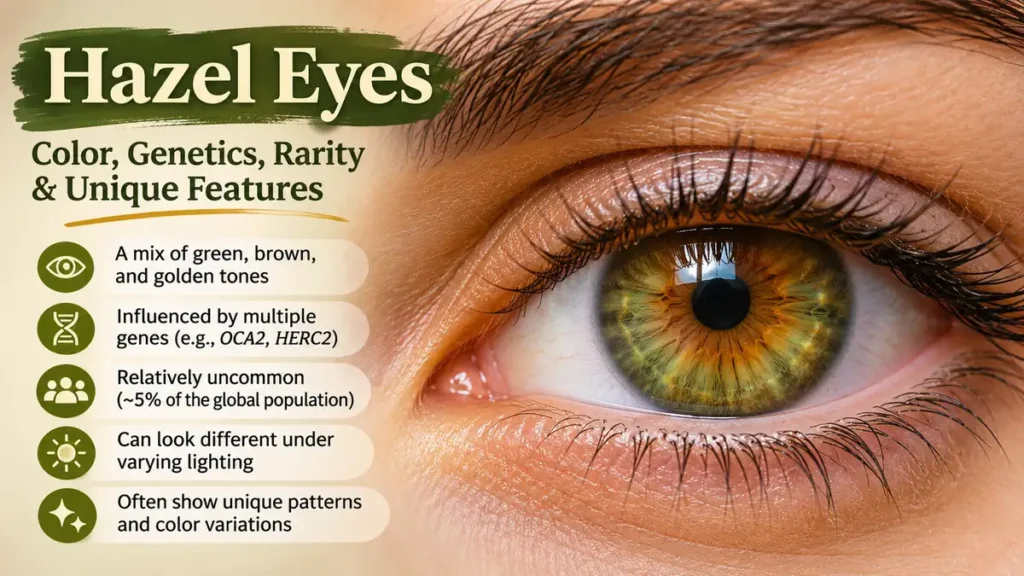
Hazel eyes are among the most visually distinctive eye colors. They can appear green in bright sunlight, golden in warm indoor lighting, or predominantly brown from a distance. This changing appearance often raises questions about what hazel eyes actually are, how they develop, and whether they are rare.
Hazel eyes are a natural eye color characterized by a combination of brown, green, gold, and sometimes amber tones within the iris. Their appearance results from the amount and distribution of melanin, the structure of the iris, and the way light interacts with its tissues. Unlike a uniform brown or blue iris, hazel eyes often display multiple visible colors.
Understanding the science behind hazel eyes reveals why two people with the same general eye color can have remarkably different-looking irises.
What Are Hazel Eyes?
Hazel eyes are typically described as a mixture of green and brown, often with golden or yellowish tones around the pupil.
Rather than displaying one consistent color across the entire iris, hazel eyes commonly feature variations in pigmentation.
Some have a brown center surrounded by a green outer region. Others appear primarily golden, with subtle green or brown flecks.
The precise appearance varies from person to person.
What Color Are Hazel Eyes Exactly?
There is no single standardized shade that defines every hazel iris.
Common color combinations include:
- Green and brown: A greenish outer iris with brown pigmentation near the pupil.
- Gold and green: Warm golden tones blended with olive-green coloring.
- Brown and amber: A predominantly brown appearance with golden or copper highlights.
- Green, gold, and brown: Multiple tones distributed throughout the iris.
The relative proportions of these colors influence whether someone describes their eyes as green-hazel, brown-hazel, or golden-hazel.
Eye color also exists along a continuum. This means that the boundary between hazel, green, amber, and light brown is not always perfectly defined.
Why Do Hazel Eyes Have Multiple Colors?
The iris contains pigment-producing cells called melanocytes. These cells produce melanin, the pigment responsible for much of the coloration in the eyes, skin, and hair.
Two important factors influence visible iris color:
- The amount and distribution of melanin within the iris.
- The way light is absorbed and scattered by iris tissues.
Hazel eyes generally contain intermediate and unevenly distributed pigmentation compared with many darker brown or lighter blue eyes.
This combination can create a multicolored appearance, particularly when different regions of the iris contain different concentrations of pigment.
How Rare Are Hazel Eyes?
Hazel eyes are relatively uncommon worldwide.
A frequently cited estimate suggests that approximately 5% of the global population has hazel eyes. However, this figure should be treated as an approximation rather than a precisely measured worldwide prevalence.
There is no universally applied classification system for eye color, and researchers sometimes group hazel eyes with green, amber, or intermediate-colored eyes.
Hazel Eyes Compared With Other Eye Colors
| Eye color | General characteristics | Global prevalence |
|---|---|---|
| Brown | Higher melanin concentration; most common | Most common worldwide |
| Blue | Lower melanin; structural light scattering | Less common than brown |
| Hazel | Mixed brown, green, and golden tones | Often estimated around 5% |
| Green | Predominantly green appearance | Uncommon |
| Gray | Grayish appearance influenced by pigmentation and light scattering | Uncommon |
| Amber | Relatively uniform golden or copper coloration | Uncommon |
Exact global percentages vary across sources because populations are sampled differently and eye-color categories overlap.
Where Are Hazel Eyes Most Common?
Hazel eyes occur in people from many geographic regions and ancestral backgrounds.
They are often reported among populations with European ancestry, particularly in areas where intermediate eye colors are relatively common.
They also occur in people with ancestry from the Middle East, North Africa, South Asia, and other regions.
Eye color alone cannot reliably establish someone’s ethnicity, nationality, or geographic ancestry.
Are Hazel Eyes Rarer Than Green Eyes?
Green eyes are generally considered less common than hazel eyes in commonly cited worldwide estimates.
However, direct comparisons are complicated by classification differences. An iris that one observer describes as green may be classified as green-hazel by another.
For this reason, precise rarity rankings should not be interpreted as universal scientific measurements.
The Genetics Behind Hazel Eyes
Eye color is inherited, but the genetics involved are more complex than the traditional explanation that brown eyes are dominant and blue eyes are recessive.
Scientists now recognize eye color as a polygenic trait, meaning multiple genes contribute to the final appearance.
Which Genes Influence Hazel Eyes?
Two of the best-studied genes associated with human eye color are OCA2 and HERC2, located on chromosome 15.
OCA2 influences pigmentation processes, while regulatory variation within HERC2 can affect OCA2 expression.
Other genes associated with pigmentation and eye-color variation include:
- SLC24A4
- SLC45A2
- TYR
- TYRP1
- IRF4
Together, genetic variations influence melanin production, transport, and distribution.
Hazel eyes do not result from one specific hazel-eye gene. Instead, they reflect a combination of inherited genetic influences.
Can Two Brown-Eyed Parents Have a Hazel-Eyed Child?
Yes.
Because eye color depends on multiple genes, two parents with brown eyes can have a child with hazel eyes.
Likewise, parents with hazel eyes may have children with brown, green, blue, or other eye colors, depending on the genetic variants inherited.
Simple inheritance charts cannot reliably predict every possible outcome.
Can Hazel Eyes Skip a Generation?
Eye colors can appear to skip generations when genetic combinations produce a visible trait in a grandchild that is not apparent in either parent.
However, this does not mean hazel eyes are controlled by a single recessive gene.
The apparent pattern reflects the complex inheritance of pigmentation-related variants.
Are Hazel Eyes Dominant or Recessive?
Hazel eyes cannot accurately be classified as simply dominant or recessive.
The familiar dominant-brown-versus-recessive-blue model is a simplified teaching example, not a complete description of human eye-color inheritance.
Modern genetic research shows that intermediate colors, including hazel, are particularly difficult to predict using simple inheritance rules.
Why Do Hazel Eyes Appear to Change Color?
One of the most recognizable features of hazel eyes is their ability to look different under changing conditions.
A person might notice that their eyes look green outdoors, brown in photographs, and golden under warm artificial lighting.
In most cases, the underlying iris pigmentation has not changed.
Instead, the visible difference results from lighting, contrast, and perception.
How Lighting Affects Hazel Eyes
Lighting influences which colors within the iris appear most prominent.
Under bright daylight, green and golden tones may become more noticeable.
In dimmer environments, darker brown regions can dominate the overall appearance.
Warm artificial lighting may emphasize amber or golden pigmentation, while cooler lighting can change the perceived balance between green and brown.
The angle of illumination also affects reflections and the visibility of fine iris patterns.
Do Hazel Eyes Change With Clothing Colors?
Clothing does not physically alter iris pigmentation.
However, surrounding colors can influence visual perception through contrast.
For example, green clothing may make greenish regions of a hazel iris appear more noticeable. Brown or gold clothing can emphasize warmer tones.
This is a perceptual effect rather than a biological change in eye color.
Can Emotions Change Hazel Eye Color?
Emotions can influence pupil size through the autonomic nervous system.
When the pupil expands or contracts, the visible arrangement of the iris changes slightly.
This may alter how its colors and patterns are perceived.
However, happiness, anger, sadness, or excitement do not normally cause the iris to produce a new pigment color.
Can Hazel Eyes Permanently Change Color?
Eye color can change during early childhood as pigmentation develops.
In adults, natural eye color is generally stable.
A noticeable, persistent change in adult iris color may occasionally be associated with medications, inflammation, injury, or an underlying eye condition.
If one eye suddenly changes color, or the change occurs alongside pain, redness, or visual disturbances, an examination by an eye-care professional is advisable.
Hazel Eyes vs. Green, Brown, and Amber Eyes
Hazel eyes are sometimes confused with green, light brown, and amber eyes because these colors share overlapping pigmentation characteristics.
The main differences involve the overall appearance and distribution of color across the iris.
| Feature | Hazel eyes | Green eyes | Brown eyes | Amber eyes |
|---|---|---|---|---|
| Main appearance | Mixed green, brown, gold | Predominantly green | Light to dark brown | Golden, yellow-brown, copper |
| Color distribution | Often varied or blended | Usually more consistently green | Usually more consistently brown | Usually relatively uniform |
| Melanin | Variable, often intermediate | Generally lower than brown | Generally higher | Variable |
| Lighting effect | Multiple tones may become prominent | Green intensity may vary | Brightness and shade may vary | Golden tones may become prominent |
| Distinguishing trait | Multicolored iris | Dominant green appearance | Dominant brown appearance | Consistent warm golden appearance |
Hazel Eyes vs. Green Eyes
The most noticeable difference is the presence of brown or golden pigmentation.
Green eyes generally appear predominantly green, although they may contain subtle golden or brown details.
Hazel eyes display a more obvious combination of green and warmer colors.
Someone with green-hazel eyes may have an iris that looks nearly green in daylight but reveals substantial brown pigmentation upon closer inspection.
Hazel Eyes vs. Brown Eyes
Brown eyes can range from light honey-brown to very dark brown.
Light brown eyes sometimes resemble hazel eyes, especially when golden highlights are present.
However, hazel eyes usually contain a noticeable greenish component that is less prominent in typical brown eyes.
A close examination under neutral lighting can help reveal the difference.
Hazel Eyes vs. Amber Eyes
Amber eyes have a more consistently golden, copper, or yellowish-brown appearance.
Hazel eyes generally contain a broader mixture of tones, particularly green and brown.
Although both can appear golden in sunlight, amber eyes typically lack the same degree of green-brown variation.
Different Types and Shades of Hazel Eyes
Hazel is a broad descriptive category rather than a collection of formally recognized medical subtypes.
Nevertheless, several common appearances can be identified.
Green Hazel Eyes
Green hazel eyes have a predominantly green appearance with noticeable brown or golden pigmentation.
The green component may be olive, moss, or yellow-green.
Brown pigment is frequently more visible near the pupil, while the outer iris appears greener.
Brown Hazel Eyes
Brown hazel eyes contain more visibly brown pigmentation.
From a distance, they may appear light brown. Under brighter lighting, green or golden flecks can become more apparent.
This variation demonstrates why hazel eyes can be difficult to classify using ordinary photographs.
Golden Hazel Eyes
Golden hazel eyes display pronounced yellow-brown or honey-colored tones.
These warmer colors may surround the pupil or extend through much of the iris.
Green pigmentation distinguishes many golden-hazel irises from more uniformly colored amber eyes.
Dark Hazel Eyes
Dark hazel eyes contain substantial brown pigmentation while retaining green or golden areas.
They may look brown in dim lighting but reveal their mixed coloring in daylight.
Light Hazel Eyes
Light hazel eyes have a relatively pale appearance, sometimes featuring a large proportion of green, gold, or olive tones.
They may resemble green eyes, especially when the brown component is subtle.
These descriptions are useful for identifying visible differences, but there are no universally accepted diagnostic boundaries separating these shades.
Hazel Eyes and Central Heterochromia
Another common question concerns the relationship between hazel eyes and heterochromia.
Heterochromia refers to differences in iris coloration. These differences may occur between the two eyes or within a single iris.
What Is Central Heterochromia?
Central heterochromia describes an iris with a distinct inner ring of color surrounding the pupil and a differently colored outer region.
For example, an individual may have a golden-brown ring around the pupil and a predominantly green outer iris.
This can resemble the appearance of hazel eyes.
The key distinction is that hazel describes a color combination, while central heterochromia describes a color-distribution pattern.
Hazel coloring often blends gradually, whereas central heterochromia generally involves a more clearly defined inner ring. The two descriptions can overlap. All About Vision+1
Can You Have Both Hazel Eyes and Central Heterochromia?
Yes.
A person can have hazel eyes with a distinctly colored central ring.
However, not every brown center in a hazel iris should automatically be classified as central heterochromia.
Natural pigmentation patterns, iris structures, and lighting can produce similar appearances.
Is Central Heterochromia Dangerous?
Central heterochromia that has been present since childhood and remains stable is often a harmless variation.
However, newly developing differences in iris coloration should be evaluated, especially when accompanied by other symptoms.
Do Hazel Eyes Affect Vision or Eye Health?
Hazel eyes are a normal variation in human pigmentation and do not inherently indicate an eye disorder.
The color of the iris alone does not determine visual acuity, intelligence, personality, or general health.
However, iris pigmentation can influence certain aspects of light absorption.
Are Hazel Eyes More Sensitive to Sunlight?
People with lighter-colored irises may experience greater sensitivity to bright light than some people with darker irises.
This is partly related to differences in melanin, which absorbs light.
Hazel eyes vary substantially in pigmentation, so not everyone with hazel eyes experiences the same level of light sensitivity.
Other factors, including pupil size, medications, ocular conditions, and individual sensitivity, also matter.
Do Hazel Eyes Need Special UV Protection?
Everyone should protect their eyes from excessive ultraviolet exposure, regardless of iris color.
Useful protective measures include wearing sunglasses that block 99–100% of UVA and UVB radiation and using a wide-brimmed hat in strong sunlight.
Hazel eyes do not require a special category of sunglasses solely because of their color.
Are Hazel Eyes Associated With Better Night Vision?
There is no reliable evidence that having hazel eyes automatically provides superior night vision.
Night vision depends on the retina, rod photoreceptors, pupil responses, and overall visual health.
Iris color is not a dependable measure of someone’s ability to see in low-light environments.
Can Hazel Eyes Indicate an Eye Disease?
Hazel eye color itself is not a disease.
Nevertheless, certain eye conditions can cause changes in iris pigmentation or appearance.
Examples include some forms of uveitis, pigment-related disorders, and conditions associated with acquired heterochromia.
A sudden or unexplained color change deserves professional assessment rather than being attributed to normal hazel-eye variation.
How to Tell if You Have Hazel Eyes
Determining whether your eyes are hazel can be challenging because photographs and artificial lighting may distort their appearance.
A simple observation process can help you identify their predominant colors.
- Use natural, indirect daylight. Stand near a window without looking directly at the sun.
- Observe the entire iris. Look beyond the central ring to identify the outer and middle regions.
- Check for multiple tones. Notice whether green, brown, and golden colors are all visible.
- Compare both eyes. Small differences between the irises are common.
- Avoid camera filters. Beauty filters, flash, and automatic color correction can alter apparent eye color.
A sharp, unfiltered photograph may help you examine pigmentation patterns more carefully.
What If Your Eyes Look Green and Brown?
If your iris contains a noticeable mixture of green and brown, hazel is often an appropriate description.
However, eye-color categories are descriptive rather than strictly diagnostic.
A person may reasonably describe the same intermediate iris as green-hazel, light hazel, or green with brown markings.
Can an Eye Color Test Identify Hazel Eyes?
Online eye-color tests and image-analysis tools may provide approximate classifications.
Their accuracy depends on lighting, image quality, camera settings, and the classification system being used.
They should not be treated as medical tests or definitive genetic analyses.
Interesting Facts and Common Myths About Hazel Eyes
Hazel eyes have attracted attention because of their multicolored appearance, but several popular claims are not supported by scientific evidence.
Are Hazel Eyes More Attractive?
Attractiveness is subjective and influenced by personal preference, culture, familiarity, and individual facial features.
Some people find the contrast between green, gold, and brown particularly striking.
However, no eye color is objectively more attractive than another.
Do People With Hazel Eyes Have Special Personality Traits?
Claims that hazel-eyed people are more adventurous, creative, independent, or unpredictable are not established by credible scientific evidence.
Personality cannot be reliably determined from iris pigmentation.
Eye color and personality are complex, separate characteristics.
Are Hazel Eyes Associated With Special Powers?
There is no scientific evidence that hazel eyes provide supernatural abilities, unusual intuition, or enhanced emotional perception.
Their distinctive appearance is explained by pigmentation, iris anatomy, and optical effects.
Does Everyone With Hazel Eyes Have the Same Pattern?
No.
The precise arrangement of iris pigmentation and structural features varies between individuals.
Even people with similar overall eye colors can have noticeably different patterns, rings, flecks, and radial markings.
The American Academy of Ophthalmology explains that the amount and distribution of iris melanin help make individual eye appearances distinctive. American Academy of Ophthalmology+1
Can Babies Be Born With Hazel Eyes?
Yes, some babies have eyes that appear hazel early in life.
However, infant eye color may continue developing as melanin accumulates.
A child’s eye color can change during the first months or years of life, although the timing and extent vary.
Not all babies are born with blue eyes, and not every child’s eye color changes significantly.
What Makes Hazel Eyes Unique?
The defining characteristic of hazel eyes is the combination of several visible tones within a single iris.
Their appearance is influenced by three closely related features: pigmentation, iris structure, and lighting.
Melanin determines much of the underlying coloration. Its distribution creates areas that may appear brown, golden, or greenish. Light scattering and absorption influence how those areas are perceived.
This explains why hazel eyes can look noticeably different in photographs taken only minutes apart.
Their variability also makes them difficult to place into rigid categories.
Scientific descriptions of eye color recognize a continuum rather than a small number of completely separate types. The National Library of Medicine identifies melanin-related genetic variation as central to this process, particularly the influence of OCA2 and HERC2. MedlinePlus+1
Final Thoughts on Hazel Eyes
Hazel eyes are a naturally occurring eye color distinguished by their mixture of green, brown, gold, and sometimes amber tones. Their distinctive appearance comes from the distribution of melanin within the iris and the interaction of light with its tissues.
Although hazel eyes are relatively uncommon, their precise global prevalence is difficult to establish because eye-color classifications vary.
Genetics explains much of their development, but no single gene determines whether someone will have hazel eyes. Their apparent color shifts are also usually optical effects rather than actual changes in pigmentation.
If you are trying to identify your own eye color, examining your irises under natural, indirect daylight is a useful starting point. Look for the overall balance of green, brown, and golden tones rather than relying on one photograph or a single colored ring.