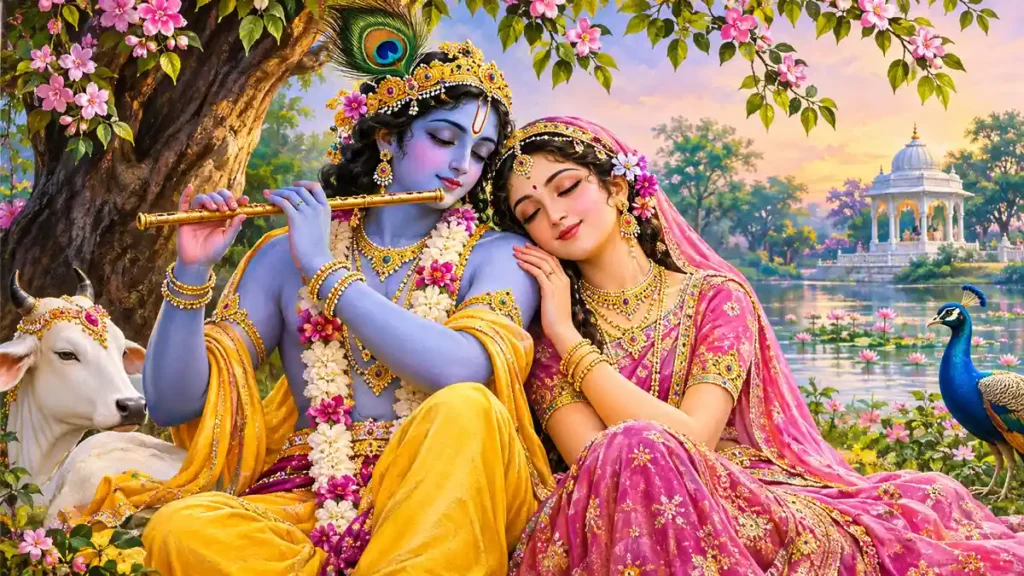
Few relationships in Hindu spirituality have inspired as much poetry, music, art, and devotion as radha krishna. Their story is more than a romantic tale. It explores the relationship between the human soul and the divine, the meaning of unconditional love, and the spiritual power of devotion.
radha krishna represents divine love and the union of the individual soul with God in many Hindu devotional traditions. Radha embodies profound devotion, while Krishna is revered as the Supreme Divine or an incarnation of Vishnu. Together, they symbolize love that transcends worldly attachment and leads toward spiritual realization.
Their relationship is celebrated through ancient Sanskrit literature, the Bhakti movement, temple worship, classical dance, and festivals such as Radhashtami and Janmashtami.
Who Are radha krishna in Hindu Mythology?
Radha and Krishna occupy a central place in Vaishnava devotional traditions, particularly those associated with Vrindavan, Braj, and the worship of Krishna.
Although they are frequently depicted together, their individual identities carry distinct theological meanings.
Who Is Radha?
Radha, also known as Radharani, Radhe, and Shri Radha, is revered as Krishna’s supreme beloved and, in several Vaishnava traditions, the embodiment of divine love.
In Gaudiya Vaishnavism, Radha is understood as the personification of hladini shakti, Krishna’s internal pleasure-giving spiritual potency.
Her devotion is considered the highest expression of prema bhakti, or loving devotion to God.
Radha is particularly associated with:
- Unconditional and selfless love
- Spiritual surrender and devotion
- Divine feminine energy
- Longing for union with Krishna
- Compassion, grace, and spiritual bliss
In some traditions, Radha is worshipped not merely as a devotee but as a divine manifestation inseparable from Krishna.
Who Is Lord Krishna?
Lord Krishna is one of the most widely worshipped deities in Hinduism. He is regarded as an avatar of Lord Vishnu in many Hindu traditions and as the Supreme Personality of Godhead in several Krishna-centered Vaishnava schools.
Krishna’s life and teachings are described in sacred texts including the Mahabharata, Bhagavad Gita, Harivamsa, Vishnu Purana, and Bhagavata Purana.
He is known for several important roles:
- Divine child: The playful Krishna of Gokul and Vrindavan
- Cowherd: The flute-playing protector of cows and companion of the gopis
- Beloved: The central figure of the devotional traditions surrounding Radha
- Teacher: The spiritual guide who delivers the Bhagavad Gita to Arjuna
- Protector: The deity who upholds dharma and protects devotees
Krishna’s flute, peacock feather, yellow garments, and dark-blue complexion have become familiar symbols throughout Hindu art and worship.
Why Are Radha and Krishna Worshipped Together?
Radha and Krishna are worshipped together because their relationship represents the inseparability of divine love and its object.
In Gaudiya Vaishnava theology, Radha represents Krishna’s loving spiritual potency, while Krishna is the supreme object of that love.
Their unity expresses a fundamental devotional principle: divine love is not simply an emotion but a spiritual relationship through which the devotee approaches God.
This interpretation is especially prominent in traditions inspired by Chaitanya Mahaprabhu.
The Love Story of radha krishna
The love story of Radha and Krishna unfolds primarily in the sacred landscape of Braj, particularly Vrindavan, Barsana, Nandgaon, and the banks of the Yamuna River.
Different scriptures, poems, and regional traditions tell their story in different ways. There is no single universally accepted narrative containing every familiar episode.
Their Divine Connection in Vrindavan
According to devotional traditions, Krishna spent his childhood among the cowherds of Gokul and Vrindavan.
Radha is traditionally associated with Barsana and the surrounding Braj region.
Their relationship is remembered through pastoral scenes involving flowering forests, riverbanks, music, dancing, and gatherings of the gopis.
These settings are not merely decorative. In Vaishnava devotional literature, Vrindavan represents a sacred environment where divine love can be experienced without the limitations of ordinary social relationships.
Radha’s love for Krishna is presented as spontaneous, complete, and free from selfish expectation.
The Significance of Krishna’s Flute
Krishna’s flute, known as the murali or bansuri, is among the most recognizable symbols of his divine presence.
In devotional poetry, the sound of the flute draws the gopis toward Krishna, awakening their longing for spiritual union.
Radha is frequently portrayed as responding to this divine call with extraordinary intensity.
The flute is often interpreted as symbolizing the divine invitation to surrender the ego and turn toward God.
Its hollow structure also inspires a popular spiritual analogy: just as the flute produces music when filled with Krishna’s breath, a person becomes receptive to divine grace through humility and surrender.
This is a devotional interpretation rather than a literal teaching found uniformly across Hindu scriptures.
The Raas Leela and Divine Dance
The Raas Leela, or Rasa Lila, is the sacred dance associated with Krishna and the gopis of Vrindavan.
The Bhagavata Purana describes Krishna’s autumn-night dance with the cowherd women, particularly in Book 10.
The narrative emphasizes the extraordinary relationship between Krishna and his devotees.
Later Vaishnava traditions give Radha a particularly prominent role in the interpretation and artistic representation of the dance.
The Raas Leela symbolizes divine joy, spiritual intimacy, and the soul’s desire for communion with God.
In many theological interpretations, its purpose is not to celebrate ordinary sensual attachment but to express the transcendental nature of divine love.
Why Did Radha and Krishna Separate?
One of the most emotionally powerful themes in Radha-Krishna literature is separation, known as viraha or vipralambha.
In the broader Krishna narrative, Krishna leaves the pastoral world of Vrindavan and travels to Mathura.
Devotional poetry explores the sorrow experienced by Radha and the gopis in his absence.
Their separation represents more than physical distance.
It expresses the intense longing of the soul for the divine.
In many Bhakti traditions, remembrance and longing can deepen devotion rather than diminish it.
The experience of separation becomes a spiritual discipline through which love is purified of selfish desires.
Why Did radha krishna Never Marry?
One of the most frequently asked questions about Radha and Krishna concerns their marriage.
The answer depends on which scripture, theological school, or regional tradition is being followed.
The Traditional Explanation
In many familiar devotional narratives, Radha and Krishna are not portrayed as a conventionally married couple.
Their relationship is understood as transcending the social structures of ordinary human relationships.
Within some theological interpretations, this distinction emphasizes that divine love cannot be measured solely through marriage or worldly expectations.
Radha’s devotion remains complete even without the conventional fulfillment associated with marriage.
However, it would be inaccurate to claim that every Hindu tradition agrees that Radha and Krishna never married.
Traditions That Describe Their Marriage
Certain later devotional texts and regional narratives describe a divine marriage between Radha and Krishna.
The Brahma Vaivarta Purana, for example, contains traditions that portray their relationship within a cosmic theological framework.
Other accounts associate their wedding with Bhandirvan in the Braj region.
These narratives are especially meaningful to communities that understand Radha and Krishna as eternally united divine counterparts.
The distinction is important because Hindu devotional literature developed across different historical periods and religious communities.
Radha and Krishna Versus Rukmini and Krishna
Krishna’s marriage to Rukmini is a prominent part of the wider Krishna tradition.
Rukmini is regarded as Krishna’s principal queen in Dvaraka and is associated with Lakshmi in many Vaishnava interpretations.
Radha’s position is different, especially in Braj-centered devotional theology.
| Aspect | Radha | Rukmini |
|---|---|---|
| Principal association | Vrindavan and Braj | Dvaraka |
| Relationship with Krishna | Supreme beloved in Radha-centered traditions | Principal queen and wife |
| Spiritual emphasis | Intimate divine love and devotion | Royal marriage, devotion, and divine partnership |
| Important literature | Gita Govinda and later Vaishnava texts | Bhagavata Purana and other Puranic narratives |
| Devotional significance | Especially prominent in Braj and Gaudiya traditions | Prominent in Krishna worship across several Vaishnava traditions |
Neither figure should be reduced to a simple comparison of who loved Krishna more. Their theological roles differ across traditions.
The Spiritual Meaning of radha krishna
The spiritual meaning of Radha and Krishna is deeply connected to bhakti, the Hindu path of loving devotion.
Their relationship illustrates how the human soul can develop an intimate and transformative relationship with the divine.
Radha as the Symbol of Pure Devotion
Radha represents a form of love that does not depend on personal gain.
Her devotion is characterized by complete dedication to Krishna.
In devotional theology, this love is often described as nishkama prema, or love without selfish motivation.
Radha does not seek Krishna merely for personal happiness. Her happiness is understood to arise from Krishna’s happiness.
This principle is central to the concept of selfless devotion.
Krishna as the Supreme Divine
Krishna represents the ultimate object of spiritual love in Krishna-centered Vaishnava traditions.
Unlike an impersonal understanding of the divine, these traditions emphasize a personal relationship between God and the devotee.
Krishna can be approached through different devotional relationships, traditionally called bhavas.
These include friendship, parental affection, service, and intimate divine love.
The relationship between Radha and Krishna is particularly associated with madhurya bhava, the devotional mood of loving intimacy.
The Meaning of Divine Union
In many interpretations, Radha and Krishna symbolize the inseparable relationship between divine energy and its source.
Their unity is not necessarily understood as two independent beings becoming one.
Rather, traditions such as Gaudiya Vaishnavism regard them as eternally connected aspects of divine reality.
The relationship is also interpreted symbolically as the longing of the individual soul, or jiva, for God.
These interpretations are related but not identical. The theological identity of Radha as Krishna’s spiritual potency is distinct from the broader metaphor of the devotee seeking divine union.
What Does Radha Krishna Love Teach Us?
Their relationship offers several lessons for spiritual reflection.
| Spiritual principle | Meaning | Application in daily life |
|---|---|---|
| Selfless love | Caring without demanding rewards | Practice generosity without expecting recognition |
| Devotion | Maintaining a sincere connection with the divine | Make time for prayer or meditation |
| Humility | Reducing ego-centered attachment | Listen and acknowledge personal limitations |
| Faithfulness | Remaining committed through difficulties | Act consistently with deeply held values |
| Spiritual longing | Turning emotional yearning toward spiritual growth | Reflect on what gives life meaning |
| Compassion | Recognizing the importance of others | Offer practical help and kindness |
These are contemporary applications of devotional themes, not a claim that every Hindu school interprets the relationship identically.
radha krishna in Hindu Scriptures and Sacred Literature
The stories and theology surrounding Radha and Krishna developed through several layers of Sanskrit literature, regional poetry, and devotional commentary.
Understanding these sources helps distinguish early Krishna narratives from later Radha-centered traditions.
Bhagavata Purana
The Bhagavata Purana is one of the most influential scriptures of Krishna devotion.
Its tenth book describes Krishna’s childhood, his activities in Vrindavan, the devotion of the gopis, and the Raas Leela.
Radha is not explicitly identified by name in the principal Raas Leela narrative.
However, Gaudiya Vaishnava commentators traditionally identify a particularly favored gopi mentioned in Bhagavata Purana 10.30.28 as Radha.
This is a theological interpretation of the passage, rather than an explicit naming of Radha in the verse.
The distinction matters because later devotional traditions developed a much more detailed understanding of her identity.
Gita Govinda by Jayadeva
The Gita Govinda is among the most important literary works devoted to Radha and Krishna.
Composed by the poet Jayadeva in the twelfth century, it presents their love through lyrical poetry, emotional longing, separation, and reunion.
The poem explores the relationship on both human and divine levels.
Its literary influence extended into temple traditions, Indian classical music, painting, and dance.
The Indira Gandhi National Centre for the Arts identifies the work as a major expression of the relationship between the individual soul and the divine. IGNCA+1
Brahma Vaivarta Purana
The Brahma Vaivarta Purana contains extensive theological narratives involving Radha and Krishna.
Its Krishna Janma Khanda presents Radha as a divine figure with a cosmic relationship to Krishna.
The text is particularly important for traditions emphasizing their eternal unity.
Because Puranic texts have complex histories of composition and transmission, individual narratives should not automatically be treated as belonging to the earliest layers of Hindu literature.
Garga Samhita
The Garga Samhita is another important source in later Krishna devotional traditions.
It contains narratives concerning Krishna’s divine activities, the sacred geography of Braj, and Radha’s relationship with him.
Stories associated with Radha’s birth, divine pastimes, and marriage appear in traditions connected with this literature.
Is Radha Mentioned in the Bhagavad Gita?
Radha is not named in the Bhagavad Gita.
The Bhagavad Gita forms part of the Mahabharata and presents Krishna’s spiritual instruction to Arjuna on the battlefield of Kurukshetra.
Its central subjects include dharma, karma yoga, jnana yoga, bhakti yoga, and liberation.
The absence of Radha from the Bhagavad Gita does not mean that Radha lacks importance in Hindu devotion.
It reflects the different subjects and literary purposes of the texts.
Radha Krishna Worship and the Bhakti Movement
The growth of Radha-Krishna worship is closely connected with the development of devotional Hindu traditions, especially during the medieval period.
Poets, teachers, temple communities, and religious movements helped establish Radha and Krishna as a central divine pair.
Chaitanya Mahaprabhu and Gaudiya Vaishnavism
Chaitanya Mahaprabhu played a major role in the development of Krishna-centered devotional practice.
His followers developed a theological tradition in which Radha’s love for Krishna became a supreme model of devotion.
Gaudiya Vaishnavism teaches achintya bhedabheda, commonly explained as inconceivable simultaneous oneness and difference between God and his energies.
Within this tradition, Radha is closely associated with Krishna’s internal spiritual potency.
The tradition also emphasizes nama sankirtana, the congregational chanting of divine names, as a central devotional practice.
Academic accounts of Chaitanya Vaishnavism identify pure love of Krishna as its ultimate spiritual goal. St Andrews Encyclopaedia of Theology+1
Other Vaishnava Traditions
Radha-Krishna devotion is not confined to Gaudiya Vaishnavism.
Several other traditions have contributed to its theological and cultural development.
The Nimbarka Sampradaya places special emphasis on the worship of Radha and Krishna together.
The Radha Vallabha tradition gives extraordinary prominence to Radha and her divine love.
The Haridasi tradition, associated with Swami Haridas, has influenced devotional music and worship in Vrindavan.
Pushtimarg, associated with Vallabhacharya, focuses especially on loving service to Krishna, although its theological emphasis differs from explicitly Radha-centered traditions.
These communities share a commitment to devotion while preserving distinct understandings of divine relationships and spiritual practice.
The Role of Bhakti Poetry
Devotional poetry made the emotions associated with Radha and Krishna accessible beyond formal Sanskrit theological study.
Poets such as Surdas, along with numerous Braj Bhasha writers, explored Krishna’s childhood, divine beauty, and relationships with devotees.
Later poets and musicians continued to develop themes of longing, surrender, joy, and spiritual intimacy.
The influence of these traditions can still be heard in bhajans, kirtans, and temple music.
Famous Radha Krishna Temples and Sacred Places
The Braj region of Uttar Pradesh is the principal geographical center of Radha-Krishna devotion.
Its temples, forests, hills, and pilgrimage routes preserve religious traditions associated with their divine activities.
Exploring the Spiritual Charm: Must-Visit Places in Vrindavan – Wanderela
Aerial view of Barsana Krishna temple during Holi
7
Temples and sacred places associated with Radha-Krishna worship in the Braj region.
Vrindavan
Vrindavan is one of the most important pilgrimage destinations for Krishna devotees.
It is associated with Krishna’s childhood pastimes, the gopis, and the sacred forests of Braj.
Prominent places of worship include the Banke Bihari Temple, Radha Raman Temple, Radha Vallabh Temple, and ISKCON Krishna Balaram Mandir.
Prem Mandir is another prominent temple complex known for its elaborate architecture and devotional displays.
Barsana
Barsana is traditionally associated with Radha’s childhood and family.
The Shri Radha Rani Temple, also known as Ladli Ji Temple, stands on a hill overlooking the town.
Barsana is especially famous for its distinctive Holi celebrations and Radhashtami observances.
Nandgaon
Nandgaon is associated with Krishna’s foster father Nanda Maharaj and his childhood household.
It is an important destination within the Braj pilgrimage circuit.
Nandgaon and Barsana are also linked through local traditions celebrating the playful interactions of Krishna, Radha, and their companions.
Govardhan and Radha Kund
Govardhan Hill is associated with Krishna’s protection of the people of Braj from torrential rain.
According to the Bhagavata Purana, Krishna lifted Govardhan to shelter the community.
Nearby Radha Kund and Shyama Kund are sacred water bodies of particular importance in Gaudiya Vaishnava devotion.
Radha Kund is revered in these traditions as an exceptionally sacred place associated with Radha’s love for Krishna.
4.6
4.7
4.7
4.2
4.7
Use two fingers to move the map
Use ctrl + scroll to zoom the map
Vrindavan4.6•Hindu templeOpen
Shri Radha Rani Temple4.7•Hindu templeOpen
Nand Bhawan Temple4.7•Hindu templeOpen
Govardhan Hill4.2•Mountain peak
Radha Kund4.7•Hindu templeOpen
Radha Krishna Festivals and Devotional Practices
Radha and Krishna are honored through festivals, temple ceremonies, devotional singing, and personal worship.
The precise rituals vary by region, community, and theological tradition.
Radhashtami
Radhashtami celebrates the appearance or birth anniversary of Radha.
It is observed on the eighth lunar day of the bright fortnight of the Hindu month of Bhadrapada.
The festival is especially significant in Barsana, Vrindavan, and Radha-centered Vaishnava communities.
Celebrations may include ceremonial bathing of the deity, flower decorations, devotional singing, scriptural readings, and special offerings.
Radhashtami is recognized across several Vaishnava traditions, although local observances differ. Radha Janmashtami
Krishna Janmashtami
Janmashtami celebrates the birth of Lord Krishna.
Devotees commonly observe fasting, prayers, devotional singing, and midnight worship.
Temples may decorate Krishna’s image as a divine child and reenact episodes from his early life.
In Radha-Krishna temples, the celebration also expresses gratitude for Krishna’s divine presence and the opportunity to develop loving devotion.
Holi in Braj
Holi has a distinctive religious and cultural character in the Braj region.
Celebrations in Barsana, Nandgaon, Mathura, and Vrindavan are associated with stories of Radha, Krishna, and the gopis.
Lathmar Holi, particularly associated with Barsana and Nandgaon, is one of the region’s best-known traditions.
Its playful customs are connected to local narratives of Krishna’s visits and interactions with Radha’s companions.
Chanting Radha Krishna Names
Chanting divine names is an important practice in several Vaishnava traditions.
Devotees may repeat names such as Radhe Radhe, Radha Krishna, or Hare Krishna.
The Hare Krishna maha-mantra is especially prominent in Gaudiya Vaishnavism and the International Society for Krishna Consciousness (ISKCON).
In devotional understanding, chanting helps direct attention toward God, cultivate humility, and deepen spiritual remembrance.
How to Practice Radha Krishna Devotion at Home
A simple devotional routine may involve:
- Choose a clean, peaceful place for prayer or meditation.
- Place an image or deity representation of Radha and Krishna if this is part of your tradition.
- Offer flowers, water, or other appropriate items according to your practice.
- Recite a prayer, chant divine names, or sing a bhajan.
- Read a passage from a devotional text.
- Spend a few minutes reflecting on compassion, humility, and selfless love.
There is no single ritual routine required across all Hindu traditions. Family customs and the guidance of a person’s spiritual community may differ.
Radha Krishna Symbols in Art, Music, and Culture
The image of Radha standing beside the flute-playing Krishna is one of the most recognizable subjects in Indian religious art.
Artists have represented their relationship through sculpture, painting, dance, poetry, and music for centuries.
The Meaning of Their Traditional Symbols
| Symbol | Common devotional interpretation |
|---|---|
| Krishna’s flute | Divine attraction and the call of spiritual love |
| Peacock feather | Beauty, playfulness, and Krishna’s connection with nature |
| Lotus flower | Purity, beauty, and spiritual awakening |
| Radha’s garments and ornaments | Divine beauty and loving devotion |
| Yamuna River | Sacred geography of Krishna’s pastimes |
| Vrindavan forests | The setting of intimate divine relationships |
| Dancing together | Spiritual joy and harmony |
| Flower garlands | Affection, offering, and devotional celebration |
Symbolic meanings vary between artists and religious traditions. They should not be treated as universally fixed interpretations.
Radha Krishna in Indian Classical Painting
Radha and Krishna became especially prominent subjects in Rajput and Pahari painting.
Artists portrayed their meetings, moments of separation, forest encounters, and musical gatherings.
The Kangra school of Pahari painting is particularly celebrated for its lyrical representations of Krishna devotion.
Paintings inspired by the Gita Govinda frequently use natural landscapes and changing seasons to express emotional states.
Art-historical accounts identify Jayadeva’s poem as an important influence on the visual representation of their relationship. Khan Academy
Classical Dance and Music
The Radha-Krishna tradition has influenced several Indian performing arts.
Manipuri dance is particularly associated with the presentation of Raas Leela.
Odissi performances frequently interpret verses from Jayadeva’s Gita Govinda.
Kathak also draws on Krishna narratives, devotional poetry, and expressive storytelling.
In Hindustani devotional music, Radha and Krishna appear in bhajans, thumri compositions, and other lyrical forms.
The emotional language of longing, reunion, and surrender allows performers to explore both artistic expression and religious devotion.
Understanding the Difference Between Divine Love and Human Romance
Radha and Krishna are often described as symbols of perfect love, but interpreting their relationship solely as a human romance overlooks important theological dimensions.
Their stories contain recognizable emotions such as affection, jealousy, longing, and reconciliation.
Yet devotional traditions frequently interpret these emotions through a spiritual framework.
Prema and Kama
Sanskrit devotional discussions often distinguish prema, divine or selfless love, from kama, desire directed toward personal enjoyment.
The distinction is especially significant in Gaudiya Vaishnava theology.
Prema seeks the happiness of the beloved, while selfish desire is centered on personal satisfaction.
Radha’s love is presented as the highest example of prema because her devotion is understood to be entirely directed toward Krishna.
This theological distinction helps explain why devotees consider their relationship sacred rather than merely romantic.
Separation as a Spiritual Experience
In ordinary relationships, separation is generally understood as an obstacle to happiness.
In Radha-Krishna devotional literature, separation can become an expression of heightened love.
The Sanskrit term viraha describes the pain of absence.
Within Bhakti poetry, longing for Krishna can intensify remembrance, surrender, and spiritual awareness.
Jayadeva’s Gita Govinda explores both separation and reunion as central experiences of divine love. IGNCA
Are Radha and Krishna One or Two?
Different Vaishnava traditions express their unity in different theological terms.
In Gaudiya Vaishnavism, Radha and Krishna are understood as eternally one divine reality manifested in two forms for the exchange of loving relationships.
This is closely connected with the understanding of divine energy and its possessor.
Other traditions may emphasize their eternal companionship, their divine feminine and masculine aspects, or their joint worship as the supreme divine pair.
Their unity is therefore best understood within the specific religious tradition being discussed rather than through one universal definition.
Why radha krishna Remains Important Today
Radha and Krishna continue to inspire religious practice, literature, music, and art throughout India and among Hindu communities worldwide.
Their appeal extends beyond the retelling of ancient narratives.
For devotees, their relationship offers a way to understand love as a spiritual discipline rather than simply an emotion.
For students of religion, Radha-Krishna traditions illustrate how sacred literature, theology, local geography, and artistic expression can develop together.
For readers interested in Indian culture, their story provides a window into the history of the Bhakti movement and the continuing influence of Sanskrit and regional devotional poetry.
Modern scholarship also examines how the sacred landscape of Braj remains connected to Radha-Krishna devotion through ritual, visual representation, pilgrimage, and religious identity. MDPI
The most meaningful lessons commonly drawn from their relationship include the importance of humility, compassionate action, sincere devotion, and love without possessiveness.
These ideas can encourage personal reflection, even while the full religious meaning of Radha and Krishna remains rooted in Hindu devotional theology.
Conclusion
The story of radha krishna is one of Hinduism’s most enduring expressions of divine love, devotion, and spiritual unity.
From the sacred forests of Vrindavan to the poetry of Jayadeva, the teachings of Gaudiya Vaishnavism, and the celebrations of Radhashtami and Janmashtami, their relationship has shaped centuries of religious and cultural life.
Radha represents the highest ideal of loving devotion in many Vaishnava traditions, while Krishna is the divine beloved toward whom that devotion is directed.
Their stories remind devotees that spiritual love involves humility, surrender, remembrance, and the willingness to place something greater than the self at the center of life.
For a deeper understanding, reading the Bhagavata Purana alongside the Gita Govinda provides two complementary perspectives: Krishna’s divine activities in Vrindavan and the profound devotional symbolism of Radha’s love.