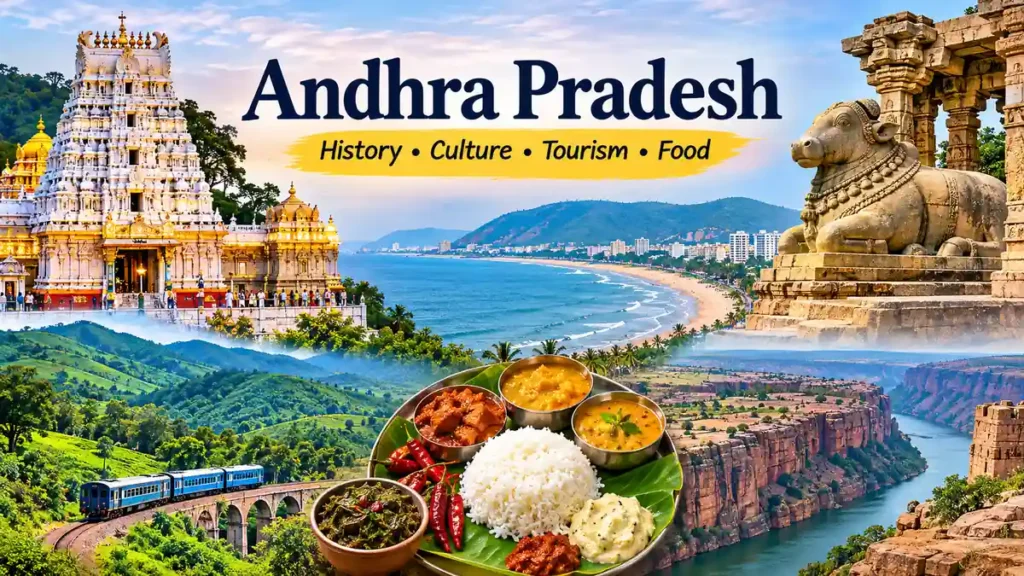
Andhra Pradesh is one of India’s most culturally rich states, known for its ancient temples, Telugu heritage, fertile river deltas, beautiful coastline, and distinctive cuisine. Located along the southeastern coast of India, the state combines centuries of history with modern agriculture, industrial development, and emerging urban centers.
From the sacred Tirumala Venkateswara Temple to the beaches of Visakhapatnam and the scenic Araku Valley, Andhra Pradesh offers remarkable geographical and cultural diversity.
Andhra Pradesh is a state in southeastern India, bordering the Bay of Bengal. Its official language is Telugu, and Amaravati is its designated capital. The state is famous for the Tirupati temple, Kuchipudi classical dance, the Krishna and Godavari rivers, and a coastline extending approximately 974 kilometers.
Andhra Pradesh at a Glance
| Feature | Details |
|---|---|
| State name | Andhra Pradesh |
| Country | India |
| Region | Southeastern India |
| Capital | Amaravati |
| Largest city | Visakhapatnam |
| Official language | Telugu |
| State formation | November 1, 1956 |
| Reorganization | June 2, 2014 |
| Area | Approximately 162,975 sq. km |
| Districts | 26 |
| Coastline | Approximately 974 km |
| Major rivers | Godavari, Krishna, Penna |
| Major cities | Visakhapatnam, Vijayawada, Guntur, Tirupati, Kurnool, Nellore |
| Classical dance | Kuchipudi |
| Time zone | Indian Standard Time (UTC+5:30) |
Andhra Pradesh occupies an important position in India’s southern economy because of its agricultural production, ports, industrial corridors, and transportation networks.
Its geography includes coastal plains, river valleys, forested hills, and parts of the Eastern Ghats.
Where Is Andhra Pradesh Located?
Andhra Pradesh lies on the southeastern side of the Indian peninsula, with the Bay of Bengal forming its eastern boundary.
It shares land borders with five Indian states:
- Telangana: Northwest
- Odisha: Northeast
- Chhattisgarh: North
- Karnataka: West
- Tamil Nadu: South
The Union Territory of Puducherry also has a small enclave, Yanam, within the coastal region near the Godavari delta.
Geographical Regions
The state’s landscape can broadly be divided into three regions.
Coastal Andhra consists of fertile plains, agricultural districts, fishing communities, and important coastal cities. The Krishna and Godavari deltas are especially productive.
Rayalaseema, in the southern interior, is known for its relatively dry climate, rocky landscapes, historic forts, and important pilgrimage destinations.
The Eastern Ghats contain forested hills, valleys, waterfalls, and biodiversity-rich environments, particularly around the northern districts.
These geographical differences influence agriculture, rainfall, food traditions, and everyday life.
Coastline and Rivers
Andhra Pradesh has one of India’s longest coastlines. Although older references commonly give approximately 974 kilometers, the Survey of India’s revised 2025 measurement reports 1,053.07 kilometers. MoEFCC
Its most important rivers include:
- Godavari, which supports extensive irrigation and fertile delta agriculture.
- Krishna, an essential source of irrigation and water supply.
- Penna, which flows through parts of southern Andhra Pradesh.
- Vamsadhara and Nagavali, which support northeastern river basins.
The Godavari and Krishna deltas are among the most important agricultural landscapes in southern India.
History of Andhra Pradesh
The history of Andhra Pradesh stretches from ancient settlements and Buddhist learning centers to powerful dynasties, colonial administration, and the modern linguistic reorganization of India.
Ancient Andhra and the Satavahana Dynasty
The Andhra region has a long history of trade, agriculture, religion, and political organization.
The Satavahana dynasty, which ruled substantial areas of the Deccan during the centuries surrounding the beginning of the Common Era, played an important role in the region’s development.
Its period witnessed expanding commercial networks, artistic production, and the growth of Buddhist establishments.
Amaravati became an important Buddhist center, particularly famous for its sculptural tradition and monumental stupa.
Other historic Buddhist sites include Nagarjunakonda, associated with monastic learning and religious architecture.
Medieval Kingdoms and Telugu Culture
Several dynasties influenced the development of Andhra society, including the Eastern Chalukyas, Kakatiyas, Reddi rulers, and the Vijayanagara Empire.
The Eastern Chalukyas contributed to the political and cultural development of the coastal region.
The Kakatiyas were influential in the wider Telugu-speaking territories, while Vijayanagara rulers shaped temple architecture, military administration, and artistic traditions across southern India.
The medieval period also witnessed significant growth in Telugu literature.
Nannaya, Tikkana, and Errana are especially remembered for their contributions to the Telugu Mahabharata.
Colonial Period and the Andhra Movement
During British rule, much of the coastal Andhra and Rayalaseema regions formed part of the Madras Presidency.
Telugu-speaking communities increasingly advocated for administrative recognition based on language.
The movement gained national attention through Potti Sreeramulu, whose prolonged fast and death in 1952 intensified demands for a separate Telugu-speaking state.
Andhra State was established on October 1, 1953, with Kurnool as its capital.
Formation of Andhra Pradesh in 1956
On November 1, 1956, Andhra State merged with Telugu-speaking areas of the former Hyderabad State to form Andhra Pradesh.
Hyderabad became the capital of the newly established state.
This reorganization was part of India’s broader effort to redraw state boundaries according to linguistic and administrative considerations.
Andhra Pradesh and Telangana Separation in 2014
A major political change occurred on June 2, 2014, when Telangana became a separate state under the Andhra Pradesh Reorganisation Act, 2014.
Hyderabad became part of Telangana and served as a shared capital for a transitional period.
The residual Andhra Pradesh required a new capital and began planning Amaravati.
The separation changed the state’s administrative boundaries, economic priorities, and long-term infrastructure plans.
What Is the Capital of Andhra Pradesh?
Amaravati is the sole statutory capital of Andhra Pradesh. Its legal status was clarified through the Andhra Pradesh Reorganisation (Amendment) Act, 2026, which received presidential assent on April 6, 2026. The amendment is deemed effective from June 2, 2024. E-Gazette+1
Amaravati is located near the Krishna River, between the major urban centers of Vijayawada and Guntur.
The capital development project includes plans for government institutions, roads, public infrastructure, residential areas, and commercial districts.
Why Was Amaravati Selected?
The Amaravati area was selected partly because of its central location within the reorganized state and its connections to established transportation and economic centers.
The region also carries historical significance because of its ancient Buddhist heritage.
The Andhra Pradesh Capital Region Development Authority (APCRDA) oversees planning and development responsibilities associated with the capital region. AMARAVATI “PEOPLES CAPITAL”
Is Visakhapatnam the Capital?
No. Visakhapatnam is an important industrial, commercial, and port city, but Amaravati is the state’s statutory capital.
Earlier political proposals involving multiple capitals created confusion, making it especially important to distinguish previous proposals from the legal position established in 2026.
Districts and Major Cities of Andhra Pradesh
Andhra Pradesh underwent major district reorganization in 2022, when the number of districts increased from 13 to 26.
A further reorganization introduced Markapuram and Polavaram districts, bringing the total to 28 districts in 2026, according to the state’s revised administrative map. Some government databases still display the earlier count of 26. Deccan Chronicle+2
Important Cities
| City | Known For |
|---|---|
| Visakhapatnam | Port, beaches, industries, naval presence |
| Vijayawada | Commerce, transportation, Kanaka Durga Temple |
| Guntur | Agriculture, chilli trade, educational institutions |
| Tirupati | Tirumala Venkateswara Temple and pilgrimage |
| Nellore | Agriculture, aquaculture, coastal economy |
| Kurnool | Historic sites and Rayalaseema regional importance |
| Rajamahendravaram | Godavari River, Telugu literary heritage |
| Kakinada | Port activities, seafood, petroleum-related industries |
| Anantapur | Dryland agriculture and historic landmarks |
| Kadapa | Mineral resources, regional commerce, heritage |
Visakhapatnam
Visakhapatnam, often called Vizag, is one of Andhra Pradesh’s largest and most economically important cities.
Its natural harbor, major port facilities, beaches, steel industry, and naval installations give it strategic importance.
The city also serves as a gateway to Araku Valley and the northern Eastern Ghats.
Vijayawada and Guntur
Vijayawada is a major transportation and commercial center situated near the Krishna River.
Its prominent landmarks include the Kanaka Durga Temple, Prakasam Barrage, and nearby Undavalli Caves.
Guntur is particularly associated with agricultural trading, including the internationally recognized Guntur chilli market.
Together, Vijayawada and Guntur form an important urban and economic region near Amaravati.
Best Tourist Places in Andhra Pradesh
Andhra Pradesh offers religious destinations, historical monuments, coastal landscapes, caves, hill stations, and wildlife sanctuaries.
Its attractions appeal to pilgrims, history enthusiasts, nature lovers, and travelers interested in regional Indian culture.
Sri Venkateswara Temple, Tirumala – greatertemples.com
1. Tirumala Venkateswara Temple
One of India’s most important Hindu pilgrimage destinations, dedicated to Lord Venkateswara, a form of Vishnu. It stands in the Tirumala Hills near Tirupati.
2. Araku Valley
A scenic hill destination known for coffee plantations, tribal heritage, green valleys, and cooler temperatures. It is particularly popular with travelers visiting Visakhapatnam.
Inside The Borra Caves, The Deepest Limestone Caves In India | Outlook Traveller
3. Borra Caves
A natural limestone cave system famous for stalactites, stalagmites, and dramatic underground formations in the Eastern Ghats.
Fort overseeing the river flowing through the canyon
4. Gandikota Fort
Known for its striking gorge along the Penna River, Gandikota combines dramatic natural scenery with historic fortifications and temples.
Lepakshi Nandi, Veerabhadra temple on UNESCO World Heritage tentative list – The Hindu
5. Lepakshi Veerabhadra Temple
Celebrated for Vijayanagara architecture, intricate stone carvings, ceiling paintings, and the famous hanging pillar.
6. Ramakrishna Beach
Popularly called RK Beach, this coastal attraction offers views of the Bay of Bengal and access to nearby museums and urban landmarks.
Other noteworthy destinations include Srisailam, Simhachalam Temple, Nagarjunakonda, Belum Caves, Horsley Hills, Pulicat Lake, and the Buddhist heritage sites around Amaravati.
India’s official tourism portal also highlights Undavalli Caves, Kondapalli Fort, Kalamkari traditions, and the region’s ancient Buddhist monuments. Incredible India
4.8
4.1
4.5
4.4
4.4
4.5
Use two fingers to move the map
Use ctrl + scroll to zoom the map
Best Time to Visit Andhra Pradesh
The most comfortable period for exploring much of Andhra Pradesh is generally October to February, when temperatures are more manageable than during the peak summer months.
| Season | Months | Travel Conditions |
|---|---|---|
| Winter | October–February | Generally comfortable for sightseeing and temples |
| Summer | March–May | Hot conditions, particularly inland |
| Monsoon | June–September | Greener landscapes, but rain may disrupt travel |
Coastal regions can experience cyclones and heavy rainfall, particularly during the northeast monsoon period.
Travelers should monitor weather warnings before visiting beaches, hill roads, and flood-prone areas.
Culture, Language and Traditions of Andhra Pradesh
Andhra Pradesh has a distinctive cultural identity shaped by Telugu literature, classical dance, religious traditions, regional festivals, and artistic craftsmanship.
Telugu Language and Literature
Telugu is the official language of Andhra Pradesh and belongs to the Dravidian language family.
It has a long literary tradition that includes poetry, religious texts, drama, and modern prose.
Important literary figures include Nannaya, Tikkana, Errana, and the celebrated poet Vemana.
Telugu is widely spoken across the state, although regional dialects differ between coastal districts and Rayalaseema.
English is also used in education, administration, and business.
Kuchipudi Classical Dance
Indian Dances – kathakali dance, kuchipudi dance, odissi dance, kathak dance.
Khammam Entertainment: Unveiling Leisure Delights | Incredible India
12
Kuchipudi originated in the village of Kuchipudi in present-day Andhra Pradesh.
It is one of India’s recognized classical dance forms and combines expressive storytelling, rhythmic movements, music, and dramatic presentation.
Performances frequently draw from Hindu mythology and devotional literature.
Kuchipudi is particularly known for its combination of graceful movement and theatrical expression.
Festivals Celebrated in Andhra Pradesh
Several festivals are central to the state’s cultural calendar.
Sankranti is especially important in agricultural communities. Families celebrate the harvest season with traditional foods, decorative rangoli patterns called muggulu, and community gatherings.
Ugadi marks the Telugu New Year and is associated with traditional foods, family celebrations, and religious observances.
Vinayaka Chavithi celebrates Lord Ganesha, while Dasara is particularly prominent in Vijayawada, where the Kanaka Durga Temple attracts large numbers of devotees.
Other widely observed festivals include Deepavali, Sri Rama Navami, and regional temple celebrations.
Traditional Arts and Handicrafts
Andhra Pradesh has several recognized artistic traditions.
- Kalamkari: Hand-painted or block-printed textiles, particularly associated with Srikalahasti and Machilipatnam.
- Kondapalli toys: Colorful wooden toys traditionally produced near Vijayawada.
- Etikoppaka toys: Lacquered wooden handicrafts made using traditional techniques.
- Mangalagiri textiles: Cotton fabrics and sarees associated with distinctive weaving traditions.
- Venkatagiri sarees: Fine woven textiles known for elegant designs.
These crafts support local livelihoods and preserve regional knowledge passed through generations.
Famous Food of Andhra Pradesh
Andhra cuisine is known for bold seasoning, rice-based meals, tangy ingredients, lentils, pickles, and regional variations in spice levels.
Although Andhra food is often described as extremely spicy, the cuisine includes many mild, sweet, and delicately flavored dishes.
Mangamma Ruchulu | Best Restaurants in Manikonda Hyderabad
Andhra Meals
A traditional meal commonly includes rice, pappu (dal), vegetable curries, pulusu (tangy stew), pickles, chutneys, and curd.
Lokpriya – Celebrating Indian Heritage & Culture
Gongura Pachadi
A tangy chutney made from sorrel leaves, often served with hot rice and ghee.
Pesarattu Upma | Green Moong Dal Dosa – Herbivore Cucina
Pesarattu
A savory crepe made primarily from green gram, commonly served with ginger chutney or upma.
Authentic Andhra Chicken Curry Recipe with Phoran Masala – Spicy Telugu Delicacy
Andhra Chicken Curry
A richly seasoned regional dish that frequently features chillies, curry leaves, onions, and aromatic spices.
Buy Pulla Reddy Dry Fruit Pootharekulu Online at Lowest Price in USA, Canada
Pootharekulu
A delicate sweet associated with Atreyapuram, made from thin rice-starch sheets layered with sugar or jaggery and ghee.
Why Is Andhra Food So Spicy?
The widespread cultivation and use of chillies contribute to Andhra cuisine’s reputation for heat.
Guntur is a major chilli-trading center, and several regional dishes use chilli powder, fresh green chillies, or dried red chillies.
However, food traditions vary considerably between coastal Andhra and Rayalaseema.
Coastal cuisine often incorporates seafood, tamarind, and rice, while Rayalaseema dishes may emphasize robust seasoning, millet preparations, and meat-based recipes.
Economy and Major Industries of Andhra Pradesh
Andhra Pradesh has a diverse economy supported by agriculture, manufacturing, ports, fisheries, trade, and services.
The state’s coastal location provides access to maritime trade routes, while its fertile river valleys support extensive food production.
Agriculture and Food Production
Agriculture remains a significant source of employment and rural income.
Major agricultural products include:
- Rice
- Chillies
- Sugarcane
- Groundnuts
- Cotton
- Maize
- Mangoes
- Bananas
The Krishna and Godavari delta regions are particularly associated with rice cultivation.
Andhra Pradesh is also a major producer of aquaculture products, including farmed shrimp.
Ports and Maritime Trade
The Bay of Bengal coastline provides opportunities for shipping, logistics, fishing, and industrial development.
Visakhapatnam Port is a major commercial port, while Gangavaram, Krishnapatnam, and Kakinada are important maritime and industrial locations.
Port development helps connect regional industries with domestic and international markets.
Manufacturing and Technology
Manufacturing activities include pharmaceuticals, food processing, textiles, chemicals, petroleum-related industries, and engineering.
Visakhapatnam is particularly important for heavy industry and maritime commerce.
Tirupati and surrounding industrial areas have attracted electronics and manufacturing investment.
The state also promotes information technology, logistics, renewable energy, and infrastructure development.
Economic Opportunities and Challenges
Andhra Pradesh benefits from agricultural resources, a substantial workforce, coastal access, and growing urban markets.
However, economic development faces several challenges, including water management, uneven regional development, employment generation, infrastructure financing, and climate-related risks.
Cyclones, extreme heat, and changing rainfall patterns can affect both coastal industries and agricultural communities.
Education and Universities in Andhra Pradesh
Andhra Pradesh has a network of schools, colleges, technical institutes, research centers, and universities.
Several institutions are particularly well known.
| Institution | Location | Major Focus |
|---|---|---|
| Andhra University | Visakhapatnam | Multidisciplinary higher education |
| Sri Venkateswara University | Tirupati | Arts, sciences, research |
| Acharya Nagarjuna University | Guntur region | Higher education and research |
| Jawaharlal Nehru Technological University | Kakinada | Engineering and technology |
| Indian Institute of Technology Tirupati | Tirupati | Engineering and scientific research |
| Indian Institute of Management Visakhapatnam | Visakhapatnam | Management education |
| National Institute of Technology Andhra Pradesh | Tadepalligudem | Engineering and technology |
The state’s educational landscape includes government institutions, private universities, professional colleges, and specialized research centers.
Technical education and workforce development are important for supporting industrial and service-sector growth.
Climate and Natural Environment
Andhra Pradesh generally experiences a tropical climate, although weather conditions vary across its coastal plains, inland districts, and hill regions.
Summer Temperatures
Summer temperatures can become very high in inland areas, particularly during April and May.
Heatwaves may affect agriculture, outdoor work, water consumption, and public health.
Coastal areas can experience high humidity alongside elevated temperatures.
Monsoon Rainfall
Andhra Pradesh receives rainfall from both the southwest and northeast monsoon systems.
Rainfall patterns differ across the state, with coastal districts exposed to tropical storms originating over the Bay of Bengal.
The availability of irrigation infrastructure is especially important in areas experiencing irregular rainfall.
Forests and Wildlife
The Eastern Ghats support diverse forest ecosystems and wildlife habitats.
Important natural areas include:
- Papikonda National Park
- Sri Venkateswara National Park
- Coringa Wildlife Sanctuary
- Rollapadu Wildlife Sanctuary
- Kolleru Lake
- Pulicat Lake
Coringa is particularly associated with mangrove ecosystems, while Kolleru Lake is an important freshwater wetland and bird habitat.
Protecting these environments requires balancing conservation with agriculture, fishing, tourism, and urban development.
Transportation and Connectivity in Andhra Pradesh
Andhra Pradesh has extensive road, rail, air, and maritime transportation networks.
Airports
Important airports include Visakhapatnam International Airport, Vijayawada Airport, Tirupati Airport, Rajahmundry Airport, and Kadapa Airport.
Flight routes and frequencies vary, so travelers should confirm current connections before planning a journey.
Railways
The Indian Railways network connects Andhra Pradesh with major cities throughout India.
Vijayawada is an important railway junction, while Visakhapatnam, Guntur, Tirupati, and other cities have significant passenger services.
Rail transport is often practical for intercity journeys and pilgrimage travel.
Roads and Highways
National Highway 16 is a major north–south corridor along the eastern coast.
National Highway 44 connects important inland areas with the wider Indian highway network.
State highways and regional roads connect smaller towns, agricultural areas, and tourism destinations.
Travel times can vary considerably because of traffic, terrain, weather, and road conditions.
Population and Demographics of Andhra Pradesh
Andhra Pradesh is among India’s more populous states.
According to the 2011 Census figures for the territory corresponding to the reorganized state, its population was approximately 49.4 million.
Population projections prepared by India’s Technical Group on Population Projections estimate approximately 53.74 million people in 2026. This is a projection, not a new census count. Statistics Times+1
The population includes urban residents, agricultural communities, fishing populations, and tribal groups living in parts of the Eastern Ghats.
Urban and Rural Population
Major urban centers include Visakhapatnam, Vijayawada, Guntur, Tirupati, Nellore, and Kurnool.
Rural communities remain important to the state’s economy and cultural identity.
Urbanization is influenced by industrial investment, education, transportation, and employment opportunities.
Religion and Social Diversity
Hinduism is the majority religion, while Muslim, Christian, and other religious communities also contribute to the state’s social and cultural landscape.
The region is home to diverse caste communities, tribal populations, and linguistic traditions.
Its social diversity is reflected in festivals, food, local customs, and historic architecture.
What Makes Andhra Pradesh Unique?
Andhra Pradesh stands out for the combination of its geographical location, historical heritage, cultural traditions, and economic resources.
Its defining characteristics include a long Bay of Bengal coastline, productive river deltas, ancient Buddhist sites, major Hindu pilgrimage centers, and a rich Telugu literary tradition.
The state is also the birthplace of Kuchipudi classical dance and is associated with distinctive textiles, wooden handicrafts, and regional cuisine.
Its modern identity has been shaped by the creation of Andhra State in 1953, the formation of Andhra Pradesh in 1956, and the separation of Telangana in 2014.
The continuing development of Amaravati reflects another significant chapter in its administrative and urban history.
Andhra Pradesh: Final Overview
Andhra Pradesh is a state where ancient history, regional culture, natural landscapes, and modern development intersect.
Its temples, Buddhist monuments, coastal cities, fertile agricultural regions, and forested hills offer insight into the diversity of southeastern India.
For anyone studying Indian geography, exploring Telugu culture, researching state history, or planning a visit, Andhra Pradesh provides a broad range of subjects and experiences worth understanding.
From Amaravati’s evolving role as the capital to Visakhapatnam’s maritime importance and Tirupati’s religious heritage, andhra pradesh remains a significant part of India’s cultural, historical, and economic landscape.