The argentina vs switzerland football rivalry has produced dramatic FIFA World Cup encounters, memorable individual performances, and decisive goals in extra time. Their 2026 quarter-final added another remarkable chapter to a history that already included Argentina’s narrow victory in 2014.
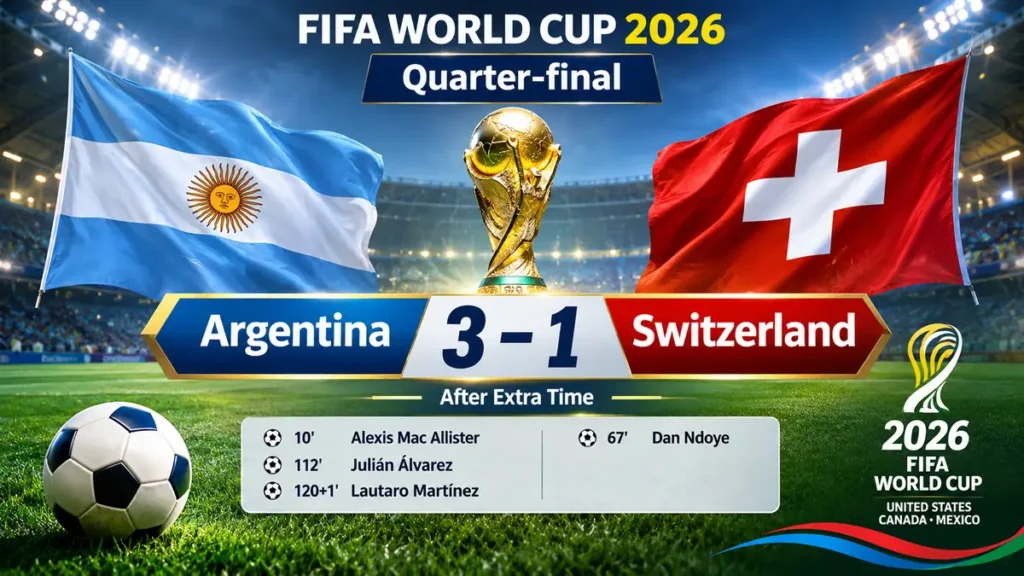
Argentina defeated Switzerland 3–1 after extra time in the 2026 FIFA World Cup quarter-finals on July 11 in Kansas City. Julián Álvarez and Lautaro Martínez scored in extra time after the teams finished regulation level at 1–1. The result extended Argentina’s unbeaten record against Switzerland and secured a place in the semi-finals. Match report & highlights+1
argentina vs switzerland: Latest Result and Match Overview
Argentina National Team Logo PNG & SVG Download | FootyLogos
Argentina
3 – 1
Switzerland
Diseño PNG Y SVG De Logotipo Del Equipo De Fútbol De Suiza Para Camisetas
2026 FIFA World Cup · Quarter-final · After extra time
The most recent meeting took place on July 11, 2026, during the FIFA World Cup hosted by the United States, Canada, and Mexico. Argentina overcame Switzerland at Kansas City Stadium in a quarter-final that required extra time to determine the winner.
| Match detail | Information |
|---|---|
| Competition | 2026 FIFA World Cup |
| Stage | Quarter-final |
| Date | July 11, 2026 |
| Venue | Kansas City Stadium, United States |
| Final score | Argentina 3–1 Switzerland |
| Result after 90 minutes | 1–1 |
| Winning team | Argentina |
| Next round | Semi-final against England |
Who scored in the 2026 match?
The match featured four goals, with Argentina scoring twice during extra time.
| Minute | Player | Team |
|---|---|---|
| 10′ | Alexis Mac Allister | Argentina |
| 67′ | Dan Ndoye | Switzerland |
| 112′ | Julián Álvarez | Argentina |
| 120+1′ | Lautaro Martínez | Argentina |
Mac Allister gave Argentina an early advantage, but Ndoye equalized midway through the second half. The match remained level at the end of regulation.
Álvarez then restored Argentina’s lead with a spectacular extra-time goal, and Martínez added a third during stoppage time. Switzerland finished with ten players, making its attempt to recover even more difficult. Match report & highlights+1
Why was the 2026 result significant?
The victory mattered for several reasons. Argentina advanced to another World Cup semi-final, maintained its unbeaten historical record against Switzerland, and demonstrated its ability to settle a close knockout contest during extra time.
For Switzerland, the defeat ended a deep tournament run. Although the team recovered from an early deficit, Argentina’s attacking quality proved decisive during the additional 30 minutes.
Argentina vs Switzerland Head-to-Head Record
Argentina has historically dominated this international fixture. The two national teams have met in World Cup competition and international friendlies, with Switzerland frequently offering competitive resistance despite its lack of victories.
Across eight recorded senior international meetings through July 2026, Argentina has won six matches, with two draws and no Swiss victories. National Football Teams
Complete historical results
| Date | Competition | Result |
|---|---|---|
| July 11, 2026 | FIFA World Cup quarter-final | Argentina 3–1 Switzerland (AET) |
| July 1, 2014 | FIFA World Cup round of 16 | Argentina 1–0 Switzerland (AET) |
| February 29, 2012 | International friendly | Switzerland 1–3 Argentina |
| June 2, 2007 | International friendly | Switzerland 1–1 Argentina |
| May 8, 1990 | International friendly | Switzerland 1–1 Argentina |
| September 1, 1984 | International friendly | Switzerland 0–2 Argentina |
| December 16, 1980 | International friendly | Argentina 5–0 Switzerland |
| July 19, 1966 | FIFA World Cup group stage | Argentina 2–0 Switzerland |
AET means after extra time. Results are shown from Argentina’s perspective where applicable.
Historical record at a glance
6
Argentina wins
2
Draws
0
Switzerland wins
Goals scored in historical meetings
Eight senior international matches through July 2026
05101520ArgentinaSwitzerland
Argentina’s record reflects its longstanding attacking strength, but the results also show that the fixture has not always been straightforward. Both the 2014 and 2026 World Cup knockout matches required extra time.
Has Switzerland ever beaten Argentina?
No. Switzerland has not recorded a victory against Argentina in the eight documented senior international meetings through July 2026.
Its two draws came in 1990 and 2007, both ending 1–1. Those matches illustrate that Switzerland has occasionally matched Argentina over 90 minutes, even without winning the fixture.
How many times have they met at the World Cup?
Argentina and Switzerland have met three times at the men’s FIFA World Cup: in 1966, 2014, and 2026.
Argentina won all three encounters, scoring six goals and conceding one. The 1966 meeting was a group-stage fixture, while the two more recent matches were knockout contests.
argentina vs switzerland: The Dramatic 2014 World Cup Match
8
Before their 2026 encounter, the most famous modern meeting between the teams was the 2014 FIFA World Cup round-of-16 match in Brazil.
Argentina entered the contest with Lionel Messi as its central attacking figure and ambitions of reaching the final. Switzerland, coached by Ottmar Hitzfeld, approached the game with a disciplined defensive plan designed to restrict space and frustrate Argentina’s creative players.
The result was an exhausting match that remained scoreless for almost the entire 120 minutes.
2014 match facts
| Detail | Information |
|---|---|
| Date | July 1, 2014 |
| Stadium | Arena Corinthians, São Paulo |
| Competition | 2014 FIFA World Cup |
| Stage | Round of 16 |
| Score | Argentina 1–0 Switzerland |
| Goalscorer | Ángel Di María, 118′ |
| Assist | Lionel Messi |
| Argentina manager | Alejandro Sabella |
| Switzerland manager | Ottmar Hitzfeld |
| Referee | Jonas Eriksson |
| Attendance | 63,255 |
Match Details+1
First half: Switzerland created the clearer opportunities
Argentina controlled substantial periods of possession but struggled to convert its territorial advantage into dangerous opportunities.
Switzerland defended compactly and attempted to exploit the spaces left when Argentina pushed forward.
Granit Xhaka tested goalkeeper Sergio Romero with a low attempt, while Josip Drmić had an excellent chance after being released behind the Argentine defense. His attempted chip lacked the power and precision needed to beat Romero.
Those moments demonstrated that Switzerland was not simply defending for a draw. Its counterattacking approach created genuine scoring opportunities.
Second half: Argentina increased the pressure
Argentina played with greater urgency after halftime.
Messi became increasingly influential between the lines, while Di María attempted to stretch the Swiss defense through movement and direct attacking runs.
Gonzalo Higuaín tested Diego Benaglio with a header, and Messi forced the goalkeeper into an important save with a low effort.
Despite the pressure, Switzerland’s defensive structure remained organized. Its defenders blocked shots, contested crosses, and limited Argentina’s access to central scoring positions.
The match reached the end of normal time without a goal.
Extra time: Di María delivered the winner
The decisive moment arrived in the 118th minute.
Messi carried the ball forward through the middle of the pitch, drawing Swiss defenders toward him. He then passed to Di María on the right side of the penalty area.
Di María guided a low left-footed shot beyond Benaglio and into the corner of the net.
Argentina led 1–0 with only minutes remaining.
Switzerland nearly equalized when substitute Blerim Džemaili headed against the post. His attempted follow-up also failed to find the net.
Argentina survived the late scare and advanced to face Belgium in the quarter-finals. BBC Sport+1
Key statistics from the 2014 encounter
| Statistic | Argentina | Switzerland |
|---|---|---|
| Possession | 61% | 39% |
| Total shots | 29 | 15 |
| Corners | 13 | 5 |
| Fouls | 19 | 28 |
| Goals | 1 | 0 |
mlssoccer+1
The figures show Argentina’s territorial and attacking advantage. However, the scoreline remained close because Switzerland defended effectively and Argentina struggled to finish its chances.
The match is a useful example of why possession and shot volume do not automatically translate into goals.
Key Players Who Shaped Argentina vs Switzerland Matches
Several internationally recognized players have influenced the history of this fixture. Their contributions help explain the different attacking and defensive approaches used by the two national teams.
Lionel Messi: Creativity and decisive passing
Lionel Messi played a central role in Argentina’s 2014 victory.
Although Messi did not score against Switzerland in that match, his movement, dribbling, and passing repeatedly challenged the Swiss defensive structure.
His most important contribution came in the 118th minute when he assisted Di María’s winning goal.
Messi’s performance demonstrated how a creative player can influence a knockout match without appearing on the scoresheet as a goalscorer.
Ángel Di María: The 2014 match-winner
Ángel Di María provided the defining moment of the 2014 encounter.
Throughout the match, he attempted to break down Switzerland’s defense with direct runs, crosses, and shots from different positions.
Some attempts were unsuccessful, but he remained an attacking threat.
His late goal showed the importance of maintaining concentration and making effective decisions even after nearly two hours of football.
Julián Álvarez and Lautaro Martínez: The 2026 finishers
In the 2026 World Cup quarter-final, Julián Álvarez and Lautaro Martínez delivered the extra-time goals that secured Argentina’s victory.
Álvarez scored in the 112th minute, breaking the deadlock after Switzerland had equalized during normal time.
Martínez added another goal in the 121st minute, putting the result beyond Switzerland’s reach.
Their contributions highlighted Argentina’s ability to maintain attacking effectiveness deep into a demanding knockout match.
Xherdan Shaqiri: Switzerland’s creative threat in 2014
Xherdan Shaqiri was among Switzerland’s most influential attacking players in the 2014 contest.
His quick passing, close control, and ability to create chances during transitions gave Argentina’s defenders problems.
Shaqiri helped create an excellent first-half opportunity for Josip Drmić, although the forward could not convert.
Diego Benaglio and Sergio Romero: Goalkeeping contributions
Both goalkeepers played significant roles in the 2014 match.
Diego Benaglio made several important saves for Switzerland, including efforts from Messi and Higuaín. His performance kept Switzerland competitive until the closing minutes of extra time.
At the opposite end, Sergio Romero prevented Switzerland from taking the lead during the first half.
The performances of both goalkeepers underline how defensive contributions can be just as influential as attacking creativity in tightly contested World Cup fixtures. BBC Sport+1
Tactical Analysis: How Argentina and Switzerland Compare
The encounters between these teams reveal contrasting tactical approaches, particularly in their 2014 World Cup meeting.
Argentina traditionally emphasizes attacking creativity and technical quality, while Switzerland has often relied on collective organization, disciplined defending, and quick transitions.
These are broad historical tendencies rather than fixed characteristics of every squad or manager.
Argentina’s attacking approach
During the 2014 encounter, Argentina used Messi as its primary creative outlet, supported by attacking players including Di María, Ezequiel Lavezzi, and Higuaín.
Its attacking approach involved circulating possession, progressing through central areas, and using movement from wide positions to create shooting opportunities.
Javier Mascherano provided defensive balance in midfield, while Fernando Gago helped connect the defensive and attacking units.
Argentina’s main difficulty was converting possession into clear chances against a compact Swiss defense.
Switzerland’s defensive organization
Under Hitzfeld, Switzerland attempted to reduce the space available to Argentina’s attacking players.
Defenders including Stephan Lichtsteiner, Fabian Schär, Johan Djourou, and Ricardo Rodríguez formed part of a defensive structure supported by midfielders Valon Behrami and Gökhan Inler.
Switzerland’s defensive approach emphasized maintaining shape, protecting central areas, and limiting Messi’s opportunities to receive the ball in dangerous positions.
When possession changed, the Swiss team looked for opportunities to advance quickly through players such as Shaqiri, Admir Mehmedi, and Drmić.
Comparing the tactical approaches
| Tactical aspect | Argentina | Switzerland |
|---|---|---|
| Main attacking strength | Individual creativity and combination play | Counterattacks and transitions |
| Typical approach in 2014 | Possession-oriented | Compact defensive organization |
| Creative influence | Messi and Di María | Shaqiri |
| Midfield responsibilities | Ball progression and attacking support | Defensive coverage and disruption |
| Main challenge | Breaking down a compact defense | Sustaining attacks under pressure |
| Decisive factor | Late attacking execution | Maintaining defensive concentration |
Why did Switzerland make the matches difficult?
Switzerland’s resistance in both the 2014 and 2026 knockout encounters demonstrates the value of defensive organization and tactical discipline.
In 2014, Switzerland limited Argentina to one goal despite facing sustained pressure.
In 2026, Switzerland recovered from an early deficit to take the match into extra time.
The broader lesson is that international knockout football often depends on a small number of decisive moments rather than consistent dominance throughout a match.
Argentina and Switzerland at the FIFA World Cup
Both countries have established histories in international football, although their achievements at the World Cup differ considerably.
Argentina’s World Cup achievements
Argentina v France: Final – FIFA World Cup Qatar 2022
Argentina is one of international football’s most successful national teams.
It won the men’s FIFA World Cup in 1978, 1986, and 2022.
Its championship history includes generations of influential players, from Diego Maradona to Lionel Messi, and demonstrates the country’s ability to compete at the highest level across different football eras.
Argentina also reached the 2014 final after defeating Switzerland, Belgium, and the Netherlands during the knockout rounds. Germany ultimately won that final 1–0 after extra time.
Switzerland’s World Cup achievements
Community: Bewerte die Nati nach dem Auftaktsieg – Blick
Switzerland has a long history of participation in the men’s World Cup and has frequently been a difficult opponent for stronger-ranked teams.
Its best historical finishes include quarter-final appearances in 1934, 1938, and 1954.
Swiss football has developed a reputation for structured defending, competitive midfield play, and producing technically capable international players.
Although Switzerland has not won the World Cup, it has repeatedly demonstrated its ability to challenge established football nations.
Comparing their World Cup records
| Achievement | Argentina | Switzerland |
|---|---|---|
| World Cup titles | 3 | 0 |
| World Cup final appearances through 2026 | 6 | 0 |
| Best finish through 2026 | Champions | Quarter-finals |
| First World Cup appearance | 1930 | 1934 |
| World Cup wins against each other | 3 | 0 |
The historical comparison shows Argentina’s greater success in major tournaments, while Switzerland’s record reflects a competitive national team with a consistent presence in international football.
What the Rivalry Reveals About International Football
The argentina vs switzerland fixture is especially interesting because the teams have repeatedly met in matches where the final result was closer than their historical records might suggest.
Three lessons stand out.
Possession does not guarantee victory
Argentina’s 2014 performance demonstrated that controlling the ball and creating numerous attempts does not necessarily lead to an early breakthrough.
Switzerland remained competitive through disciplined defending and effective goalkeeping.
Extra-time performance can determine a tournament
Both the 2014 and 2026 World Cup knockout meetings required extra time.
Argentina eventually won each contest through late attacking contributions.
Fitness, substitutions, concentration, and decision-making become increasingly important as players approach the end of a demanding match.
Historical records cannot predict every match
Argentina’s unbeaten record provides useful historical context, but it does not guarantee future victories.
National-team squads change, tactical systems evolve, and tournament conditions vary.
A head-to-head record is best understood as a description of previous results rather than a reliable prediction of what will happen next.
Final Thoughts on argentina vs switzerland
The argentina vs switzerland rivalry has delivered several memorable international encounters, particularly at the FIFA World Cup.
Argentina’s 1–0 extra-time victory in 2014 remains a classic example of a difficult knockout match decided by individual brilliance. The 2026 quarter-final added another dramatic result, with Argentina winning 3–1 after extra time.
Across eight recorded meetings through July 2026, Argentina holds six wins and two draws, while Switzerland has yet to register a victory.
For readers exploring this fixture, the most useful perspective comes from examining both the historical results and the tactical details behind them. Argentina has consistently achieved better outcomes, but Switzerland’s performances demonstrate why knockout football can remain unpredictable until the final whistle.