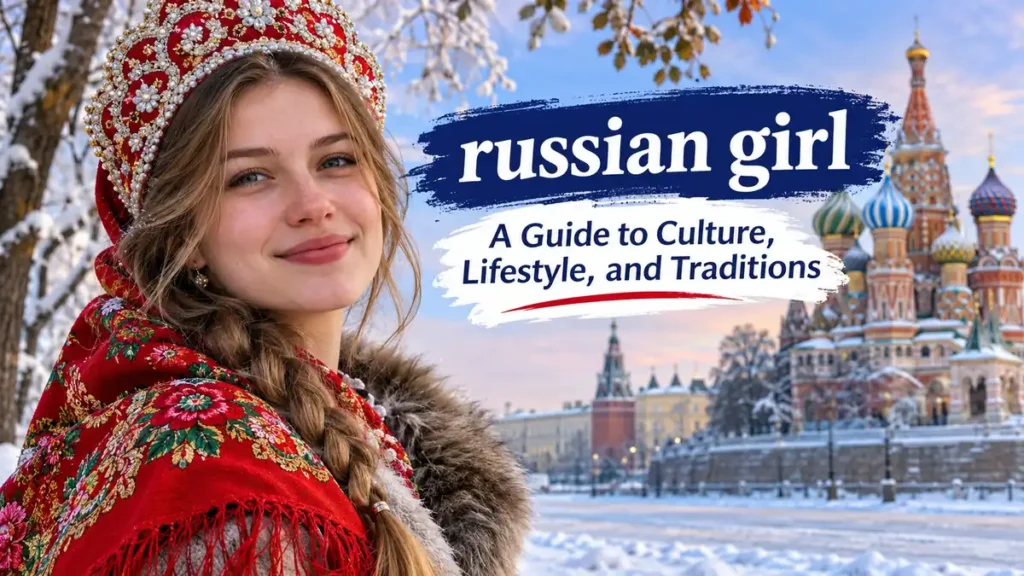
The phrase “russian girl” often brings to mind familiar images of Russian fashion, beauty, traditional clothing, and life in cities such as Moscow and Saint Petersburg. Yet these impressions reveal only a small part of the story.
Russian girls and women come from diverse cultural, ethnic, educational, and regional backgrounds. Their experiences are shaped by family, language, history, personal ambitions, and the social changes taking place across Russia.
A russian girl is generally a girl or young woman from Russia, or someone who identifies with Russian nationality or cultural heritage. Her identity may reflect Russian language, family traditions, education, regional customs, and contemporary influences. There is no single appearance, personality, lifestyle, or set of beliefs that defines all Russian girls.
Understanding this diversity offers a more meaningful perspective than relying on popular stereotypes.
What Does russian girl Mean?
The expression “russian girl” usually refers to a female child, teenager, or young adult who comes from Russia or has Russian cultural roots.
However, nationality, ethnicity, language, and cultural identity are not always interchangeable.
Russia is a multinational country spanning Eastern Europe and northern Asia. Its population includes ethnic Russians alongside Tatars, Bashkirs, Chechens, Buryats, Yakuts (Sakha), and many other communities.
A girl born in Kazan, for example, may identify as Tatar and Russian by nationality. Someone raised in Moscow might come from a multilingual household. A young woman living abroad may maintain strong connections with Russian culture through family and language.
Russian nationality versus Russian ethnicity
These distinctions help explain the country’s diversity.
| Term | Meaning |
|---|---|
| Russian nationality | Citizenship or national belonging associated with Russia |
| Ethnic Russian | Membership in the ethnic Russian cultural and historical community |
| Russian-speaking | Someone who speaks Russian, regardless of nationality |
| Russian heritage | Family or ancestral connections to Russia |
| Russian diaspora | People of Russian origin or identity living outside Russia |
In English, the word “Russian” can describe several of these identities. In Russian, the distinction between russkiy (ethnically or culturally Russian) and rossiyskiy (associated with the Russian state) can be useful.
These categories may overlap, but they should not be treated as identical.
Russian Girl Culture and Everyday Life
Everyday life for Russian girls varies considerably depending on their age, household, education, financial circumstances, and location.
A teenager in Moscow may spend her day attending school, practicing sports, and communicating with friends online. Someone in a smaller Siberian town might have a different routine shaped by local opportunities, weather, and family responsibilities.
Neither experience represents every young woman in Russia.
Family relationships and upbringing
Family plays an important role in many Russian households, although parenting practices differ widely.
Children may grow up maintaining close relationships with parents, grandparents, and extended relatives. Grandparents sometimes help with childcare, especially in households where both parents work.
Common family activities can include shared meals, birthday celebrations, visits to relatives, and seasonal holidays.
Respect for older family members is a recognizable cultural value in many communities, but it does not mean every household follows traditional expectations.
Friendships and social activities
Russian girls participate in many of the same activities as young people elsewhere.
Depending on their interests, these may include:
- Spending time with friends at cafés, parks, or shopping centers.
- Playing volleyball, basketball, tennis, or other sports.
- Studying music, dance, art, or foreign languages.
- Watching films, gaming, or creating digital content.
- Visiting museums, theaters, festivals, and cultural events.
- Exploring photography, literature, fashion, or technology.
Social opportunities can differ between large cities, smaller towns, and rural communities.
Urban and rural lifestyles
Moscow and Saint Petersburg are major cultural and educational centers, offering extensive public transportation, universities, entertainment venues, and employment opportunities.
In smaller communities, social life may revolve more heavily around local schools, community activities, family gatherings, and regional traditions.
Digital communication connects people across these geographic differences, but access to opportunities remains uneven.
Russian Girl Beauty: Appearance, Fashion, and Stereotypes
Online discussions frequently associate Russian girls with particular physical characteristics or beauty standards.
Such descriptions can be misleading.
Russia’s ethnic diversity means that women have many different skin tones, facial features, hair textures, eye colors, and body types.
There is no universal Russian appearance.
Are Russian girls usually blonde?
Blonde hair is often associated with Eastern European populations in popular media. However, Russian women can have blonde, brown, black, red, or other hair colors.
Hair color also varies naturally across ethnic backgrounds, and many people dye their hair.
It is inaccurate to assume that a Russian girl must have blonde hair, blue eyes, or a particular facial structure.
Fashion and personal style
Russian fashion includes everything from practical winter clothing to contemporary streetwear and designer styles.
В чем ходить зимой в москве (57 фото) – картинки и фото fashionhot.club
Ensemble – Russian – The Metropolitan Museum of Art
12
In major cities, people may follow international trends while incorporating local preferences.
Common clothing choices include winter coats, insulated boots, knitwear, jeans, dresses, sneakers, and formal outfits for special occasions.
Climate influences fashion significantly. In colder regions, warmth and weather protection often matter more than appearance.
Traditional Russian clothing
Historical Russian women’s clothing includes garments such as the sarafan, a traditional sleeveless dress, and the kokoshnik, a decorative headdress associated with certain regional and historical styles.
These garments are now more commonly encountered at cultural performances, museums, festivals, and heritage celebrations than in everyday life.
Traditional clothing also varies across Russia’s many ethnic communities.
Education and Career Opportunities for Russian Girls
Education is an important part of contemporary Russian society.
Girls attend primary and secondary schools, participate in extracurricular activities, and may pursue vocational training or university education.
The Russian education system generally includes primary general education, basic general education, and secondary general education, followed by various higher education pathways.
School life in Russia
Students commonly study subjects such as mathematics, Russian language and literature, history, science, geography, and foreign languages.
Some schools offer specialized programs emphasizing mathematics, technology, humanities, languages, or the arts.
The academic experience depends on the institution and region.
Outside the classroom, students may participate in academic competitions, music schools, sports clubs, or creative programs.
University education
Russia has numerous universities and specialized higher education institutions.
Among its well-known institutions are:
- Lomonosov Moscow State University.
- Saint Petersburg State University.
- National Research University Higher School of Economics.
- Bauman Moscow State Technical University.
- Novosibirsk State University.
Students may pursue degrees in medicine, engineering, economics, law, education, computer science, design, and other disciplines.
University admission and academic requirements vary by program and institution.
Careers and professional ambitions
Russian women work in a wide range of industries, including healthcare, education, science, technology, finance, media, entrepreneurship, and public administration.
Individual ambitions vary. Some prioritize professional advancement, while others seek different combinations of career development, family responsibilities, personal interests, and financial security.
Traditional gender expectations still influence parts of society, but they do not determine every woman’s choices.
Russian Language and Communication
Russian is the country’s principal official language and a major part of its cultural identity.
It uses the Cyrillic alphabet, which differs from the Latin alphabet used in English.
Learning a few everyday expressions can help visitors, students, and people interested in Russian culture communicate more comfortably.
Common Russian words and phrases
| Russian | Pronunciation | English meaning |
|---|---|---|
| Привет | Privet | Hi |
| Здравствуйте | Zdravstvuyte | Hello (formal) |
| Спасибо | Spasibo | Thank you |
| Пожалуйста | Pozhaluysta | Please / You’re welcome |
| Как дела? | Kak dela? | How are you? |
| Хорошо | Khorosho | Good / Fine |
| До свидания | Do svidaniya | Goodbye |
| Меня зовут… | Menya zovut… | My name is… |
Russian communication styles can vary between formal and informal settings.
For example, people commonly use different forms of address depending on familiarity, age, and social context.
Are Russian girls fluent in English?
English proficiency varies considerably.
Some Russian students learn English throughout school and develop advanced skills through university, travel, work, or online learning.
Others have limited opportunities to practice spoken English.
Knowledge of English should therefore be considered an individual skill rather than a characteristic of Russian girls generally.
Russian Girl Traditions, Holidays, and Celebrations
Russia’s cultural traditions reflect centuries of historical, religious, and regional influences.
Some celebrations are widely observed across the country, while others belong to particular ethnic or religious communities.
Moscow Kremlin – All You SHOULD Know Before Going (2026 Reviews)
New Year celebrations
New Year is a major holiday in Russia. Families may decorate a tree, exchange presents, prepare special meals, and gather at midnight. Ded Moroz, often accompanied by Snegurochka, is a familiar figure in seasonal celebrations.
Масленица 2026: традиции, дни недели, рецепт тонких блинов с начинками
Maslenitsa
This traditional festival marks the period before Orthodox Lent. Celebrations can include pancakes called blini, outdoor festivities, music, and community gatherings.
International Women’s Day (Russia) – ExcelNotes
International Women’s Day
Celebrated on March 8, this public holiday is often marked by flowers, gifts, and expressions of appreciation. It also has a broader history connected to women’s rights and social participation.
Religion and cultural diversity
Russian Orthodox Christianity has influenced many historical traditions, including Christmas and Easter celebrations.
However, Russia also has substantial Muslim communities and followers of Buddhism, Judaism, other religions, and nonreligious traditions.
For example, girls from Muslim families in Tatarstan or Bashkortostan may observe Ramadan and Eid celebrations. Buddhist communities in Buryatia and other regions maintain their own cultural practices.
A Russian girl’s traditions cannot be determined simply by her nationality.
Traditional food and family meals
Food is another way people experience Russian culture.
Common dishes include pelmeni (filled dumplings), borscht (beet-based soup), blini (thin pancakes), syrniki (cottage cheese pancakes), and pirozhki (small filled pastries).
These foods have varied regional and historical connections, and several are shared with neighboring cultures.
Cooking habits differ between households. Modern Russian families may combine traditional recipes with international cuisine and convenient everyday meals.
Russian Girls in Modern Society and Digital Culture
Technology has changed how young people in Russia study, communicate, entertain themselves, and express their identities.
Social media, messaging services, online education, and digital creative platforms are part of contemporary life for many young Russians.
Social media and online communities
Platforms such as VK and Telegram are familiar within Russia’s digital environment.
Young people use online spaces for entertainment, study groups, hobbies, news, and communication with friends.
Some also create content about fashion, language learning, gaming, travel, music, and everyday experiences.
Access to international digital platforms has been affected by changing regulations and restrictions, so platform availability should not be assumed to remain constant.
Music, films, and popular culture
Russian popular culture includes contemporary pop, rap, rock, electronic music, cinema, television, and online entertainment.
Young women may follow domestic artists, international musicians, independent creators, or regional performers.
Russia also has a longstanding tradition of classical music, ballet, theater, and literature.
Cultural institutions such as the Bolshoi Theatre in Moscow and the Mariinsky Theatre in Saint Petersburg remain important parts of the country’s artistic heritage.
Sports and creative interests
Girls in Russia participate in figure skating, gymnastics, volleyball, swimming, martial arts, athletics, and many other sports.
Creative interests may include painting, animation, graphic design, photography, dance, and writing.
Participation depends on personal preference, affordability, accessibility, and available facilities.
Russian Girl Personality: Understanding Cultural Stereotypes
One of the most common questions about Russian girls concerns personality.
Are they reserved? Independent? Family-oriented? Serious?
No nationality determines someone’s personality.
Although social norms can influence communication, individual behavior is shaped by upbringing, temperament, education, experience, and personal circumstances.
Why are Russian girls sometimes described as reserved?
Some visitors interpret unfamiliar communication styles as emotional distance.
In certain social situations, people may place less emphasis on smiling at strangers or engaging in casual conversation than visitors from other cultures expect.
However, this does not establish that Russian women are inherently unfriendly or reserved.
Behavior also changes depending on context. Someone may act formally in a professional environment but be expressive and humorous with close friends.
Are Russian girls family-oriented?
Family relationships matter to many Russian women, just as they do to people in numerous other societies.
However, assumptions that all Russian girls want marriage, motherhood, or traditional domestic roles are inaccurate.
Personal priorities vary. Some individuals focus on education or professional development, some prioritize family life, and others pursue different goals at different stages.
The problem with romanticized stereotypes
Popular media sometimes portrays Russian women as exceptionally beautiful, submissive, mysterious, or eager to marry foreigners.
These portrayals reduce individuals to national stereotypes.
Research published in the Russian Journal of Communication examined how Russian immigrant women experienced labels involving exotic beauty and marriage expectations. Participants described how such assumptions affected their experiences of migration and social belonging. Get Access+1
A more useful approach is to understand each person through their own interests, values, experiences, and choices.
How Russian Girls’ Lives Differ Across Regions
Russia stretches across eleven time zones and includes a wide range of climates, landscapes, languages, and cultural communities.
Regional differences influence educational access, employment, transportation, recreation, and daily routines.
| Region or city | Notable characteristics | Potential influence on everyday life |
|---|---|---|
| Moscow | Major metropolitan and economic center | Extensive universities, cultural institutions, and career opportunities |
| Saint Petersburg | Historic cultural center | Museums, architecture, arts, and higher education |
| Kazan | Capital of Tatarstan | Strong Russian and Tatar cultural influences |
| Novosibirsk | Major Siberian city | Research institutions, universities, and urban amenities |
| Vladivostok | Pacific coastal city | Maritime culture and connections with East Asia |
| Yakutsk | City in the Sakha Republic | Extremely cold winters and distinctive regional traditions |
These descriptions identify broad regional features, not fixed characteristics of residents.
Climate and seasonal routines
Winter conditions differ significantly across Russia.
Moscow experiences cold winters, but parts of Siberia and the Russian Far East can experience much more extreme temperatures.
Seasonal conditions influence transportation, clothing, recreation, and school activities.
Summer can bring outdoor festivals, family travel, visits to country houses known as dachas, and recreational activities.
Multicultural identities
Girls growing up in Russia may speak Russian alongside another language used in their family or community.
Examples include Tatar, Bashkir, Chechen, Sakha, and Buryat.
Language, cuisine, family customs, and celebrations may reflect more than one cultural tradition.
This diversity challenges the idea that Russian identity has only one ethnic or cultural expression. Academic research also distinguishes ethnic Russianness from the broader civic identity associated with Russian citizenship. Russian Journal of Linguistics+1
Russian Girls Abroad and International Cultural Exchange
Russian communities exist in many countries, including Germany, the United States, Canada, Kazakhstan, and Israel.
People move abroad for different reasons, including education, employment, family circumstances, and personal safety.
Young women from Russian-speaking families may maintain connections with their heritage while adapting to a different society.
Studying and working internationally
Russian students may pursue international education in science, technology, business, arts, and other subjects.
Studying abroad can involve learning another language, adapting to unfamiliar academic expectations, and navigating cultural differences.
For students from Russian-speaking households, maintaining fluency in Russian may also be an important personal or family goal.
Identity across generations
A young woman born outside Russia to Russian-speaking parents may feel connected to Russian culture without having lived in the country.
Her identity might combine family traditions, local customs, and international influences.
Others may identify primarily with the country where they grew up.
There is no single correct way to express cultural heritage.
Respectful cross-cultural communication
When meeting someone from Russia, basic cultural curiosity can help create a comfortable conversation.
Useful approaches include learning the correct pronunciation of someone’s name, asking about personal interests, avoiding assumptions about political opinions, and respecting cultural or linguistic preferences.
It is also helpful to distinguish curiosity about Russian culture from making generalizations about Russian women.
Common Misconceptions About Russian Girls
Several widely repeated claims deserve closer examination.
| Common assumption | More accurate explanation |
|---|---|
| All Russian girls look alike | Russia includes many ethnic groups and physical appearances |
| Every Russian girl speaks English | Language proficiency varies by individual |
| Russian girls are naturally cold | Communication styles and personalities differ |
| All Russian women prefer traditional roles | Family and career preferences are personal |
| Every Russian girl lives in a cold climate | Russia contains diverse climate zones |
| Russian girls always wear glamorous clothing | Fashion varies by individual, region, and occasion |
| Russian women want to marry foreigners | Relationship preferences cannot be inferred from nationality |
Stereotypes can also affect women living outside Russia.
Research involving Russian female migrants has documented how assumptions about appearance, femininity, and national identity can influence their social experiences. Taylor & Francis Online+1
Understanding these misconceptions encourages more accurate and respectful discussions.
Why Understanding Russian Girl Culture Matters
Learning about Russian girls and women offers a window into Russia’s broader cultural and social diversity.
It also highlights the importance of separating individual identity from assumptions based on nationality.
A russian girl may be a school student interested in mathematics, a university graduate pursuing engineering, a musician developing her craft, or a young professional building an international career.
She may identify with ethnic Russian traditions, another ethnic community within Russia, or several cultural backgrounds.
The most accurate way to understand a russian girl is to recognize her as an individual rather than a stereotype. Russian language, history, traditions, education, and regional cultures provide useful context, but personal experiences and choices tell a much fuller story.
Exploring Russia’s literature, languages, regional histories, and contemporary culture is a valuable next step toward understanding the people behind the familiar images.