Santa Fe feels unlike almost any other state capital in America. Adobe buildings line walkable streets, centuries of Native American and Spanish history remain visible downtown, and world-class galleries sit within minutes of mountain trails and high-desert scenery.
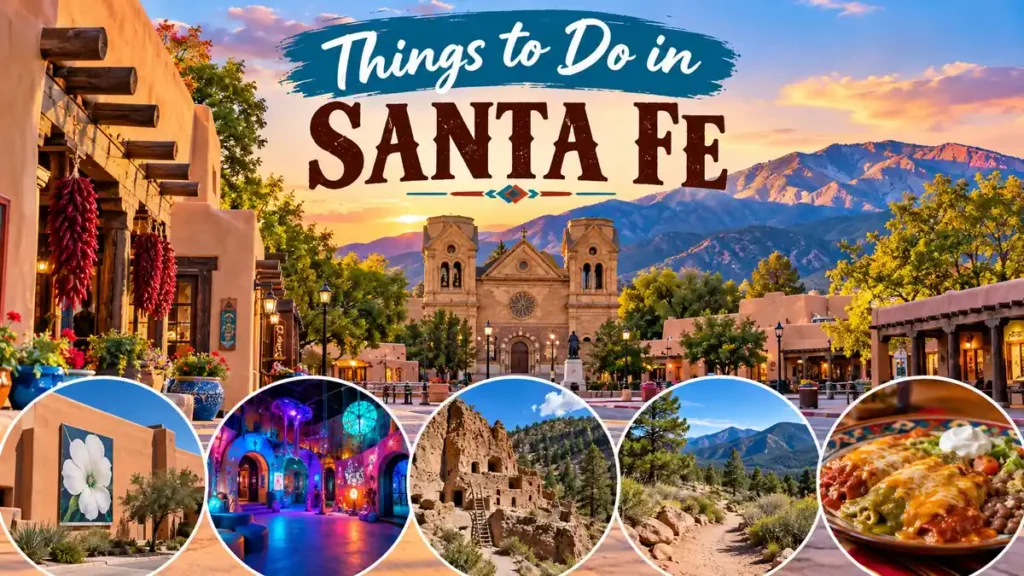
If you are looking for the best things to do in santa fe, start with the historic Santa Fe Plaza, explore Canyon Road and the Georgia O’Keeffe Museum, experience Meow Wolf, discover Museum Hill, taste New Mexican cuisine, visit the Railyard, and leave time for nearby places such as Bandelier National Monument and Pecos National Historical Park. Santa Fe Tourism
Santa Fe rewards travelers who slow down. Rather than rushing between attractions, give yourself time to walk through historic neighborhoods, enter smaller galleries, try red and green chile, and notice how Pueblo, Spanish, Mexican, and American influences overlap throughout the city.
1. Start at the Historic Santa Fe Plaza
For a first visit, the Santa Fe Plaza is the natural starting point.
The Plaza has long served as the city’s geographic and cultural center. Today, its surrounding streets contain restaurants, galleries, shops, museums, historic buildings, and hotels. It is also one of the easiest areas of Santa Fe to explore on foot. Santa Fe Tourism
Instead of treating the Plaza as one attraction to check off a list, use it as the beginning of a walking route through downtown.
Nearby sights include the Palace of the Governors, New Mexico History Museum, Cathedral Basilica of St. Francis of Assisi, Loretto Chapel, and numerous galleries and shops.
Morning is particularly pleasant because the streets tend to feel calmer. Return after sunset and the same neighborhood takes on a different atmosphere as restaurants and patios fill up.
Quick takeaway: If you only have one day in Santa Fe, build most of your itinerary around the Plaza, downtown museums, Canyon Road, and one major attraction such as Meow Wolf.
2. Explore the Palace of the Governors
Facing the Plaza, the Palace of the Governors is one of Santa Fe’s most significant historic landmarks.
Dating to 1610, the structure represents centuries of political and cultural change in New Mexico. Tourism Santa Fe describes it as the oldest public building in continuous use constructed by the Spanish for government administration. Santa Fe Tourism
It now forms part of the New Mexico History Museum experience.
For travelers interested in understanding Santa Fe rather than simply photographing it, this is an important stop. The broader museum provides context for Indigenous communities, Spanish colonization, Mexican rule, the Santa Fe Trail, American territorial expansion, and modern New Mexico.
3. Visit the Georgia O’Keeffe Museum
Few artists are as closely associated with northern New Mexico as Georgia O’Keeffe.
The Georgia O’Keeffe Museum in downtown Santa Fe explores her life, creative development, and connection with the landscapes of New Mexico. Tourism Santa Fe specifically highlights it among downtown’s essential cultural attractions. Santa Fe Tourism
Even people who are not serious art enthusiasts can appreciate the museum because it helps explain why Santa Fe and the surrounding desert have attracted generations of artists.
O’Keeffe’s relationship with places such as Ghost Ranch and Abiquiú also provides inspiration for travelers considering a longer road trip through northern New Mexico.
Popular admission periods can sell out, so reserving ahead is sensible during busy travel seasons. Travel + Leisure
4. Walk Canyon Road and Browse the Galleries
If Santa Fe has a street that captures its reputation as an art destination, it is Canyon Road.
The roughly half-mile stretch is packed with galleries showcasing painting, sculpture, photography, jewelry, contemporary art, traditional Southwestern work, and other media. Tourism Santa Fe reports that the district contains more than 100 galleries. Santa Fe Tourism
You do not need to be shopping for art to enjoy it.
Part of the experience is simply walking among adobe buildings, courtyards, gardens, sculptures, and historic architecture.
Allow at least a couple of hours if art interests you. People who enjoy browsing slowly can easily spend half a day here.
When is the best time to visit Canyon Road?
Late morning through afternoon works well because more galleries are open. Check individual gallery hours before visiting, particularly on holidays or quieter weekdays.
Comfortable walking shoes matter more than they might seem. Santa Fe’s elevation and strong sun can make an easy-looking walk surprisingly tiring.
5. Step Inside Meow Wolf’s House of Eternal Return
For something completely different from Santa Fe’s historic museums, visit Meow Wolf’s House of Eternal Return.
This immersive art experience encourages visitors to explore interconnected rooms, installations, unusual environments, and an underlying story rather than following the traditional museum format.
Meow Wolf describes House of Eternal Return as an interactive exhibit shaped by movement, exploration, and curiosity. It also hosts workshops, community programming and live events. Meow Wolf
It is particularly good for families with older children, couples, groups of friends, contemporary-art fans, and anyone who enjoys unusual experiences.
Give yourself enough time to explore rather than rushing through. Visitors interested in following the narrative will generally spend longer than those who simply want to see the installations.
House of Eternal Return is located at 1352 Rufina Circle, outside the historic Plaza area. Meow Wolf FAQ
6. See the Cathedral Basilica of St. Francis of Assisi
The Cathedral Basilica of St. Francis of Assisi rises prominently near the Plaza.
Its Romanesque Revival architecture creates an interesting contrast with the Pueblo Revival and adobe-style buildings for which Santa Fe is famous.
Inside, visitors can appreciate the architecture, religious art, stained glass, and peaceful atmosphere. The cathedral also provides another perspective on the Spanish and Catholic influence that shaped Santa Fe.
Remember that this remains an active place of worship. Visit respectfully, particularly when services are taking place.
7. Discover Loretto Chapel and Its Famous Staircase
Another popular downtown landmark is Loretto Chapel, best known for its spiral staircase.
The staircase has become surrounded by stories and legends because of its construction and unusual design. Whatever your interpretation of those stories, the craftsmanship itself makes the chapel worth seeing.
Tourism Santa Fe regularly pairs Loretto Chapel with Canyon Road when suggesting short itineraries, making the two easy to combine in one afternoon. Santa Fe Tourism
Because it is close to the Plaza, visiting does not require a major detour.
8. Spend Half a Day at Museum Hill
Travelers interested in culture should reserve time for Museum Hill.
Rather than focusing on a single institution, this part of Santa Fe brings several museums and cultural attractions into one area. It is particularly valuable for visitors who want to understand the artistic and cultural traditions of New Mexico and the wider Southwest.
One of its major institutions is the Museum of Indian Arts and Culture, while the Museum of International Folk Art offers a much broader global perspective.
Museum Hill works particularly well on very hot, cold, windy, or rainy days because you can spend several hours indoors while still experiencing something distinctly connected to Santa Fe.
Avoid trying to absorb every museum in one rushed visit. Choose the institutions that genuinely interest you and give them sufficient time.
9. Experience Contemporary Native American Art
Santa Fe’s Indigenous culture should not be treated only as ancient history.
Contemporary Native artists continue to shape the city’s creative identity. One place to experience that perspective is the Institute of American Indian Arts Museum of Contemporary Native Arts, commonly called MoCNA.
Its exhibitions can provide a useful counterpoint to archaeological and historical collections elsewhere.
This distinction matters: Pueblo and other Native cultures are living communities, not simply chapters in Southwestern history.
When purchasing Native jewelry, pottery, textiles, or other artwork, look for clearly identified artists and reputable sellers rather than mass-produced imitations.
10. Explore the Santa Fe Railyard
For a more contemporary neighborhood, head to the Santa Fe Railyard.
The revitalized district brings together art, food, public spaces, shopping, entertainment, and community events. Depending on when you visit, you may encounter local farmers, artists, makers, live music, or other activities. Lonely Planet
The atmosphere feels different from the Plaza.
Downtown emphasizes historic Santa Fe, while the Railyard offers a glimpse of how residents use the city today.
It is a good place to wander without a strict schedule.
11. Shop at the Santa Fe Farmers’ Market
If your visit overlaps with a market day, the Santa Fe Farmers’ Market deserves a place on your itinerary.
Seasonal produce, chile, baked goods and locally produced foods provide a much more grounded introduction to northern New Mexico than a typical souvenir shop.
It is also an easy activity to combine with the wider Railyard district.
Arriving earlier generally gives you more time to browse before popular products disappear.
12. Eat Traditional New Mexican Food
Food is one of the essential experiences in Santa Fe.
New Mexican cooking has its own identity, shaped by Indigenous, Spanish, Mexican, and regional influences. Chile—especially red and green chile—is central to many dishes.
Look for dishes such as:
- Enchiladas with red or green chile
- Breakfast burritos
- Posole
- Carne adovada
- Tamales
- Blue-corn dishes
- Sopapillas
You will eventually hear the question “Red or green?”
It refers to your choice of chile sauce. If you want both, order it “Christmas.”
Santa Fe also has a strong fine-dining scene alongside casual cafés, bakeries, food trucks, and long-established New Mexican restaurants. Tourism Santa Fe notes that the city has multiple AAA Four Diamond restaurants as well as restaurants and chefs recognized by the James Beard Foundation. Santa Fe Tourism
Reservations are wise for highly regarded dinner restaurants.
13. Follow the Santa Fe Margarita Trail
Adults interested in cocktails can explore the Santa Fe Margarita Trail.
Participating establishments serve different interpretations of the margarita, making the trail a fun way to combine drinks with Santa Fe’s restaurant scene. Tourism Santa Fe offers both an app and passport system for following participating locations. Santa Fe Tourism
You certainly do not need to complete the entire trail.
Choose one or two stops, pair drinks with food, and treat it as an evening activity rather than a drinking challenge.
14. See the New Mexico State Capitol
State capitol buildings tend to look monumental and formal. New Mexico’s is different.
Known as the Roundhouse, the New Mexico State Capitol is circular and incorporates regional architectural influences.
Tourism Santa Fe notes that it is the only circular state capitol building in the United States and recommends exploring its art collection. Santa Fe Tourism
That combination makes it worthwhile even for travelers who normally skip government buildings.
Check public access and current opening arrangements before going, especially if the legislature is in session or security procedures have changed.
15. Hike the Trails Around Santa Fe
One reason Santa Fe works so well as a destination is that museums and restaurants are only part of the experience.
The Sangre de Cristo Mountains and high-desert terrain put outdoor recreation within easy reach of downtown.
Depending on your fitness level and available time, you can find everything from short walks to demanding mountain hikes.
Tourism Santa Fe reports more than 300 miles of trails across Santa Fe County. Santa Fe Tourism
Remember Santa Fe’s elevation
Santa Fe sits at roughly 7,000 feet above sea level.
Visitors arriving from lower elevations may notice shortness of breath, headaches, fatigue, or reduced exercise capacity.
On your first day:
- Drink plenty of water.
- Limit strenuous exercise until you know how your body responds.
- Use sunscreen—the high-altitude sun can be intense.
- Take hiking distances seriously.
- Carry more water than you think you will need.
Those precautions can make outdoor activities far more enjoyable.
16. Head Toward the Sangre de Cristo Mountains
The mountains northeast of the city provide an easy escape from downtown.
In warmer months, the area attracts hikers and sightseers. Autumn brings changing foliage at higher elevations, while winter transforms the mountains into a snow-sports destination.
Even travelers who are not planning a serious hike can enjoy the transition from high desert to forested mountain terrain.
Weather can differ significantly between downtown Santa Fe and higher elevations, so check conditions before leaving.
17. Visit Santa Fe’s Historic Adobe Neighborhoods
Some of the best things to do in santa fe require no admission ticket.
Walking through older residential streets allows you to appreciate adobe walls, wooden vigas, courtyards, traditional doors, Pueblo Revival architecture, and the distinctive earthy palette of the city.
The historic downtown area contains buildings and cultural sites from different eras, including some of the oldest surviving structures associated with European settlement in the United States. Santa Fe Tourism
Walk quietly through residential areas and remember that many photogenic adobe homes are private property.
18. Attend a Festival, Market, or Performance
Santa Fe’s experience changes dramatically depending on when you visit.
Art markets, cultural festivals, live performances, seasonal celebrations, workshops, and community events can become highlights of a trip.
The Santa Fe Indian Market is among the city’s best-known events and showcases Native artists and their work. Lonely Planet also identifies it as one of Santa Fe’s standout cultural experiences. Lonely Planet
Because major events can significantly increase demand for accommodation, travelers planning around a specific festival should book early.
Check official calendars shortly before traveling rather than relying on old annual schedules.
19. Take a Day Trip to Bandelier National Monument
If you have an extra day, Bandelier National Monument is one of the most rewarding excursions from Santa Fe.
The monument protects an extraordinary concentration of Ancestral Pueblo archaeological sites on the Pajarito Plateau. The Main Loop Trail leads past places including Tyuonyi, Long House, the Big Kiva, and cliff-side cavates, some of which visitors can enter using ladders. National Park Service
The combination of archaeology, canyon scenery, hiking, and cultural history makes Bandelier much more than a conventional sightseeing stop.
Driving from Santa Fe takes about an hour each way under normal conditions. The National Park Service also warns that cellular service inside the canyon is limited, so do not depend entirely on rideshare services or your phone for transportation. National Park Service
Bring water, sun protection, suitable footwear, and enough time to explore without rushing.
20. Explore Pecos National Historical Park
Another excellent day trip is Pecos National Historical Park, roughly 25 miles east of Santa Fe.
The park brings together thousands of years of human history, including Pecos Pueblo, Spanish missions, the Santa Fe Trail, ranch history, and the Civil War Battle of Glorieta Pass. National Park Service
That range makes Pecos especially valuable for visitors who want context for the historical forces that shaped northern New Mexico.
Start at the visitor center before exploring the archaeological and historic areas.
As of October 2026, National Park Service information lists the park grounds as generally open from 8:00 a.m. to 4:30 p.m., with closures on Thanksgiving, Christmas Day, and New Year’s Day. Always verify current hours before driving out. National Park Service
21. Leave Time to Simply Wander
A packed itinerary can actually make Santa Fe less enjoyable.
Some of the most memorable moments happen between the major attractions: finding a small courtyard gallery, seeing chile ristras hanging from an adobe wall, stopping at a local café, discovering a bookstore, or watching the light change across the mountains.
Santa Fe is compact enough that wandering works particularly well around the Plaza, downtown, Canyon Road, and the Railyard.
Build unplanned time into your schedule.
What Are the Best Free Things to Do in Santa Fe?
Santa Fe can become expensive once museum tickets, restaurants, shopping, and accommodation are added together, but you can still experience much of the city’s character without spending heavily.
Walking the Plaza, exploring historic downtown streets, browsing Canyon Road galleries, seeing the exterior architecture of historic buildings, visiting public spaces around the Railyard, exploring parts of the Capitol, and hiking nearby trails can all keep costs down.
Free activities are also useful between scheduled museum visits rather than simply as budget alternatives.
What Are the Best Things to Do in Santa Fe With Kids?
Families do not have to build a Santa Fe trip entirely around traditional museums.
Meow Wolf’s interactive environments are often more engaging for children and teenagers than conventional galleries. Easy outdoor walks, the Railyard, markets, and appropriate trails around the city provide additional variety.
Bandelier National Monument can also be memorable for older children interested in archaeology and outdoor exploration, particularly because parts of the Main Loop experience involve viewing cliff dwellings and climbing ladders into cavates. National Park Service
Keep Santa Fe’s elevation in mind when planning strenuous family activities.
How Many Days Do You Need in Santa Fe?
Three days is a strong starting point for a first visit.
With one day, concentrate on the Plaza, historic downtown, one museum, Canyon Road, and dinner featuring New Mexican cuisine.
With two days, add Museum Hill, the Railyard, Meow Wolf, or nearby hiking.
With three days, you can experience the city at a more relaxed pace and use part of a day for Bandelier, Pecos, or another northern New Mexico excursion.
Four or five days make sense for travelers who are especially interested in art, hiking, history, food, or day trips.
A Simple 3-Day Santa Fe Itinerary
Day 1: Historic Santa Fe
Begin at Santa Fe Plaza and explore the Palace of the Governors and surrounding downtown streets.
Visit either the New Mexico History Museum or Georgia O’Keeffe Museum, then walk toward the Cathedral Basilica of St. Francis of Assisi and Loretto Chapel.
Spend the afternoon browsing Canyon Road.
Finish with New Mexican food and, if you drink alcohol, one stop on the Margarita Trail.
Day 2: Art and Modern Santa Fe
Start at Museum Hill and choose one or two museums rather than rushing through everything.
Later, visit Meow Wolf’s House of Eternal Return.
Finish your afternoon or evening around the Railyard, checking whether a market, performance, or community event coincides with your visit.
Day 3: Mountains or Ancient History
Choose your final day according to your interests.
For archaeology and outdoor scenery, make the roughly one-hour drive to Bandelier National Monument. National Park Service
For Pueblo, Spanish colonial, Santa Fe Trail, and Civil War history, head east to Pecos National Historical Park. National Park Service
If you would rather avoid driving, spend the day hiking near Santa Fe, exploring additional galleries, or revisiting downtown at a slower pace.
When Is the Best Time to Visit Santa Fe?
There is no single perfect season because Santa Fe changes considerably throughout the year.
Spring can bring pleasant temperatures and fewer peak-season crowds, although conditions may be windy and changeable.
Summer offers a busy calendar of markets, cultural events, outdoor activities, and performances. Afternoon storms can occur, and popular accommodation may cost more.
Fall is particularly attractive for hiking, cooler temperatures, mountain scenery, and changing foliage.
Winter creates an entirely different trip, combining museums, galleries, restaurants, snowy mountain scenery, and skiing in the nearby Sangre de Cristo Mountains.
Santa Fe’s elevation means temperature swings can be substantial. Even during warmer periods, evenings may feel cool.
Is Santa Fe Walkable?
Central Santa Fe is very walkable.
The Plaza, downtown museums, churches, shops, restaurants, and Canyon Road can be combined largely on foot. Tourism Santa Fe specifically describes the city as walkable and recommends walking from the Plaza toward Canyon Road. Santa Fe Tourism
However, not every major attraction is downtown.
Meow Wolf, Museum Hill, mountain trailheads, Bandelier National Monument, and Pecos National Historical Park require additional transportation for most travelers.
A car becomes much more useful if your itinerary includes hiking or regional day trips.
Practical Tips for Visiting Santa Fe
The biggest mistake first-time visitors make is underestimating the environment.
Santa Fe is a high-desert destination at substantial elevation. Hydration, sun protection, comfortable shoes, and realistic hiking expectations matter.
Restaurant reservations are useful for sought-after dinner spots, while advance tickets can save frustration at popular attractions such as the Georgia O’Keeffe Museum and Meow Wolf.
Do not try to see every museum simply because Santa Fe has so many. Pick collections that match your interests.
Most importantly, approach Native American culture respectfully. The Pueblo peoples and other Indigenous communities connected to northern New Mexico are living cultures. Rules surrounding photography, ceremonies, sacred spaces, and access should always be followed, particularly when visiting tribal lands or cultural events.
Final Thoughts on Things to Do in Santa Fe
The best things to do in santa fe reveal several versions of the city at once.
Start at the Santa Fe Plaza to understand its history. Walk Canyon Road and visit the Georgia O’Keeffe Museum for its artistic identity. Experience Meow Wolf for something contemporary, explore the Railyard for local life, and taste red and green chile to understand why food is inseparable from New Mexican culture.
Then look beyond downtown.
The Sangre de Cristo Mountains introduce Santa Fe’s natural side, while Bandelier National Monument and Pecos National Historical Park reveal histories stretching far beyond the modern city.
That combination of living Indigenous culture, Spanish colonial history, distinctive architecture, internationally recognized art, high-desert landscapes, and New Mexican food is what makes Santa Fe worth more than a quick sightseeing stop.