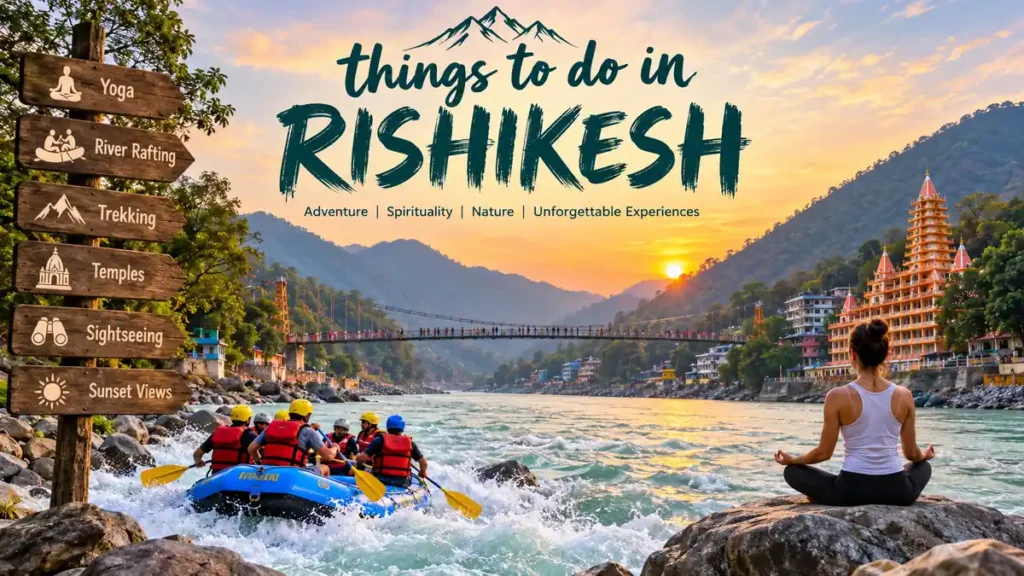
Rishikesh is one of those rare destinations where a single day can begin with yoga beside the Ganga, continue with white-water rafting through Himalayan foothills, and end with lamps glowing during an evening Ganga Aarti.
Set in Uttarakhand, where the Ganga emerges from the Himalayan foothills, Rishikesh combines spirituality, outdoor adventure, nature, Hindu pilgrimage sites, yoga traditions, and an easygoing café culture. The most memorable things to do in rishikesh include attending Ganga Aarti, rafting from Shivpuri, exploring Beatles Ashram, practicing yoga, visiting Ram Jhula and nearby temples, hiking to waterfalls, meditating in Vashishta Gufa, and watching sunrise from Kunjapuri Temple.
Best things to do in rishikesh at a glance
If you’re visiting for the first time, it helps to understand how different the experiences can be.
| Experience | Best for | Time needed | Good time to go |
|---|---|---|---|
| Ganga Aarti | Culture & spirituality | 1–2 hours | Evening |
| River rafting | Adventure | 2–6 hours | Morning |
| Beatles Ashram | History & photography | 1.5–3 hours | Morning |
| Yoga & meditation | Wellness | 1 hour–several days | Early morning |
| Ram Jhula area | Sightseeing | 1–2 hours | Morning/evening |
| Neer Garh Waterfall | Nature & hiking | 2–3 hours | Morning |
| Kunjapuri Temple | Mountain views | 3–4 hours | Sunrise |
| Neelkanth Mahadev Temple | Pilgrimage | Half day | Morning |
| Vashishta Gufa | Meditation | 1–2 hours | Morning |
| Rajaji landscape | Wildlife & nature | Half/full day | Early morning |
A three-day visit is enough to combine the major spiritual, adventure, and sightseeing experiences without rushing. Four or five days gives you considerably more room for yoga, waterfalls, temples, cafés, and slower walks along the river.
1. Watch the evening Ganga Aarti
If you experience only one spiritual tradition in Rishikesh, make it the Ganga Aarti.
Every evening, worshippers gather beside the river as lamps are lit, devotional songs are sung, and offerings are made to the Ganga. The ceremony is visually striking, but its importance goes beyond photography: the Ganga is sacred within Hindu tradition, and the ritual is an act of worship.
Two popular places to experience it are Parmarth Niketan and Triveni Ghat.
Parmarth Niketan’s riverside ceremony is particularly well known, while Triveni Ghat provides another atmospheric setting in central Rishikesh. Evening schedules vary with sunset and season, so confirm the current time locally and arrive early if you want a comfortable viewing position.
Which Ganga Aarti should you attend?
For a visually memorable riverside ceremony, Parmarth Niketan is a natural choice. Triveni Ghat is equally worthwhile if you’re exploring the central part of town.
Don’t treat the ceremony simply as a tourist performance. Dress respectfully, avoid obstructing worshippers for photographs, and follow instructions around the prayer area.
Quick takeaway: Make the Aarti the final activity of your sightseeing day rather than squeezing it between other stops.
2. Go white-water rafting on the Ganga
Among the adventurous things to do in rishikesh, river rafting is the experience most closely associated with the city.
Rafting routes operate on different stretches upstream, with Shivpuri and Kaudiyala among the names you’ll encounter frequently. The difficulty, distance, water conditions, and duration vary by route.
Uttarakhand Tourism describes the Kaudiyala section as containing multiple rapids across Grades I to IV and explicitly recommends expert guidance for difficult sections.
For first-time rafters, a shorter or moderate stretch is generally more appropriate than choosing a route simply because it is longer.
What to check before rafting
Use a properly authorized operator and pay attention during the safety briefing. Wear the supplied personal flotation device and helmet correctly, and tell the guide if you are not a confident swimmer or have relevant physical limitations.
Rafting availability is seasonal and can be affected by monsoon conditions, water levels, weather, and government restrictions. Never assume a particular stretch is operating just because it appears in an old itinerary.
That seasonal detail matters: adventure operators commonly run trips outside the peak monsoon period, but actual opening and closing dates should be confirmed for your travel dates.
3. Explore the Beatles Ashram
The Beatles Ashram, officially associated with the former Maharishi Mahesh Yogi ashram and commonly called Chaurasi Kutia, is one of Rishikesh’s most unusual cultural attractions.
The Beatles came here in 1968 to study Transcendental Meditation. Today, visitors explore meditation structures, weathered buildings, forest paths, and walls covered with colorful artwork.
You don’t need to be a Beatles fan to appreciate it.
Its appeal comes from the unusual combination of pop-culture history, meditation heritage, architecture, forest, and art. Allow roughly two hours, or longer if you enjoy photography.
Because admission charges and opening arrangements can change, check the current information before visiting rather than relying on an old ticket price.
4. Take a yoga class in the Yoga Capital
Rishikesh’s international reputation is inseparable from yoga.
The city has long attracted people interested in yoga, meditation, Vedanta, spirituality, and ashram life. Classes range from casual drop-in sessions to residential retreats and intensive teacher-training programs.
Rough Guides describes Rishikesh as India’s yoga capital and notes that its ashrams offer programs ranging from short sessions to courses lasting months.
If you’ve never practiced yoga, don’t feel pressured to sign up for an advanced retreat. A beginner-friendly morning class can be a much better introduction.
More experienced practitioners can explore traditional ashrams and dedicated yoga schools around Tapovan, Swarg Ashram, Ram Jhula, and the wider Rishikesh area.
Yoga versus an ashram stay
They aren’t the same experience.
A yoga class may last an hour or two. An ashram stay can involve a structured daily routine incorporating meditation, yoga, communal meals, lectures, prayer, and behavioral rules.
Read those rules before booking. An ashram is not simply a low-cost hotel with yoga attached.
5. Walk around Ram Jhula and Swarg Ashram
The Ram Jhula area is ideal for experiencing Rishikesh on foot.
Rather than treating the bridge as a single attraction, spend time exploring the wider riverside neighborhood. You’ll encounter temples, ashrams, ghats, small shops, cafés, religious institutions, pilgrims, and viewpoints across the Ganga.
The riverside walk toward Swarg Ashram is particularly pleasant when the temperature is comfortable. One recent local guide estimates the walk from Ram Jhula toward Swarg Ashram at roughly 20–30 minutes.
Go early in the morning if you want quieter surroundings.
Evening is busier but has its own appeal as temples light up and people begin gathering for prayers.
6. Understand the situation at Lakshman Jhula
Lakshman Jhula, also spelled Laxman Jhula, remains one of the names most strongly associated with Rishikesh.
However, bridge access and infrastructure around Rishikesh have changed over time, so travelers should not build an itinerary around outdated descriptions that assume every historic crossing operates exactly as it once did.
The better approach is to explore the wider Lakshman Jhula/Tapovan riverside area for views, temples, cafés, and walks, while checking locally for the current pedestrian crossing situation.
This is a good example of why recent local information matters more than an old “top attractions” checklist.
7. Hike to Neer Garh Waterfall
Need a break from temples and busy streets? Head toward Neer Garh Waterfall, also called Neer Gaddu Waterfall.
The experience involves more than seeing the waterfall itself. The walk takes you away from the urban riverfront and into greener terrain, with pools and cascades appearing along the route.
The site is several kilometers from the main Rishikesh area, followed by walking on a forest trail. Conditions can be especially slippery around wet rocks.
Wear shoes with decent grip rather than flip-flops.
Morning is preferable if you want cooler temperatures and fewer people.
Is Neer Garh Waterfall worth visiting?
Yes, particularly if you enjoy short hikes and have at least two or three days in Rishikesh.
Its appearance changes significantly with rainfall and season, however. A waterfall seen during or after the monsoon may look very different during a dry period.
Never enter a pool simply because other visitors are swimming. Assess current flow and local warnings first.
8. Watch sunrise from Kunjapuri Temple
For Himalayan scenery, Kunjapuri Temple deserves an early alarm.
The hilltop temple sits well above Rishikesh and is known for sunrise views across the surrounding mountains and valleys. On clear mornings, the changing light over the Himalayan landscape can be spectacular.
Most visitors reach the area by road and then climb the final steps toward the temple. The overall outing generally requires several hours.
Leave before sunrise rather than at sunrise.
Cloud, haze, and seasonal weather determine visibility, so no mountain panorama is guaranteed. Even without perfect visibility, the temple setting and morning atmosphere make the trip worthwhile.
9. Visit Neelkanth Mahadev Temple
Neelkanth Mahadev Temple is an important Shiva temple in the hills outside Rishikesh.
For travelers interested in Hindu pilgrimage traditions, this isn’t merely another sightseeing stop. It provides a clearer sense of Rishikesh’s relationship with the wider sacred geography of Uttarakhand.
The road journey takes you away from the main riverfront and into forested hills.
Set aside around half a day rather than trying to squeeze the temple into an already crowded schedule.
During major religious periods, expect heavier traffic and larger numbers of pilgrims.
Dress conservatively and remember that worship takes priority over sightseeing and photography.
10. Meditate inside Vashishta Gufa
For something quieter, travel upstream to Vashishta Gufa, or Vashishta Cave.
The cave is traditionally associated with the sage Vashishta and is used as a meditation space. Compared with Rishikesh’s busy bridges and adventure centers, the atmosphere can feel dramatically different.
Silence is part of the experience.
Sit quietly for a while rather than entering, taking photographs, and immediately leaving. Keep conversations outside the meditation space and respect people who have come specifically for spiritual practice.
Nearby river scenery makes the journey worthwhile even for travelers without a formal meditation practice.
11. Try bungee jumping and other adventure activities
Rafting isn’t the only adrenaline option around Rishikesh.
The wider region has developed a substantial adventure-sports scene involving activities such as bungee jumping, flying fox, trekking, and other height-based experiences. Rough Guides specifically highlights bungee jumping and flying fox activities around Mohanchatti.
Safety standards matter more than price.
Before participating, check the operator’s current credentials, equipment, weight or age restrictions, medical requirements, weather policy, and emergency procedures.
If an operator treats the safety briefing casually, find another one.
12. Spend a slow morning beside the Ganga
Not every worthwhile Rishikesh experience requires a ticket.
One of the simplest is getting up early and walking beside the Ganga before the busiest part of the day begins.
Morning Rishikesh has a different rhythm. You’ll see yoga practitioners, pilgrims, temple visitors, residents, sadhus, and travelers sharing the riverfront while bells and prayers carry across the water.
Find a safe public place along the ghats and simply sit for a while.
The Ganga is fast-moving in this region. Don’t confuse a peaceful-looking surface with safe swimming conditions, and respect barriers and local warnings.
For many visitors, these quiet hours become more memorable than a packed checklist of attractions.
13. Explore Triveni Ghat outside Aarti time
Most people arrive at Triveni Ghat specifically for evening Aarti, but visiting at another time provides a different perspective.
Early morning is calmer. Pilgrims come for ritual bathing and prayer, while the riverfront gradually wakes up around them.
Return in the evening and the same space feels completely transformed.
This morning-and-evening contrast helps visitors understand that the ghats aren’t simply tourist attractions. They remain active religious spaces woven into everyday life.
If photography is permitted, be considerate about photographing people performing personal religious rituals.
14. Explore Rishikesh’s café culture
Rishikesh has developed a surprisingly varied café scene, especially around Tapovan and the Lakshman Jhula side.
Expect vegetarian Indian dishes alongside coffee, chai, smoothie bowls, Israeli-inspired food, Tibetan dishes, baked goods, and international traveler staples.
Alcohol and non-vegetarian food are restricted in the holy-city environment, so Rishikesh’s dining culture differs from that of many Indian tourist destinations.
Rather than chasing a single “famous” café, choose places for their atmosphere and location.
A river-view café works particularly well after rafting, hiking, or several hours of sightseeing. Give yourself permission to sit there longer than planned.
That’s part of experiencing Rishikesh too.
15. Discover the ashrams
If yoga interests you, explore the tradition beyond commercial studios.
Parmarth Niketan and Sivananda Ashram, associated with the Divine Life Society and Swami Sivananda, are among the best-known names visitors encounter. Rishikesh also contains numerous smaller spiritual centers representing different teachings and practices.
Visitors should understand basic ashram etiquette before entering.
Keep clothing modest, speak quietly, remove shoes where instructed, and ask before photographing ceremonies or practitioners.
Some institutions welcome casual visitors; others operate primarily for residents or registered students.
16. Experience Rishikesh on foot
Walking is one of the easiest ways to notice details that disappear from a vehicle.
Build a route around Ram Jhula, Swarg Ashram, ghats, temples, local markets, and the riverbank rather than constantly moving between isolated attractions by taxi.
You’ll encounter small shrines, monkeys, flower sellers, pilgrims, bookshops, cafés, yoga centers, and unexpected viewpoints.
One practical warning: monkeys can be opportunistic.
Keep food secured and avoid waving snacks around them. Don’t try to feed or touch wildlife for photographs.
Traffic is another consideration. Some roads can become congested, so pedestrian routes are often more enjoyable when available.
17. Explore Rajaji National Park responsibly
The forests around Rishikesh form part of a much larger natural landscape.
Rajaji National Park is known for wildlife including Asian elephants and a wide range of birds and other species. It provides a completely different experience from yoga studios, temples, and rafting.
A wildlife excursion should be treated as wildlife observation, not a guaranteed animal sighting.
Go with authorized arrangements, stay within permitted zones, maintain distance from animals, and follow forest rules. Early hours can be rewarding for birdlife and general forest activity.
Wildlife sightings always depend on season, luck, route, and conditions.
18. Take a day trip toward Shivpuri
Shivpuri is closely associated with Rishikesh’s outdoor side.
Located upstream, it’s commonly used as a starting area for rafting and is surrounded by river and mountain scenery. It’s useful even if your goal isn’t simply to race back downstream in a raft.
A day around Shivpuri can combine outdoor activity with quieter time near the river.
Camping has historically been popular in the broader region, but rules concerning campsites, riverbanks, forest areas, and environmental protection can change. Use authorized accommodation rather than setting up independently on an attractive-looking patch of riverbank.
19. Try a short Himalayan foothill hike
You don’t need a multi-day Himalayan expedition to add hiking to a Rishikesh trip.
Short routes around waterfalls, hill temples, forest areas, and viewpoints offer an accessible introduction to the surrounding landscape.
Kunjapuri and Neer Garh are two obvious choices, while guided walks can open up additional routes.
Start early, especially in warmer months.
Carry drinking water, sun protection, and footwear suitable for uneven surfaces. During the monsoon, trails may become muddy or slippery and landslide conditions can affect roads and walking routes.
Avoid isolated trails after dark.
20. Make time for meditation
Rishikesh rewards travelers who deliberately leave gaps in their itinerary.
Meditation sessions are available through yoga schools, ashrams, spiritual centers, and retreats. But you don’t necessarily need an organized class.
A quiet morning beside the Ganga or time inside an appropriate meditation space can be enough.
If you’re new to meditation, start simply: sit comfortably, pay attention to your breathing, and allow yourself ten or fifteen quiet minutes.
There’s no need to turn it into a performance.
Best things to do in rishikesh for different travelers
Different visitors can have completely different trips without either missing the point of Rishikesh.
| Traveler | Experiences to prioritize |
|---|---|
| First-time visitor | Ganga Aarti, rafting, Beatles Ashram, Ram Jhula |
| Adventure traveler | Rafting, bungee jumping, hiking, Shivpuri |
| Spiritual traveler | Yoga, meditation, ashrams, Triveni Ghat |
| Nature lover | Neer Garh, Kunjapuri, Rajaji landscape |
| Photographer | Kunjapuri sunrise, ghats, Beatles Ashram, river views |
| Solo traveler | Yoga classes, cafés, walking routes, group rafting |
| Family | Ganga Aarti, Beatles Ashram, temples, gentle sightseeing |
| Slow traveler | Ashram stay, meditation, riverside walks, yoga |
The biggest mistake is trying to do everything.
Choose one major experience each morning and afternoon, then leave your evenings relatively flexible.
things to do in rishikesh in 1 day
If you have only one day, focus on experiences that reveal different sides of the city rather than spending most of the day driving.
Start early around the Ram Jhula or riverfront area. Take a morning yoga session or walk beside the Ganga, then explore the ashram district.
Visit Beatles Ashram later in the morning.
After lunch, spend time around the river and bridges. If rafting is your main priority, substitute it for some sightseeing rather than trying to cram both into a tight schedule.
Finish at Parmarth Niketan or Triveni Ghat for Ganga Aarti.
That gives you spirituality, history, river scenery, and local atmosphere in one manageable day.
things to do in rishikesh in 2 days
With two days, add adventure.
Day 1: Explore Ram Jhula, Swarg Ashram, Beatles Ashram, riverside areas, and evening Ganga Aarti.
Day 2: Go rafting in the morning, then visit a café or waterfall in the afternoon. Finish with a relaxed walk beside the river.
If rafting isn’t your thing, replace it with Kunjapuri sunrise and Neer Garh Waterfall.
Two days will still feel fairly active, so avoid adding distant temples unless they’re a priority.
things to do in rishikesh in 3 days
Three days provides a much better balance.
Use the first day for Rishikesh’s spiritual and cultural core: ghats, ashrams, bridges, Beatles Ashram, and Aarti.
Make day two your adventure day with rafting or another professionally operated activity.
On day three, get outside the center. Choose Kunjapuri for sunrise, Neer Garh for a short hike, Vashishta Gufa for quiet meditation, or Neelkanth Mahadev Temple for a pilgrimage-focused outing.
This pace gives you enough time to actually experience places rather than merely photograph them.
Free things to do in rishikesh
Rishikesh works surprisingly well for travelers who don’t want to spend heavily.
Walking along the Ganga, exploring public ghats, watching religious life, visiting accessible temples, attending many prayer ceremonies, browsing local markets, and exploring parts of the Ram Jhula and Swarg Ashram area cost little or nothing.
Ganga Aarti itself generally doesn’t require an admission ticket, though donations may be welcomed.
A sunrise walk can be every bit as memorable as a paid adventure activity.
Save your budget for experiences where professional expertise genuinely matters—especially rafting, adventure sports, transportation to distant viewpoints, or structured yoga instruction.
Best time for things to do in rishikesh
The experience changes considerably by season.
Spring and autumn generally provide comfortable conditions for combining sightseeing, outdoor activities, and yoga. Recent travel guides commonly highlight periods around February–April and September–November as especially attractive, though exact conditions vary from year to year.
Summer can become hot, making early starts more valuable.
The monsoon brings lush scenery but also heavy rainfall, stronger river conditions, slippery trails, landslide risk, and interruptions to adventure activities. Rafting should never be assumed available during unsafe river conditions.
Winter brings colder mornings and evenings but can offer a quieter atmosphere.
Always check current weather, road, river, and activity conditions shortly before traveling.
Practical tips before exploring Rishikesh
A little preparation makes a noticeable difference.
Wear comfortable walking shoes because Rishikesh involves more walking, stairs, and uneven terrain than many first-time visitors expect. Carry water, but reduce unnecessary single-use plastic where possible.
Dress respectfully around temples, ashrams, and religious ceremonies.
Don’t photograph worshippers at close range without permission. Remove footwear wherever instructed.
For rafting, bungee jumping, and other adventure sports, prioritize properly operated activities over unusually cheap deals.
And don’t underestimate the Ganga. The river can be powerful even where it looks calm from shore.
Traffic is another reality. Travel times can expand considerably during weekends, festivals, pilgrimage periods, and peak tourist seasons.
How many days are enough for Rishikesh?
For most first-time visitors, three days is a practical minimum for a rounded trip.
One day gives you the highlights. Two days lets you add rafting or nature. Three days creates enough room to combine adventure, spirituality, and sightseeing without constantly watching the clock.
Four to seven days makes more sense if yoga, meditation, an ashram stay, hiking, or slower travel is central to your visit. Current destination guides similarly suggest roughly four to seven days for travelers who want to explore beyond the basic highlights.
If you’re primarily coming for a yoga retreat, the retreat itself may determine your length of stay.
What should you not miss in Rishikesh?
For a first trip, five experiences capture the destination particularly well: Ganga Aarti, time beside the Ganga, a yoga or meditation session, Beatles Ashram, and either rafting or a Himalayan foothill excursion.
Together, they reveal why Rishikesh is difficult to categorize.
It is simultaneously a pilgrimage town, international yoga destination, adventure hub, Himalayan gateway, and place where doing very little can sometimes be the best part of the day.
That is ultimately the key to choosing the best things to do in rishikesh: don’t build the trip entirely around attractions. Leave space for an early walk beside the Ganga, an unexpectedly long conversation over chai, or twenty quiet minutes watching the river move past.
Those unscheduled moments are often where Rishikesh makes the strongest impression.