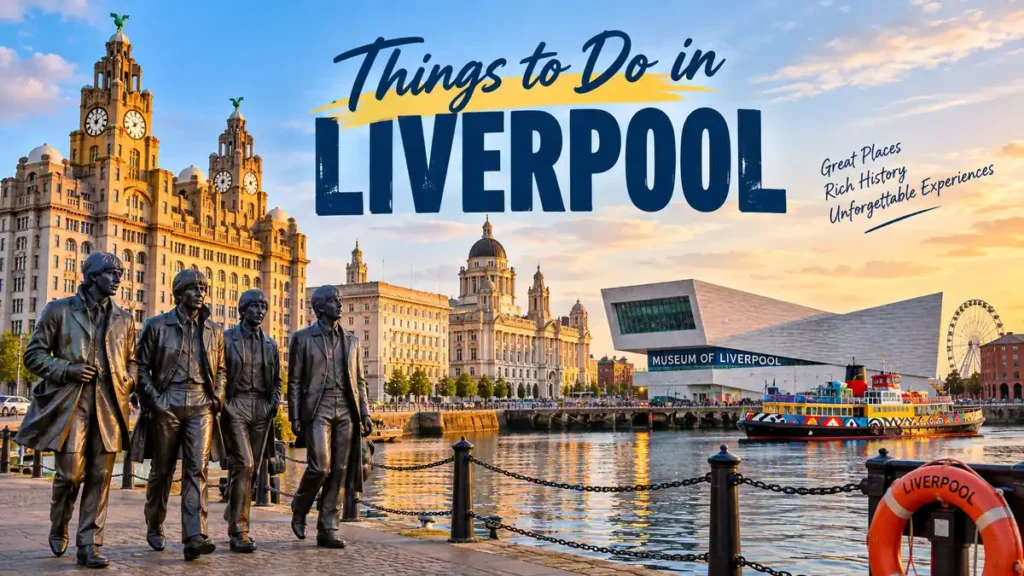
Liverpool is one of those cities where a weekend can disappear surprisingly quickly. You might arrive for The Beatles or football, then find yourself spending hours beside the River Mersey, wandering through museums, exploring Georgian streets or listening to live music in a basement club.
If you are looking for things to do in liverpool, start with the Royal Albert Dock and Pier Head, ride a Mersey Ferry, explore The Beatles Story and Cavern Quarter, visit Liverpool Cathedral, discover the city’s museums and galleries, and make time for Anfield, Sefton Park and the Baltic Triangle. Many central attractions are walkable, and several major museums are free.
This guide covers Liverpool’s essential sights as well as free activities, family attractions, outdoor spaces and places worth adding when you have more than one day.
Best Things to Do in Liverpool at a Glance
| Experience | Best for | Area | Typical time |
|---|---|---|---|
| Royal Albert Dock | First-time visitors | Waterfront | 1–3 hours |
| Mersey Ferry | Skyline views | Pier Head | About 50 minutes |
| The Beatles Story | Music history | Royal Albert Dock | 1–2 hours |
| Cavern Quarter | Beatles fans & nightlife | City centre | 1–3 hours |
| Museum of Liverpool | Local history | Waterfront | 1–2 hours |
| Liverpool Cathedral | Architecture & views | Georgian Quarter | 1–2 hours |
| Anfield Stadium | Football fans | Anfield | 2–3 hours |
| Royal Liver Building | Architecture & views | Pier Head | 1–2 hours |
| Sefton Park | Parks & relaxation | South Liverpool | 1–3 hours |
| Baltic Triangle | Street art & independent culture | Baltic Triangle | 2–4 hours |
| Walker Art Gallery | Art | St George’s Quarter | 1–2 hours |
| Crosby Beach | Outdoor day trip | Sefton | 2–4 hours |
Liverpool city centre is relatively compact and walkable, with distinct areas including the Waterfront, Cavern Quarter, Ropewalks, Georgian Quarter, Baltic Triangle, Chinatown and St George’s Quarter. Merseyrail is useful when your plans take you farther from the centre.
Things to Do in Liverpool Around the Waterfront
Liverpool’s waterfront is the easiest place to begin a first visit. Within a relatively small area you can combine historic architecture, museums, Beatles attractions, river views and a ferry ride.
1. Walk Around the Royal Albert Dock

6
The Royal Albert Dock is one of Liverpool’s signature landmarks and an excellent introduction to the city’s maritime identity.
The old dock warehouses have been transformed into a cultural and leisure district filled with attractions, restaurants, cafés and shops. Major visitor sites around the dock and waterfront include The Beatles Story and several cultural institutions.
Don’t treat the dock simply as somewhere to rush through between attractions. Walk around the water, explore the colonnades and then continue toward Pier Head.
Best for: First-time visitors, photography, couples and families.
Practical tip: Combine the dock with The Beatles Story, Museum of Liverpool, Pier Head and the Mersey Ferry rather than making separate journeys.
2. Explore Pier Head and the Three Graces
Continue north along the waterfront to Pier Head, where Liverpool’s historic skyline becomes the main attraction.
This is where you will find the famous group of buildings known as the Three Graces:
- Royal Liver Building
- Cunard Building
- Port of Liverpool Building
The area also offers excellent views across the River Mersey and easy access to the ferry terminal.
The waterfront is particularly enjoyable near sunset, when the buildings and river begin to catch the evening light.
3. Take a Ferry Across the Mersey

5
A Mersey Ferry ride gives you something walking around the city cannot: a full view of Liverpool’s waterfront from the river.
The River Explorer Cruise currently takes about 50 minutes and operates between Liverpool and Seacombe. Recorded commentary covers Liverpool and Wirral’s maritime and musical history.
As of September 2026, the standard adult River Explorer fare is £14, while children aged 5–15 pay £9; under-fives travel free. Timetables can change for events or operational reasons, so check the current schedule before travelling.
What actually works: Sit outside when the weather cooperates. The broad waterfront view is the main reason to take the trip.
4. See Liverpool From the Royal Liver Building
The Royal Liver Building dominates Pier Head and is instantly recognisable because of the Liver Birds watching over the city.
Royal Liver Building 360 allows visitors to go inside the landmark rather than simply photographing it from outside. VisitLiverpool highlights the experience as a chance to enter the clock tower and see the enormous clock faces up close.
For skyline views without leaving the waterfront, it is one of the most convenient options.
5. Visit the Museum of Liverpool
The Museum of Liverpool focuses specifically on the city and the people who shaped it.
Its location beside the Mersey makes it easy to include while exploring Pier Head and Albert Dock. Exhibitions help put the rest of your visit into context by covering Liverpool’s social, cultural and urban history.
VisitLiverpool describes it as the world’s first national museum devoted to the history of a regional city.
If Liverpool is completely new to you, visiting early in your trip can make the landmarks you encounter later more meaningful.
Beatles Things to Do in Liverpool
Liverpool’s connection with The Beatles is not limited to a single museum. The band’s history is scattered throughout the city, from Mathew Street to Penny Lane and Strawberry Field.
6. Start at The Beatles Story

6
The Beatles Story at Royal Albert Dock is the logical starting point for visitors who want the full background before seeing individual landmarks.
The exhibition follows the band’s development and rise to international fame through displays, memorabilia and an audio-led visitor experience. VisitLiverpool describes it as the largest Beatles exhibition of its kind.
Even casual listeners can benefit from starting here because the exhibition provides context for the locations around Liverpool associated with John Lennon, Paul McCartney, George Harrison and Ringo Starr.
7. Walk Down Mathew Street and Enter the Cavern Club
Next, head into the Cavern Quarter and Mathew Street.
The Cavern Club remains one of Liverpool’s best-known music landmarks. The Beatles’ association with the venue turned it into a pilgrimage point for music fans, but live music keeps the area from feeling purely historical.
Nearby you’ll also find the Liverpool Beatles Museum, which VisitLiverpool says contains more than 1,000 items in its collection.
Mathew Street is much livelier later in the day, so timing your visit for late afternoon or evening lets you experience both the history and current music scene.
8. See Penny Lane and Strawberry Field
To explore Beatles history beyond the city centre, head south.
Penny Lane became internationally famous through the band’s music, while Strawberry Field has developed into a visitor attraction with an exhibition, gardens and the famous gates.
These locations make more sense when visited together rather than as isolated photo stops.
If you’re short on time, organised Beatles tours can connect multiple landmarks efficiently.
9. Take the Magical Mystery Tour
The Magical Mystery Tour is useful when you want to see several Beatles locations without figuring out public transport between them.
The approximately two-hour bus experience includes major landmarks such as Penny Lane and Strawberry Field. Beatles-themed tours in Liverpool are also available by foot, car and bike.
For serious fans, this is usually more rewarding than seeing only Mathew Street.
Quick Takeaway: For a compact Beatles day, combine The Beatles Story → Beatles statues at Pier Head → Mathew Street and Cavern Club → Penny Lane → Strawberry Field.
Historic and Cultural Things to Do in Liverpool
Liverpool’s architecture deserves as much attention as its music. The Georgian Quarter in particular shows a completely different side of the city from the docks.
10. Step Inside Liverpool Cathedral

5
Liverpool Cathedral is Britain’s largest cathedral and one of the city’s most imposing buildings.
The scale of the interior is the immediate attraction, but the Tower Experience adds panoramic views across Liverpool, the River Mersey and, in clear conditions, farther toward North Wales. The tower visit involves two lifts followed by 108 stairs.
The cathedral itself can be visited without booking, although events and services occasionally affect visitor access.
11. Walk Between Liverpool’s Two Cathedrals
One of Liverpool’s most enjoyable urban walks connects Liverpool Cathedral with the Metropolitan Cathedral of Christ the King.
The contrast is striking.
Liverpool Cathedral feels monumental and Gothic Revival in character, while the Metropolitan Cathedral presents a much more modern architectural vision.
Walk along Hope Street between them rather than travelling by bus. The surrounding Georgian Quarter contains elegant terraces, theatres, pubs and restaurants and rewards slow exploration.
12. Explore St George’s Hall
Near Lime Street Station, St George’s Hall is another essential piece of Liverpool’s architectural story.
Its grand Neoclassical exterior immediately establishes the character of the surrounding St George’s Quarter. VisitLiverpool also highlights immersive experiences inside the building among Liverpool’s architectural attractions.
Combine it with nearby cultural attractions rather than visiting the area solely for the hall.
13. Visit the Walker Art Gallery
The Walker Art Gallery contains paintings, sculpture and decorative art and is one of the city’s major cultural attractions.
It works particularly well on rainy days because it can be combined with nearby indoor attractions around William Brown Street and St George’s Quarter.
Travellers interested in art should also keep Tate Liverpool on their radar, but check its current location and exhibition arrangements before travelling: its Albert Dock home is undergoing redevelopment, and Tate has been operating in temporary arrangements during that work.
14. Discover Liverpool’s Maritime History
Liverpool’s growth was inseparable from its position as a major port.
Understanding that history means confronting both extraordinary maritime achievement and the city’s connections with slavery and empire. That darker history should not be reduced to a footnote.
The International Slavery Museum has traditionally been one of the most significant places for exploring those connections, while Liverpool’s broader museum network covers maritime trade, migration and the port’s development. Because major waterfront museum redevelopment has affected access, check National Museums Liverpool’s current visitor information before planning around a particular museum.
For a different angle on Liverpool’s wartime history, Western Approaches preserves the underground command centre that played a role in Britain’s Second World War Atlantic operations. The attraction describes a network of rooms and offices hidden beneath central Liverpool.
Football and Sporting Things to Do in Liverpool
Few cities connect identity and football as intensely as Liverpool.
15. Tour Anfield Stadium


6
For football supporters, Anfield is one of the headline things to do in liverpool.
The Liverpool FC Stadium Tour provides access to areas including the press conference room, players’ tunnel, manager’s dugout, home dressing room and the famous This Is Anfield sign. Entry to the LFC Museum is also included with the standard stadium tour.
As of September 2026, advance adult admission for the standard Stadium Tour & Museum is listed at £26, although prices and availability can change.
Matchdays operate differently. Matchday tours may use modified routes and do not automatically include a match ticket.
16. See Liverpool’s Other Football Landmarks
Liverpool’s football culture extends beyond one stadium.
Everton is equally embedded in the city’s sporting history, and football fans can use a longer stay to explore the city’s wider football identity rather than focusing exclusively on Liverpool FC.
If you’re visiting during the football season, check fixture dates before arranging your itinerary. Matchdays can significantly alter transport demand and the atmosphere around football areas.
Free Things to Do in Liverpool
Liverpool is unusually good for travellers who want to control their budget.
VisitLiverpool notes that the city has more museums and art galleries than any UK city outside London and that many can be visited free of charge.
17. Build a Free Museum Day
A museum-heavy day can cost surprisingly little.
Depending on current exhibitions and temporary closures, your options can include the Museum of Liverpool, Walker Art Gallery and World Museum, alongside other National Museums Liverpool venues.
The World Museum is especially useful for families, with collections spanning areas such as natural history, science and global cultures.
Temporary exhibitions sometimes carry separate charges, so don’t assume every exhibition inside a free museum is also free.
18. Walk Liverpool’s Waterfront
You don’t need a ticket to enjoy one of Liverpool’s defining experiences.
Start around Royal Albert Dock, walk toward the Museum of Liverpool and Pier Head, photograph the Three Graces and Beatles statue, then continue along the riverside.
It’s one of the simplest free activities in Liverpool and gives first-time visitors an immediate sense of the city’s geography.
19. Explore Liverpool’s Street Art
Head toward the Baltic Triangle and surrounding streets for a more contemporary side of Liverpool.
Former industrial buildings now sit alongside independent businesses, creative spaces, murals and nightlife venues. The area changes frequently, which is precisely why it is worth walking rather than trying to follow a rigid checklist.
Nearby Ropewalks offers another concentration of independent venues and nightlife.
Outdoor Things to Do in Liverpool
When the weather cooperates, move beyond the museums and waterfront.
20. Spend a Few Hours in Sefton Park


8
Sefton Park provides around 250 acres of green space in south Liverpool, making it one of the city’s most useful escapes from busy sightseeing.
Walk around the lake, find quieter wooded sections and visit the beautiful Palm House.
The park works particularly well when combined with south Liverpool attractions such as Penny Lane.
21. Visit Crosby Beach and Another Place
If you have extra time, leave the city centre for the coast.
Crosby Beach is known for Another Place, Antony Gormley’s installation of human figures spread along the shoreline.
VisitLiverpool specifically recommends Crosby among the coastline experiences accessible from the city.
Check tide conditions and weather before going. Some figures can be surrounded by water as the tide moves in, and visitors should not attempt to walk out toward inaccessible statues.
22. Take a Day Trip to Formby
For dunes, woodland and a broader stretch of coastline, Formby makes an excellent extension to a Liverpool city break.
It’s particularly appealing after spending several days among busy urban attractions.
VisitLiverpool highlights both Formby and Crosby as outdoor options beyond the centre.
Fun Things to Do in Liverpool With Kids
Liverpool works well for families because many attractions combine entertainment with learning.
23. Explore World Museum
World Museum is an obvious family choice because its collections cover enormous subjects — from the natural world to science.
It is also centrally located, making it easy to combine with the Walker Art Gallery and St George’s Hall.
For families trying to keep costs down, Liverpool’s large selection of free cultural attractions is a major advantage.
24. Take the Ferry to Eureka! Science + Discovery
Families can turn the Mersey Ferry into more than a sightseeing cruise.
Eureka! Science + Discovery is at Seacombe Ferry Terminal in Wirral and focuses on interactive STEAM experiences for children and young people up to age 14.
That creates a convenient combination: ferry ride, skyline views and hands-on science in the same outing.
Note that Eureka states adult-only groups are not admitted; visitors must be accompanied by children under 14 as part of their booking.
25. Visit Knowsley Safari
For a full family day outside central Liverpool, Knowsley Safari is one of the wider Liverpool City Region’s major attractions.
VisitLiverpool includes it among the region’s top visitor experiences and highlights wildlife attractions as a family option.
Allow considerably more time than you would for a city-centre museum.
Things to Do in Liverpool at Night
Liverpool’s reputation as a music city is not just historical.
The Cavern Quarter is the obvious starting point for visitors interested in Beatles heritage and live music, while Ropewalks offers a dense collection of bars, restaurants and late-night venues.
The Baltic Triangle generally feels more alternative and creative, with converted industrial spaces contributing to its character.
For theatre, concerts and cultural events, check what’s happening around the Liverpool Empire, Royal Court, Everyman, Playhouse and the waterfront event venues during your dates.
Rather than choosing nightlife purely by venue name, choose an area that suits your mood and explore on foot. Liverpool’s compact centre makes this much easier than in more spread-out cities.
Unusual and Lesser-Known Things to Do in Liverpool
Once you’ve covered the headline attractions, several places reveal more unusual layers of the city.
Explore Williamson’s Tunnels
The Williamson’s Tunnels are among Liverpool’s strangest historic sites — an underground network associated with 19th-century businessman Joseph Williamson.
Guided visits take you beneath the streets into spaces very different from the polished waterfront attractions. Tripadvisor’s current Liverpool attraction listings continue to highlight Williamson’s Tunnels among the city’s notable historic experiences.
See the Bombed Out Church
St Luke’s Church, commonly called the Bombed Out Church, was badly damaged during the Liverpool Blitz.
Its roofless shell has become both a memorial and a cultural space.
It takes little time to see, making it an easy stop while walking between Ropewalks and the Georgian Quarter.
Walk Through Chinatown
Liverpool’s Chinatown sits near the Georgian Quarter and is marked by its striking Chinese arch.
Rather than treating it purely as a photo opportunity, incorporate the neighbourhood into a walk between the city centre and Liverpool Cathedral.
Explore Port Sunlight
Cross the Mersey into Wirral and you’ll find Port Sunlight, a distinctive planned village built for workers in the late 19th century.
The Lady Lever Art Gallery is one of its major cultural attractions; VisitLiverpool describes it as one of Europe’s finest galleries.
It is a worthwhile half-day option when you’ve already seen central Liverpool’s major sights.
How to Spend One Day in Liverpool
If you only have one day, resist trying to tick off 15 attractions. Liverpool rewards walking, and constantly travelling between sights wastes the advantage of its compact centre.
A practical route is:
- Begin at Royal Albert Dock.
- Visit The Beatles Story if music history interests you.
- Walk along the waterfront to Museum of Liverpool and Pier Head.
- Take a 50-minute Mersey Ferry.
- Walk into the Cavern Quarter and Mathew Street.
- Continue toward the Georgian Quarter.
- Finish at Liverpool Cathedral or around Hope Street.
- Return to Ropewalks, the Baltic Triangle or Cavern Quarter for dinner and evening entertainment.
This route covers maritime Liverpool, Beatles history, architecture and music without repeatedly crossing the city.
How to Spend Two Days in Liverpool
With a second day, choose one of Liverpool’s major themes rather than repeating central sightseeing.
Football fans can tour Anfield and visit the LFC Museum.
Beatles fans can head south for Penny Lane, Strawberry Field and a Beatles tour.
Families can combine the Mersey Ferry with Eureka! Science + Discovery.
Outdoor travellers can visit Sefton Park before continuing to Crosby Beach or Formby.
Culture-focused visitors can spend additional time around the Walker Art Gallery, World Museum, Georgian Quarter and temporary exhibitions.
VisitLiverpool’s current weekend guidance similarly concentrates the first part of a short stay around the waterfront, Royal Albert Dock, Royal Liver Building and Museum of Liverpool because these attractions naturally group together.
What Are the Best Things to Do in Liverpool for Free?
You can fill much of a day without paying admission.
Start at the Royal Albert Dock and walk the waterfront to Pier Head. See the Beatles statue and Three Graces, then visit free museums and galleries where available. Continue through St George’s Quarter, explore the city’s architecture and finish with a park or neighbourhood walk.
Other worthwhile free experiences include:
- Sefton Park
- Liverpool Cathedral’s main interior
- Crosby Beach
- Street art around the Baltic Triangle
- Chinatown
- Hope Street and the Georgian Quarter
- Liverpool’s waterfront
- Walker Art Gallery
- Museum of Liverpool
- World Museum
Some special exhibitions, tours and tower experiences charge admission even when the main attraction is free, so check before travelling.
When Is the Best Time to Visit Liverpool?
Liverpool is a year-round city-break destination, but your experience changes with the season.
Spring is good for walking, parks and waterfront sightseeing without peak summer crowds.
Summer brings longer daylight hours and a busy events calendar, making it particularly good for combining indoor attractions with Sefton Park and the coast.
Autumn works well for museums, football and cultural trips.
Winter suits indoor attractions, shopping, live music and museums, although shorter daylight hours make planning outdoor stops more important.
Rain is possible at any time, so build flexibility into your schedule rather than making an itinerary that depends entirely on sunshine.
Getting Around Liverpool
One reason Liverpool works so well for short breaks is that the central visitor areas are compact.
VisitLiverpool identifies the Waterfront, Cavern Quarter, Ropewalks, Georgian Quarter, Baltic Triangle, Chinatown, St George’s Quarter and Liverpool ONE as distinct central districts, with Merseyrail connecting the centre to destinations farther out.
Walking is usually the best option between:
Royal Albert Dock → Pier Head → Cavern Quarter → Liverpool ONE → Ropewalks.
Use public transport for places such as Anfield, Penny Lane, Strawberry Field, Sefton Park, Crosby and Formby.
Comfortable shoes matter more than they sound. A day that combines the waterfront, city centre and Georgian Quarter can involve a considerable amount of walking even though everything looks close on a map.
How Many Days Do You Need in Liverpool?
One day is enough for the waterfront, Cavern Quarter and one or two major attractions.
Two days is better for first-time visitors because you can add Beatles sites, Anfield, museums or the Georgian Quarter without rushing.
Three days allows you to explore beyond the centre, adding places such as Sefton Park, Crosby Beach, Formby, Port Sunlight or other parts of Liverpool City Region.
The mistake many visitors make is assuming Liverpool is simply a Beatles-and-football weekend. Those are major parts of its identity, but the museums, maritime history, architecture, neighbourhoods, parks and coastline can easily fill several days.
Making the Most of the Best Things to Do in Liverpool
The most memorable things to do in liverpool reveal different sides of the city rather than repeating the same type of attraction.
Begin with the Royal Albert Dock and Liverpool Waterfront to understand the city’s maritime setting. Take the ferry for the skyline, follow The Beatles through Mathew Street and south Liverpool, explore the Georgian Quarter and Liverpool Cathedral, and add Anfield if football matters to you.
Then leave some unscheduled time.
Walk through the Baltic Triangle. Sit beside the Mersey. Explore Sefton Park. Catch live music without planning it weeks ahead. Or take the train toward Crosby or Formby and see how quickly the dense city gives way to open coastline.
That mix of music, football, maritime history, monumental architecture, free museums, neighbourhood culture and nearby nature is what gives Liverpool far more depth than a simple checklist of attractions suggests.