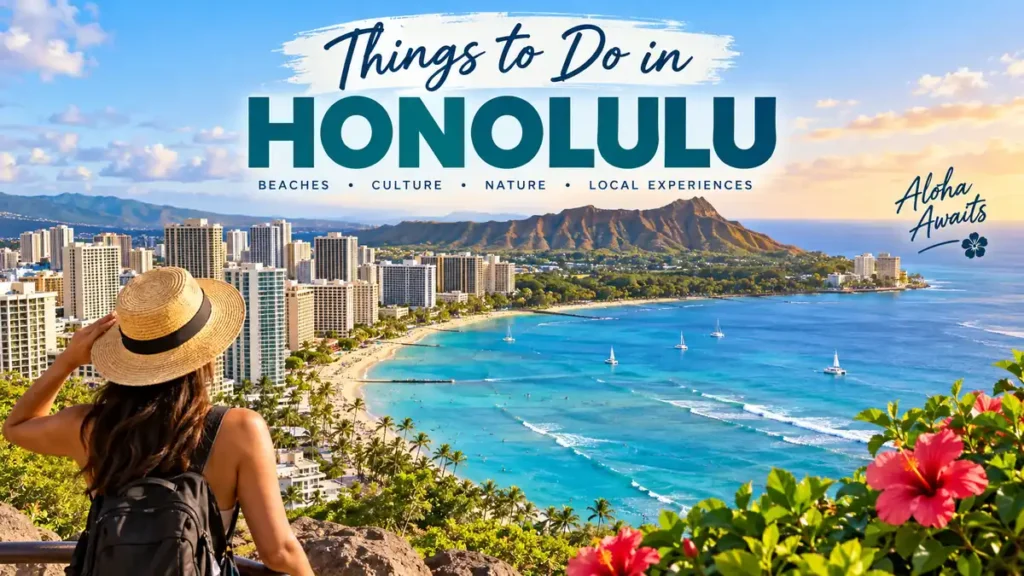
Honolulu can look deceptively simple on a map: beaches, hotels, a downtown core, and mountains rising behind the city. Spend a little time here, though, and you discover a destination where Hawaiian history, surf culture, volcanic landscapes, World War II sites, food, art, and modern island life overlap.
The best things to do in honolulu include swimming or learning to surf at Waikiki Beach, hiking Diamond Head, visiting Pearl Harbor and the USS Arizona Memorial, exploring ʻIolani Palace and Bishop Museum, snorkeling at Hanauma Bay, eating local food, and spending time in neighborhoods beyond the main resort strip.
This guide focuses on experiences actually worth building a Honolulu itinerary around, including major landmarks, cultural attractions, outdoor adventures, free activities, and practical advice that can save you time once you arrive.
1. Start With Waikiki Beach
For a first visit, Waikiki Beach is the natural starting point.
The famous beachfront sits along Honolulu’s south shore beneath the recognizable profile of Diamond Head. Today it combines a dense resort district with one of Hawaii’s best-known stretches of sand and a deep connection to surfing culture.
Swimming, paddling, people-watching, and simply walking the beachfront are all easy ways to spend a few hours. Beginners can also take a surf lesson in the relatively accessible waves found along parts of Waikiki.
Don’t assume you need to stay on the sand all day. Walk along Kalākaua Avenue, explore the neighboring beaches, or continue toward Kapiʻolani Park for a quieter change of pace.
Is Waikiki Beach free?
Yes. Visiting the public beach itself doesn’t require an admission ticket. That makes Waikiki one of the easiest free things to do in Honolulu.
The trade-off is crowds. Early morning tends to provide a calmer experience, while sunset brings a completely different atmosphere.
Quick takeaway: See Waikiki even if crowded tourist districts aren’t normally your style. Its relationship with Honolulu’s history and surfing culture makes it more than just another resort beach.
2. Hike Diamond Head for Classic Honolulu Views
If you have seen a postcard of Honolulu, there is a good chance Diamond Head—known in Hawaiian as Lēʻahi—was somewhere in the picture.
The Diamond Head Summit Trail climbs through the interior of the volcanic crater toward panoramic views over Honolulu and the Pacific. Parts of the route include switchbacks, stairs and a 225-foot tunnel before reaching historic military structures near the summit.
Allow roughly 1.5 to 2 hours rather than trying to race through the hike. There is limited shade, so water, sunscreen, a hat and decent walking shoes matter.
Non-Hawaii residents currently need advance entry reservations. The state lists admission at $5 for non-residents and an additional $10 for non-resident vehicle parking. Current operating hours are 6 a.m. to 6 p.m., with the final hiking reservation at 4 p.m.
Diamond Head State Monument visitor information
Is Diamond Head difficult to hike?
Most reasonably active visitors can complete it, but don’t mistake a short trail for an effortless walk. The steep sections, uneven surfaces, heat and final stairs can make the ascent challenging.
The summit trail is also not ADA accessible.
For the most comfortable experience, reserve an early slot and avoid the strongest midday sun.
3. Visit Pearl Harbor National Memorial
Pearl Harbor deserves considerably more attention than a quick photo stop.
The Pearl Harbor National Memorial interprets the December 7, 1941 attack and its consequences during World War II in the Pacific. The visitor center itself is free and doesn’t require a reservation.
Exhibits provide valuable context before visiting the memorial sites.
The wider Pearl Harbor area also includes attractions such as the USS Bowfin Submarine, Battleship Missouri and Pearl Harbor Aviation Museum. Those operate separately from the National Park Service’s free visitor-center experience.
Give yourself several hours if history is a major reason for your visit.
4. Take the USS Arizona Memorial Program
The USS Arizona Memorial is one of Hawaii’s most significant historical sites.
The National Park Service’s program includes an orientation, boat transportation to the memorial, time at the memorial itself, and the return journey. Programs generally operate throughout the day, subject to conditions.
The program itself is free, although the official reservation system charges a small reservation fee.
Reservations are released through Recreation.gov in two windows: eight weeks and 24 hours in advance, with releases at 3 p.m. Hawaii Standard Time. Limited standby access may exist, but relying on it during busy travel periods is risky.
Official USS Arizona Memorial information
A common planning mistake is treating Pearl Harbor like an ordinary attraction that can simply be squeezed between other stops. Arrive early and leave room in the schedule for security procedures, exhibits and reflection.
5. Step Inside ʻIolani Palace
One of the most important things to do in Honolulu is also one of the best ways to understand that Hawaii’s story did not begin with tourism or U.S. statehood.
ʻIolani Palace was the royal residence of Hawaii’s monarchy and provides essential context for understanding the Hawaiian Kingdom, its rulers and the political changes that transformed the islands.
The palace is associated particularly with King Kalākaua and Queen Liliʻuokalani. Restored interiors, royal objects and historical interpretation make this a much deeper experience than viewing the building from outside.
Current visitor hours are Tuesday through Saturday from 9 a.m. to 4 p.m.; the palace is normally closed Sunday and Monday. Tour formats vary by day.
ʻIolani Palace visitor information
Pair the palace with a walk around downtown Honolulu rather than returning immediately to Waikiki.
6. Explore Historic Downtown Honolulu
Downtown contains several landmarks within a relatively compact area.
Near ʻIolani Palace, you can see Aliʻiolani Hale and the King Kamehameha I statue before continuing through Honolulu’s historic civic district.
Aloha Tower offers another connection to the city’s past. Completed in 1926, it once welcomed travelers arriving in Honolulu by sea and became one of the waterfront’s defining landmarks.
Walking this area helps connect places that otherwise appear as isolated attractions on a checklist.
It also reveals an important distinction: Honolulu and Waikiki are not interchangeable. Waikiki is one neighborhood within the larger city, while downtown tells a very different part of Honolulu’s story.
7. Discover Hawaiian Culture at Bishop Museum
If you have time for only one museum focused broadly on Hawaiian and Pacific history, make a strong case for Bishop Museum.
Founded in 1889 by Charles Reed Bishop in honor of Princess Bernice Pauahi Bishop, it developed from a collection of Hawaiian royal heirlooms into Hawaii’s major natural and cultural history institution.
Hawaiian Hall is particularly valuable. Its three levels explore Hawaiian beliefs, everyday relationships with land and nature, aliʻi, and major moments in Hawaiian history. Pacific Hall broadens the story to Oceania, migration, archaeology and navigation.
The museum also incorporates natural science. Its Richard T. Mamiya Science Adventure Center covers subjects including volcanology, biodiversity and oceanography.
Bishop Museum is currently open daily from 9 a.m. to 5 p.m., apart from specified holidays.
Bishop Museum visitor information
Plan at least two or three hours if you enjoy history. Families can easily stay longer.
8. Snorkel at Hanauma Bay Nature Preserve

5
For marine life close to Honolulu, Hanauma Bay is the obvious name—but it needs more advance planning than an ordinary beach trip.
The protected bay lies inside an ancient volcanic formation on southeastern Oʻahu and is known for snorkeling and marine education.
Visitors should treat it as a nature preserve rather than a swimming pool. Don’t stand on coral, chase wildlife or touch marine animals.
Current visitor guidance has the preserve operating Wednesday through Sunday, with reservations generally released two days beforehand at 7 a.m. Hawaii Standard Time. Entry reservations and parking are separate.
Because operating procedures can change, check the official Honolulu reservation system shortly before your intended date.
Early visits are generally preferable: temperatures are cooler, you have more time available, and you aren’t trying to squeeze snorkeling into the end of the day.
9. See Manoa Falls and Honolulu’s Rainforest Side
Beaches dominate Honolulu travel photography, but the mountains behind the city show another side of Oʻahu.
The Manoa Falls Trail enters a lush valley where dense vegetation, moisture and mountain scenery feel surprisingly removed from Waikiki.
Expect mud after rainfall. Shoes with reasonable grip are far more useful than flip-flops, particularly on the descent.
The waterfall’s flow also varies with recent rainfall, so don’t judge the hike solely by how dramatic the falls appear.
More importantly, don’t enter restricted areas or ignore posted warnings for the sake of a photograph. Tropical landscapes can change quickly after heavy rain.
10. Spend Time in Kapiʻolani Park
When Waikiki begins to feel too busy, walk toward Kapiʻolani Park.
The large green space sits toward the Diamond Head end of Waikiki and provides room for walking, picnicking, running and simply escaping the dense hotel corridor. Its history reaches back to Hawaii’s monarchy; King Kalākaua established the area as a public park in the 19th century.
Combine it with nearby beaches for an inexpensive half-day.
This is also a useful example of how to enjoy Honolulu without scheduling every hour around a ticketed attraction.
11. Explore Honolulu’s Art Scene
Honolulu’s cultural attractions extend beyond Hawaiian history.
Honolulu Museum of Art holds an extensive collection spanning Asian, European, American and Pacific art.
Current collection highlights include works connected with Claude Monet, Georgia O’Keeffe and the Buddhist bodhisattva Guanyin. The museum also runs guided tours, films, talks and rotating exhibitions.
As of 2026, standard adult admission is $25, while visitors 18 and under enter free. The museum is closed Monday and Tuesday and stays open until 9 p.m. on Fridays.
Honolulu Museum of Art visitor information
For travelers wondering what to do in Honolulu when it rains, museums such as HoMA and Bishop Museum are strong alternatives to abandoning the day’s plans.
12. Walk Through Honolulu’s Chinatown
Chinatown is one of the best places to experience Honolulu beyond the resort environment.
The neighborhood mixes markets, restaurants, historic buildings, galleries and businesses reflecting the city’s long connections with Asia and the wider Pacific.
Rather than treating Chinatown as one attraction, explore it slowly. Look through produce markets, stop for food and pay attention to the changing architecture as you move between Chinatown and downtown.
It works particularly well alongside ʻIolani Palace and other downtown sights because you can combine several experiences without repeatedly crossing the city.
13. Eat Your Way Through Honolulu
Food deserves its own place on any Honolulu itinerary.
Hawaii’s cuisine reflects Native Hawaiian traditions alongside generations of Japanese, Chinese, Filipino, Portuguese, Korean and other influences.
Look beyond familiar resort restaurants and try dishes and snacks such as:
- Poke
- Saimin
- Spam musubi
- Plate lunch
- Malasadas
- Shave ice
- Fresh local seafood
- Hawaiian foods such as poi, laulau and kalua-style preparations
Kapahulu is particularly useful for a casual food crawl because several well-known local food stops are concentrated along and around the corridor. Contemporary Honolulu travel guides increasingly highlight the area as an alternative to eating every meal along the main Waikiki strip.
One useful rule: don’t try to experience Hawaii’s food culture through one “traditional” meal. Honolulu’s culinary identity comes from many communities and generations.
14. Learn to Surf
Surfing isn’t simply an activity imported for visitors. It has deep Hawaiian roots.
Waikiki played an enormous role in introducing modern surfing to international visitors, with legendary Hawaiian waterman Duke Kahanamoku becoming one of its most famous ambassadors.
First-time surfers don’t need giant waves. A beginner lesson normally focuses on positioning, paddling, timing, standing up safely and basic surf etiquette.
Even if you don’t surf, watching experienced riders around Waikiki at sunrise or late afternoon costs nothing and connects you with one of Honolulu’s defining traditions.
15. Watch Sunset From the Beach
One of the simplest things to do in honolulu is also one of the easiest to overlook when filling an itinerary with reservations.
Leave an evening open for sunset.
Waikiki provides the classic option, but nearby stretches such as Kuhio Beach and Fort DeRussy Beach Park can also work well. Fort DeRussy is especially convenient for families looking for a beach and park environment close to Waikiki.
Arrive before the sun reaches the horizon rather than showing up at the last minute. The changing light across the water and mountains is half the experience.
And you don’t need a sunset cruise to enjoy it.
16. Visit Ala Moana Beach Park
For another beach experience away from central Waikiki, head toward Ala Moana.
Ala Moana Regional Park combines green space with a long beachfront and sits conveniently between Waikiki and downtown Honolulu. It is recognized among Honolulu’s notable attractions and provides a more everyday recreational setting than the resort-heavy Waikiki shoreline.
It’s particularly useful for travelers who want a picnic, walk or relaxed beach afternoon without turning the outing into a major excursion.
Nearby shopping and dining also make it easy to combine with other plans.
17. Take the Tantalus–Round Top Scenic Drive
If you have access to a car, the Tantalus–Round Top area gives you an elevated perspective of Honolulu.
The approximately 8.5-mile circuit climbs through the forested slopes above the city, with the western portion following Tantalus Drive and the eastern side following Round Top Drive.
This is less about ticking off a famous monument and more about understanding Honolulu’s geography.
From higher viewpoints, you can appreciate how tightly the city sits between the Koʻolau mountains and the Pacific.
Drive cautiously. Roads can be narrow and winding, and stopping should only be done in designated areas.
18. Find Free things to do in honolulu
Honolulu can become expensive quickly, but a good itinerary doesn’t need to consist entirely of paid tours.
Some of the strongest free or inexpensive experiences include Waikiki Beach, Kapiʻolani Park, Ala Moana Regional Park, downtown walking, Chinatown and selected cultural sites.
Capitol Modern—the Hawaiʻi State Art Museum—is another option for travelers interested in art connected to Hawaii. Honolulu’s free attractions also include historical buildings and viewpoints that are easy to overlook when concentrating exclusively on famous paid experiences.
A practical approach is to alternate expensive activities with free ones. For example, combine a paid museum in the morning with a beach afternoon and sunset walk.
You experience more of the city without feeling that every hour has a price attached.
19. Experience Hawaiian Music, Hula and Cultural Programs
Hula is not simply entertainment for visitors. It is an important Hawaiian cultural practice connected with storytelling, history, language and identity.
When choosing cultural experiences, prioritize programs that explain what visitors are seeing rather than presenting Hawaiian and Polynesian cultures as interchangeable decoration.
Museums are useful starting points. Bishop Museum, for example, runs cultural programs alongside its permanent collections, including activities that explore Hawaiian traditions and relationships with the natural environment.
Live music can also be found throughout Waikiki and other parts of Honolulu.
Approach these experiences with curiosity rather than treating them as background entertainment. Learning a little about Hawaiian history beforehand makes performances much more meaningful.
20. Use Honolulu as a Base for Exploring Oʻahu

6
Some attractions routinely marketed as “Honolulu” experiences are actually elsewhere on Oʻahu.
That distinction matters when planning travel times.
Once you’ve explored the city, possible day trips include the North Shore, Windward Oʻahu, Kualoa, Haleʻiwa and scenic sections of the island’s eastern coast.
A rental car gives you flexibility, but don’t underestimate Oʻahu traffic. Trying to see Pearl Harbor, Diamond Head, the North Shore and Waikiki in a single day turns an island experience into a driving exercise.
Spend at least one day concentrating on Honolulu itself before branching out.
Best things to do in honolulu for Different Travelers
The “best” Honolulu itinerary changes depending on who is traveling.
| Traveler | Strong choices |
|---|---|
| First-time visitor | Waikiki, Diamond Head, Pearl Harbor, ʻIolani Palace |
| History lover | Pearl Harbor, USS Arizona Memorial, Bishop Museum, ʻIolani Palace |
| Beach lover | Waikiki, Ala Moana, Kuhio Beach, Hanauma Bay |
| Outdoor traveler | Diamond Head, Manoa Falls, Hanauma Bay, Tantalus |
| Families | Waikiki, Bishop Museum, Kapiʻolani Park, beach time |
| Budget traveler | Beaches, parks, Chinatown, downtown walking |
| Art lover | Honolulu Museum of Art, Capitol Modern |
| Food lover | Kapahulu, Chinatown, local markets and neighborhood restaurants |
The biggest planning mistake is choosing ten attractions simply because they’re famous. Pick experiences that show different sides of the city.
How Many Days Do You Need in Honolulu?
Three days is enough for the essentials, while four or five days creates a much more relaxed trip.
One day in Honolulu
With only one day, concentrate on one geographic area rather than crossing Oʻahu repeatedly.
A strong city-focused day might include Diamond Head early, Waikiki later in the morning, a cultural or historical attraction in the afternoon, and sunset at the beach.
If Pearl Harbor is your priority, build the day around your USS Arizona reservation instead.
Three days in Honolulu
Three days gives you room for a more balanced itinerary:
- Day 1: Diamond Head, Waikiki, surfing or swimming, sunset.
- Day 2: Pearl Harbor, downtown Honolulu and ʻIolani Palace.
- Day 3: Hanauma Bay or Manoa Falls, followed by a museum, local food or Chinatown.
Check operating days before assigning attractions. For example, ʻIolani Palace is currently closed Sunday and Monday, while Hanauma Bay normally closes Monday and Tuesday.
Five days in Honolulu
With five days, you can slow down.
Add Bishop Museum, Honolulu Museum of Art, more neighborhood exploration and a half- or full-day trip elsewhere on Oʻahu.
That extra breathing room is valuable because Honolulu is more enjoyable when every meal and sunset isn’t squeezed between timed reservations.
Do You Need a Car in Honolulu?
Not necessarily.
If you’re primarily exploring Waikiki and central Honolulu, renting a vehicle for the entire trip can create unnecessary parking expenses and hassle. Walking, buses, taxis and rideshare services cover many visitor needs.
A car becomes more useful when exploring destinations farther around Oʻahu.
One sensible strategy is staying car-free for the Honolulu portion of the trip and renting a vehicle only for the days when you intend to travel beyond the urban core.
Pearl Harbor currently charges $7 per day for parking, while Diamond Head has its own reservation and parking system for non-residents.
Always compare transportation costs with hotel parking fees before automatically reserving a car.
When Is the Best Time to Visit Honolulu Attractions?
Early mornings are valuable throughout the year.
They help with heat on Diamond Head, provide a quieter Waikiki experience and leave more room when visiting attractions with fixed entry schedules.
Honolulu is a year-round destination, but individual conditions vary. Ocean conditions, rainfall, surf and crowds can change seasonally.
Winter can bring larger surf, particularly elsewhere on Oʻahu, and Diamond Head’s official visitor information notes that humpback whales may sometimes be visible from the summit during winter.
For outdoor activities, check current weather and ocean conditions rather than assuming Hawaii always means calm water and sunshine.
Honolulu Reservations You Should Plan Ahead
Some of Honolulu’s most popular attractions are no longer places where arriving whenever you want is a reliable strategy.
| Attraction | Plan ahead? | Key point |
|---|---|---|
| Diamond Head | Yes | Non-resident entry reservations required |
| USS Arizona Memorial | Yes | Reservations strongly recommended |
| Hanauma Bay | Yes | Timed reservation system for most visitors |
| ʻIolani Palace | Recommended | Tours and operating days vary |
| Bishop Museum | Usually flexible | Check current programs and exhibits |
| Honolulu Museum of Art | Usually flexible | Closed Monday and Tuesday |
Diamond Head’s official state website confirms reservation requirements for non-residents, while the National Park Service recommends USS Arizona reservations because capacity is limited.
This is one area where planning ahead genuinely improves a Honolulu trip.
Respectful Travel Matters in Honolulu
Honolulu is a major tourist destination, but it is also home.
Respect posted rules, private property, cultural sites, wildlife and residents. Don’t enter closed hiking trails because social media says there is a good view.
Never touch coral or marine wildlife while snorkeling. Pack out rubbish, use reef-conscious sun protection practices, and pay attention to lifeguard and ocean-safety warnings.
Using Hawaiian place names correctly when you can and learning about Native Hawaiian history also changes how you experience the city.
Most importantly, don’t reduce Honolulu to Waikiki.
Visit Hawaiian cultural institutions, learn about the monarchy, understand Pearl Harbor in context, eat beyond resort restaurants and spend some time in neighborhoods where everyday Honolulu is visible.
Making the Most of things to do in honolulu
The strongest Honolulu itinerary combines four elements: ocean, landscape, history and culture.
Start with Waikiki, climb Diamond Head, give Pearl Harbor the time and respect it deserves, and visit ʻIolani Palace or Bishop Museum to understand Hawaii beyond the familiar vacation imagery. Then add snorkeling, art, local food, neighborhood walks and an evening when the only plan is watching the Pacific at sunset.
That’s the advantage of the best things to do in honolulu: you don’t have to choose between a beach vacation and a meaningful city trip. Honolulu gives you both.