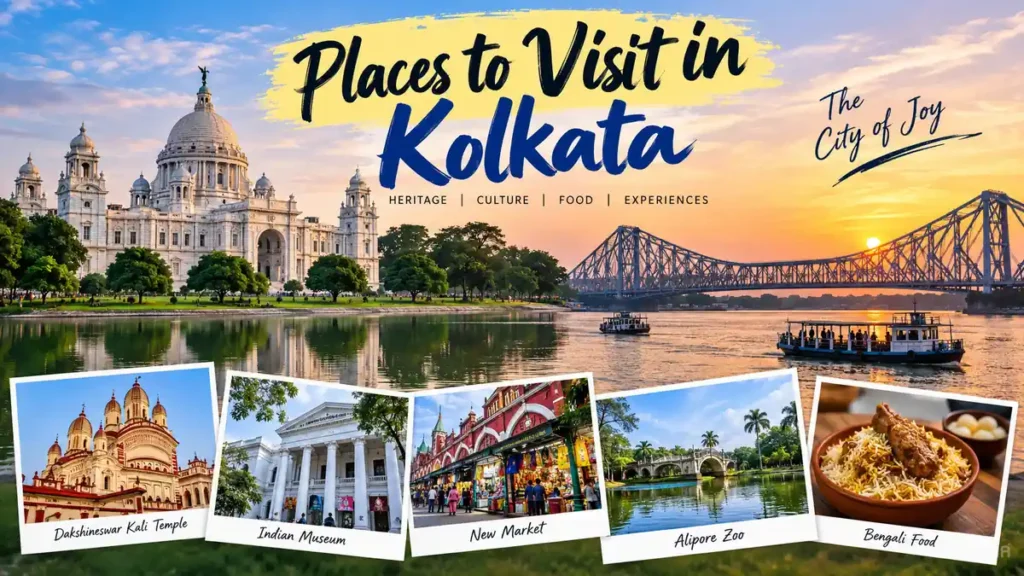
Kolkata is not a city you understand by seeing one monument. Its real character appears gradually—in marble landmarks, old bookshops, crowded flower markets, riverside ghats, historic temples, yellow taxis, colonial streets, and cafés where conversations seem to last forever.
For anyone searching for the best places to visit in kolkata, start with Victoria Memorial, Howrah Bridge, Indian Museum, Prinsep Ghat, Dakshineswar Kali Temple, Belur Math, Park Street, College Street, Kumartuli, and Jorasanko Thakur Bari. Together, these attractions reveal Kolkata’s colonial history, Bengali culture, religious traditions, literary heritage, food, art, and life along the Hooghly River.
Kolkata, the capital of West Bengal, rewards slow exploration. Rather than racing between attractions, choose a neighborhood or theme each day. Spend one morning among museums and colonial buildings, another beside the Hooghly, and leave enough time to wander through North Kolkata’s older neighborhoods.
Best Places to Visit in Kolkata for First-Time Visitors
If your time is limited, prioritize the landmarks that best explain the city’s history and personality.
| Place | Best For | Suggested Time |
|---|---|---|
| Victoria Memorial | History and architecture | 2–3 hours |
| Howrah Bridge | Iconic city views | 30–60 minutes |
| Indian Museum | History and archaeology | 2–4 hours |
| Prinsep Ghat | Riverfront and sunset | 1–2 hours |
| Dakshineswar Kali Temple | Spiritual experience | 1–2 hours |
| Belur Math | Architecture and tranquility | 1–2 hours |
| Park Street | Food and evening atmosphere | 2–3 hours |
| College Street | Books and local culture | 2 hours |
| Kumartuli | Artisans and photography | 1–2 hours |
| Jorasanko Thakur Bari | Bengali literary history | 1–2 hours |
1. Victoria Memorial
The Victoria Memorial is the landmark most closely associated with sightseeing in Kolkata. Constructed between 1906 and 1921, the monumental white-marble building was created in memory of Queen Victoria and today operates as a museum surrounded by extensive gardens. Its collection includes paintings, manuscripts, sculptures, and objects connected with the city’s history and the colonial period.
The museum deserves time, but so do the grounds. The combination of formal gardens, reflecting water, statues, and the enormous marble building makes this one of the city’s most photogenic locations.
Quick takeaway: Visit earlier for a quieter museum experience or later in the afternoon if photography and the gardens are your priorities.
2. Howrah Bridge
Few structures identify a city as instantly as Howrah Bridge identifies Kolkata.
The huge cantilever bridge crosses the Hooghly River between Kolkata and Howrah and stands beside one of India’s busiest urban transport zones. Rather than treating it simply as something to photograph from a distance, walk around the surrounding riverfront to experience the movement of commuters, vendors, ferries, and flower sellers.
Early morning is particularly atmospheric. The city is already active, yet temperatures and traffic can be easier to handle than later in the day.
3. Indian Museum
Founded in 1814, the Indian Museum is one of Kolkata’s essential cultural institutions. Its collections span archaeology, art, anthropology, geology, zoology, fossils, textiles, manuscripts, and natural history. Among the exhibits that have long attracted visitors are Egyptian material, fossils, Buddhist sculpture, miniature paintings, and geological specimens.
Do not schedule it as a quick stop if museums interest you. The collections are broad enough to occupy several hours.
It also fits naturally into a central Kolkata sightseeing day with Victoria Memorial, St. Paul’s Cathedral, the Maidan, and Park Street.
4. Prinsep Ghat
Prinsep Ghat offers a completely different Kolkata experience: open sky, river breezes, boats, and views around the Hooghly waterfront.
Its distinctive monument and location near Vidyasagar Setu make it especially popular around sunset. Morning visits are calmer, while evenings bring couples, families, photographers, walkers, and visitors taking short boat rides. India’s official tourism portal also highlights early morning as a particularly peaceful time around the ghat.
For photographers, try arriving before sunset rather than exactly at sunset. You will have time to explore the promenade before the light changes.
5. St. Paul’s Cathedral
Close to Victoria Memorial stands St. Paul’s Cathedral, completed in 1847 and known for its Gothic architecture.
Its soaring interior provides a peaceful contrast to Kolkata’s busy streets. Because Victoria Memorial, Birla Planetarium, and the cathedral are clustered relatively close together, travelers can combine them instead of repeatedly crossing the city.
Remember that this remains an active place of worship. Dress and behave accordingly, particularly when services are taking place.
Places to Visit in Kolkata for Temples and Spiritual Heritage
Religion is woven deeply into Kolkata’s history. Hindu temples, Christian institutions, monasteries, mosques, synagogues, and Jain places of worship reflect communities that have shaped the city over generations.
6. Dakshineswar Kali Temple
Set beside the Hooghly River, Dakshineswar Kali Temple is one of the most significant religious attractions around Kolkata.
The temple is dedicated to Bhavatarini, a form of Kali, and is closely associated with the spiritual figure Sri Ramakrishna. Its riverside location adds considerably to the experience.
Expect crowds during important religious occasions. A quieter visit gives you more opportunity to appreciate the temple complex rather than concentrating only on the main shrine.
7. Belur Math
Across the river is Belur Math, headquarters of the Ramakrishna Math and Ramakrishna Mission and a major spiritual center associated with the Ramakrishna movement.
The atmosphere differs noticeably from the intensity of many busy urban temples. Open spaces, river views, and restrained architecture encourage visitors to slow down.
A practical sightseeing combination is Dakshineswar followed by Belur Math, allowing the two places to form a single spiritual and riverside itinerary.
8. Kalighat Kali Temple
Kalighat is one of Kolkata’s most famous pilgrimage destinations and an important shrine dedicated to Goddess Kali. Kolkata Municipal Corporation describes Kalighat as a sacred Hindu pilgrimage center connected with the traditional story of Sati.
This is not primarily an architectural sightseeing stop. Its value lies in experiencing a living religious tradition.
The surrounding lanes can become intensely crowded. Keep personal belongings secure, and be cautious when accepting unsolicited assistance from unofficial guides or intermediaries.
9. Mother House
Mother House, associated with Mother Teresa and the Missionaries of Charity, attracts visitors interested in her life and humanitarian work. It provides a quieter, reflective experience compared with the city’s large monuments and busy markets.
Travelers commonly combine it with central Kolkata attractions because it does not require an entire sightseeing day. Tripadvisor’s current Kolkata attractions listing places Mother House among the city’s most highly reviewed landmarks.
Keep the character of the site in mind: this is a religious and contemplative place rather than a conventional tourist attraction.
Places to Visit in Kolkata for Bengali Culture and History
Some of Kolkata’s strongest attractions are not monumental buildings at all. They are neighborhoods and institutions where literature, art, craftsmanship, political history, and everyday life overlap.
10. Jorasanko Thakur Bari
Anyone interested in Bengali literature should make time for Jorasanko Thakur Bari, the ancestral home of Rabindranath Tagore.
The property is associated with Tagore’s life, family, literature, art, and intellectual legacy and now serves as a museum. India’s official tourism portal identifies Jorasanko Thakur Bari as an important place for understanding the Nobel laureate’s life and work.
Knowing a little about Tagore beforehand makes the visit considerably richer. His influence extends beyond poetry into music, education, visual art, philosophy, and Bengali cultural identity.
11. Kumartuli
Kumartuli is one of the most distinctive places to visit in kolkata because you are entering a working artisan neighborhood rather than a purpose-built attraction.
Generations of craftspeople here create clay idols, especially representations of Goddess Durga for Durga Puja. India’s tourism portal specifically recommends Kumartuli for travelers seeking an authentic look at Kolkata’s traditional idol-making culture.
Walk slowly through the narrow lanes and remember that these studios are workplaces.
If you are photographing artisans, ask permission before taking close portraits. During the months leading up to Durga Puja, the neighborhood becomes particularly fascinating as unfinished bamboo-and-clay structures gradually turn into elaborate idols.
12. College Street
College Street—or Boi Para—is Kolkata’s legendary book district.
Rows of booksellers occupy shops and pavement stalls around an area strongly connected with universities, colleges, publishing houses, and Bengali intellectual life. New books sit beside used textbooks, academic works, classics, rare editions, and unexpected finds.
The pleasure here is browsing rather than checking off a monument.
Give yourself enough time to explore the smaller stalls instead of staying only on the main stretch.
13. Indian Coffee House
A College Street visit feels incomplete without stopping at the Indian Coffee House.
The establishment became famous as a meeting place for students, writers, artists, academics, and intellectuals. India’s tourism portal describes the College Street Coffee House as a historic cultural institution associated with discussions and debates across generations.
Come for the atmosphere as much as the coffee.
The experience offers something that monuments cannot: a sense of Kolkata’s long tradition of adda—extended conversation about politics, literature, cinema, society, and almost everything else.
14. Marble Palace
North Kolkata’s Marble Palace offers another window into the city’s nineteenth-century elite history.
The mansion is known for its elaborate interiors, sculptures, artworks, antiques, and distinctive architectural character. It also appears alongside Victoria Memorial and St. Paul’s Cathedral in official tourism material highlighting Kolkata’s historical attractions.
Access arrangements can be more restrictive than at mainstream museums, so verify current visitor requirements before planning your day around it.
15. Netaji Bhawan
Netaji Bhawan is associated with Subhas Chandra Bose and offers context for visitors interested in India’s independence movement.
Rather than presenting Kolkata only through colonial monuments, a visit here introduces the political movements and personalities that challenged colonial rule.
It works especially well for travelers already visiting heritage attractions but wanting a broader understanding of twentieth-century Bengal and Indian nationalism.
Places to Visit in Kolkata for Food, Markets and Local Life
The most memorable Kolkata itinerary usually leaves room for eating and wandering. Bengali cuisine, historic restaurants, markets, tea stalls, bakeries, sweets, and street snacks are part of sightseeing rather than something separate from it.
16. Park Street
Park Street remains one of Kolkata’s best-known dining and entertainment districts.
Historic restaurants, cafés, bakeries, pubs, and newer establishments make it an easy place to spend an evening. Official tourism material describes Park Street as a culinary and nightlife hub, particularly lively after dark.
Christmas and New Year bring especially large crowds and elaborate lighting.
Food traditions associated with Kolkata extend far beyond Park Street, but first-time visitors often appreciate having many well-known options concentrated in one area.
17. New Market
New Market is the place to go when you want organized chaos.
The historic shopping district and surrounding streets offer clothing, accessories, food, flowers, household goods, souvenirs, bakeries, and countless small businesses.
Do not rush through looking only for a particular purchase. Watching negotiations, navigating narrow passages, and stopping for food are part of the experience.
It is also conveniently located for combining with central Kolkata sightseeing.
18. Mullick Ghat Flower Market
Near Howrah Bridge, the flower market around Mullick Ghat produces one of Kolkata’s most vivid street scenes.
Vendors handle enormous quantities of marigolds, roses, garlands, leaves, and other flowers destined for temples, ceremonies, weddings, and everyday religious use.
Come early.
Morning light, fresh deliveries, porters carrying huge bundles of flowers, and Howrah Bridge rising overhead create extraordinary photographic opportunities.
Wear shoes that can handle wet and muddy ground, and remember that this is a working wholesale market rather than a staged tourist attraction.
19. Chinatown
Kolkata’s Chinese community forms an important part of the city’s multicultural history. Exploring the city’s Chinese heritage introduces another layer beyond its Bengali and colonial narratives.
Food is the most accessible entry point for many visitors. Chinese-Indian culinary traditions developed here over generations and became influential far beyond Kolkata.
Early morning food outings have traditionally been associated with the city’s Chinatown experience, although individual vendors and businesses change, so current opening information is worth checking.
Places to Visit in Kolkata with Family and Children
Kolkata has several attractions that work particularly well when traveling with children. Mixing museums with interactive attractions and outdoor spaces prevents a family itinerary from becoming an endless sequence of historical buildings.
20. Science City
Science City is one of the strongest family-oriented attractions in Kolkata and appears among the city’s major attractions on India’s official tourism portal.
Interactive displays and science-focused experiences make complex ideas more approachable for younger visitors. Allow several hours rather than squeezing it between unrelated attractions.
It is especially useful during hot or rainy weather when extended outdoor sightseeing becomes uncomfortable.
21. Birla Planetarium
Located near Victoria Memorial, Birla Planetarium makes an easy addition to a central Kolkata family itinerary.
Its astronomy and space-science presentations use a domed projection environment, with shows traditionally offered in different languages.
Check the current show schedule before arriving because the language and timing of a particular presentation can affect your plans.
22. Alipore Zoological Garden
The Alipore Zoological Garden is a longstanding family attraction and is included among the recognized attractions on Kolkata’s official tourism listings.
Families should plan around the weather. A morning visit is generally more comfortable than walking through large outdoor grounds during the hottest part of the afternoon.
23. Eco Park
For open spaces and a break from Kolkata’s older, denser neighborhoods, head toward Eco Park in New Town.
The modern recreational landscape is better suited to a relaxed family outing than intensive historical sightseeing. Gardens, water, walking areas, and recreational activities make it a useful counterpoint to museums and temples.
Because New Town lies away from many central heritage attractions, combine Eco Park with other sights on the eastern side of the metropolitan area rather than repeatedly traveling back and forth.
24. Maidan
The Maidan is Kolkata’s great urban green space.
Surrounded by major institutions and landmarks, it provides a welcome sense of openness in the heart of a crowded metropolis. Official tourism material highlights the Maidan as one of the city’s important green gathering spaces.
A walk here pairs naturally with Victoria Memorial, St. Paul’s Cathedral, or the surrounding central district.
Unique Places to Visit in Kolkata Beyond the Main Attractions
Once you have covered the famous monuments, Kolkata becomes even more interesting.
25. South Park Street Cemetery
South Park Street Cemetery is a fascinating choice for travelers interested in colonial history and unusual architecture.
Its old tombs and funerary monuments provide a quieter look at the European community that lived in colonial Calcutta. The combination of aging stone, vegetation, inscriptions, and monumental tombs creates an atmosphere unlike Kolkata’s busier heritage attractions.
It is particularly worthwhile if your idea of sightseeing goes beyond famous landmarks.
Explore North Kolkata on Foot
North Kolkata deserves to be treated as an attraction in its own right.
Its lanes preserve old mansions, traditional houses, neighborhood markets, religious buildings, courtyards, workshops, and architectural details easily missed from a car. Official tourism material similarly recommends wandering North Kolkata to understand the city’s historical layers and older neighborhoods.
This is where walking pays off.
Instead of trying to cover enormous distances, select a compact area around Jorasanko, College Street, Kumartuli, or the older neighborhoods and explore slowly.
Ride a Ferry on the Hooghly River
Seeing Kolkata from the water changes your perspective of the city.
A ferry journey lets you observe Howrah Bridge, ghats, riverside buildings, boats, and the constant movement between Kolkata and Howrah. Official tourism guidance also recommends a Hooghly boat experience for views of the waterfront skyline.
It is inexpensive, practical, and often more memorable than a conventional sightseeing ride.
Best Places to Visit in Kolkata in One Day
One day is enough for the highlights, but not enough to understand the entire city.
A practical first-time route is:
- Start early at Howrah Bridge and the flower market.
- Continue to the Indian Museum.
- Visit Victoria Memorial and St. Paul’s Cathedral.
- Walk around the Maidan if weather permits.
- Reach Prinsep Ghat in the late afternoon.
- Finish with dinner around Park Street.
This route concentrates on central and riverfront attractions instead of losing hours traveling between distant parts of the metropolitan area.
If temples matter more than museums, replace the central museum portion with Dakshineswar Kali Temple and Belur Math.
Places to Visit in Kolkata in 2 Days
Two days allow you to balance famous attractions with local culture.
Day 1: Central Kolkata and the River
Begin with Victoria Memorial and St. Paul’s Cathedral. Continue to the Indian Museum, then explore the Maidan before reaching Prinsep Ghat for the evening.
Finish on Park Street.
Day 2: North Kolkata and Spiritual Sites
Start around Howrah Bridge and Mullick Ghat Flower Market. Continue toward Kumartuli and Jorasanko Thakur Bari.
Spend part of the afternoon around College Street and Indian Coffee House, or travel north toward Dakshineswar Kali Temple and Belur Math.
This combination provides a far more representative picture of Kolkata than spending both days visiting museums.
Places to Visit in Kolkata in 3 Days
With three days, sightseeing becomes much more relaxed.
Use the first two days above for Kolkata’s essential landmarks. On day three, choose according to your interests.
Families can spend time at Science City or Eco Park. History enthusiasts can explore Netaji Bhawan, Marble Palace, South Park Street Cemetery, or additional colonial architecture. Food-focused travelers can devote more time to markets, Bengali restaurants, sweets, Chinatown, and neighborhood food walks.
Three days also gives you enough flexibility to return to the Hooghly around sunset without sacrificing another attraction.
What Is the Best Time to Visit Kolkata?
The cooler months are generally the most comfortable for extensive sightseeing. Current travel guidance consistently identifies roughly October through February or March as Kolkata’s main visitor season, when conditions are better suited to walking and outdoor attractions.
Winter is particularly pleasant for heritage walks, markets, riverfront evenings, and long days outdoors.
Kolkata During Durga Puja
Durga Puja deserves separate consideration.
During the festival, Kolkata transforms through elaborate temporary pandals, artistic installations, illuminated streets, processions, food, and enormous crowds. Kumartuli becomes particularly relevant because its artisans produce many of the clay idols used in celebrations.
It can be one of the most culturally rewarding times to visit, but ordinary sightseeing takes more planning because crowds and traffic increase dramatically.
Kolkata During the Monsoon
Rain changes the pace of the city.
If visiting during the wetter months, build flexibility into your schedule. Museums, cafés, bookstores, Science City, and indoor cultural attractions become useful alternatives when heavy rain disrupts outdoor plans.
Avoid creating an itinerary so tight that one downpour ruins the entire day.
How to Get Around Kolkata
Kolkata’s attractions are spread across central Kolkata, North Kolkata, South Kolkata, the riverfront, Howrah, and newer eastern districts such as New Town.
The Kolkata Metro is useful for many journeys, while buses, taxis, app-based cabs, suburban trains, ferries, and auto-rickshaws cover different parts of the metropolitan area.
For visitors, the best strategy is geographic clustering.
Do Victoria Memorial, St. Paul’s Cathedral, the Maidan, and nearby central attractions together. Group Jorasanko, College Street, and North Kolkata separately. Pair Dakshineswar with Belur Math. Leave Eco Park and New Town attractions for another block of time.
This simple approach can save hours.
Practical Tips for Visiting Kolkata
A little planning makes sightseeing significantly easier.
- Start early. Markets, temples, and outdoor photography are often better before the city reaches peak heat and traffic.
- Check official timings before leaving. Museum, temple, planetarium, and heritage-property schedules can change.
- Carry water. Kolkata can be humid even outside peak summer.
- Dress respectfully at religious sites. Follow footwear and photography rules at individual temples and institutions.
- Keep small cash denominations. They can still be useful for local transport and small purchases.
- Use the Metro where practical. Road journeys can take considerably longer during busy periods.
- Ask before photographing people. This matters particularly in Kumartuli, markets, workshops, and religious spaces.
- Leave room for food. Trying Bengali sweets, street snacks, tea, and local meals is part of understanding the city.
- Avoid overplanning. Kolkata is best experienced when you have enough time to notice what happens between major landmarks.
Opening hours and entry arrangements change, so verify them directly with the relevant attraction before visiting rather than relying on an old itinerary.
Which Part of Kolkata Is Best for Tourists?
There is no single neighborhood containing everything.
Central Kolkata works best for first-time sightseeing because Victoria Memorial, the Indian Museum, Maidan, St. Paul’s Cathedral, Park Street, and several heritage areas are relatively accessible from there.
North Kolkata is stronger for traditional neighborhoods, Bengali culture, old architecture, Kumartuli, Jorasanko, and College Street.
The Hooghly riverfront provides Howrah Bridge, ghats, ferries, and some of the city’s most atmospheric views.
New Town and eastern Kolkata are better suited to modern recreational attractions such as Eco Park.
The right base therefore depends on what you want to see, but central Kolkata is usually the simplest starting point for a short first visit.
Why Kolkata Is Worth Exploring Slowly
Kolkata’s biggest mistake, from a visitor’s perspective, is reducing it to Victoria Memorial and Howrah Bridge.
Those landmarks matter, but the city’s identity is equally visible in College Street’s book stalls, Kumartuli’s clay workshops, the conversations at Indian Coffee House, worship beside the Hooghly, Bengali food, North Kolkata’s aging mansions, Park Street after dark, and ferries moving across the river.
The best places to visit in kolkata therefore form more than a checklist. Victoria Memorial introduces the city’s colonial history; Jorasanko reveals its literary legacy; Dakshineswar and Belur Math illuminate its spiritual traditions; Kumartuli shows living craftsmanship; and College Street captures its intellectual personality.
Start with the famous sights, but leave part of your itinerary unscheduled. Walk a neighborhood, take a ferry, browse a bookstall, stop for tea, and watch the city operate around you.
That is usually where Kolkata becomes memorable.