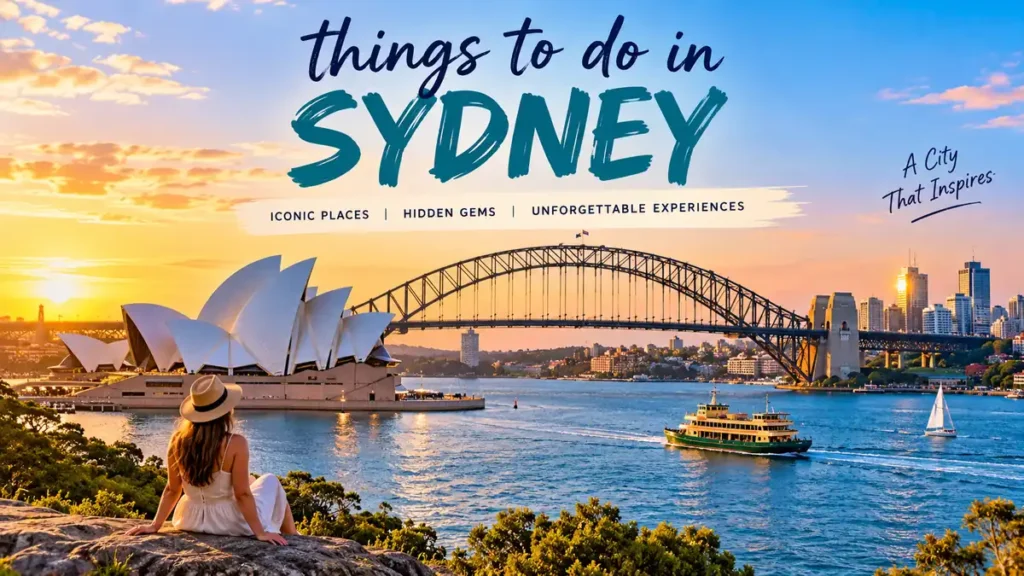
Sydney is one of those cities where the landmarks you have seen countless times in photographs somehow look better in person. The Sydney Opera House and Harbour Bridge dominate the waterfront, but beaches, coastal walks, Aboriginal culture, neighbourhood food scenes, wildlife and national parks are just as important to the experience.
For first-time visitors wondering about the best things to do in sydney, start around Sydney Harbour, explore the Opera House and The Rocks, ride a ferry from Circular Quay, walk the Bondi coastline and spend time in the city’s museums and gardens. Then venture into neighbourhoods such as Surry Hills, Newtown and Manly or take a day trip to the Blue Mountains.
This guide brings those experiences together so you can decide what deserves a place in your itinerary.
Best things to do in sydney for first-time visitors
Sydney rewards slow exploration. Instead of racing between attractions, group your days geographically. Circular Quay, the Opera House, The Rocks, the Royal Botanic Garden and Harbour Bridge fit naturally together, while Bondi and the eastern beaches deserve another day.
Here are the experiences that give you the clearest introduction to the city.
1. See the Sydney Opera House up close
Few buildings are as closely associated with their city as the Sydney Opera House.
Standing at Bennelong Point on Sydney Harbour, the UNESCO World Heritage-listed building is worth seeing from several perspectives. Walk around its exterior to appreciate the tiled shells and harbour setting, then continue toward the Royal Botanic Garden for broader views.
The Opera House is also a working performing-arts venue rather than simply a monument. Official Sydney tourism information notes that it hosts more than 1,600 performances each year.
You can explore the public areas, take an architectural or backstage tour, attend a performance or simply sit by the water.
Best for: architecture, culture and first-time visitors
Allow: 1–3 hours
2. Walk around Circular Quay
Circular Quay is the practical and visual heart of central Sydney. The Opera House lies at one end, The Rocks and Harbour Bridge at the other, while ferries continuously cross the harbour.
It is an excellent starting point because many major attractions are within walking distance.
Come once during daylight and, if possible, return after sunset. Illuminated ferries moving across the water between the Opera House and Harbour Bridge create an entirely different atmosphere.
Circular Quay is also Sydney’s most useful ferry hub, with services connecting visitors to places including Manly, Taronga Zoo and Watsons Bay.
3. Explore The Rocks
Immediately west of Circular Quay, The Rocks reveals an older layer of Sydney.
Sandstone buildings, narrow lanes, historic pubs and harbour views make the district enjoyable without a rigid itinerary. The Rocks Discovery Museum is particularly useful if you want context about the area’s history.
Spend some time away from the main pedestrian routes. Smaller lanes and stairways often reveal details that disappear when you simply walk directly from Circular Quay toward the bridge.
You can comfortably combine The Rocks, Circular Quay and the Opera House in half a day.
4. Experience the Sydney Harbour Bridge
The Sydney Harbour Bridge is Sydney’s second great architectural icon.
You do not need to climb it to appreciate it. Walking across the pedestrian pathway provides impressive views over the harbour and city skyline.
For something more adventurous, BridgeClimb takes visitors high above Sydney Harbour. Tourism Australia describes the summit experience as reaching approximately 134 metres above sea level.
If heights are not your thing, stay at ground level. Some of the most satisfying bridge views are completely free.
5. Wander through the Royal Botanic Garden
Beside the Opera House, the Royal Botanic Garden Sydney offers a remarkably peaceful contrast to the CBD.
Paths wind between lawns, themed gardens and waterfront viewpoints. It is especially useful for travellers trying to balance sightseeing with quieter time outdoors.
Continue toward Mrs Macquarie’s Point for one of the classic perspectives where the Opera House and Harbour Bridge appear together.
Quick takeaway: If you have only one day in central Sydney, combine the Royal Botanic Garden, Opera House, Circular Quay, The Rocks and Harbour Bridge.
Beaches and coastal things to do in sydney
Sydney’s beaches aren’t detached resort areas on the edge of town. They are part of everyday city life.
Bondi receives most of the international attention, but Manly, Coogee, Bronte and numerous smaller beaches make Sydney’s coastline worth exploring beyond a single afternoon.
6. Spend a morning at Bondi Beach
Bondi Beach deserves its fame.
The broad sweep of sand, surf culture and surrounding cafés make it one of the easiest places to experience Sydney’s beach lifestyle.
Early morning is particularly appealing. Walk along the promenade, watch surfers or swim when conditions permit before the busiest part of the day.
Always pay attention to beach conditions and swim between the red-and-yellow flags at patrolled beaches. Ocean conditions can be very different from what they appear to be from shore.
7. Walk from Bondi to Coogee
If you complete only one long walk in Sydney, make it the Bondi to Coogee coastal walk.
The route follows dramatic sandstone cliffs and passes beaches and bays including Tamarama, Bronte and Clovelly before reaching Coogee.
Rather than treating it as exercise to finish quickly, allow time for swimming, photographs and stops along the way.
Good walking shoes, water and sun protection make the experience considerably more comfortable, particularly on warm days.
8. Take the ferry to Manly
The journey is part of the attraction.
Ferries departing Circular Quay cross Sydney Harbour before reaching Manly Beach. Tourism Australia specifically highlights the Circular Quay-to-Manly journey for its views of the Opera House, Harbour Bridge and skyline.
Once there, walk through The Corso to Manly Beach, explore the waterfront or continue toward Shelly Beach.
For travellers trying to choose between Bondi and Manly, there is no universal winner. Bondi pairs beautifully with the eastern coastal walk; Manly provides the added pleasure of a harbour ferry journey.
9. Discover Sydney’s ocean pools
Ocean pools are an underrated part of Sydney’s coastal identity.
These seawater swimming pools sit beside the ocean, providing a distinctive alternative to swimming directly in the surf. You’ll find them along various parts of Sydney’s coastline, including around Bondi and the Northern Beaches.
They are especially photogenic when waves break against their outer edges, although conditions should always be respected.
10. Visit Watsons Bay
Watsons Bay provides another reason to use Sydney’s ferry network.
The harbour-side suburb feels noticeably removed from the CBD despite being easily accessible from central Sydney. Walk around the waterfront, explore nearby coastal viewpoints and enjoy views toward the city.
It’s a good alternative for visitors who want coastal scenery without committing most of a day to Bondi or Manly.
Explore Sydney’s museums, galleries and Aboriginal culture
Sydney makes more sense when you look beyond its postcard landmarks.
The city’s cultural attractions introduce Aboriginal history and contemporary culture, Australian and international art, colonial history, migration and Sydney’s relationship with the sea.
11. Visit the Art Gallery of New South Wales
Art Gallery of New South Wales sits close to the Royal Botanic Garden, making it easy to combine culture and outdoor sightseeing.
Its collections span Australian, Aboriginal and Torres Strait Islander, Asian, European and contemporary art.
It is particularly valuable on a rainy or very hot afternoon, but don’t treat it merely as a weather backup. Give yourself enough time to explore rather than rushing through on the way to another landmark.
12. Explore the Museum of Contemporary Art Australia
At Circular Quay, the Museum of Contemporary Art Australia provides contemporary art within one of Sydney’s busiest sightseeing districts.
Its location makes it particularly convenient. You can move from the Opera House through Circular Quay to the museum and then continue into The Rocks.
Sydney’s official tourism site identifies both the MCA and Art Gallery of NSW among the city’s major cultural experiences.
13. Learn about Aboriginal Sydney
Sydney stands on Country with tens of thousands of years of Aboriginal history.
The area around Sydney Cove and Circular Quay is known as Warrane, while central Sydney sits on Gadigal Country, part of the wider Eora Nation. Tourism Australia highlights Aboriginal cultural tours, exhibitions, sacred places and storytelling as important ways to understand the city.
A First Nations-led walking or cultural experience can completely change how you interpret familiar places.
Instead of viewing the harbour purely through colonial history, you begin to understand its much older cultural landscape.
14. Step inside Hyde Park Barracks
Hyde Park Barracks is a UNESCO World Heritage-listed Australian Convict Site in the city centre.
It provides useful historical context for travellers interested in colonial Sydney and convict history. Sydney’s official tourism guide specifically highlights the barracks among the CBD’s significant heritage attractions.
Combine it with nearby Hyde Park, St Mary’s Cathedral and the Australian Museum for a history-focused afternoon.
15. Visit the Australian Museum
The Australian Museum is particularly strong for natural history and Australian biodiversity.
Families can easily spend several hours here, although adults interested in science, nature and cultural collections will find plenty to explore too.
It’s another useful indoor option when Sydney’s weather disrupts outdoor plans.
Free things to do in Sydney
Sydney has a reputation for being expensive, but many of its defining experiences cost nothing.
That matters because the city’s greatest asset—its landscape—is largely accessible on foot.
16. Walk through Hyde Park
Hyde Park provides a green corridor through the CBD and makes a convenient pause between attractions.
The Archibald Fountain, tree-lined paths and ANZAC Memorial give the park more substance than a simple patch of grass.
It connects naturally with St Mary’s Cathedral, the Australian Museum and central shopping streets.
17. See the harbour from Mrs Macquarie’s Point
For a classic Sydney photograph, walk through the Royal Botanic Garden toward Mrs Macquarie’s Point.
From this side of the harbour, the Opera House can be framed against the Harbour Bridge.
Sunset is popular, but morning often gives you more breathing room.
18. Explore Barangaroo Reserve
Barangaroo has transformed a former industrial waterfront into one of central Sydney’s most interesting modern precincts.
Walk the foreshore, explore Barangaroo Reserve and continue toward Walsh Bay or Darling Harbour.
Tourism Australia describes Barangaroo as a revitalised former container-terminal area that now combines waterfront public space with dining and other experiences.
19. Walk across the Harbour Bridge
BridgeClimb costs money; crossing the bridge on foot doesn’t.
The pedestrian route gives you elevated harbour views and takes you toward Milsons Point and North Sydney.
Combine the crossing with Luna Park or return by ferry for a simple half-day harbour circuit.
20. Browse Sydney’s markets
Markets offer an easy glimpse into neighbourhood life.
Depending on the day, you’ll encounter fresh produce, vintage clothing, crafts, street food and independent designers across different parts of the city.
Check current schedules before travelling specifically for a market, because operating days and hours can change.
Things to do in Sydney with kids
Families don’t have to choose between attractions designed solely for children and sightseeing that adults actually want to do.
Several of Sydney’s major experiences work for both.
21. Visit Taronga Zoo Sydney
Few zoos have a setting comparable to Taronga Zoo Sydney.
The ferry ride from Circular Quay already makes the outing memorable, and parts of the zoo provide expansive harbour and skyline views.
Tourism Australia says the zoo houses more than 4,000 native and exotic animals.
Allow most of a day if you’re visiting with children rather than squeezing it between other attractions.
22. Explore Darling Harbour
Darling Harbour concentrates several family attractions within a walkable waterfront district.
SEA LIFE Sydney Aquarium and WILD LIFE Sydney Zoo are among the best-known options, and Sydney’s official tourism information highlights both as major Darling Harbour attractions.
The Australian National Maritime Museum is another worthwhile choice, particularly for children interested in ships and maritime history.
23. Have fun at Luna Park Sydney
Across the harbour at Milsons Point, Luna Park Sydney is immediately recognisable from its giant entrance face.
The amusement park can be combined with a Harbour Bridge walk or ferry journey, creating a straightforward family day without travelling far from central Sydney.
Even visitors who don’t plan on rides may enjoy the waterfront setting and views back toward the city.
Sydney neighbourhoods worth exploring
The CBD contains many headline attractions, but Sydney’s personality becomes clearer when you explore its neighbourhoods.
24. Eat and wander around Surry Hills
Surry Hills is an easy choice for cafés, restaurants, pubs and independent shops.
Instead of arriving with a checklist of individual venues, leave enough time to walk around. Crown Street and surrounding streets provide a useful starting point before you explore the quieter side streets.
It’s particularly enjoyable around brunch or dinner.
25. Experience Newtown and the Inner West
Newtown presents a different version of Sydney from Circular Quay.
King Street is lined with restaurants, bars, live-music venues and independent shops, while the surrounding Inner West has strong multicultural food and craft-beer scenes.
The contrast is useful: spend your first day seeing Sydney’s icons, then visit Newtown when you want something more neighbourhood-oriented.
Explore Chinatown and Haymarket
Sydney’s multicultural character is especially visible around Chinatown and Haymarket.
Come hungry. Dumplings, noodles, desserts, Asian supermarkets and restaurants covering numerous regional cuisines make food the obvious reason to explore.
Sydney’s official visitor guide specifically recommends eating through Chinatown as one of the city’s characteristic experiences.
Outdoor adventures and nature around Sydney
Sydney’s unusual advantage is how quickly dense urban neighbourhoods give way to beaches, bushland and national parks.
You can spend the morning inside an art gallery and the afternoon hiking beside the Pacific.
Walk the Manly Scenic Walkway
If the Bondi-to-Coogee route is Sydney’s famous coastal walk, the Manly Scenic Walkway provides an excellent harbour-side alternative.
The longer Spit-to-Manly route covers roughly 10 kilometres through bushland, beaches and viewpoints.
Carry water and allow several hours rather than treating it as a short stroll.
Explore Cockatoo Island / Wareamah
Cockatoo Island / Wareamah offers heritage, industrial architecture and harbour scenery on one island.
Its layers of Aboriginal, convict and maritime history make it far more than a scenic ferry destination.
It’s particularly appealing for repeat visitors who have already covered Sydney’s most obvious landmarks.
Visit Royal National Park
South of the city, Royal National Park brings beaches, bushwalking and rainforest landscapes within reach of Sydney.
Sydney’s official tourism site describes it as Australia’s oldest national park and highlights access via Cronulla and Bundeena for exploring the area’s wilderness and Aboriginal heritage.
It deserves a substantial part of the day rather than being treated as a quick detour.
Best day trips from Sydney
If your visit lasts four days or longer, consider spending at least one day outside the city.
Sydney sits within easy reach of mountains, national parks, beaches and historic communities.
Take a Blue Mountains day trip
The Blue Mountains National Park is the classic Sydney day trip.
Expect sandstone cliffs, eucalyptus forests, valleys, waterfalls and expansive viewpoints. Tourism Australia places the World Heritage-listed Blue Mountains less than two hours from Sydney.
Katoomba makes a practical base for exploring famous viewpoints including the Three Sisters.
For a day trip, don’t overload your schedule with too many separate stops. A good walk and several well-chosen viewpoints usually create a better experience than constantly moving between attractions.
Visit Parramatta
Parramatta combines colonial heritage, multicultural food and riverside spaces west of central Sydney.
It can be reached by public transport, including ferry services, making the journey itself part of the experience.
For travellers with several days in Sydney, Parramatta also demonstrates just how geographically and culturally broad the metropolitan area really is.
Explore the Northern Beaches
Beyond Manly, Sydney’s Northern Beaches continue through coastal suburbs toward Palm Beach.
This is a worthwhile full-day excursion if beaches are a priority. Rather than hopping between every possible stop, choose two or three beaches and give yourself time to enjoy them.
Things to do in Sydney at night
Sydney doesn’t shut down when sightseeing hours end.
The harbour is arguably at its most impressive after dark, when the Opera House, bridge and skyline illuminate the waterfront.
Start with an evening walk around Circular Quay. From there, you could see a performance at the Opera House, catch live music, explore small bars or head toward neighbourhoods such as Surry Hills and Darlinghurst.
Sydney’s official visitor site recommends live performances, gigs, pubs and clubs among the city’s nighttime options.
Darling Harbour and Barangaroo are convenient if you want waterfront surroundings, while Newtown and the Inner West offer a more neighbourhood-focused evening.
Seasonal experiences in Sydney
Some of the best Sydney experiences depend on when you visit.
Whale watching
Whales migrate along the New South Wales coastline during part of the year. Sydney’s tourism authority identifies May to November as the city’s whale-watching season.
Coastal lookouts can provide opportunities to spot whales from land, while cruises offer another perspective.
Vivid Sydney
During the cooler part of the year, Vivid Sydney transforms major buildings and public spaces with light installations, performances and cultural programming.
The exact program and dates vary, so check the current event schedule before planning a trip specifically around it.
Sydney Fringe Festival
Visitors arriving in September can encounter Sydney Fringe Festival performances across the city. In 2026, the official Sydney events calendar lists the festival from September 1–30.
New Year’s Eve
Sydney Harbour’s New Year’s Eve fireworks are among the city’s most famous annual spectacles.
Demand for prime viewing areas can be intense, so anyone visiting specifically for New Year’s Eve should research access arrangements well in advance rather than assuming they can simply arrive at Circular Quay shortly before midnight.
How many days do you need in Sydney?
Three days is enough for the highlights, while four to five days gives you a much better balance of landmarks, beaches, neighbourhoods and a day trip.
A practical first visit might look like this:
| Day | Suggested focus |
|---|---|
| Day 1 | Opera House, Royal Botanic Garden, Circular Quay, The Rocks, Harbour Bridge |
| Day 2 | Bondi Beach, Bondi-to-Coogee walk, eastern suburbs |
| Day 3 | Manly ferry, Manly Beach, harbour sightseeing |
| Day 4 | Museums, Aboriginal cultural experience, Surry Hills or Newtown |
| Day 5 | Blue Mountains or Royal National Park |
With only one day, stay around the harbour rather than wasting time crossing the city repeatedly.
What are the best things to do in Sydney for free?
Some of Sydney’s strongest experiences require no admission ticket.
Walk around Circular Quay and the Opera House, cross the Harbour Bridge, explore the Royal Botanic Garden and Hyde Park, visit beaches, complete part of the Bondi-to-Coogee walk and watch the sunset from the harbour foreshore.
Several museums and galleries also offer free access to parts of their collections, although special exhibitions may require tickets.
The trick to seeing Sydney inexpensively is to spend money selectively. Pay for the experiences that genuinely add something—perhaps a performance, cultural tour or major attraction—while using beaches, walks, gardens and public spaces to fill the rest of your itinerary.
Getting around Sydney efficiently
Sydney is large, so efficient sightseeing depends on grouping attractions rather than simply following a ranked list.
Public transport includes trains, buses, light rail and ferries. Ferries are particularly useful because they function as both transportation and sightseeing.
Circular Quay is the key harbour transport hub. From here you can reach destinations including Manly, Taronga Zoo and Watsons Bay.
Walking works well around central districts, particularly the Opera House, The Rocks, Barangaroo, Hyde Park and the Royal Botanic Garden.
For Bondi and other locations farther from the CBD, public transport usually makes more sense.
Check current Transport for NSW journey information, service changes and fares before travelling because schedules and arrangements can change.
When is the best time to visit Sydney?
There isn’t a single bad season for sightseeing, but the experience changes throughout the year.
Spring brings comfortable conditions for walking and gardens, along with Sydney’s famous jacaranda displays.
Summer is the obvious season for beaches, swimming and long evenings, but popular coastal areas become busier and hot days can make exposed walks tiring.
Autumn often suits travellers who want outdoor sightseeing without peak summer conditions.
Winter can still work extremely well for city exploration, museums, coastal walking and seasonal events. It’s also part of the whale-watching period.
Whatever the season, Sydney’s outdoor lifestyle means sun protection matters. Carry water, use sunscreen and take exposed coastal routes seriously during hot weather.
Practical tips for seeing Sydney
A few choices make a surprisingly large difference.
Wear comfortable shoes because central Sydney involves more walking and hills than many first-time visitors expect. Carry sun protection even when you’re not planning a beach day.
Don’t build an itinerary entirely around the CBD. Sydney Harbour is spectacular, but Bondi, Manly, Newtown, Surry Hills and the national parks show different sides of the city.
Use ferries whenever the route makes sense. A normal journey across Sydney Harbour can double as one of the most memorable sightseeing experiences of the trip.
Most importantly, leave empty space in your itinerary. Sydney is particularly good at unplanned detours—a beach swim that lasts longer than expected, a harbour walk at sunset or a neighbourhood café you hadn’t intended to visit.
Making the most of the best things to do in sydney
The essential things to do in sydney aren’t limited to checking the Opera House, Harbour Bridge and Bondi Beach off a list. Those icons deserve their reputation, but the city becomes far more interesting when you connect them with ferry journeys, coastal walks, Aboriginal culture, neighbourhoods, museums and surrounding wilderness.
For a first trip, begin with Sydney Harbour, dedicate another day to the coast and use your remaining time to explore beyond the postcard sights. If you have four or five days, add Manly, local neighbourhoods and a Blue Mountains or Royal National Park day trip.
Sydney works best when you experience the city and its landscape together—and give yourself enough time to enjoy both.