Paris can overwhelm a first-time visitor for one simple reason: there is far more to see than anyone can fit into one trip. Between world-famous museums, Gothic churches, neighborhood markets, gardens, cafés, monuments, and the Seine, deciding what deserves your time is harder than finding something interesting.
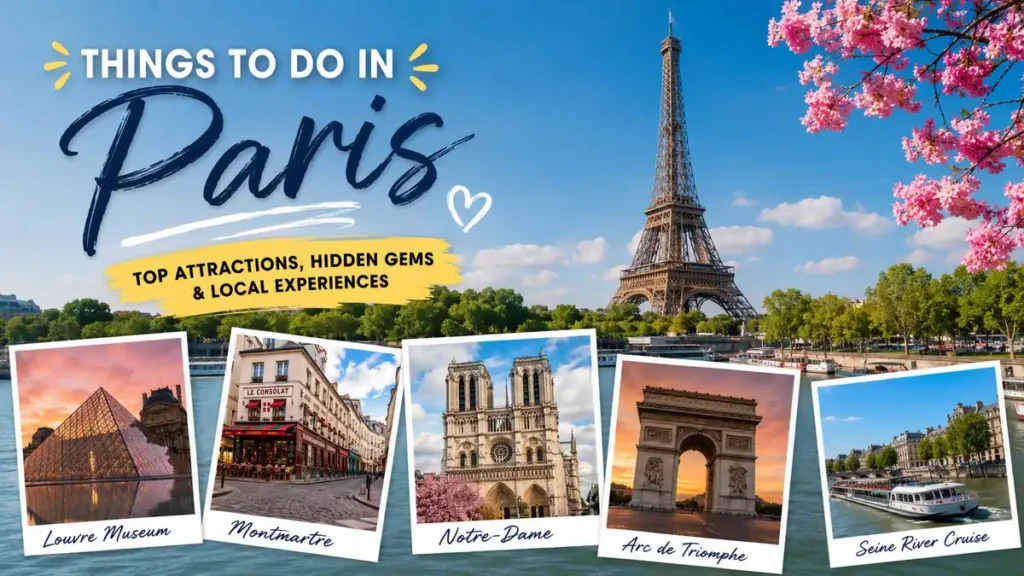
The best things to do in paris combine major landmarks such as the Eiffel Tower, Louvre Museum, Notre-Dame Cathedral, and Arc de Triomphe with slower experiences: walking through Montmartre and Le Marais, relaxing in the Luxembourg Gardens, exploring food markets, seeing Impressionist art, and spending an evening beside the Seine. Three to five days gives most first-time visitors a useful introduction to the city.
1. Start With the Eiffel Tower
Eiffel Tower is the obvious place to begin, but that does not make it overrated.
Built for the 1889 Exposition Universelle, Gustave Eiffel’s iron tower became the defining symbol of Paris despite attracting plenty of criticism when it was new. Today, the experience changes depending on where you see it.
Going up the tower gives you a broad view across the city, but some of the best photographs actually come from the ground.
Try several perspectives:
- Trocadéro for the classic frontal view
- Champ de Mars for a close-up perspective
- Pont de Bir-Hakeim for tower-and-Seine compositions
- Rue de l’Université for a street-level photograph
- A Seine cruise for views from the water
If going to the summit matters to you, treat it as a planned attraction rather than something to squeeze spontaneously between other stops.
Quick takeaway: See the tower twice if possible—once during daylight and again after dark. The atmosphere feels completely different.
2. Explore the Louvre Without Trying to See Everything
Louvre Museum is enormous, and trying to “complete” it is one of the easiest ways to turn a great museum into an exhausting afternoon.
Instead, choose several collections or masterpieces beforehand.
The Mona Lisa by Leonardo da Vinci is the most famous stop, but don’t make it your entire Louvre experience. Look for the Venus de Milo, Winged Victory of Samothrace, French paintings, Egyptian antiquities, decorative arts, and the architecture of the former royal palace itself.
A focused visit of two or three hours usually works better for first-time visitors than wandering until museum fatigue sets in.
The surrounding area deserves time too. Walk through the Cour Carrée and beneath I. M. Pei’s glass pyramid before continuing toward the Tuileries Garden.
3. Step Inside the Restored Notre-Dame Cathedral
Notre-Dame Cathedral belongs near the top of a modern Paris itinerary again.
Following the devastating April 2019 fire and more than five years of restoration, the cathedral formally reopened in December 2024.
That makes a visit particularly meaningful now.
Inside, notice the soaring Gothic nave, ribbed vaults, stained glass, religious artwork, and restored stonework. Then walk around Île de la Cité to appreciate the exterior architecture and the cathedral’s relationship with the Seine.
Notre-Dame is an active place of worship rather than simply another tourist attraction, so visitors should dress and behave accordingly.
Afterward, cross toward Île Saint-Louis for a quieter riverside walk.
4. See Sainte-Chapelle’s Extraordinary Stained Glass
A short walk from Notre-Dame brings you to Sainte-Chapelle.
The 13th-century royal chapel is much smaller than Notre-Dame, yet its upper chapel can produce an even stronger first impression.
Tall stained-glass windows seem to replace much of the surrounding wall. Biblical scenes cover the panels in extraordinary detail, creating one of Europe’s great examples of Rayonnant Gothic architecture.
Sunny weather helps illuminate the glass, although the chapel remains worth visiting in less-than-perfect conditions.
Pairing Sainte-Chapelle, Notre-Dame, and Île de la Cité makes geographical sense because all three can be explored without wasting time crossing Paris.
5. Walk Along the Seine
Some of the most memorable things to do in paris cost nothing.
Walking beside the Seine lets you experience the city without constantly moving between attractions.
The river connects many major sights, including Notre-Dame, the Louvre, Musée d’Orsay, Place de la Concorde, and the Eiffel Tower. Historic bridges and the traditional green stalls of the bouquinistes add character along the way.
A particularly pleasant route runs through central Paris around Île de la Cité and continues west toward the Louvre and Tuileries.
Don’t rush it.
Stop on a bridge. Browse old books and prints. Sit on the embankment. Watch boats pass.
This kind of unstructured time is part of experiencing Paris rather than time lost between attractions.
6. Take a Seine River Cruise
Walking gives you one perspective; a river cruise gives you another.
From the boat, the city’s monuments appear as part of a continuous historic landscape rather than separate attractions on a checklist.
Typical sightseeing routes provide views of landmarks such as the Eiffel Tower, Musée d’Orsay, Louvre, Notre-Dame, and several historic bridges.
For a first trip, sunset is particularly appealing because you begin with daylight and gradually watch the city illuminate.
You don’t necessarily need an elaborate dinner cruise. A straightforward sightseeing cruise can provide the same architectural perspective while leaving dinner free for a neighborhood restaurant.
7. Discover Impressionist Art at Musée d’Orsay
If you enjoy 19th-century art, Musée d’Orsay may become your favorite museum in Paris.
The museum occupies the former Gare d’Orsay railway station, making the building almost as memorable as the collection.
Its strengths include Impressionist and Post-Impressionist art associated with artists such as Claude Monet, Pierre-Auguste Renoir, Edgar Degas, Vincent van Gogh, Paul Cézanne, and Édouard Manet.
Compared with the Louvre, the collection can feel easier to navigate during a relatively short visit.
If you only have time for two major Paris museums, the Louvre and Musée d’Orsay create an excellent pairing: one provides a vast journey through art history while the other gives you a more concentrated look at the 19th and early 20th centuries.
8. Wander Through Montmartre
Montmartre rewards walking without a rigid route.
This hilltop neighborhood in the 18th arrondissement has long associations with artists, cabarets, studios, cafés, and bohemian Paris.
The obvious destination is Sacré-Cœur Basilica, but Montmartre is more enjoyable when the basilica is treated as one part of the neighborhood rather than the whole attraction.
Explore side streets around the hill, Place du Tertre, old stairways, small squares, and quieter residential lanes.
Visit early in the morning if you want the atmospheric streets without peak crowds.
9. Climb the Arc de Triomphe
Arc de Triomphe provides one of the best elevated views in Paris.
Unlike the Eiffel Tower, the panorama from here includes the Eiffel Tower itself.
The monument stands at the center of Place Charles de Gaulle, where avenues radiate outward in a dramatic geometric pattern. From the terrace, you can clearly understand the city’s grand urban planning and see the Champs-Élysées stretching toward Place de la Concorde.
At ground level, the Tomb of the Unknown Soldier and its eternal flame commemorate French soldiers who died in war.
Never attempt to cross the traffic circle directly. Use the designated pedestrian passage.
10. Walk the Champs-Élysées—But Know What to Expect
Avenue des Champs-Élysées is historically important and worth seeing, particularly as part of the route between the Arc de Triomphe and Place de la Concorde.
But travelers expecting the most intimate or romantic street in Paris may be surprised.
Today it is a broad commercial avenue filled with major brands, restaurants, cinemas, and heavy visitor traffic.
Walk it for the scale and urban perspective rather than expecting a quiet neighborhood experience.
For atmospheric streets, spend more time in Saint-Germain-des-Prés, Montmartre, the Latin Quarter, or Le Marais.
11. Slow Down in the Luxembourg Gardens
Luxembourg Gardens demonstrates why Parisian gardens are attractions in their own right.
Created around the Luxembourg Palace, the garden combines formal landscaping, statues, fountains, lawns, tree-lined paths, and the famous green chairs that visitors move into their preferred sunny—or shady—position.
This is an ideal place to deliberately do very little.
Bring something from a nearby bakery, find a chair, and rest between museum visits.
The Medici Fountain is worth seeking out, especially when the central areas feel busy.
12. Explore Le Marais
Le Marais combines several versions of Paris within a relatively compact neighborhood.
You’ll find historic mansions, Jewish heritage, museums, galleries, boutiques, cafés, restaurants, and some of the city’s liveliest streets.
Start around Place des Vosges, one of Paris’s most elegant historic squares.
Then explore rather than following one rigid route.
Rue des Rosiers takes you through the historic Jewish Quarter, while surrounding streets reveal everything from fashion stores to courtyards and small museums.
The neighborhood also contains Musée Carnavalet, which is particularly useful for travelers interested in the history of Paris itself.
13. Eat Your Way Through a Paris Market
Food markets reveal everyday Paris in a way that landmark restaurants sometimes cannot.
One of the best-known is Marché des Enfants Rouges, a historic covered market in the Marais.
Another option is the market on Boulevard Raspail, particularly its organic market.
Browse seasonal produce, cheeses, breads, prepared foods, flowers, and other local products rather than treating the visit simply as a place to grab lunch.
Paris has nearly 100 markets, according to Condé Nast Traveller, making market browsing a genuine part of the city’s food culture rather than a niche tourist activity.
14. Experience Parisian Café Culture
You don’t need a famous café to enjoy café culture.
In fact, one of the better experiences is simply choosing a neighborhood café with outdoor seating and staying longer than strictly necessary.
Order coffee, breakfast, or an afternoon drink and watch the street.
Historic names such as Café de Flore and Les Deux Magots in Saint-Germain-des-Prés attract visitors partly because of their associations with writers and intellectuals. They can be interesting for that history, but ordinary neighborhood cafés often provide a more relaxed experience.
The point isn’t checking off a particular establishment. It is adopting the pace.
15. Taste Classic Paris Foods
Paris sightseeing becomes considerably better when meals are treated as part of the itinerary.
Foods worth trying include:
- A fresh croissant or pain au chocolat
- Baguette or jambon-beurre
- French cheeses
- Crêpes
- Steak-frites
- Onion soup
- Duck confit
- Macarons
- Paris-Brest
- Seasonal pastries from neighborhood pâtisseries
You don’t need Michelin-starred dining to eat well.
A good boulangerie breakfast, market lunch, and neighborhood bistro dinner can reveal more about everyday French food culture than constantly chasing famous restaurants.
16. Walk Through the Latin Quarter
The Latin Quarter is one of the best areas for combining history with aimless exploration.
Its intellectual identity developed around the Sorbonne and other educational institutions, while the neighborhood’s narrow streets preserve a different scale from Paris’s grand boulevards.
Visit bookshops, explore streets around the Sorbonne, stop near Place de la Contrescarpe, and continue toward the Panthéon.
The neighborhood is also home to Panthéon, where major French figures including Victor Hugo, Voltaire, Marie Curie, and Alexandre Dumas are commemorated or interred.
17. Browse Shakespeare and Company
Across the Seine from Notre-Dame stands Shakespeare and Company.
The English-language bookstore has become a literary landmark in its own right.
Book lovers can browse shelves packed into small rooms and explore the store’s connection with generations of writers and travelers.
Because it sits beside the Latin Quarter and Île de la Cité, it is easy to include without designing an entire afternoon around it.
18. Visit Père Lachaise Cemetery
A cemetery might sound like an unusual recommendation, but Père Lachaise Cemetery is simultaneously a historic site, landscaped space, sculpture collection, and place of remembrance.
Among the famous people buried here are Oscar Wilde, Jim Morrison, Édith Piaf, Frédéric Chopin, and Marcel Proust.
Allow time to wander rather than moving directly between celebrity graves.
Its cobbled lanes, trees, monuments, mausoleums, and sculptures create an atmosphere unlike almost anywhere else in Paris.
19. Explore the Paris Catacombs
For something completely different, descend beneath the city into Catacombs of Paris.
The official visitor route passes through former quarry tunnels containing the remains of millions of Parisians, transferred underground when overcrowded cemeteries created serious public-health problems in the late 18th century.
The experience is fascinating but intentionally somber.
Expect stairs, confined underground passages, uneven surfaces, and cooler temperatures.
Anyone uncomfortable with enclosed spaces or human remains may prefer another historic attraction.
20. Discover the Covered Passages
Paris’s passages couverts offer a quieter architectural experience.
These glass-roofed shopping galleries flourished during the 18th and 19th centuries and preserve traces of Paris before modern department stores transformed retail.
Passage des Panoramas, Galerie Vivienne, and Passage Jouffroy are useful starting points.
Look for mosaic floors, old storefronts, book dealers, cafés, stamp shops, and decorative glass roofs.
Because several passages sit relatively close together, they work particularly well on a rainy afternoon.
21. Visit Paris’s Parks Beyond the Famous Gardens
The Tuileries and Luxembourg Gardens deserve their popularity, but Paris has far more green space.
Condé Nast Traveller notes that the city contains more than 400 parks.
Parc des Buttes-Chaumont feels very different from the formal central gardens. Its hills, lake, bridges, cliffs, and elevated viewpoints create a more dramatic landscape.
Other worthwhile green spaces include Parc Monceau, Parc de la Villette, Bois de Boulogne, and Coulée Verte René-Dumont.
The latter is an elevated linear park created along a former railway route and makes an interesting alternative to conventional sightseeing.
22. See Contemporary Art—But Remember the Pompidou Closure
Travel guides written before late 2025 can now create confusion around one major Paris attraction.
The historic Centre Pompidou building closed in autumn 2025 as part of a major transformation and is expected to reopen in 2030. Renovation work began in early 2026.
So don’t build a 2026 itinerary around visiting the traditional Beaubourg museum galleries.
Contemporary-art fans still have strong alternatives.
Fondation Louis Vuitton sits in the Bois de Boulogne in a striking Frank Gehry-designed building and hosts major contemporary exhibitions.
The Palais de Tokyo and Bourse de Commerce – Pinault Collection offer other options depending on current exhibitions.
23. Find Free Things to Do in Paris
Paris can become expensive quickly, but an excellent itinerary does not need to consist entirely of paid attractions.
Some of the best free things to do include walking along the Seine, exploring Montmartre, wandering Le Marais, browsing markets, enjoying parks, photographing the Eiffel Tower from public viewpoints, and walking through historic neighborhoods.
Permanent collections at some city museums, including Musée Carnavalet and the Petit Palais, can also provide excellent cultural experiences without the admission cost associated with major national museums.
Window-shopping, neighborhood wandering, and flânerie—the pleasure of walking and observing without a rigid purpose—are especially suited to Paris. Condé Nast Traveller highlights both the city’s parks and free museums among its best budget experiences.
Can You Visit Paris on a Budget?
Yes, provided you don’t equate sightseeing with buying an admission ticket every few hours.
Plan one major paid attraction each day and build the rest of the itinerary around neighborhoods, parks, churches, markets, viewpoints, and walks.
It usually produces a better-paced trip as well as a cheaper one.
24. Experience Paris at Night
Paris deserves at least one evening without an early return to the hotel.
Start beside the Seine around sunset, then watch the city lights appear.
One particularly memorable low-cost experience is riding Métro Line 6 across the elevated section between Bir-Hakeim and Passy, which provides a brief but striking Eiffel Tower view. Condé Nast Traveller recommends the route among its nighttime Paris experiences.
Other options include:
- An evening Seine cruise
- A late museum opening
- A jazz club
- A neighborhood wine bar
- An evening walk around Saint-Germain-des-Prés
- A cabaret performance
- Illuminated monuments and bridges
Some major museums offer late opening on particular weekdays, but schedules change. Check the institution’s current calendar rather than planning around old guidebook hours.
25. Take a Day Trip to Versailles
If you have four or more days in the region, Palace of Versailles is the classic day trip.
The former royal residence associated particularly with Louis XIV demonstrates the scale and ceremony of the French monarchy before the Revolution.
Inside, the Hall of Mirrors is the star attraction, but the palace is only part of the experience.
The formal gardens, fountains, Grand Trianon, Petit Trianon, and Marie Antoinette’s Estate can turn Versailles into a full-day excursion.
Trying to combine it with several major Paris attractions on the same day usually creates unnecessary rushing.
Best Things to Do in Paris for First-Time Visitors
If you only have a few days, prioritization matters more than collecting the longest possible attraction list.
For a first visit, these ten experiences provide an excellent introduction:
- See the Eiffel Tower
- Visit the Louvre Museum
- Explore Notre-Dame and Île de la Cité
- Walk along the Seine
- Visit Musée d’Orsay
- Wander Montmartre
- Explore Le Marais
- Relax in Luxembourg Gardens
- See Paris from the Arc de Triomphe
- Spend an evening walking or cruising beside the Seine
These cover art, architecture, history, neighborhoods, food culture, public spaces, and city views without turning the trip into a race.
How Many Days Do You Need in Paris?
Three days is enough for a focused introduction. Four or five days is more comfortable for a first trip, particularly if you enjoy museums and neighborhood exploration. Condé Nast Traveller similarly recommends roughly three to five days for experiencing the city.
With three days, concentrate on central Paris.
A sensible structure might look like this:
| Day | Main Area | Good Experiences |
|---|---|---|
| 1 | Seine & historic center | Notre-Dame, Sainte-Chapelle, Latin Quarter, Louvre area |
| 2 | West Paris | Eiffel Tower, Musée d’Orsay, Champs-Élysées, Arc de Triomphe |
| 3 | Neighborhoods | Montmartre, Le Marais, markets, café time |
| 4 | Deeper Paris | Catacombs, parks, covered passages, museums |
| 5 | Day trip | Versailles or another excursion |
Most major first-time sights lie close to the Seine and within the central arrondissements, which makes geographical grouping far more efficient than jumping repeatedly from one side of Paris to another.
What Are the Best Things to Do in Paris With Kids?
Paris works surprisingly well for families when museum visits are balanced with outdoor activities.
Good choices include the Eiffel Tower, Seine cruises, Luxembourg Gardens, Jardin des Plantes, parks, pastry stops, and shorter museum visits focused on a few memorable objects.
The biggest mistake is planning a child’s day like an adult’s museum marathon.
Choose one demanding cultural attraction, then alternate it with gardens, food, boats, or open space.
Disneyland Paris can be added as a separate full-day excursion for families who consider it a priority, but it should not replace exploring Paris itself unless theme parks are a major reason for the trip.
Unusual Things to Do in Paris
Once you’ve covered the major monuments, look beyond the traditional checklist.
Walk the elevated Coulée Verte René-Dumont, explore Père Lachaise, browse Saint-Ouen’s flea markets, visit Canal Saint-Martin, discover Belleville, explore the covered passages, or seek out smaller museums such as Musée de Cluny.
The Marché aux Puces de Saint-Ouen is particularly interesting for antiques, vintage objects, furniture, collectibles, and people-watching.
Travelers returning to Paris often find these experiences more rewarding precisely because they aren’t rushing between internationally famous landmarks.
A Seasonal Note for 2026: Swimming in the Seine
Swimming in the Seine became one of Paris’s most unusual modern summer experiences following the river cleanup associated with the Paris Olympics.
For summer 2026, supervised swimming operated at three Seine sites—Bras Marie, Bercy, and Grenelle—with water quality monitored by the city.
That season has now ended. The City of Paris reported that the Seine swimming sites closed at the end of August 2026, with the three river locations receiving 120,000 swimmers during the season.
So visitors arriving after August should not assume that swimming in the Seine is currently available just because a 2026 travel guide lists it.
This illustrates an important rule for Paris planning: seasonal activities, temporary exhibitions, opening hours, and access conditions should always be checked shortly before visiting.
Practical Tips for Seeing Paris Without Wasting Time
Group Attractions by Neighborhood
Paris looks compact on a map, but unnecessary cross-city journeys consume valuable time.
Combine nearby attractions.
For example:
Île de la Cité + Latin Quarter: Notre-Dame → Sainte-Chapelle → Seine → Shakespeare and Company → Panthéon.
Louvre + western center: Louvre → Tuileries → Place de la Concorde → Champs-Élysées → Arc de Triomphe.
Eiffel Tower area: Musée d’Orsay → Seine → Eiffel Tower → Trocadéro.
Don’t Overbook Your Day
Three major ticketed attractions in one day can feel more like work than travel.
A better formula is usually one or two major sights plus a neighborhood, garden, market, or long meal.
Use the Métro, but Walk Often
The Paris Métro is invaluable for longer distances, yet walking is how you discover courtyards, bakeries, architecture, bookshops, passages, and small streets that never appear on a conventional attractions list.
Reserve High-Demand Attractions Ahead
The Eiffel Tower, Louvre, Sainte-Chapelle, Catacombs, and major temporary exhibitions can become difficult to visit at popular times.
For anything you consider essential, check the attraction’s official site before your travel date.
Leave Space for Paris Itself
This may be the most useful advice in the entire guide.
A technically perfect itinerary can still be a poor Paris experience if every hour is scheduled.
Leave an afternoon partially open. Wander. Sit beside the Seine. Stop at a bakery because something in the window looks good. Take a street you didn’t plan to take.
Paris rewards curiosity.
Final Thoughts on things to do in paris
The best things to do in paris aren’t limited to the Eiffel Tower, Louvre, Notre-Dame, or other famous landmarks. Those places matter, especially on a first visit, but the city’s character emerges between them—in neighborhood cafés, markets, gardens, bridges, bookstores, side streets, and long walks beside the Seine.
Start with the landmarks you’ve always wanted to see, then deliberately slow the itinerary down. Explore Montmartre and Le Marais on foot, spend time with Impressionist art at Musée d’Orsay, eat something from a neighborhood boulangerie, watch Paris from the Arc de Triomphe, and give yourself at least one evening beside the river.
You probably won’t see everything.
That’s not a planning failure. It’s one of the best reasons to return.