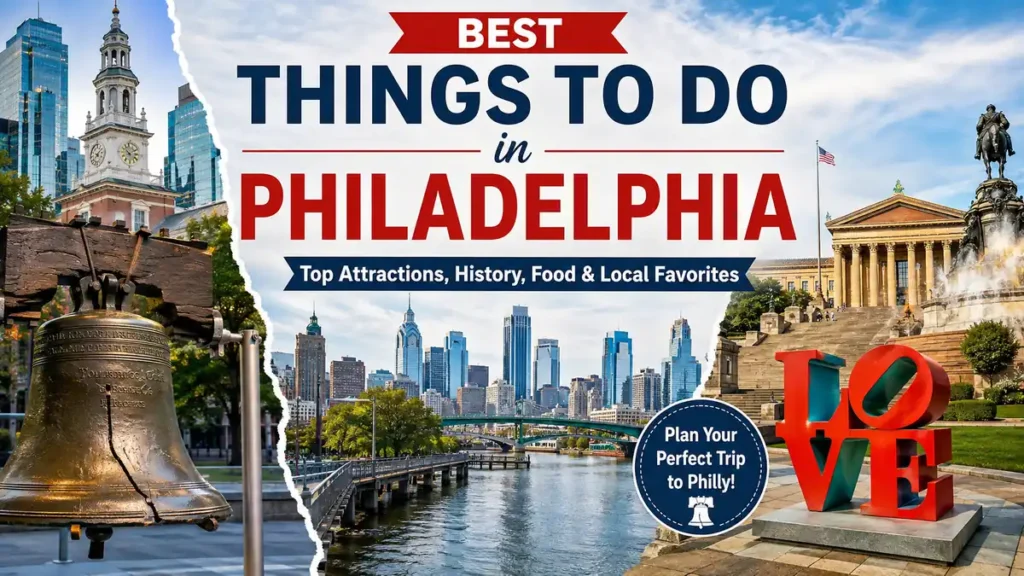
Philadelphia is one of those cities where a few blocks can take you from the birth of the United States to a century-old food market, a world-class art collection, a riverside park, or a neighborhood covered in murals.
For first-time visitors, the best things to do in philadelphia include exploring Independence Hall and the Liberty Bell, eating your way through Reading Terminal Market, visiting the Philadelphia Museum of Art, walking the Benjamin Franklin Parkway, touring Eastern State Penitentiary, discovering Old City, and spending time along the Delaware and Schuylkill rivers.
Philadelphia is especially significant in 2026, when the United States marks its 250th anniversary. The city is hosting exhibitions, public programs and cultural events connected to the Semiquincentennial, making this an unusually interesting year to explore the place where the Declaration of Independence was adopted.
1. Start With Independence Hall
Any serious list of things to do in Philadelphia should begin at Independence Hall.
The building sits within Independence National Historical Park in Old City and is one of the most important historic places in the United States. Both the Declaration of Independence and the U.S. Constitution were signed here.
Rather than simply photographing the exterior, go inside. The rooms help put the events of the American Revolution and Constitutional Convention into physical context.
As of 2026, Independence Hall has a ticket-free morning open-house period, followed by ticketed tours during the day. Because procedures and operating hours can change, check the National Park Service schedule before your visit.
What else is nearby?
One reason Old City works so well for visitors is the concentration of landmarks. Within a relatively small area you can see:
- Congress Hall
- President’s House Site
- National Constitution Center
- Museum of the American Revolution
- Carpenters’ Hall
- Betsy Ross House
- First Bank of the United States
- Benjamin Franklin-related historic sites
Give this part of Philadelphia at least half a day rather than rushing from landmark to landmark.
Quick Takeaway: If you have only one day in Philadelphia, begin in the Historic District early in the morning. You’ll cover several major attractions without spending much time traveling between them.
2. See the Liberty Bell
The Liberty Bell is one of Philadelphia’s most recognizable symbols and one of the easiest major attractions to combine with Independence Hall.
The bell became a powerful symbol of liberty beyond its original purpose, eventually becoming associated with abolitionists and other movements seeking greater freedom and equality.
The Liberty Bell Center is free to enter.
You can see the bell up close, but spend a few minutes with the exhibits leading toward it. They explain how the bell’s meaning evolved over time rather than treating it as nothing more than a photo opportunity.
The National Park Service currently lists the Liberty Bell Center as open daily, though hours and security procedures should be checked before visiting.
For lighter crowds, arriving near opening time is usually more pleasant than appearing in the middle of a busy sightseeing day.
3. Explore the Museum of the American Revolution
Once you’ve seen where American independence was debated and declared, the Museum of the American Revolution adds the broader story.
Its galleries examine the Revolutionary era through objects, documents, artwork and personal stories. That makes it particularly useful for travelers who want more context after visiting Independence Hall.
In 2026, the museum’s The Declaration’s Journey exhibition examines the Declaration of Independence and its influence beyond the United States. The exhibition is scheduled to continue into January 2027.
History enthusiasts could comfortably spend several hours here.
4. Walk Around Old City
Don’t treat Old City simply as a collection of museums.
Walk it.
Cobblestone streets, historic brick buildings, galleries, restaurants and small shops make the neighborhood worth exploring between major attractions.
Elfreth’s Alley is particularly popular. The narrow residential street offers a striking contrast to modern Center City and is an easy addition to an Old City walking route.
Nearby Franklin Square is another useful stop, especially for families or anyone wanting a break from museums.
A practical Old City route is:
- Start at Independence Visitor Center.
- See the Liberty Bell.
- Tour Independence Hall.
- Walk toward Carpenters’ Hall.
- Continue to the Museum of the American Revolution.
- Wander toward Elfreth’s Alley.
- Finish around the Delaware River waterfront.
This approach saves time because you’re moving naturally through the neighborhood rather than repeatedly crossing Center City.
5. Eat Your Way Through Reading Terminal Market
Few attractions tell you as much about Philadelphia as Reading Terminal Market.
The historic indoor market is packed with prepared-food counters, bakeries, produce vendors, meat and seafood sellers, specialty shops and Pennsylvania Dutch merchants.
Philadelphia International Airport’s visitor guide describes it as one of America’s largest and oldest public markets.
Come hungry.
You can find Philadelphia staples alongside cuisines from around the world. Depending on the vendor, possibilities include roast pork sandwiches, cheesesteaks, pretzels, baked goods and Pennsylvania Dutch specialties.
The biggest mistake is buying the first appealing thing you see. Walk through once before deciding. The market is dense, and some of its most interesting counters are easy to miss.
Is Reading Terminal Market worth visiting?
Yes, even if you don’t consider yourself a “foodie.”
It functions simultaneously as a meal stop, historic attraction and slice of everyday Philadelphia. It also sits conveniently near City Hall and the Pennsylvania Convention Center.
Quick Takeaway: Visit before the busiest lunch period when possible, then walk toward City Hall afterward.
6. See Philadelphia City Hall
Philadelphia City Hall is impossible to miss.
The enormous masonry building occupies the intersection of Broad and Market streets and is crowned by a statue of city founder William Penn.
Its architecture alone warrants a closer look.
Walk around the exterior before continuing north toward the Benjamin Franklin Parkway or south along Broad Street’s Avenue of the Arts.
Nearby Dilworth Park provides a useful pause in the middle of Center City, while the famous LOVE sculpture is a short walk away.
7. Photograph the LOVE Sculpture
Robert Indiana’s LOVE sculpture has become one of Philadelphia’s classic photo stops.
It stands in LOVE Park near City Hall and the beginning of the Benjamin Franklin Parkway.
You don’t need to devote a major portion of your itinerary to it. Think of LOVE Park as a natural waypoint between Center City and the Parkway museums.
The Philadelphia airport’s official visitor information even lists “Get some LOVE” alongside essentials such as Independence Hall, Reading Terminal Market and the Rocky Steps.
8. Visit the Philadelphia Museum of Art
The Philadelphia Museum of Art deserves more than a run up its front steps.
Its collections span centuries and cultures, making it one of Philadelphia’s major cultural institutions.
The museum sits at the end of the Benjamin Franklin Parkway, creating one of the city’s most recognizable views.
In 2026, the museum is also participating with the Pennsylvania Academy of the Fine Arts in A Nation of Artists, an expansive exhibition examining roughly three centuries of American art.
Allow several hours if art is a priority.
Trying to see every gallery is exhausting. Pick the collections that interest you most and leave time to enjoy the architecture and surroundings.
9. Run Up the Rocky Steps
Even people who have never watched every Rocky movie recognize the staircase.
The Rocky Steps are the 72 steps leading to the Philadelphia Museum of Art’s east entrance. Running to the top and raising your arms has become an unofficial Philadelphia ritual.
The Rocky Statue stands nearby.
It is touristy.
It is also fun.
More importantly, the top of the steps provides a great view down the Benjamin Franklin Parkway toward Center City.
Do the steps before entering the museum, then spend time looking at actual masterpieces instead of leaving immediately after the photograph.
10. Explore the Barnes Foundation
Art lovers should also make room for the Barnes Foundation.
Its collection is particularly famous for Impressionist, Post-Impressionist and early modern art, with artists such as Renoir, Cézanne, Matisse, Picasso and Van Gogh represented.
What makes the Barnes distinctive isn’t simply the names on the walls. Works are displayed in carefully constructed ensembles alongside furniture, metalwork and decorative objects rather than following a conventional chronological museum arrangement.
That makes the experience feel very different from the Philadelphia Museum of Art.
In September 2026, the Barnes is also scheduled to open Noguchi to Asawa: Designing Postwar America, focusing on Asian American artists and designers including Isamu Noguchi and Ruth Asawa.
11. See Rodin Without Going to Paris
Continue along the Benjamin Franklin Parkway and you’ll find the Rodin Museum.
The museum holds an important collection devoted to French sculptor Auguste Rodin.
Even travelers with limited museum time can fit this into a Parkway day more easily than another huge institution.
The garden and building also make it a worthwhile stop for architecture and photography.
Combining the Barnes Foundation, Rodin Museum and Philadelphia Museum of Art creates an exceptionally strong art-focused day without requiring a car.
12. Tour Eastern State Penitentiary
For something completely different, visit Eastern State Penitentiary.
The massive former prison once represented a radical approach to incarceration. Today, its crumbling cellblocks create one of Philadelphia’s most atmospheric historic experiences.
Rather than functioning as a simple “haunted prison,” the site explores incarceration, criminal justice and the development of prison systems.
It is also consistently prominent on visitor lists; Tripadvisor currently places Eastern State Penitentiary among Philadelphia’s top-rated attractions.
You’ll also encounter one particularly famous former prisoner: gangster Al Capone.
Give yourself time for the exhibits instead of walking quickly through the cellblocks. The history is more interesting than the building’s spooky reputation suggests.
13. Spend a Few Hours at The Franklin Institute
Families looking for things to do in Philadelphia with kids should consider The Franklin Institute.
Named for Benjamin Franklin, the science museum is known for interactive exhibits and hands-on learning.
It works especially well when the weather isn’t cooperating because you can spend several hours indoors without relying on children being interested in traditional historical exhibits.
For visitors arriving around Labor Day 2026, Universal Theme Parks: The Exhibition is scheduled through September 7 and includes eight immersive galleries and more than 100 original objects connected with Universal’s theme parks.
14. Take Kids to the Please Touch Museum
The Please Touch Museum is designed around something children are usually told not to do in museums: touch things.
Its interactive exhibits are geared toward younger children, making it a better choice for some families than trying to push small kids through an entire day of historic buildings.
The museum is housed in Memorial Hall in Fairmount Park, a surviving structure from Philadelphia’s 1876 Centennial Exhibition.
That setting gives adults a little history while children focus on playing.
15. Visit Philadelphia Zoo
Another classic family option is the Philadelphia Zoo.
Founded in the 19th century, it has long been associated with Philadelphia’s list of American “firsts.”
Today, visitors come for the animal exhibits and Zoo360, a network of overhead and ground-level trails designed to let some animals move through spaces beyond conventional exhibits.
Time Out ranks the zoo among Philadelphia’s standout attractions.
Pairing the zoo with another large attraction can make for an overly ambitious day, particularly with younger children. Let it be the main activity.
16. Discover Philadelphia’s Magic Gardens
South Street has one of Philadelphia’s most unusual visual attractions: Philadelphia’s Magic Gardens.
Artist Isaiah Zagar transformed the space into an immersive mosaic environment made with mirrors, tiles, bottles, ceramics and found objects.
It doesn’t resemble a conventional museum.
Narrow passages and densely decorated surfaces create an experience that rewards slow exploration. It’s also one of Philadelphia’s most distinctive photography spots.
Because the site is relatively compact and popular, planning ahead is wiser than assuming you’ll simply walk in during a busy weekend.
Afterward, continue exploring South Street rather than immediately heading elsewhere.
17. Walk Through the Italian Market
The South 9th Street Italian Market offers another side of South Philadelphia.
Despite the name, the neighborhood food scene isn’t exclusively Italian. Mexican, Vietnamese and other immigrant communities have contributed to the area’s evolving identity.
Walk past produce stands, specialty food stores, butcher shops, bakeries and restaurants.
This is a good place to experience Philadelphia as a living city rather than moving only between formal tourist attractions.
Where should you eat a Philadelphia cheesesteak?
The famous Pat’s-versus-Geno’s debate attracts plenty of attention because both are located near the Italian Market.
Try one if the experience appeals to you, but don’t assume Philadelphia has only two cheesesteak options.
Ask locals and you’ll hear many different loyalties.
More importantly, don’t make the cheesesteak your only Philadelphia sandwich. A good roast pork sandwich with sharp provolone and broccoli rabe deserves equal attention.
18. Experience Philadelphia’s Mural Arts
Philadelphia’s art isn’t confined to museums.
Murals appear throughout the city, turning entire neighborhoods into an enormous outdoor gallery.
Mural Arts Philadelphia has helped build this identity through thousands of public-art projects and community programs.
You can encounter murals casually while exploring neighborhoods, or make street art the focus of a walk.
In 2026, Mural Arts projects are also part of Philadelphia’s America 250 cultural programming.
This is one of the best free things to do in Philadelphia because you don’t necessarily need a ticket or even a fixed itinerary.
19. Relax in Rittenhouse Square
Not every hour needs to involve a museum.
Rittenhouse Square is one of William Penn’s original public squares and remains one of Center City’s most pleasant gathering places.
Grab coffee, sit on a bench, watch dogs and pedestrians pass, then explore the surrounding streets.
The neighborhood is packed with restaurants, cafés and shops.
Rittenhouse works particularly well late in the afternoon when you want to slow down before dinner.
20. Walk or Bike the Schuylkill River Trail
For outdoor time without leaving the city, head toward the Schuylkill River Trail.
The trail provides a completely different view of Philadelphia from the historic streets of Old City.
Walking, jogging and cycling are all popular.
The stretch around Schuylkill Banks is particularly convenient for Center City visitors and can be incorporated into a morning walk or sunset outing.
Continue toward the Fairmount area if you want a longer route.
21. Escape Into Fairmount Park
Philadelphia has far more green space than many first-time visitors expect.
Fairmount Park spreads across a huge portion of the city and includes trails, historic houses, recreation areas and cultural attractions.
It’s useful to think of Fairmount Park not as one manicured city park but as a network of landscapes and destinations.
If your itinerary is packed with indoor museums, spending a few hours outside here can reset the entire trip.
22. Hike in Wissahickon Valley Park
Want something that barely feels like Philadelphia?
Head to Wissahickon Valley Park.
Wooded trails follow Wissahickon Creek through a landscape that can feel surprisingly remote considering you’re still inside a major American city.
Forbidden Drive provides an accessible introduction, while surrounding trails offer more demanding options.
Wear proper walking shoes and check trail conditions if the weather has been poor.
Visit Philadelphia specifically highlights Wissahickon Valley Park alongside Fairmount Park when presenting the city’s major outdoor attractions.
23. Explore the Delaware River Waterfront
Philadelphia’s eastern edge follows the Delaware River, where former industrial and transportation spaces have increasingly become places to walk, eat and relax.
Popular waterfront destinations include Spruce Street Harbor Park, Cherry Street Pier and the Penn’s Landing area.
Seasonal programming changes throughout the year.
Spruce Street Harbor Park, for example, appears on Visit Philadelphia’s current 2026 weekly attractions guide.
This is especially enjoyable toward evening when temperatures drop and the waterfront becomes more atmospheric.
24. Visit the Independence Seaport Museum
While you’re near the Delaware, consider the Independence Seaport Museum.
The museum explores Philadelphia’s relationship with the Delaware River and maritime history.
Historic vessels make this more than an indoor gallery experience. It is particularly worthwhile for visitors interested in ships, engineering or the city’s commercial history.
In 2026, the museum’s programming also examines Philadelphia’s early international trade relationships and their role in the development of the United States.
25. Experience Philadelphia’s Neighborhoods
The biggest mistake visitors make is assuming Philadelphia ends at Center City.
Once you’ve covered the essential landmarks, spend time in its neighborhoods.
Fishtown
Fishtown has become known for restaurants, music venues, independent businesses and nightlife.
It’s a good evening destination for travelers who want a contemporary Philadelphia experience after spending the morning surrounded by 18th-century history.
Manayunk
Manayunk sits along the Schuylkill River and has a walkable commercial corridor centered on Main Street.
Restaurants, shops and nearby recreation make it suitable for a slower half-day outside the historic core.
Chestnut Hill
Tree-lined streets, independent businesses and access to nearby green spaces give Chestnut Hill a noticeably different atmosphere from Center City.
University City and West Philadelphia
West Philadelphia mixes major universities, residential neighborhoods, restaurants and cultural institutions.
The University of Pennsylvania and Drexel University anchor much of University City, but exploring farther west reveals a more neighborhood-oriented side of Philadelphia.
South Philadelphia
South Philly is essential for food, sports and neighborhood culture.
The Italian Market, East Passyunk Avenue and the stadium district offer very different experiences, yet each reveals something about how Philadelphians actually use their city.
Quick Takeaway: Spend your first day on Philadelphia’s famous sights. Use your second or third day to explore neighborhoods. That’s when the city begins to feel less like a history lesson and more like Philly.
More Unique Things to Do in Philadelphia
Once you’ve covered the major attractions, Philadelphia gets stranger—in a good way.
The Mütter Museum houses a famous collection related to medical history and anatomy. It isn’t suitable for every visitor, but people fascinated by medical science and unusual museums often consider it unforgettable.
Condé Nast Traveler includes the Mütter among its notable Philadelphia museum experiences.
Architecture enthusiasts can explore the grand interiors and historic buildings scattered around Center City.
Music and performing arts fans should look around Broad Street, home to the Academy of Music and other venues in the Avenue of the Arts district.
Sports fans have another option entirely.
Depending on the season, you can see the Philadelphia Eagles, Philadelphia Phillies, Philadelphia 76ers, Philadelphia Flyers or Philadelphia Union. The airport’s official visitor guide lists catching a Philadelphia sports game among the city’s signature experiences.
Few cities take their teams quite as personally as Philadelphia does.
Best Free Things to Do in Philadelphia
Philadelphia is relatively friendly to travelers trying to control sightseeing costs.
Several memorable experiences don’t require paying admission.
Start with the Liberty Bell, then walk through Independence National Historical Park. Continue through Old City and Elfreth’s Alley before exploring public squares and the Delaware waterfront.
Other inexpensive or free possibilities include:
- Photographing the LOVE sculpture
- Seeing the Rocky Steps
- Exploring Philadelphia’s murals
- Walking Rittenhouse Square
- Hiking Wissahickon Valley Park
- Walking the Schuylkill River Trail
- Exploring Fairmount Park
- Browsing Reading Terminal Market
- Walking the Italian Market
- Exploring Penn’s Landing
- Wandering different neighborhoods
Some museums also have free, pay-what-you-wish or discounted admission periods, but schedules change. Verify current policies directly with each institution rather than building an itinerary around outdated admission information.
Things to Do in Philadelphia With Kids
Philadelphia works surprisingly well as a family city because you can alternate educational attractions with places where children can move around.
For younger kids, prioritize the Please Touch Museum and Philadelphia Zoo.
School-age children interested in science may prefer The Franklin Institute, while American history becomes much more tangible at Independence Hall and the Museum of the American Revolution.
Reading Terminal Market works well for families with different food preferences because everyone can choose something different.
Outdoor breaks matter too.
Franklin Square, Fairmount Park, the Delaware River waterfront and Schuylkill River Trail can prevent a museum-heavy itinerary from becoming exhausting.
Don’t try to fit five attractions into one day with children. Philadelphia is compact enough that you can see a lot without turning the trip into a race.
What to Do in Philadelphia in 2026
There is an extra reason to visit Philadelphia in 2026.
The United States is celebrating the 250th anniversary of the Declaration of Independence, placing Philadelphia at the center of the Semiquincentennial.
Special programming extends well beyond July 4.
Among the continuing initiatives are 52 Weeks of Firsts, a citywide series celebrating inventions, milestones and historic “firsts” associated with Philadelphia. Free Saturday Firstivals are scheduled throughout 2026.
Other 2026 highlights include new exhibitions at the National Constitution Center, the reopening of the First Bank of the United States to visitors, The Declaration’s Journey at the Museum of the American Revolution and A Nation of Artists at the Philadelphia Museum of Art and Pennsylvania Academy of the Fine Arts.
If you’re traveling specifically for one of these programs, verify dates before booking because temporary exhibitions and events have different closing dates.
How Many Days Do You Need in Philadelphia?
Two days is enough for the essential attractions, but three days is better.
With one day, concentrate on Independence Hall, the Liberty Bell, Old City, Reading Terminal Market and one major museum.
With two days, add the Benjamin Franklin Parkway, Philadelphia Museum of Art, Rocky Steps, Barnes Foundation or Eastern State Penitentiary.
A third day gives you room for South Philadelphia, Fishtown, the waterfront, Fairmount Park, Wissahickon Valley Park or family attractions.
Here’s a simple approach:
| Trip Length | What to Prioritize |
|---|---|
| 1 day | Old City, Liberty Bell, Independence Hall, Reading Terminal Market, Rocky Steps |
| 2 days | Add Philadelphia Museum of Art, Barnes Foundation and Eastern State Penitentiary |
| 3 days | Add South Philly, Magic Gardens, waterfront and neighborhood exploration |
| 4+ days | Add Wissahickon, zoo, more museums, sports and Greater Philadelphia attractions |
Trying to see everything is unnecessary. Philadelphia rewards walking and detours, so leave some gaps in the schedule.
A Practical One-Day Philadelphia Itinerary
If you’re visiting for only a day, geography matters more than the number of attractions on your wish list.
Start early at Independence National Historical Park.
See the Liberty Bell and Independence Hall before walking through Old City. If American history is your main interest, add the Museum of the American Revolution.
Around lunchtime, head to Reading Terminal Market.
After eating, walk past City Hall and LOVE Park toward the Benjamin Franklin Parkway.
Choose the Barnes Foundation or Philadelphia Museum of Art rather than attempting both in a couple of hours.
Finish at the Rocky Steps around late afternoon.
For dinner, explore Rittenhouse Square, East Passyunk, Fishtown or another neighborhood instead of eating beside the final tourist attraction you visited.
This route gives you history, food, architecture and art without spending your entire day moving between distant parts of the city.
What Food Should You Try in Philadelphia?
The obvious answer is a Philly cheesesteak, but stopping there misses much of the city’s food culture.
Try a roast pork sandwich. Get a soft pretzel. Explore Reading Terminal Market. Visit the Italian Market. Look beyond famous sandwich counters toward Philadelphia’s Mexican, Vietnamese, Italian, Jewish, Middle Eastern and contemporary American restaurants.
Condé Nast Traveler’s Philadelphia recommendations similarly stretch beyond cheesesteaks to roast pork, tacos, fine dining and neighborhood food experiences.
Food is one of the best excuses to explore outside the tourist core.
Rather than asking, “Where is the single best cheesesteak?” ask what neighborhood you’re exploring and find a respected place nearby.
You’ll spend less time traveling for one sandwich and more time actually experiencing Philadelphia.
Is Philadelphia Walkable?
Central Philadelphia is highly walkable for sightseeing.
Old City, Washington Square, Reading Terminal Market, City Hall, Rittenhouse Square and much of the Benjamin Franklin Parkway can be linked on foot if you’re comfortable with a substantial walking day.
Visit Philadelphia describes the downtown area as relatively easy to navigate on foot or by public transportation.
You won’t want to walk everywhere, though.
Attractions such as Philadelphia Zoo, Wissahickon Valley Park, Manayunk and some neighborhood destinations require more planning.
The practical strategy is to group attractions geographically.
Don’t visit Old City, then jump across town, then return to Old City two hours later. Finish one area before moving to the next.
Comfortable shoes make a surprisingly large difference here. Historic paving, museum floors and long urban blocks add up quickly.
When Is the Best Time to Visit Philadelphia?
Philadelphia is a year-round destination, but each season changes the experience.
Spring brings comfortable sightseeing temperatures and gardens returning to life.
Summer has festivals, waterfront activities and long daylight hours, but heat and humidity can make midday walking tiring.
Fall is excellent for parks, neighborhood exploration and long walking days.
Winter means colder weather and shorter days, yet museums, markets, restaurants and historic attractions remain worthwhile.
September is particularly active in 2026, with exhibitions, performing arts, sporting events and cultural celebrations scheduled across the city.
Whenever you visit, check the calendar. Philadelphia’s festivals, sports schedules and temporary exhibitions can substantially change what is available from one week to another.
What Should First-Time Visitors Not Miss?
If your schedule is limited, narrow the enormous list of things to do in Philadelphia to experiences that collectively explain the city.
Prioritize these five:
- Independence Hall and the Liberty Bell for American history.
- Reading Terminal Market for Philadelphia’s food culture.
- Philadelphia Museum of Art and the Rocky Steps for art and an iconic city view.
- Old City for walking through the historic urban landscape.
- One neighborhood beyond the tourist core for contemporary Philadelphia.
If you have another day, add Eastern State Penitentiary, the Barnes Foundation, Magic Gardens or the Museum of the American Revolution according to your interests.
That produces a better trip than simply working through the longest possible attractions checklist.
Making the Most of the Best things to do in philadelphia
Philadelphia’s strength is variety packed into a relatively manageable city.
You can stand inside Independence Hall in the morning, eat lunch at Reading Terminal Market, spend the afternoon with major works of art, walk along a river before sunset and finish the evening in a neighborhood restaurant or music venue.
History may be what brings many travelers here, particularly during America’s 250th anniversary in 2026, but it shouldn’t be the only thing you see.
The best things to do in philadelphia combine the famous landmarks with food, art, parks, neighborhoods and ordinary street life. Start with Independence Hall and the Liberty Bell, but leave enough time to wander. Philadelphia becomes much more interesting once you stop treating it as a checklist.