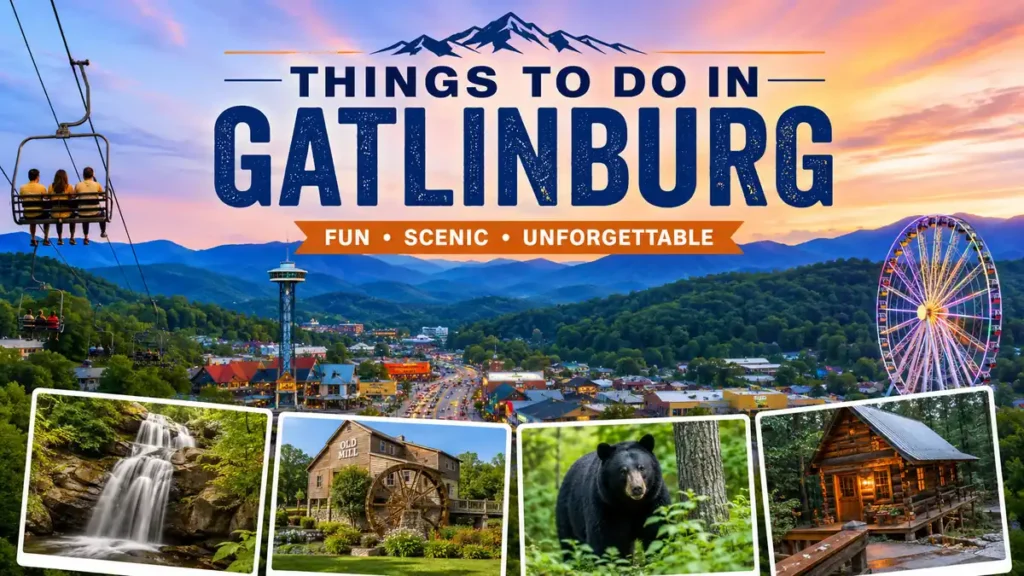
Gatlinburg packs an unusual amount of adventure into a small Tennessee mountain town. One minute you can be hiking beside a waterfall in Great Smoky Mountains National Park; a few hours later, you can cross a suspension bridge above town, explore an aquarium, watch Appalachian artisans at work, or ride a tram into the mountains.
For first-time visitors wondering about the best things to do in gatlinburg, start with Great Smoky Mountains National Park, then combine one mountaintop attraction with downtown Gatlinburg, Ripley’s Aquarium, and the Arts & Crafts Community. Three days gives most travelers enough time to experience nature, family attractions, scenic views, and local culture without rushing.
Gatlinburg works especially well because many downtown attractions are walkable, while three entrances to Great Smoky Mountains National Park are accessible from the community. The surrounding Smokies receive millions of visitors annually, making Gatlinburg one of the region’s main bases for exploring the national park.
Best things to do in gatlinburg for first-time visitors
If you have limited time, don’t try to visit every attraction on the Parkway. Gatlinburg is more enjoyable when you balance the town’s entertainment with the mountains that made the destination famous.
These are the experiences worth putting near the top of a first trip:
- Explore Great Smoky Mountains National Park
- Hike to a Smokies waterfall
- Drive Newfound Gap Road
- Visit Kuwohi
- Explore Cades Cove
- Ride the Gatlinburg SkyLift
- Cross the Gatlinburg SkyBridge
- Spend time at Anakeesta
- Visit Ripley’s Aquarium of the Smokies
- Ride the aerial tram to Ober Gatlinburg
- Walk downtown and the Parkway
- Explore the Great Smoky Arts & Crafts Community
- Visit The Village Shops
- Experience a mountain coaster
- Try local Appalachian food and treats
The right mix depends on the weather, season, age of your group, and how much hiking you want to do.
1. Explore Great Smoky Mountains National Park
The defining Gatlinburg experience is not actually on the Parkway. It begins where the buildings disappear and Great Smoky Mountains National Park takes over.
America’s most visited national park surrounds Gatlinburg on three sides. Forested ridges, waterfalls, historic buildings, mountain streams, wildlife, scenic overlooks, and hundreds of miles of trails create enough possibilities for an entire vacation.
You don’t need to be an experienced hiker. A first visit can be as simple as driving through the mountains, stopping at overlooks, taking a short walk, and spending time at a visitor center.
What does it cost to visit the Smokies?
Great Smoky Mountains National Park does not charge an entrance fee. However, vehicles parked inside the park for more than 15 minutes generally require a parking tag.
Current standard parking-tag prices are $5 daily, $15 weekly, and $40 annually. Check National Park Service information before traveling because regulations, closures, and operating conditions can change.
Quick Takeaway: If you do only one thing around Gatlinburg, spend meaningful time inside the national park rather than treating it as a backdrop for downtown attractions.
2. Hike to a waterfall
Waterfall hikes are among the best outdoor activities near Gatlinburg because you get streams, forest scenery, mountain terrain, and a natural destination in one outing.
Popular choices in the Gatlinburg area have traditionally included trails leading toward waterfalls such as Grotto Falls and Rainbow Falls. Trail conditions and closures can change, however, so check current National Park Service alerts before choosing a route.
Pick a trail based on actual distance and elevation gain rather than photographs alone. Mountain miles usually feel harder than flat miles.
Carry water, wear shoes with reliable traction, and begin early during busy periods. After rain, roots, rocks, and streamside sections can become surprisingly slippery.
3. Take a scenic drive on Newfound Gap Road
You don’t have to hike several miles to experience the Smokies.
Newfound Gap Road, or U.S. 441, crosses the national park between Gatlinburg and Cherokee, North Carolina. Along the way, the road climbs from lower forests into cooler high-elevation environments.
The drive is particularly rewarding when clouds move through the valleys or fall color spreads across different elevations.
Newfound Gap Road is considered a primary park road and normally operates year-round, weather permitting. Mountain weather can still cause temporary closures.
Allow extra time for overlooks. Trying to race from Gatlinburg to the other side defeats the purpose.
4. See the Smokies from Kuwohi
Kuwohi, formerly known as Clingmans Dome, is the highest peak in Great Smoky Mountains National Park.
From the Kuwohi area, visitors can experience expansive mountain views when conditions cooperate. The visitor center sits at the end of Kuwohi Road, seven miles from Newfound Gap Road.
The final walk toward the observation area is relatively short but steep, and the elevation can make it feel more demanding than its distance suggests.
Bring an extra layer even when downtown Gatlinburg feels warm. Temperatures at higher elevations can be noticeably cooler.
Kuwohi Road is seasonal rather than permanently open. For the 2026 season, the National Park Service lists its scheduled operating period as April 1 through November 29, subject to weather-related closures.
5. Spend half a day in Cades Cove
Cades Cove is farther from downtown than many Gatlinburg attractions, but it provides one of the best combinations of natural scenery, wildlife habitat, and human history in the Smokies.
The valley contains historic structures surrounded by broad mountain views. Wildlife sightings are possible, although animals should never be approached or fed.
Cades Cove works best when you give it time. Traffic can move slowly, particularly during busy weekends and fall.
The loop road is generally open from sunrise to sunset. During its seasonal vehicle-free program, the road closes to motor vehicles on Wednesdays, typically from May through September, creating a different experience for cyclists and pedestrians.
If your schedule is tight, save Cades Cove for a half-day rather than squeezing it between several downtown reservations.
6. Ride the Gatlinburg SkyLift
For a dramatic transition from busy downtown streets to mountain scenery, take the yellow Gatlinburg SkyLift toward Crockett Summit.
The chairlift itself is part of the experience. As you rise above town, buildings gradually give way to wider views of Gatlinburg and the surrounding Smokies.
At the summit, Gatlinburg SkyPark combines overlooks, walking areas, trails, and its best-known attraction: the SkyBridge.
Try visiting earlier in the day if avoiding the heaviest crowds matters more than sunset views.
7. Walk across the Gatlinburg SkyBridge
The Gatlinburg SkyBridge has become one of the town’s signature modern landmarks.
The pedestrian cable bridge stretches high above the mountainside and gives visitors a very different perspective from a traditional observation deck. SkyPark describes it as North America’s longest pedestrian cable bridge.
You don’t need to rush across. Stop where permitted, look toward the national park, and enjoy the change in perspective.
Visitors who dislike heights may prefer the surrounding observation areas and trails instead.
The larger SkyPark experience also includes the SkyTrail, SkyDeck, and Clayton’s Landing, making it possible to spend more time on the mountain than simply crossing the bridge and leaving.
8. Spend a few hours at Anakeesta
Anakeesta combines a mountaintop park with scenic overlooks, gardens, family activities, and adventure attractions.
The experience begins downtown, where guests travel up the mountain by gondola or Ridge Rambler.
At the summit, the Treetop Skywalk uses a network of hanging bridges through the forest. AnaVista Tower provides 360-degree views, while Vista Gardens offers a slower-paced alternative to the park’s adventure activities.
More adventurous visitors can look into ziplining and mountain coasters, while families can spend time around TreeVenture and BearVenture.
Anakeesta is particularly useful for groups with different interests because not everyone has to do the same activity.
Is Anakeesta or SkyPark better?
Choose SkyPark if your priority is the SkyBridge and a relatively focused scenic experience.
Choose Anakeesta if you want enough activities, gardens, dining, walks, and adventure experiences to occupy several hours.
Both offer excellent Smoky Mountain views, so visiting both isn’t essential on a short trip.
9. Visit Ripley’s Aquarium of the Smokies
A rainy day doesn’t have to ruin a Gatlinburg itinerary.
Ripley’s Aquarium of the Smokies is one of the strongest indoor options, particularly for families. The aquarium reports more than 10,000 animals representing over 350 species.
Sharks and other marine animals make it considerably more than a quick children’s attraction. It also provides a useful break from hiking, heat, cold, or rain.
For families trying to decide what to do in Gatlinburg with kids, the aquarium is one of the easiest recommendations because it works across a broad age range.
Expect it to become busier when bad weather pushes other visitors indoors.
10. Ride the aerial tram to Ober Gatlinburg
Ober Gatlinburg brings another kind of mountaintop experience to the city.
The aerial tram travels approximately 2.1 miles from downtown toward the mountain recreation area. At the top, activities change with the seasons.
During warmer months, attractions can include mountain recreation, rides, tubing, disc golf, archery, and other family activities. Winter transforms Ober into Tennessee’s ski destination, with skiing, snowboarding, and snow tubing among its seasonal draws.
In 2026, the attraction returned to its historic Ober Gatlinburg name after operating as Ober Mountain since 2022. Recent additions have included downhill mountain biking, tubing, archery, and disc golf.
Weather and maintenance can affect individual rides, so check operating conditions before building an entire day around a specific activity.
11. Walk the downtown Gatlinburg Parkway
Downtown Gatlinburg is compact enough that walking is usually more enjoyable than repeatedly moving your car.
The Parkway is the town’s main entertainment corridor, lined with restaurants, candy stores, attractions, souvenir shops, arcades, museums, and places to stop for snacks.
The atmosphere is intentionally lively and tourist-oriented. That makes it very different from the quiet trails only minutes away.
Rather than trying to enter every attraction, give yourself an hour or two to wander. Explore side streets and pedestrian areas instead of staying exclusively on the main road.
The contrast between a morning in the national park and an evening downtown is part of Gatlinburg’s appeal.
12. Slow down along River Road
Travelers who find the Parkway overwhelming can escape some of its noise without leaving downtown.
River Road follows the Little Pigeon River just off the primary tourist corridor. It’s a pleasant place for an easy stroll and offers a quieter perspective on central Gatlinburg.
The official tourism bureau highlights the riverwalk as a free activity where visitors can relax along the river and watch anglers on the water.
It won’t occupy half a day, but that’s the point. Use it as a decompression break between larger attractions.
13. Explore the Great Smoky Arts & Crafts Community
One of the biggest mistakes first-time visitors make is assuming Gatlinburg begins and ends with the Parkway.
The Great Smoky Arts & Crafts Community offers a completely different experience.
Spread along an approximately eight-mile loop, the community brings together independent artists and craftspeople working in mediums such as pottery, painting, woodworking, weaving, jewelry, leather, glass, and other traditional and contemporary crafts.
The tourism bureau describes the area as North America’s largest group of independent artisans, with close to 100 shops, studios, galleries, cafes, and related businesses.
Take your time here. The experience is much better when you enter studios, talk with makers, and watch how individual pieces are produced instead of treating the loop like another shopping center.
14. Visit Arrowmont School of Arts and Crafts
For a deeper look at Gatlinburg’s creative side, visit Arrowmont School of Arts and Crafts.
Founded in 1945, Arrowmont has developed into a major center for contemporary arts and crafts education. Its presence helps explain why Gatlinburg’s craft tradition feels more substantial than a typical tourist-town collection of souvenir stores.
Available galleries and public areas can provide an interesting cultural break between outdoor activities.
It’s an especially worthwhile stop for travelers interested in ceramics, textiles, woodworking, sculpture, or craft education.
15. Browse The Village Shops
The Village is one of downtown Gatlinburg’s most recognizable shopping areas.
Instead of a conventional strip of storefronts facing the Parkway, its shops are arranged around pedestrian lanes and courtyards with an Old World-inspired atmosphere.
There are 27 boutiques, dining spots, and other businesses within the complex.
You don’t need a shopping list. The setting itself makes The Village worth walking through while exploring downtown.
Morning can be particularly pleasant before the central Parkway becomes crowded.
16. Try a mountain coaster
Mountain coasters have become a staple of the Smokies.
Unlike a traditional roller coaster, many alpine-style coasters let riders control their speed within the system’s limits while descending a track built into mountainous terrain.
You’ll find coaster experiences in and around Gatlinburg, including options associated with major mountaintop attractions.
The biggest practical tip is simple: don’t assume every coaster experience is identical. Track layouts, operating systems, height restrictions, speed controls, nighttime lighting, and weather policies differ.
Families should check rider requirements before arriving, especially when traveling with younger children.
17. Experience Gatlinburg after dark
Gatlinburg doesn’t shut down when the hikers return from the mountains.
Downtown becomes a different place after sunset, with illuminated attractions, arcades, restaurants, entertainment venues, and busy sidewalks.
Anakeesta also operates nighttime experiences during applicable periods, including Astra Lumina, an immersive forest light-and-sound experience.
For a simpler evening, walk the Parkway, find dessert, browse The Village, or sit near the river.
A useful itinerary rule is to reserve daylight for the Smokies whenever weather is good and shift indoor attractions and downtown entertainment toward evening.
18. Look for wildlife responsibly
Black bears are strongly associated with Gatlinburg and Great Smoky Mountains National Park, but seeing one should never become an excuse to approach it.
Wild animals need space.
Never feed a bear, block its path, surround it for photographs, or leave food where wildlife can reach it. If you are staying in a cabin, follow all food and trash-storage instructions.
Wildlife encounters are more rewarding when animals remain wild rather than learning to associate people with food.
The official Gatlinburg visitor information specifically encourages travelers to review BearWise practices when planning a trip.
19. Find free things to do in Gatlinburg
A Gatlinburg vacation doesn’t need to consist entirely of paid attractions.
Some of the best free or inexpensive experiences include:
- Entering Great Smoky Mountains National Park, although parking-tag rules apply
- Walking the downtown Parkway
- Exploring River Road
- Visiting the Great Smoky Arts & Crafts Community
- Taking in the Gatlinburg Overlook
- Browsing available galleries at Arrowmont
- Window-shopping around downtown
- Riding the Gatlinburg Trolley
- Enjoying scenic drives through the Smokies
These activities can substantially reduce the cost of a family trip.
The national park remains the standout value: there is no entrance fee, though parking longer than 15 minutes generally requires a paid tag.
20. Use the free Gatlinburg Trolley
Parking in a busy mountain tourist town can quickly become frustrating.
Gatlinburg’s trolley system provides free transportation around serviced areas of the city. The system operates more than 20 trolleys, with routes serving downtown and other destinations; seasonal service also connects with the Arts & Crafts Community.
Park-and-ride options can be particularly helpful when central Gatlinburg is crowded.
The trolley won’t replace a car for exploring remote areas of Great Smoky Mountains National Park, but it can reduce unnecessary driving once you’re spending time in town.
21. Taste Appalachian flavors
Gatlinburg’s food scene ranges from classic breakfast restaurants and barbecue to candy shops and mountain-themed dining.
Rather than trying to identify one universally “best” restaurant, look for regional experiences that fit the trip.
Popular Smokies flavors and traditions include:
- Biscuits and gravy
- Country ham
- Cornbread
- Barbecue
- Trout
- Pancakes
- Fudge
- Taffy
- Fried comfort foods
- Appalachian-inspired dishes
Downtown is also known for Tennessee moonshine and whiskey distilleries. Adults interested in that tradition will find established producers around the Parkway, including Ole Smoky and Sugarlands. Tripadvisor currently lists both among Gatlinburg’s most heavily reviewed visitor attractions.
Families and non-drinkers can get just as much local character from bakeries, candy kitchens, barbecue restaurants, and breakfast spots.
22. Visit during fall color season
Autumn is one of Gatlinburg’s signature seasons.
Because the Smokies span a large range of elevations, fall color does not necessarily peak everywhere at once. Higher elevations often begin changing before lower valleys.
That makes scenic drives particularly rewarding.
The tradeoff is popularity. Fall weekends can bring significant traffic, crowded trails, busy restaurants, and limited parking.
If possible, stay several nights and avoid designing an itinerary that requires repeatedly driving through downtown at peak times.
An early start can make an enormous difference.
23. Experience Gatlinburg in winter
Winter gives the Smokies a completely different personality.
Bare trees reveal mountain contours hidden during summer, crowds can be lighter outside holiday periods, and seasonal lighting changes the atmosphere downtown.
Ober Gatlinburg becomes particularly relevant because it is Tennessee’s only ski area, offering winter activities such as skiing, snowboarding, snow tubing, and ice-related recreation depending on conditions.
Mountain weather is unpredictable, however. Snow and ice can temporarily close high-elevation roads.
Kuwohi Road, for example, closes seasonally during winter.
Check road conditions rather than assuming an attraction accessible in July will be accessible in January.
24. Enjoy Gatlinburg with kids
Gatlinburg is particularly easy to plan for families because outdoor and indoor attractions are close together.
Good family choices include Ripley’s Aquarium of the Smokies, Anakeesta, Ober Gatlinburg, mini-golf, arcades, mountain coasters, easy nature walks, and scenic rides.
Tripadvisor currently ranks Ripley’s Aquarium, Gatlinburg SkyPark, and Great Smoky Mountains National Park among its prominent family activities in Gatlinburg.
The key is not overplanning.
Young children rarely enjoy being moved through six ticketed attractions in one day. One major attraction, some unstructured downtown time, and a short nature experience usually creates a better pace.
What can you do in Gatlinburg when it rains?
Start with Ripley’s Aquarium, indoor entertainment, shops, galleries, arcades, and a long meal.
Keep your schedule flexible enough to move hiking or scenic viewpoints to the clearest day of your trip.
Mountain forecasts change quickly, and rain in downtown Gatlinburg doesn’t necessarily mean an entire day is lost.
25. Build a balanced three-day Gatlinburg itinerary
The easiest way to enjoy Gatlinburg is to organize days geographically rather than bouncing repeatedly between downtown and the national park.
Day 1: Great Smoky Mountains National Park
Start early and dedicate the morning to the Smokies.
Choose a waterfall hike, Newfound Gap Road, Kuwohi, or another scenic area based on current conditions. Return to Gatlinburg later in the afternoon.
Spend the evening walking the Parkway, River Road, and The Village.
Day 2: Mountaintop Gatlinburg
Choose Anakeesta or Gatlinburg SkyPark as your main attraction.
Allow several hours rather than treating the mountain as a photo stop. Afterward, visit Ripley’s Aquarium or another downtown attraction.
Finish with dinner and an evening walk.
Day 3: Local culture and another mountain experience
Explore the Great Smoky Arts & Crafts Community in the morning.
Spend the afternoon at Ober Gatlinburg, take another short national park excursion, or return to a favorite downtown area.
This schedule gives you mountains, local culture, family entertainment, and downtown Gatlinburg without turning the vacation into a checklist.
When is the best time to visit Gatlinburg?
There isn’t one perfect month for everyone.
| Season | Best for | What to expect |
|---|---|---|
| Spring | Waterfalls, wildflowers, hiking | Changing weather and fresh greenery |
| Summer | Families, long days, outdoor attractions | Warm temperatures and larger crowds |
| Fall | Scenic drives and foliage | Spectacular color and heavy peak-period traffic |
| Winter | Seasonal atmosphere and Ober activities | Colder weather and possible mountain road closures |
Spring is excellent for active outdoor trips. Summer offers the widest range of family vacation activities. Fall is hard to beat for scenery. Winter suits travelers interested in holiday atmosphere, mountain views, and seasonal recreation.
Whichever season you choose, treat weather as part of the itinerary rather than an inconvenience.
How many days do you need in Gatlinburg?
Three days is a good minimum for a first Gatlinburg trip.
One day gives you enough time for a quick overview but forces difficult choices. Two days can combine the national park with downtown attractions.
Three days lets you experience the Smokies, a major mountaintop attraction, downtown Gatlinburg, and the Arts & Crafts Community at a comfortable pace.
Four or five days are worthwhile if hiking, Cades Cove, scenic drives, or nearby communities are major priorities.
Practical tips that make a Gatlinburg trip easier
A few planning decisions have a bigger impact than squeezing another attraction into the schedule.
Start mountain days early. Trailheads, overlooks, and roads become busier as the day progresses.
Don’t drive everywhere downtown. Walk or use the free trolley when practical.
Check park alerts. Weather, construction, trail work, and seasonal schedules can affect plans.
Remember the parking tag. Parking longer than 15 minutes inside Great Smoky Mountains National Park generally requires one.
Separate town time from park time. Driving back and forth wastes hours during crowded periods.
Leave space in the itinerary. Gatlinburg is more enjoyable when you have time to stop at an overlook, explore an unexpected shop, or stay longer on a trail.
Respect wildlife. A black bear sighting should be observed from a safe distance, not turned into a close-up photo opportunity.
Check seasonal operations. High-elevation roads and some attractions operate differently throughout the year.
Which Gatlinburg attractions are actually worth your time?
For most first-time visitors, the strongest experiences fall into four categories.
Great Smoky Mountains National Park provides the natural experience. Gatlinburg SkyPark or Anakeesta provides the classic mountaintop attraction. Ripley’s Aquarium gives families and rainy-day visitors a strong indoor option. The Great Smoky Arts & Crafts Community provides the local culture that many short itineraries miss.
After those, choose attractions according to your interests instead of popularity.
If you love heights, ride lifts and cross the SkyBridge. If you have young children, prioritize the aquarium and easy outdoor activities. If you prefer quieter travel, spend more time in the national park and craft community and less time on the Parkway.
That’s the best way to approach things to do in gatlinburg: don’t try to do everything. Build the trip around the Great Smoky Mountains, add a few distinctive Gatlinburg experiences, and leave enough unscheduled time to actually enjoy where you are.