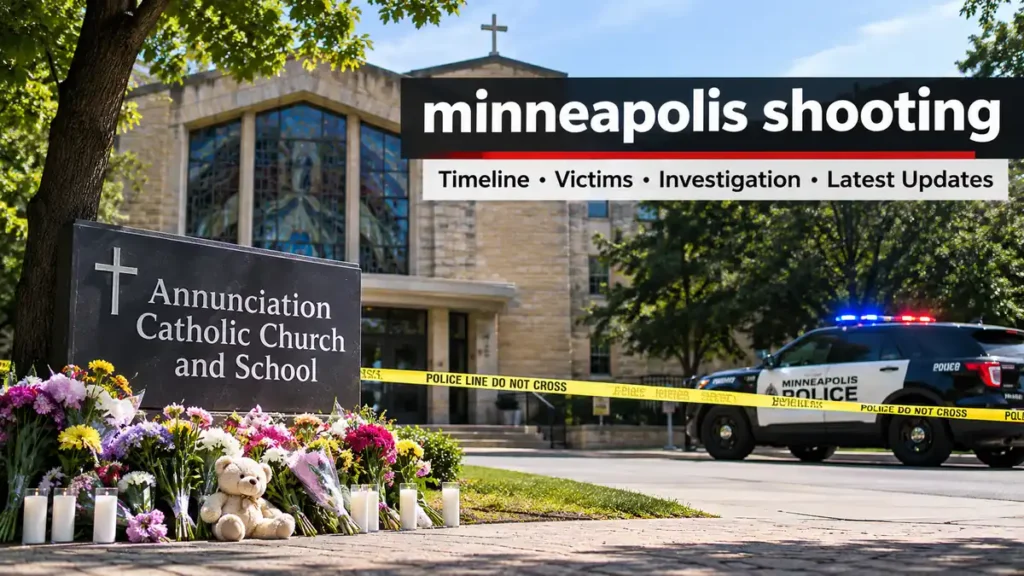
The minneapolis shooting at Annunciation Catholic Church and School on August 27, 2025, devastated families and raised urgent questions about school safety, gun violence, and emergency preparedness. More than a year later, newly released investigative records continue to shed light on what happened, although important questions remain unanswered.
The August 27, 2025, Minneapolis shooting occurred during a school Mass at Annunciation Catholic Church in south Minneapolis, Minnesota. Two children, ages 8 and 10, were killed, and numerous others were injured. Police identified 23-year-old Robin Westman as the attacker, who died by suicide at the scene. City of Minneapolis+1
The tragedy became one of the most closely examined school-related shootings in Minnesota. Investigators reviewed firearms evidence, witness statements, emergency communications, and the attacker’s background.
This report explains the confirmed sequence of events, identifies the victims, examines the police response, and summarizes developments available as of November 3, 2026.
What Happened During the Minneapolis Shooting?
On Wednesday, August 27, 2025, students, teachers, parents, and parishioners gathered at the Church of the Annunciation for an all-school Catholic Mass. The service took place during the first week of the academic year.
Shortly before 8:30 a.m., an armed attacker approached the church from outside and fired through its stained-glass windows toward people seated inside.
The attack created immediate panic as children and adults sought protection beneath pews and elsewhere in the building.
According to Minneapolis police, the attacker did not enter the church. Emergency personnel arrived within minutes, began providing medical assistance, and helped evacuate survivors.
The incident ended when the attacker died from a self-inflicted gunshot wound outside the building. Star Tribune+2
Key Facts About the Annunciation Church Shooting
| Detail | Confirmed information |
|---|---|
| Date | August 27, 2025 |
| Location | Annunciation Catholic Church, Minneapolis, Minnesota |
| Time | Approximately 8:27 a.m. |
| Setting | School-wide Catholic Mass |
| Children killed | 2 |
| Victims killed | Fletcher Merkel and Harper Moyski |
| Identified attacker | Robin Westman, 23 |
| Weapons | Rifle, shotgun, and handgun recovered |
| Attacker’s fate | Died by suicide |
| Investigating authorities | Minneapolis Police Department and partner agencies |
These details come from official city communications and subsequent investigative reporting. GovDelivery+2
Minneapolis Shooting Timeline: How the Attack Unfolded
Understanding the timeline helps explain the speed of the attack and the challenges facing emergency responders.
Before 8:30 a.m.: Students Gather for Mass
Annunciation Catholic School had recently begun its academic year.
Students and adults were inside the adjoining church when the attacker approached the property.
The congregation included young children, school personnel, and older parishioners.
Approximately 8:27 a.m.: Gunfire Begins
The first emergency calls were received at approximately 8:27 a.m.
The attacker fired through the church windows toward the congregation.
Witnesses later described shattered glass, confusion, and attempts to protect children.
Police subsequently recovered evidence indicating that more than 100 rounds had been fired.
Approximately 8:31 a.m.: First Responders Arrive
Law enforcement officers reached the location within minutes.
Their immediate priorities included identifying the threat, reaching injured victims, and moving survivors to safety.
Officers and medical personnel entered the church, where some children had sheltered beneath pews.
The response involved multiple law enforcement and emergency medical agencies.
Later That Morning: Police Secure the Scene
Authorities confirmed that the attacker was dead and that there was no continuing active threat at the location.
Investigators began documenting the scene, collecting physical evidence, and interviewing witnesses.
Police also initiated searches at other locations connected with the suspect.
Following Days: Investigation Expands
Investigators examined the firearms, recovered ammunition, digital materials, and evidence relating to the attacker’s history.
Officials worked to establish whether anyone else was involved and what had motivated the violence.
Early police findings indicated that the attacker had acted alone. GovDelivery+2
Who Were the Victims of the Minneapolis Shooting?
The two children killed in the Annunciation attack were:
- Fletcher Merkel, age 8
- Harper Moyski, age 10
Both were students attending the school Mass.
Their deaths deeply affected the Annunciation school community and families throughout Minneapolis.
Other victims included children and adult parishioners who suffered gunshot wounds and other injuries.
How Many People Were Injured?
The number of injured people reported in news coverage changed as hospitals, investigators, and city officials updated their records.
Early reports on August 27 described 17 injured survivors. Later news reports cited higher figures as additional injuries were documented.
The City of Minneapolis’s retrospective account identifies 26 children and three adults injured by gunfire, as well as one person with an injury unrelated to gunfire. Its summary also describes 31 victims in total, although the separately listed injury categories require care when comparing counts. City of Minneapolis+1
These figures should not be treated as interchangeable. Some reports count only gunshot victims, while others include additional injuries or use information available at different stages of the investigation.
How Did the Community Support Survivors?
The immediate response extended beyond emergency medical treatment.
Families needed information about their children, safe reunification arrangements, and access to emotional support.
The Annunciation community also faced longer-term challenges involving grief, recovery, and the return to normal school activities.
For children who experience violence, support may involve trauma-informed counseling, stable routines, and opportunities to discuss concerns without pressure to recount distressing events.
Recovery does not follow a fixed timeline. Survivors and families may need different forms of assistance long after the immediate emergency has ended.
Who Was Responsible for the Minneapolis Shooting?
Minneapolis police identified the attacker as 23-year-old Robin Westman, a former student at Annunciation Catholic School.
Investigators also established that Westman’s mother had previously worked at the parish.
Authorities initially believed Westman acted alone, and the available investigative reporting has not established that another person participated in the attack.
What Weapons Were Used?
Police recovered three firearms associated with the shooting:
- A rifle
- A shotgun
- A handgun
Authorities said the firearms had been purchased legally.
Investigators also recovered ammunition, knives, smoke bombs, and other materials connected with the attack.
According to police evidence, the attacker fired nearly 120 rounds toward the church. Investigators examined shell casings, bullet fragments, and other physical evidence to reconstruct what occurred. CBS Minnesota+1
What Was the Motive Behind the Shooting?
The precise motive remains unresolved in the publicly reported findings.
Investigators recovered writings and other materials containing hostility toward religious, racial, and ethnic groups, alongside references to previous mass shootings.
Police Chief Brian O’Hara described evidence suggesting an intense fascination with previous mass attackers.
The FBI investigated the incident as potential domestic terrorism and a hate crime targeting Catholics.
However, an investigation under those classifications does not, by itself, establish a definitive motive.
Records released in August 2026 provided further information about Westman’s background and behavior before the attack but did not conclusively explain why the church congregation was targeted. FOX 9 Minneapolis-St. Paul+1
Did Investigators Identify Warning Signs?
Investigators interviewed family members, former colleagues, friends, and a former romantic partner.
Some described Westman as socially isolated and having experienced depression or suicidal thoughts.
Others said they had not observed behavior indicating an imminent threat to other people.
These accounts are relevant to understanding the investigation, but they do not establish that depression or social isolation caused the shooting.
Mental health conditions alone are not reliable indicators of violence. Investigators must consider specific threatening behavior, preparations, access to weapons, and other evidence rather than assuming a diagnosis explains an attack.
Minneapolis Shooting Investigation: What Police Discovered
The investigation involved the Minneapolis Police Department (MPD), the Minnesota Bureau of Criminal Apprehension (BCA), and other local, state, and federal agencies.
Authorities collected physical evidence, examined electronic devices, interviewed witnesses, and reconstructed the emergency response.
What Did the August 2026 Investigative Records Reveal?
Around the first anniversary of the shooting, authorities released an extensive collection of investigative documents.
CBS Minnesota reported that the records totaled approximately 2,600 pages and included material from Minneapolis police and the BCA.
The records contained witness interviews, dispatch information, crime laboratory findings, photographs, and officer accounts.
Among the significant findings were:
- The first officer arrived approximately three and a half minutes after the initial emergency report.
- Officers immediately began assessing injuries and providing lifesaving treatment.
- Teachers and students had sheltered in different areas of the church and school.
- Investigators recovered extensive physical and digital evidence.
- Interviews and other records still did not provide a definitive explanation of the attacker’s motive.
The documents also described more than 150 first responders participating in the broader response. CBS Minnesota+1
Why Were Some Records Withheld?
Authorities redacted portions of the released material to protect victims and other individuals.
Photographs and video from inside the church were not included in the public release described by the Associated Press.
Such restrictions can protect children, preserve privacy, and reduce unnecessary exposure to traumatic material.
Public access to investigative records must be balanced against the rights and safety of survivors.
What Role Did Digital Evidence Play?
Investigators examined electronic records, writings, and footage associated with the attacker.
One significant source was dashboard-camera footage from the vehicle Westman used.
Police accounts of the footage described distressing behavior before the shooting, including emotional episodes and travel near the church.
Although these materials provided information about the period preceding the attack, they did not establish a single clear motive. ABC News+1
How Did Police and Emergency Services Respond?
The rapid emergency response became a major focus of the investigation.
Dispatch records showed that officers reached the scene within minutes of the initial report.
By the time the first responding officer arrived, the attacker was already suffering from a self-inflicted gunshot wound.
The immediate task was therefore to secure the area, locate survivors, and provide emergency medical assistance.
Emergency Medical Treatment
Officers and paramedics encountered victims with serious injuries.
They used emergency trauma-care measures, including direct pressure on wounds and tourniquets to control severe bleeding.
One officer assisted an adult who had suffered a serious leg injury in the parking lot. Medical personnel later indicated that the officer’s actions likely saved the person’s life.
Inside the church, responders searched for injured people and helped evacuate children and adults.
How Did Students and Teachers Protect Themselves?
Witness accounts described several protective actions.
Children sheltered beneath pews or moved with adults to safer areas.
Teachers in nearby classrooms barricaded doors and tried to keep younger children calm.
Some adults helped prevent access through interior doors.
Police later indicated that locked church doors had prevented the attacker from entering the building, potentially limiting further harm. MPR News+1
These accounts highlight the importance of emergency planning while also showing the limits of any single security measure.
No child or teacher should be expected to overcome an armed attacker. The primary responsibility for prevention and response rests with institutions, trained emergency services, and broader public safety systems.
How the Minneapolis Shooting Affected School Safety and Gun Laws
The Annunciation shooting intensified discussion about protecting schools, religious institutions, and community gathering places.
Families, educators, lawmakers, and public safety officials examined possible measures to reduce the risk of future attacks.
School Security and Emergency Preparedness
School safety planning involves several overlapping measures rather than one universal solution.
Common elements include controlled building access, emergency communication systems, clear reunification procedures, and staff training.
Schools also benefit from multidisciplinary threat-assessment teams that can evaluate credible threats and coordinate appropriate interventions.
A threat-assessment process should distinguish between immediate danger, concerning behavior, and situations requiring supportive intervention.
Minnesota’s Gun Safety Debate
Following the shooting, Minnesota lawmakers considered proposals involving firearm restrictions and school security.
Some Democratic lawmakers supported restrictions on assault-style weapons, high-capacity magazines, and firearms without serial numbers.
Republican lawmakers emphasized measures such as mental health funding, school safety programs, and stronger penalties for firearm-related crimes.
During the 2026 legislative session, major proposed firearm restrictions did not become law.
However, lawmakers approved other measures, including requirements for schools to establish anonymous threat-reporting systems. MPR News+1
Why Anonymous Threat Reporting Matters
Anonymous reporting systems allow students, parents, and staff to share concerns about possible violence without publicly identifying themselves.
Reports may involve direct threats, alarming communications, or other behavior suggesting a risk of harm.
The purpose is not to label people as dangerous based on personal characteristics. It is to ensure that specific concerns can be evaluated promptly and fairly.
Effective systems require trained personnel, clear procedures, confidentiality protections, and appropriate follow-up.
Latest Minneapolis Shooting Updates as of November 2026
The Annunciation tragedy continues to influence public discussion more than a year after the attack.
Several developments have shaped the continuing response.
August 2026: One-Year Anniversary
Minneapolis marked the first anniversary of the shooting on August 27, 2026.
Community members participated in remembrance activities and acts of service honoring the victims.
Religious leaders, families, and residents reflected on the continuing effects of the tragedy.
Father Dennis Zehren, the Annunciation pastor, spoke publicly about healing, trauma, and the resilience of children. MPR News+1
August 2026: Investigative Records Released
The release of extensive investigative records provided a clearer picture of the emergency response.
The documents described the actions of police officers, witnesses, teachers, and medical personnel.
They also reinforced an important limitation: investigators had gathered substantial evidence without establishing a definitive motive.
October 2026: Families Continue Public Advocacy
Public advocacy continued into October 2026.
MPR News reported on October 22 that Harper Moyski’s parents had become involved in Minnesota’s political debate over gun violence prevention.
Their participation reflected the continuing role of victims’ families in discussions about public safety policy. MPR News+1
Are There Any New Confirmed Findings?
As of November 3, 2026, the sources reviewed for this article do not establish a newly confirmed motive or evidence of additional attackers in the Annunciation case.
The most substantial recent investigative development remains the release of records around the first anniversary.
Readers should distinguish new public discussion about the tragedy from new findings by investigators.
Other Major Minneapolis Shooting Incidents in 2026
The phrase minneapolis shooting can also refer to separate incidents in the city.
These events should not be confused with the August 2025 Annunciation attack.
September 2, 2026: Loring Park Apartment Shooting
On September 2, 2026, a shooting occurred at the Shoreline Plaza apartment complex, formerly known as Loring Towers, in Minneapolis’s Loring Park neighborhood.
Authorities identified the attacker as 35-year-old Carlton Neal Johnson II.
The incident began during an apparent child-custody exchange and escalated into violence inside the apartment building.
Two residents, Dale Henry Spry, 63, and Muse A. Afrah, 61, were killed.
Johnson was subsequently killed during an exchange of gunfire with police.
Several other people were injured, including Minneapolis police officers.
The Minnesota Bureau of Criminal Apprehension investigated the incident, which authorities described as involving domestic violence. MPR News+1
October 3, 2026: Green Line Transit Shooting
Another fatal shooting occurred on October 3 in connection with the Metro Green Line.
In November 2026, the Minnesota Star Tribune reported that Jaquan Darrian Edwards had been charged with second-degree murder in connection with the incident.
Investigators reportedly relied on video evidence and DNA samples during the investigation.
A criminal charge is an allegation, not a conviction, and the accused is presumed innocent unless proven guilty. Star Tribune+1
Why Accurate Incident Identification Matters
Minneapolis has experienced multiple unrelated shootings, each with its own victims, circumstances, and investigation.
When reading a breaking-news headline, checking the date, location, and reporting agency helps avoid mixing details from separate cases.
This is especially important when older articles appear alongside new reporting in search results.
How to Find Reliable Minneapolis Shooting Updates
During major public safety incidents, information can change quickly.
Early reports may contain incomplete casualty counts, uncertain suspect details, or unverified witness claims.
Readers should prioritize confirmed information from identifiable authorities and established reporting organizations.
Official Sources
The City of Minneapolis publishes police announcements, public safety information, and community updates.
The Minnesota Department of Public Safety and its Bureau of Criminal Apprehension provide information about investigations involving state authorities.
For detailed local reporting, MPR News and the Minnesota Star Tribune regularly cover public safety developments across the Twin Cities.
How to Verify a Breaking-News Claim
Before sharing a report, check its publication date and determine whether it concerns the same incident.
Compare major claims with official statements or multiple independent news organizations.
Pay particular attention to whether information is described as confirmed, preliminary, alleged, or under investigation.
Avoid circulating graphic footage or identifying injured individuals before authorities or families have released that information.
What to Do During an Active Shooting Emergency
If an active shooting occurs nearby, follow instructions from emergency authorities.
In the United States, call 911 when it is safe to do so.
General emergency guidance emphasizes escaping from immediate danger when a safe route is available, finding secure shelter when escape is impossible, and following law enforcement directions.
People should not travel toward an incident to observe events or record footage.
Family reunification should occur through official channels rather than by entering restricted emergency areas.
The Lasting Impact of the Minneapolis Shooting
The Annunciation shooting left lasting consequences for families, students, teachers, religious leaders, and the wider Minneapolis community.
Its impact cannot be measured only through casualty statistics.
Survivors may experience physical recovery, emotional distress, disruptions to education, and changing feelings about safety.
Parents and educators may also face difficult decisions about how to discuss violence with children.
Supporting Children After Community Violence
Children respond differently to traumatic events.
Some may ask repeated questions. Others may become quieter, experience sleep disturbances, or worry about returning to school.
Adults can help by providing age-appropriate explanations, maintaining predictable routines, and limiting repeated exposure to distressing footage.
When symptoms persist or interfere with daily life, a qualified mental health professional can assess whether additional support is needed.
Remembering the Victims Without Glorifying Violence
Responsible coverage should center the people affected rather than sensationalize the attacker.
Accurate reporting can explain the circumstances, investigation, and policy implications without repeatedly reproducing violent material.
For the Annunciation community, remembrance also means recognizing the lives of Fletcher Merkel and Harper Moyski, the experiences of survivors, and the continuing needs of their families.
Conclusion: What We Know About the Minneapolis Shooting
The minneapolis shooting at Annunciation Catholic Church on August 27, 2025, killed two children and injured numerous others during a school Mass.
Investigators identified Robin Westman as the attacker and established that the shooting was carried out from outside the church. Emergency responders reached the scene within minutes and provided critical medical assistance.
Records released in August 2026 offered extensive new detail about the response, witnesses, and physical evidence, but did not conclusively establish the motive.
The tragedy continues to influence conversations about school safety, firearm legislation, emergency preparedness, and support for survivors.
For future developments, the most reliable approach is to consult official Minneapolis public safety updates and verified local reporting, while keeping the facts of the Annunciation attack separate from other shooting incidents in the city.