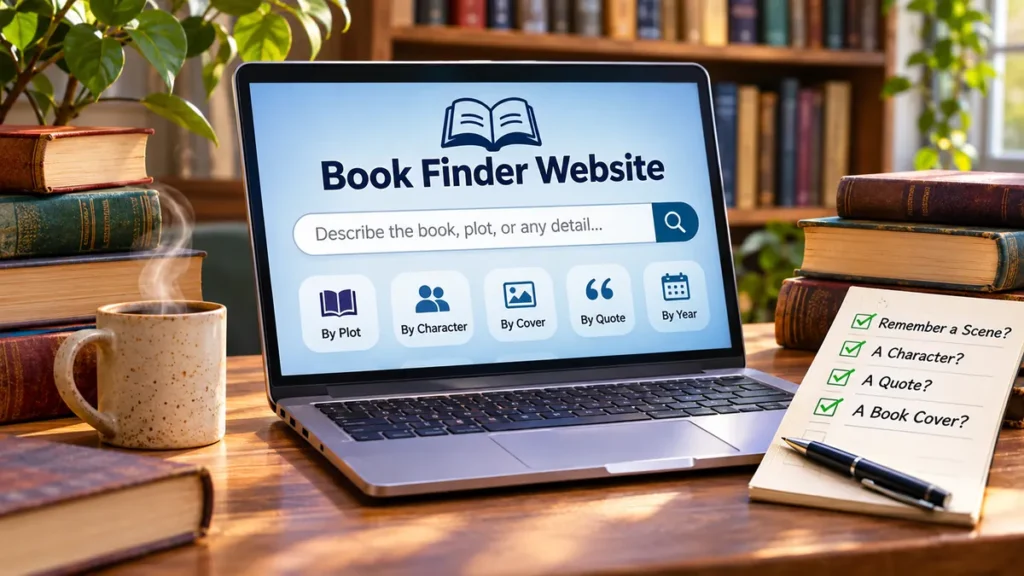
You remember an unforgettable scene, a mysterious character, or the color of a book cover, but the title has completely disappeared from your memory. Searching for that book can feel surprisingly difficult, especially when you cannot remember the author.
A book finder website helps readers identify books using clues such as plot descriptions, character names, memorable quotes, cover designs, genres, or approximate publication dates. Popular options include Google Books, Goodreads, Open Library, WorldCat, and specialized AI book identification tools. The right search method depends on what you remember.
Finding a forgotten book is not always a matter of typing a few keywords into Google. Different search tools examine different information, and knowing which one to use can make a significant difference.
What Is a book finder website?
A book finder website is an online search service designed to help users discover or identify books. Unlike a traditional bookstore search, which often requires a title or author, many book discovery platforms support searches using incomplete information.
These services generally fall into four categories:
- Bibliographic search engines: Search book records by title, author, ISBN, subject, and publication details.
- AI-powered book finders: Interpret natural-language descriptions of plots, characters, and settings.
- Reader communities: Help identify forgotten books through discussions with other readers.
- Library catalogs: Provide structured records that help distinguish editions, translations, and similarly titled books.
For example, someone might remember a novel involving a mysterious mansion, a missing family member, and a series of letters but have no idea what the book was called.
A description-based finder can suggest possible matches, while a library catalog can help verify whether a suggested title actually exists.
The Library of Congress recommends using book databases, library catalogs, and reader communities when searching for forgotten literary works. Research Guides
Best book finder website Options for Different Searches
No single platform works equally well for every situation. Some are particularly useful for exact bibliographic information, while others specialize in identifying books from incomplete memories.
| Website | Best for | Main search method |
|---|---|---|
| Google Books | Quotes, titles, keywords | Book metadata and searchable text |
| Goodreads | Reader suggestions, forgotten titles | Book listings and communities |
| Open Library | Editions, authors, publication records | Library-style catalog search |
| WorldCat | Library holdings and bibliographic records | Advanced catalog filters |
| LibraryThing | Obscure titles and community help | Catalogs and discussion forums |
| What Is That Book? | Forgotten plots and scenes | AI-assisted descriptions |
| What Book Is This? | Plot, character, and cover clues | AI-powered identification |
Google Books: Finding Books Through Text and Keywords
Google Book Search Guide – Library
Google Books is especially helpful when you remember a phrase, a distinctive character name, or a topic discussed in a book.
Its searchable collection includes book descriptions, publication information, and varying levels of text previews.
A practical search might look like:
"the clock stopped at midnight" novel
Quotation marks tell the search engine to look for that particular wording.
However, a missing result does not necessarily mean the book does not exist. Some books have limited previews, incomplete indexing, or no searchable text.
Goodreads: Finding Books Through Other Readers
What Is Goodreads? the Popular Site for Readers
Goodreads combines book discovery with reader reviews, lists, and discussions.
Its community called What’s the Name of That Book??? is particularly relevant for identifying books when readers remember fragments rather than complete titles.
Useful clues to include in a discussion are the approximate year you read the book, its genre, the age of the main character, and any distinctive events.
Goodreads is also useful for browsing books that share themes or settings, although user-created lists are not guaranteed to contain every relevant title.
Open Library: Searching Titles and Editions
Open Library is an initiative of the Internet Archive that provides searchable bibliographic records.
It is particularly useful when you know part of a title, an author’s name, or an approximate publication period.
Because different editions of a book may have different covers, browsing edition records can help identify a copy you remember from childhood.
Open Library also provides information about available reading and borrowing options for some titles, although access varies.
WorldCat: Finding Books in Library Collections
WorldCat brings together catalog records from participating libraries.
It is useful for academic books, translated works, older publications, and titles that are difficult to identify through ordinary web searches.
WorldCat records may include subject classifications, publication dates, languages, formats, and identifiers.
The Library of Congress also identifies WorldCat and its fiction discovery resources as valuable tools for locating books using subjects, characters, settings, and other descriptive information. Research Guides
AI Book Finders: Searching by Description
Specialized services such as What Is That Book? and What Book Is This? accept natural-language descriptions.
Instead of requiring an exact title, these tools let readers explain what they remember.
For example:
A young woman discovers that the rooms inside an unusual house are connected to an ocean, with rising tides and mysterious statues.
An AI-based finder can compare those clues with known book descriptions and return possible matches.
These services are convenient, but results should always be checked against reliable book records. AI systems can misunderstand plot details or suggest incorrect titles. What Book Is This+1
How to Find a Book Without Knowing Its Title or Author
The most effective approach is to start with the strongest clue you remember, rather than writing a long description filled with uncertain details.
Step 1: Write Down Everything You Remember
Before searching, make a short record of your memories.
Include information such as:
- The central event or conflict
- Names or descriptions of characters
- The country, city, or historical period
- Whether the story involved fantasy, romance, mystery, or science fiction
- The approximate year you read it
- The cover’s colors, illustrations, or typography
- Any memorable dialogue or unusual phrases
Separate details you clearly remember from details you are guessing.
For instance, remembering that a story took place in a lighthouse may be reliable, while assuming it was published in the 1990s might be uncertain.
Step 2: Search for the Most Distinctive Detail
Generic descriptions produce broad results.
Compare these two searches:
Broad: book about a girl who goes missing
Specific: mystery novel girl disappears during school camping trip abandoned lighthouse
The second description provides a setting, an event, and a genre.
Even if some details are inaccurate, the additional context can help narrow the possibilities.
Step 3: Try a Description-Based Finder
Enter the strongest clues into an AI book identification tool.
If the first suggestions are incorrect, revise the description rather than repeating the same search.
Add a remembered character name, an unusual event, or the approximate period when you encountered the book.
Step 4: Check the Suggested Titles
Do not assume the first result is correct.
Compare each candidate’s synopsis with your memories. Check character names, major events, setting, and publication information.
When possible, use a publisher’s description, a library catalog, or a legitimate book preview to confirm the match.
Step 5: Ask a Reading Community
If automated tools fail, try a community such as r/whatsthatbook.
A detailed description gives other readers a better chance of recognizing the work.
Include the approximate age group, reading year, language, format, and the details you are most confident about.
How to Find a Book by Plot or Story Description
A plot-based search is useful when the storyline remains familiar but the title and author have been forgotten.
Start by identifying three elements: the protagonist, the central conflict, and a distinctive event.
For example:
A teenage boy discovers that his community has eliminated painful memories. After receiving a special assignment, he begins learning the truth about the society around him.
This description contains several clues associated with The Giver.
The assigned role, controlled community, and discovery of hidden memories distinguish the novel from many other dystopian stories.
Use Character Names When Available
A distinctive character name can be more valuable than an entire paragraph describing a generic plot.
Try combinations such as:
novel character named [name] mystery
fantasy book [character name] kingdom
If you remember only a nickname, search it alongside the genre or setting.
Search for Unusual Scenes
A memorable scene may identify a book more effectively than its broad subject.
For instance, a novel involving a mysterious house with endless halls, statues, and ocean tides points toward Piranesi.
Similarly, a story involving an extraordinary black-and-white circus appearing at night may suggest The Night Circus.
These examples demonstrate why distinctive scenes can be more useful than general descriptions such as “fantasy novel about magic.” What Book Is This
How to Find a Book by Its Cover
Stella & Rose’s Books : Pictorial Bindings | Articles
Classic Books Job Lot for sale | eBay UK
15
Sometimes the cover is the only thing you remember.
You might recall a red background, a golden bird, a mysterious castle, or a silhouette beneath a tree.
A cover-based search can work, but it introduces an important complication: the same book may have several different covers.
Hardcover editions, paperback editions, international releases, and anniversary editions frequently use different artwork.
Search Using Visual Details
Try combining the cover description with the likely genre.
For example:
fantasy novel blue cover silver dragon castle
If the image is particularly distinctive, an image search may reveal matching editions.
Google Images and Google Lens can also help when you have a photograph of the cover.
Check Different Editions
Once you identify a possible title, look through its publication history.
Open Library, Goodreads, and library catalogs may display different editions.
Do not reject a promising title merely because its current cover looks unfamiliar.
Use the Approximate Reading Year
If you read the book around 2008, an edition published in 2024 cannot be the physical copy you remember.
The original book may still be much older, so distinguish the work’s first publication date from the date of a particular edition.
This is especially helpful when identifying childhood books and school reading materials.
Finding a Book by a Quote or Forgotten Phrase
A memorable sentence can be an excellent starting point.
Begin with an exact-phrase search using quotation marks.
For example:
"it was the best of times, it was the worst of times"
This famous opening identifies A Tale of Two Cities.
When you remember a less recognizable passage, try Google Books or another searchable book-text collection.
What If the Quote Is Not Exact?
Human memory often preserves meaning rather than precise wording.
If an exact search fails, remove quotation marks and search the most distinctive words.
You can also substitute likely synonyms or combine the phrase with the book’s genre.
For example, if you remember a line about a clock and a deserted railway station, search those concepts together.
Understand the Limits of Full-Text Search
Not every published book is fully searchable online.
Copyright restrictions, scanning quality, and database coverage can limit what a search engine can find.
A missing phrase is not proof that the book is absent from the collection.
How to Find Children’s Books and Older Publications
Childhood books can be particularly difficult to identify.
Readers may remember illustrations, animal characters, unusual settings, or the emotional tone of a story but almost nothing about the title.
Older books may also have limited online descriptions.
Start With the Intended Reading Age
Determine whether the book was likely a picture book, early reader, middle-grade novel, or young adult title.
This reduces the number of possibilities.
If you encountered the book in a school library, consider the grade level you were in at the time.
Describe Illustrations and Physical Features
For illustrated books, note the artwork style.
Was it watercolor, black-and-white line drawing, cartoon-like, or realistic?
Did the book have large illustrations on every page, or only occasional drawings?
These features can help librarians and reading communities distinguish similar stories.
Search Library Catalogs and Specialist Communities
LibraryThing’s Name That Book forum and Goodreads’ identification discussions are useful places to ask about older titles.
A librarian may also recognize a book from a plot description, subject heading, or unusual illustration.
The Library of Congress specifically recommends reader communities and library reference services for identifying forgotten novels and stories. Research Guides
Using a Book Finder to Discover Similar Books
A book finder website is not limited to identifying forgotten titles. Many platforms also support discovering books with related themes, genres, settings, or writing styles.
For example, someone who enjoyed a historical mystery might search for novels with an unreliable narrator, an isolated setting, or an investigation involving family secrets.
Search by Genre and Subgenre
Broad categories such as fantasy or romance contain thousands of titles.
More specific subgenres can produce more relevant discoveries.
Examples include cozy mystery, historical fantasy, psychological thriller, literary fiction, and space opera.
Search by Theme or Mood
A theme-based search might focus on friendship, survival, identity, grief, or personal transformation.
Mood-based searches can explore atmospheric mysteries, humorous fantasy, comforting fiction, or suspenseful adventures.
These descriptions are subjective, so reader reviews and curated lists can provide useful additional context.
Compare Similar Books Carefully
Two books may share a setting without offering a similar reading experience.
Consider narrative pace, complexity, intended audience, tone, and character development alongside genre.
A slow literary mystery and a fast-paced thriller may both involve a disappearance, yet appeal to different readers.
Free Book Finder Websites vs. AI-Powered Tools
Both traditional catalogs and AI-powered finders have strengths and limitations.
| Feature | Traditional book catalogs | AI-powered book finders |
|---|---|---|
| Exact title searches | Strong | Varies |
| Author and ISBN searches | Strong | Varies |
| Natural-language plot searches | Limited or variable | Often supported |
| Publication metadata | Generally structured | Depends on source |
| Forgotten scene identification | Sometimes difficult | Designed for this |
| Edition comparison | Often available | May be limited |
| Accuracy verification | Useful for confirming records | Requires independent checking |
Traditional catalogs are usually preferable when you have exact bibliographic information.
AI-powered tools are more convenient when you remember only a narrative fragment.
For difficult searches, using both approaches is often more effective than relying exclusively on one.
Are Free Book Finders Reliable?
Many book search services offer free functionality, but their accuracy depends on their underlying collections and search methods.
A catalog may omit a rare publication. An AI finder may return a convincing but incorrect suggestion. A reader community may provide conflicting answers.
Reliability improves when you compare information across independent sources.
Common Mistakes When Searching for a Forgotten Book
Several habits make book identification unnecessarily difficult.
Using Only Generic Keywords
A search for “romantic book about two people” describes an enormous number of novels.
Adding a distinctive setting, event, or character relationship makes the search more useful.
Treating Guesses as Facts
An incorrect publication date or cover color can eliminate the right title.
Keep uncertain details flexible and test searches without them.
Searching Only One Website
Different platforms contain different records and descriptions.
A title missing from one database may be easy to identify in another.
Trusting AI Suggestions Without Verification
General-purpose AI assistants and specialized identification tools can produce inaccurate matches.
Before accepting a suggested book, confirm that the title, author, and plot details correspond to a real publication.
Confusing the Book With Its Adaptation
A remembered scene may come from a film or television adaptation rather than the original novel.
Adaptations sometimes change character names, settings, endings, or important events.
If the plot seems close but not exact, investigate whether the book was adapted.
How to Improve Your Book Search Results
When an initial search fails, use a more systematic approach.
Search with one distinctive clue
Begin with an unusual scene, character name, or exact phrase rather than a broad description.
Refine the query
Add genre, setting, reading age, or approximate publication period. Remove details that may be incorrect.
Verify the candidates
Compare plot summaries, publication records, character details, and available previews.
Ask for human help
Share a detailed description with a reading community or librarian if automated searches fail.
A useful technique is to maintain a small record of unsuccessful searches and rejected titles.
This prevents repeated work and makes it easier to explain what you have already investigated when asking others for help.
For particularly obscure books, include the language in which you read the work. A translated title may differ substantially from the original.
Can a Book Finder Identify Rare or Out-of-Print Books?
Sometimes, but success depends on how much information has been preserved.
Out-of-print books may still appear in library catalogs even when they are unavailable from retailers.
An ISBN, publisher name, approximate publication year, or author surname can help locate older editions.
Books published before ISBN systems became widespread may require searches using title fragments, publishers, or library subject classifications.
Rare books, privately printed works, and regional publications can be more difficult because their metadata may be incomplete.
When online searches produce no credible results, specialist libraries, archives, and professional librarians may offer additional research avenues.
Final Thoughts on Choosing a book finder website
The best book finder website depends on the information you remember.
Google Books is useful for distinctive phrases and searchable text. Goodreads and LibraryThing offer reader communities. Open Library and WorldCat help verify bibliographic information and editions. Specialized AI tools can interpret incomplete descriptions of plots, characters, and scenes.
Start with your strongest memory, search using specific details, and verify promising matches against reliable records.
Even when the title and author have disappeared from memory, a single unusual scene, character, or illustration may provide the clue needed to rediscover the book.