You are writing an email, essay, or important report when you suddenly hesitate: should you use affect or effect? The two words look similar, sound somewhat alike, and often appear in sentences about change.
The difference becomes much easier once you understand what each word does in a sentence.
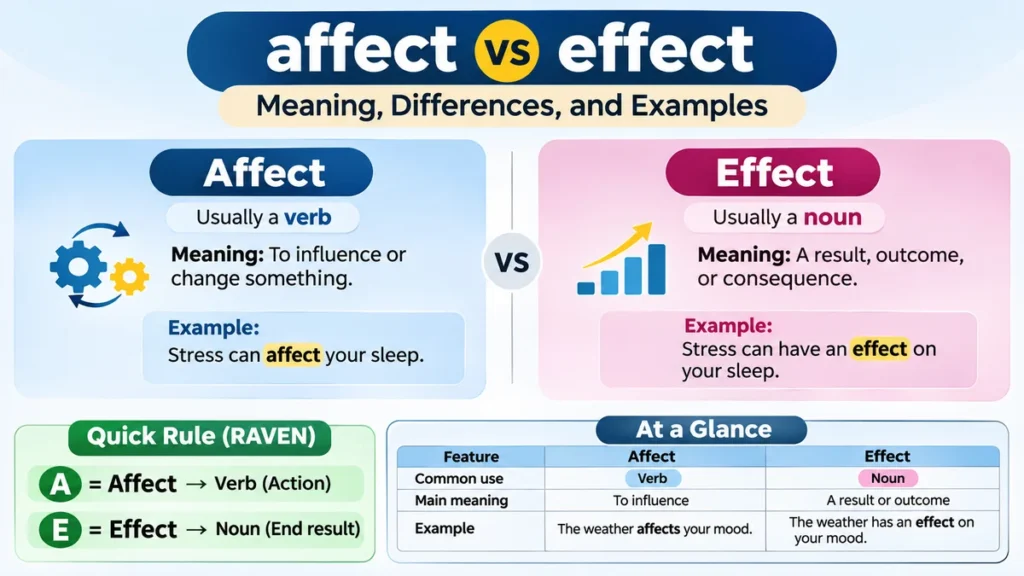
Affect is usually a verb meaning to influence or change something, while effect is usually a noun meaning a result or consequence. For example, stress can affect your sleep, and poor sleep can have an effect on your concentration. Both words also have less common meanings that follow different grammatical rules.
What Is the Difference Between affect vs effect?
The main difference between affect and effect is their grammatical function.
- Affect (verb): To influence, change, or make a difference to something.
- Effect (noun): A result, outcome, or consequence of an action or event.
Consider these sentences:
- The weather can affect your mood.
- The weather can have an effect on your mood.
Both sentences express a similar idea, but they use different grammatical structures.
The first sentence describes what the weather does. The second describes the result or influence of the weather.
Affect vs Effect Comparison Table
| Feature | Affect | Effect |
|---|---|---|
| Common part of speech | Verb | Noun |
| Main meaning | To influence | A result or outcome |
| Main role | Describes an action | Names a consequence |
| Example | Noise affects sleep. | Noise has an effect on sleep. |
| Common forms | Affect, affects, affected, affecting | Effect, effects |
| Less common use | Noun describing emotional expression | Verb meaning to bring about |
| Pronunciation | Usually /əˈfekt/ | Usually /ɪˈfekt/ |
The distinction is especially useful in academic writing, professional communication, scientific explanations, and everyday English.
When to Use Affect in a Sentence
Affect is most commonly a verb. It describes an action that influences someone or something.
The usual sentence structure is:
Subject + affect + object
For example:
- Exercise can affect your energy levels.
- Social media may affect how people communicate.
- High temperatures affect plant growth.
- Your attitude can affect your performance at work.
- A sudden change in plans affected everyone.
In each sentence, affect describes an influence on a person, situation, condition, or process.
Does Affect Mean Change or Influence?
Affect generally means to influence or produce a change in something.
However, it does not necessarily mean that a major change occurs.
For example:
“The new policy may affect employee schedules.”
This sentence tells readers that the policy could influence schedules. It does not specify whether the changes will be positive, negative, large, or small.
Affect can also describe an influence without identifying its exact outcome.
For instance:
“Weather conditions affect flight operations.”
The sentence establishes a relationship between weather and flight operations without explaining every possible consequence.
Examples of Affect in Everyday English
Here are several common situations where affect is the correct choice.
Education
- Lack of sleep can affect students’ concentration.
- Regular practice affects how quickly people learn new skills.
Health
- Dehydration can affect physical performance.
- Certain medications may affect appetite.
Business
- Customer feedback can affect product development.
- Inflation affects purchasing power.
Technology
- Internet speed can affect video quality.
- Software updates sometimes affect device performance.
Relationships
- Poor communication can affect trust.
- Kind words can positively affect someone’s confidence.
A useful test is to replace affect with influence.
If the sentence still makes sense, affect is probably the correct word.
For example:
“Stress can influence productivity.”
Because influence fits naturally, affect also works.
When to Use Effect in a Sentence
Effect is most commonly a noun referring to a result, consequence, or change caused by something else.
It often appears after words such as an, the, some, many, or several.
Examples include:
- The medicine had a positive effect.
- The new law produced several unexpected effects.
- The speech had a powerful effect on the audience.
- Regular exercise has beneficial effects on health.
- The storm’s effects were visible throughout the town.
In these sentences, effect names the outcome rather than describing the action that produces it.
What Does Effect Mean?
Effect refers to something that happens because of an action, event, decision, or condition.
For example:
“The new teaching method had a positive effect on student performance.”
Here, effect refers to the outcome associated with the teaching method.
The word is closely related to cause-and-effect relationships.
A cause is something that produces or contributes to an outcome. An effect is the outcome itself.
Consider this example:
- Cause: Heavy rainfall
- Effect: Flooding in low-lying areas
The relationship can be expressed as:
“Heavy rainfall caused flooding.”
Or:
“Flooding was an effect of heavy rainfall.”
Both sentences describe the same basic causal relationship.
Common Phrases Using Effect
Effect appears in several frequently used English expressions.
| Expression | Meaning | Example |
|---|---|---|
| Have an effect on | Influence something | Music can have an effect on mood. |
| Take effect | Begin operating or applying | The new rules take effect tomorrow. |
| In effect | In operation or essentially | The regulation remains in effect. |
| Side effect | Additional, often unwanted result | Drowsiness can be a side effect. |
| Cause and effect | Relationship between events and outcomes | Scientists study cause and effect. |
| Come into effect | Become officially active | The agreement comes into effect in June. |
| With immediate effect | Starting immediately | The policy changed with immediate effect. |
| To no effect | Without producing the desired result | They searched for hours, to no effect. |
These expressions help explain why effect appears so frequently in news articles, scientific writing, legal documents, and business communication.
Affect vs Effect: Easy Rules to Remember
The easiest way to distinguish affect from effect is to remember their most common grammatical roles.
The RAVEN Memory Trick
A popular mnemonic is RAVEN:
A
Affect
Verb — Action
E
Effect
Noun — End result
RAVEN = Remember: Affect Verb, Effect Noun
This memory trick works for most everyday sentences.
For example:
“Cold weather affects battery performance.”
Affect is a verb because it describes what cold weather does.
“Cold weather has an effect on battery performance.”
Effect is a noun because it names the influence or result.
The Action and End-Result Trick
Another simple method is to associate:
- A in affect with action.
- E in effect with end result.
Consider:
“Poor planning affected the project.”
The sentence focuses on the action or influence.
“The effect of poor planning was a delayed project.”
The sentence focuses on the outcome.
These shortcuts are useful, although they do not cover every possible use of the words.
The Replacement Test
When you are unsure, try substituting a simpler word.
For affect, use influence:
“Does caffeine affect sleep?”
“Does caffeine influence sleep?”
Both sentences work.
For effect, use result:
“What was the effect of the decision?”
“What was the result of the decision?”
Again, both sentences work.
This test is particularly helpful when editing essays, reports, and professional emails.
Affect vs Effect Examples in Sentences
Seeing both words in similar contexts makes their differences easier to recognize.
The following examples show how the same idea can be expressed using either affect or effect.
| Affect (verb) | Effect (noun) |
|---|---|
| Rain affects road conditions. | Rain has an effect on road conditions. |
| Stress affects memory. | Stress can have an effect on memory. |
| Technology affects communication. | Technology has an effect on communication. |
| Exercise affects physical fitness. | Exercise has an effect on physical fitness. |
| Pollution affects air quality. | Pollution has harmful effects on air quality. |
| Prices affect consumer decisions. | Price changes have an effect on consumer decisions. |
| Sleep affects concentration. | Sleep has an effect on concentration. |
| Leadership affects team morale. | Leadership has an effect on team morale. |
Notice that the underlying meaning remains similar.
The difference lies in whether the sentence uses a verb to describe influence or a noun to identify that influence.
Affect vs Effect in Academic Writing
Academic writing frequently discusses relationships between variables, events, and outcomes.
For example:
“Temperature affects the rate of evaporation.”
Here, affects describes the relationship between temperature and evaporation.
“The effect of temperature on evaporation was measured.”
Here, effect is a noun referring to the influence being investigated.
Another example:
“Researchers examined how light exposure affects plant growth.”
Compare that with:
“Researchers examined the effect of light exposure on plant growth.”
Both are grammatically correct.
However, an important scientific distinction remains: observing an association does not automatically establish causation. Researchers must consider their study design and evidence before claiming that one factor produces a particular effect.
Affect vs Effect in Professional Emails
These words often appear in workplace messages.
Correct examples include:
“The updated schedule will affect tomorrow’s meeting.”
“The changes will take effect on Monday.”
“We are reviewing how the new process affects productivity.”
“The policy had an unexpected effect on response times.”
Using the correct word makes communication more precise and reduces ambiguity.
Exceptions: When Affect Is a Noun and Effect Is a Verb
The familiar rule that affect is a verb and effect is a noun works in most situations. However, English has exceptions.
Both words can function as nouns and verbs, although their less common uses have specialized meanings. MLA Style Center+1
Effect as a Verb: To Bring About Change
Effect can be a verb meaning to cause, accomplish, or bring something into existence.
This usage is more formal and often appears in discussions about leadership, policy, government, and organizational change.
Examples:
- The new manager hopes to effect meaningful improvements.
- The organization worked to effect social change.
- The committee introduced measures to effect a transition.
- The government attempted to effect reforms.
The distinction between affect change and effect change is particularly important.
Affect change means to influence a change that is happening.
Effect change means to bring about or accomplish change.
For example:
“The new manager affected the changes.”
This suggests that the manager influenced changes.
“The new manager effected the changes.”
This means the manager brought those changes about.
The difference is subtle but meaningful, especially in formal writing.
Affect as a Noun: Emotional Expression
Affect can also be a noun in psychology and psychiatry.
In this context, affect refers to observable emotional expression, including facial expressions, gestures, and tone of voice.
For example:
“The clinician observed a flat affect.”
A flat affect describes a marked reduction in outward emotional expression.
Other expressions include:
- Blunted affect: Reduced intensity of emotional expression.
- Restricted affect: A limited range of observable emotional expression.
- Labile affect: Emotional expression that changes rapidly or markedly.
- Appropriate affect: Emotional expression that fits the situation.
These terms describe observed emotional presentation rather than necessarily revealing everything a person feels internally.
This specialized meaning is recognized in clinical and psychological terminology. English meaning – Cambridge Dictionary+1
Affect Can Also Mean to Pretend
Affect has another verb meaning: to adopt or display a manner, attitude, or characteristic, sometimes artificially.
For example:
“He affected a sophisticated accent.”
This means he deliberately adopted that accent.
“She affected an air of indifference.”
This suggests that she presented herself as indifferent, whether or not she genuinely felt that way.
The related adjective affected can describe behavior that seems unnatural or designed to impress others.
This meaning is less common than affect meaning influence, but it appears in literary and descriptive writing.
Affected vs Effected: What Is the Difference?
Affected and effected are the past-tense forms of two different verbs.
Affected means influenced, changed, or emotionally moved.
Effected means brought about, achieved, or caused to happen.
Consider these examples:
“The storm affected several communities.”
The storm influenced or harmed those communities.
“The negotiations effected a peaceful resolution.”
The negotiations brought about the resolution.
| Word | Meaning | Example |
|---|---|---|
| Affected | Influenced or changed | The delay affected our plans. |
| Effected | Brought about or achieved | The reforms effected lasting improvements. |
| Affecting | Influencing or changing | The noise is affecting concentration. |
| Effecting | Bringing about | The team is effecting a transition. |
Is It Affected by or Effected by?
In ordinary English, affected by is almost always the correct expression when describing something influenced by another factor.
Correct:
“The village was affected by the earthquake.”
Incorrect for the intended meaning:
“The village was effected by the earthquake.”
The second sentence would suggest that the earthquake brought the village into existence, which is not the intended meaning.
However, effected by can be grammatically correct in a different context:
“The transition was effected by a new leadership team.”
Here, the leadership team accomplished the transition.
The surrounding meaning determines which word is appropriate.
Common Affect vs Effect Grammar Mistakes
Most mistakes occur when writers choose a word based on sound rather than its grammatical function.
Here are some frequent errors and their corrections.
| Incorrect | Correct |
|---|---|
| The weather will effect our plans. | The weather will affect our plans. |
| The medicine had a strong affect. | The medicine had a strong effect. |
| Stress can effect your health. | Stress can affect your health. |
| The new rules will take affect tomorrow. | The new rules will take effect tomorrow. |
| What affect did the change have? | What effect did the change have? |
| The decision effected everyone. | The decision affected everyone. |
These corrections follow the ordinary verb-and-noun distinction. The specialized meanings discussed earlier may justify different choices in other contexts.
Is It Positive Affect or Positive Effect?
Both expressions are possible, but they mean different things.
Positive effect refers to a beneficial result.
For example:
“Regular exercise can have a positive effect on well-being.”
Positive affect is a psychological term referring to positive emotional experience or expression.
For example:
“The researchers measured positive affect using a questionnaire.”
In everyday writing about beneficial outcomes, positive effect is usually the intended expression.
Is It Negative Affect or Negative Effect?
The same distinction applies.
A negative effect is an undesirable consequence.
“Poor sleep can have a negative effect on concentration.”
In psychology, negative affect refers to unpleasant emotional states, such as distress, fear, or irritability.
“The study examined the relationship between stress and negative affect.”
When describing harmful consequences in ordinary English, negative effect is generally correct.
Is It Affect My Life or Effect My Life?
The natural expression is:
“How will this affect my life?”
Affect is correct because the sentence asks how something will influence your life.
You could also write:
“What effect will this have on my life?”
Both versions are correct, but they use different grammatical structures.
How to Pronounce Affect and Effect
Affect and effect are often pronounced similarly, which contributes to confusion.
In their common uses, both words have stress on the second syllable.
- Affect (verb): uh-FEKT — /əˈfekt/
- Effect (noun): ih-FEKT — /ɪˈfekt/
The first vowel can sound very similar in natural speech, depending on the speaker’s accent.
The noun affect, used in psychology, is typically pronounced differently:
– Affect (noun): AF-ekt — /ˈæfekt/
Here, the stress moves to the first syllable.
Because pronunciation alone is not always reliable, grammatical context is the better way to choose the correct spelling.
Affect vs Effect Practice Exercises
The following exercises test the common rules and the less common exceptions.
Choose the correct word
0 of 8 answered
1. Lack of sleep can ___ your memory.affecteffect
2. The new policy had a noticeable ___ on attendance.affecteffect
3. The new rules will take ___ next week.affecteffect
4. The manager hopes to ___ meaningful change.affecteffect
5. The storm ___ several coastal towns.affectedeffected
6. The reforms ___ a major improvement.affectedeffected
7. The clinician observed a flat ___.affecteffect
8. What ___ did the announcement have on employees?affecteffect
Check Answers
Final Tips for Choosing Affect vs Effect Correctly
The most reliable approach is to identify what the word is doing in your sentence.
When describing an influence, use affect as a verb:
“Changes in temperature affect water consumption.”
When naming a result or consequence, use effect as a noun:
“The effect of higher temperatures was increased water consumption.”
Remember the two important exceptions: effect can be a verb meaning to bring about something, while affect can be a noun describing emotional expression.
For everyday writing, the RAVEN memory trick remains a useful starting point: Affect is usually a Verb; Effect is usually a Noun.
Once you recognize whether your sentence describes an action or its result, choosing between affect vs effect becomes much simpler.