An online store can offer excellent products, competitive prices, and a smooth checkout experience yet struggle to attract customers from Google. Often, the problem is not the products themselves. It is how search engines discover, understand, and rank the store’s pages.
An ecommerce seo agency specializes in improving the organic search visibility of online retailers. Unlike general SEO providers, these agencies work with product catalogs, category pages, inventory changes, technical indexing challenges, and shopping-related search behavior.
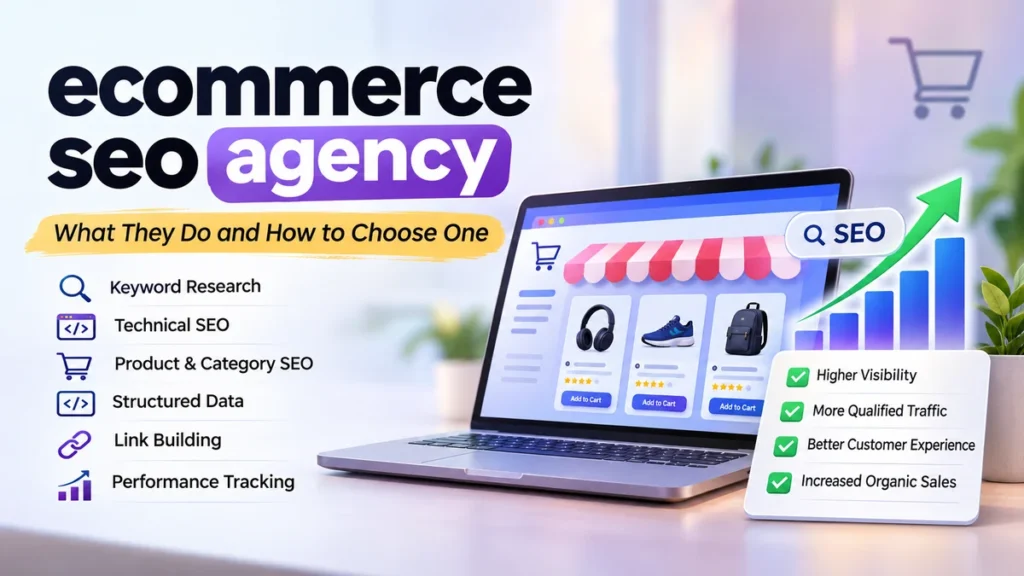
An ecommerce seo agency helps online stores improve their visibility in organic search by optimizing product pages, category structures, technical performance, structured data, and website authority. Its work combines search intent research, crawlability improvements, content optimization, and performance measurement to attract relevant shoppers and increase revenue from unpaid search traffic.
Understanding how these agencies operate makes it easier to evaluate their services, interpret their recommendations, and decide whether specialist support is appropriate for a particular store.
What Does an ecommerce seo agency Actually Do?
An ecommerce SEO agency provides specialized search engine optimization services for websites that sell physical or digital products online.
Its primary responsibility is to connect a store’s product offerings with the language potential customers use when searching.
For example, an online retailer selling running shoes might want to appear for searches such as:
- Waterproof running shoes for men
- Best trail running shoes for beginners
- Lightweight running shoes for women
- Running shoes for flat feet
These searches represent different customer needs. Some shoppers are researching product features, while others are comparing specific options.
An agency studies those differences and develops pages that satisfy each search intent.
How Ecommerce SEO Differs From Traditional SEO
Traditional SEO and ecommerce SEO share several principles, including keyword research, technical optimization, content quality, and backlinks.
However, online stores introduce additional complexity.
| SEO area | General website SEO | Ecommerce SEO |
|---|---|---|
| Primary pages | Articles and service pages | Categories and product pages |
| Keyword targeting | Informational and service queries | Product, comparison, and shopping queries |
| Technical challenges | Indexing, speed, redirects | Product variants, filters, pagination, duplicate URLs |
| Content strategy | Educational and service content | Product descriptions, buying guides, category content |
| Structured data | Article, Organization, LocalBusiness | Product, Offer, Review, BreadcrumbList |
| Performance measurement | Leads, engagement, traffic | Organic transactions, revenue, conversion rate |
An online store with thousands of products may generate considerably more URLs through color variants, size filters, sorting options, and collections.
Managing these URLs requires a different approach from optimizing a small business website.
For this reason, ecommerce specialists frequently work alongside developers, merchandising teams, content writers, and analytics professionals.
Core Services Provided by an ecommerce seo agency
Most ecommerce SEO programs combine several interconnected services. Each addresses a different barrier preventing an online store from performing well in search results.
1. Ecommerce SEO Audits
An ecommerce SEO audit examines the website to identify technical, structural, and content-related problems.
The process typically involves reviewing:
- Crawlability and indexability
- XML sitemaps and robots.txt directives
- Canonical tags and duplicate URLs
- Product and category page optimization
- Internal linking and site architecture
- Mobile usability and Core Web Vitals
- Structured data implementation
- Organic search performance
Tools such as Google Search Console, Screaming Frog SEO Spider, Ahrefs, and Semrush help identify different types of issues.
For example, Search Console may reveal that important product pages are not indexed. A website crawler can then help investigate whether those pages are blocked, poorly linked, duplicated, or assigned incorrect canonical URLs.
A useful audit does more than generate a list of warnings. It prioritizes problems according to their likely business impact.
2. Ecommerce Keyword Research and Search Intent Mapping
Keyword research determines how potential customers search for products and which pages should target those searches.
An effective strategy separates keywords into distinct groups.
| Keyword type | Example | Suitable page |
|---|---|---|
| Broad category | Men’s running shoes | Category page |
| Specific product | Nike Pegasus running shoes | Product or collection page |
| Product comparison | Trail vs road running shoes | Comparison guide |
| Informational | How to choose running shoes | Educational article |
| Feature-based | Waterproof trail running shoes | Filtered or dedicated category page |
The challenge is not simply finding keywords with high search volume.
An agency must determine whether a keyword deserves a dedicated page and whether the store has relevant products to satisfy the query.
Creating multiple pages that target essentially the same search intent can lead to keyword cannibalization.
For instance, separate pages titled “Men’s Running Shoes” and “Running Shoes for Men” may compete unnecessarily if both offer the same products and serve the same purpose.
Keyword mapping helps prevent this overlap.
3. Product Page SEO Optimization
Product pages are central to ecommerce search visibility because they contain the information customers need before purchasing.
A well-optimized product page typically includes a descriptive title, original product information, useful specifications, relevant images, availability details, and clear internal links.
Consider a product titled simply “Wireless Headphones.”
That title provides limited information.
A more descriptive version might be:
Wireless Noise-Cancelling Headphones with 40-Hour Battery Life
The improved title communicates relevant product characteristics without relying on unnecessary keyword repetition.
Unique Product Descriptions
Manufacturer descriptions are often reused across multiple retailers.
Although duplicate manufacturer text does not automatically trigger a penalty, it may make it harder for a retailer’s page to offer distinctive value.
Useful original descriptions can explain:
- Who the product is designed for
- Its important features and specifications
- Practical usage scenarios
- Compatibility and sizing information
- Differences from related models
- Maintenance or care requirements
The goal is to help customers make informed decisions rather than simply increase word count.
Product Images and Accessibility
Product imagery also contributes to page quality.
Descriptive file names, appropriate alternative text, responsive image dimensions, and modern compression formats can improve accessibility and performance.
Alternative text should describe the image accurately, not become a collection of keywords.
4. Category Page Optimization
Category pages often represent significant organic search opportunities because they organize multiple relevant products around a broader customer need.
For example, a footwear retailer might structure its catalog as:
Footwear
Men’s Shoes
Women’s Shoes
Running Shoes
Walking Shoes
Illustrative category hierarchy; actual subcategories should follow the store’s catalog and customer demand.
An agency reviews category names, heading structures, introductory descriptions, product organization, and internal links.
Category descriptions should explain what shoppers can find and offer genuinely useful guidance.
For instance, a hiking boots category might explain waterproofing, ankle support, sole materials, and terrain suitability.
This makes the page more useful than a generic product grid accompanied by repetitive SEO text.
5. Technical SEO for Ecommerce Websites
Technical SEO ensures search engines can access, interpret, and index the pages that matter.
It is especially important for large ecommerce websites.
Faceted Navigation and URL Parameters
Faceted navigation allows shoppers to filter products by attributes such as color, size, brand, or price.
A single category might generate URLs like:
/shoes/
/shoes/?color=black
/shoes/?size=10
/shoes/?color=black&size=10
These filters improve usability, but unrestricted combinations can create large numbers of low-value URLs.
An ecommerce SEO specialist decides which filtered pages deserve search visibility and which should remain accessible primarily for shoppers.
Possible solutions include canonicalization, crawl controls, and selective indexing.
These controls must be implemented carefully. A canonical tag is a signal rather than a guaranteed instruction, and blocking a URL through robots.txt can prevent crawlers from seeing its canonical tag.
Product Variants and Duplicate Content
Products may have several colors, sizes, or configurations.
An agency evaluates whether variants should share a primary product URL or have separate indexable pages.
The correct decision depends on whether the variants satisfy distinct search demand and contain sufficiently differentiated information.
Pagination and Product Discovery
Large collections may contain hundreds of products across multiple pages.
Crawlable pagination links and a logical internal linking structure help search engines discover deeper products.
Important product URLs should not depend exclusively on interactions that search crawlers cannot reliably follow.
Core Web Vitals
Google’s Core Web Vitals assess important aspects of user experience.
Good Core Web Vitals thresholds
LCP
≤ 2.5s
Loading
INP
≤ 200ms
Responsiveness
CLS
≤ 0.1
Visual stability
Good thresholds are evaluated at the 75th percentile of real-user page experiences.
Large product images, excessive JavaScript, third-party apps, and poorly optimized themes can negatively affect these metrics.
However, achieving good performance scores does not guarantee higher rankings. Page relevance, content quality, and other ranking signals remain essential.
6. Product Structured Data and Shopping Visibility
Structured data helps search engines interpret product information.
Ecommerce websites commonly use Schema.org vocabulary, including:
- Product
- Offer
- AggregateRating
- Review
- BreadcrumbList
- Organization
Valid product markup can help eligible pages display enhanced search features such as prices, availability, and ratings.
However, structured data does not guarantee rich results.
An agency should ensure that marked-up information matches what customers can actually see on the page.
For example, a product marked as in stock should not display an out-of-stock message to visitors.
Google Merchant Center Integration
Google Merchant Center allows eligible retailers to provide product information to Google.
Product feeds can contain attributes such as identifiers, titles, images, prices, availability, shipping information, and product categories.
Accurate feed data supports shopping-related visibility and reduces inconsistencies between the store and Google’s product listings.
Google’s own ecommerce guidance emphasizes accurate product data, structured attributes, and technical accessibility as foundational elements of store optimization. Shopify Pakistan+1
7. Content Marketing and Topical Authority
Product and category pages are not always sufficient to answer every question customers ask.
Educational content helps cover informational searches that occur earlier in the buying journey.
For example, an outdoor equipment store might publish guides about choosing camping tents, understanding sleeping bag temperature ratings, or comparing hiking backpack materials.
These articles can link naturally to relevant product collections.
The important distinction is that content should solve a genuine problem.
Publishing hundreds of shallow articles around loosely related keywords rarely creates a strong long-term strategy.
A focused content plan connects customer questions, product expertise, and existing website categories.
8. Link Building and Digital PR
Backlinks from relevant websites can help search engines discover content and evaluate its authority.
Ecommerce agencies may support link acquisition through original research, product expertise, useful resources, industry partnerships, and digital public relations.
For example, a sports equipment retailer could publish a well-researched report on equipment durability that relevant publications choose to reference.
Not every backlink has equal value.
Links from unrelated websites, automated networks, or placements created primarily to manipulate rankings may introduce unnecessary risk.
Google’s spam policies prohibit link schemes intended to manipulate search rankings.
A trustworthy agency should explain its link acquisition methods, identify the kinds of publications it targets, and avoid guaranteeing specific rankings through purchased links.
Ecommerce SEO Across Different Platforms
Online stores operate on different content management and commerce platforms.
Each platform introduces specific technical considerations.
TOOLS WE LOVE – Ecommerce Documentation
Shopify
Shopify SEO involves collection templates, product URLs, theme performance, apps, canonical handling, and product data. Agencies must understand the platform’s routing and theme limitations.
Best WooCommerce Hosting: Tested & Ranked in 2025
WooCommerce
WooCommerce operates within WordPress and offers substantial flexibility. Common concerns include plugin conflicts, hosting performance, taxonomy archives, product variations, and theme optimization.
Adobe Commerce (Magento)
Adobe Commerce often supports complex catalogs and multiple storefronts. SEO challenges may include layered navigation, canonical rules, rendering, international storefronts, and large-scale indexing.
BigCommerce Logo Vector PNG | BigCommerce E‑commerce Platform Emblem – freepng
BigCommerce
BigCommerce SEO commonly involves category organization, URL configuration, product data, structured markup, and theme performance. Headless implementations may require additional rendering analysis.
Platform experience matters because a recommendation that works on one system may require a completely different implementation on another.
For example, optimizing a WordPress database and caching stack is not the same as improving a hosted Shopify theme.
How an Ecommerce SEO Agency Develops a Strategy
A structured SEO program generally follows a sequence of research, prioritization, implementation, and measurement.
- Discovery and performance baselineReview business goals, product categories, historical organic traffic, analytics configuration, and previous SEO changes.
- Technical and content auditIdentify indexing problems, weak category structures, duplicate content, slow templates, and missing product information.
- Keyword mapping and prioritizationConnect search demand to appropriate product, category, and educational pages. Prioritize opportunities using relevance, competition, and potential commercial impact.
- ImplementationImprove templates, metadata, internal links, content, structured data, and technical configurations in coordination with developers.
- Monitoring and refinementEvaluate organic visibility, transactions, revenue, and indexing changes. Adjust the strategy using measured results rather than assumptions.
The sequence is not strictly linear. Ecommerce SEO requires ongoing attention because new products, discontinued inventory, platform updates, and seasonal demand continually change the website.
How Much Does an ecommerce seo agency Cost?
Ecommerce SEO pricing varies according to catalog size, technical complexity, market competition, and the services included.
Agencies may charge monthly retainers, project-based fees, or hourly consulting rates.
Published agency pricing in 2026 spans from relatively small specialist engagements to comprehensive retainers costing several thousand dollars per month. Some providers advertise retainers starting around $2,000–$2,500, while others describe $4,000–$10,000 or more for extensive programs. These are provider-published examples, not a verified market-wide average. charleagency.com+2
Common Pricing Models
| Model | How it works | Typical use |
|---|---|---|
| Monthly retainer | Recurring fee for ongoing SEO work | Continuous optimization |
| Fixed project | Agreed price for defined deliverables | Technical audit or migration |
| Hourly consulting | Payment for specialist time | Troubleshooting or advisory work |
| Hybrid engagement | Initial project followed by ongoing support | Audit, implementation, and monitoring |
A store with 50 products may need a different level of support from one managing 50,000 SKUs across several countries.
A lower monthly fee is not automatically better value.
The scope of work, implementation responsibility, specialist expertise, and reporting quality matter more than the headline price.
What Influences Ecommerce SEO Pricing?
Several factors affect the amount of work required.
Catalog size: Larger product inventories create more opportunities for duplication, crawl inefficiency, and template-related problems.
Competition: Highly competitive categories may require extensive content improvements and stronger authority signals.
Platform complexity: Custom ecommerce systems and headless storefronts can demand specialized development knowledge.
International targeting: Multiple languages, currencies, and regional storefronts add technical and editorial requirements.
Implementation scope: An agency that performs development work directly may charge differently from one that provides recommendations to an internal team.
Businesses should request clear deliverables before comparing proposals.
How to Choose the Right Ecommerce SEO Agency
Selecting an agency requires more than reviewing its website or examining a list of clients.
The most useful evaluation focuses on relevant experience, methodology, transparency, and measurable outcomes.
Check Ecommerce-Specific Experience
An agency should understand the platform and catalog structure used by the store.
Ask for examples involving comparable product inventories, customer markets, and technical challenges.
A specialist experienced with large apparel catalogs may have valuable knowledge of product variants and filtering systems.
An agency working primarily with small local businesses may need additional expertise before handling the same problems.
Review Case Studies Carefully
Case studies should explain the original problem, actions taken, measurement period, and resulting changes.
For example, a case study claiming a 150% increase in organic traffic is more useful when it also shows whether the additional visitors generated qualified transactions.
Seasonality, promotions, brand campaigns, and tracking changes can affect performance.
Results should therefore be interpreted in context.
Understand the Proposed Deliverables
A detailed proposal should identify what work will actually be completed.
Examples include:
- Technical audit and prioritized recommendations
- Category keyword mapping
- Product template improvements
- Internal linking changes
- Structured data validation
- Monthly performance analysis
Vague promises such as “complete optimization” provide little information about the work involved.
Evaluate Communication and Reporting
SEO recommendations often require coordination between marketing and development teams.
An effective agency should communicate technical issues in language that business stakeholders can understand.
Reports should distinguish completed work, observed results, unresolved problems, and next priorities.
Recognize Warning Signs
Certain claims deserve additional scrutiny.
Be cautious when a provider guarantees first-place Google rankings, refuses to explain its methods, offers large volumes of unrelated backlinks, or reports only keyword positions without discussing business outcomes.
Google explicitly advises that nobody can guarantee a number-one ranking. QCK+1
A credible agency should explain both the potential benefits and the limitations of its strategy.
Ecommerce SEO Agency vs Freelancer vs In-House Team
Not every online retailer needs a full-service agency.
The appropriate arrangement depends on the store’s complexity, available expertise, and implementation requirements.
| Consideration | SEO agency | Freelancer | In-house SEO team |
|---|---|---|---|
| Expertise | Multiple specialists may be available | Depends on individual skills | Depends on hiring |
| Scalability | Often suitable for broad projects | May have capacity limits | Can expand through recruitment |
| Communication | Requires external coordination | Usually direct | Integrated with internal teams |
| Cost structure | Retainer or project fees | Hourly or project fees | Salaries and operational costs |
| Business familiarity | Develops over the engagement | Develops over the engagement | Usually deeper over time |
| Best fit | Complex or ongoing SEO programs | Defined specialist tasks | Businesses needing continuous internal control |
A freelancer may be appropriate for a targeted technical audit or keyword research project.
An agency may be useful when a store needs coordinated technical, editorial, analytical, and authority-building work.
An in-house team can provide closer integration with merchandising, product management, and development.
Some retailers use a hybrid model, retaining internal ownership while consulting external specialists for particular projects.
How to Measure Ecommerce SEO Performance
SEO success should be measured through outcomes that connect search visibility with business performance.
Rankings are useful diagnostic indicators, but they are not the complete picture.
Organic Search Traffic
Organic traffic measures visitors arriving through unpaid search results.
A sustained increase can indicate improved visibility, but traffic quality matters.
A large increase in informational visitors may have limited commercial impact if those visitors are unrelated to the products being sold.
Non-Branded Search Visibility
Branded searches include the retailer’s name.
Non-branded searches describe products or problems without naming the business.
Tracking both helps distinguish existing brand demand from broader search discovery.
Organic Revenue and Transactions
Organic revenue measures sales attributed to organic search under a particular analytics attribution model.
It can be tracked using ecommerce events in Google Analytics 4.
Attribution is not perfect. Customers may discover a product through organic search and return later through email, direct navigation, or paid advertising.
Consequently, reported organic revenue should be interpreted alongside other business metrics.
Ecommerce Conversion Rate
Conversion rate shows the percentage of sessions or users that produce a purchase, depending on the chosen measurement definition.
For example, if 10,000 organic sessions generate 250 purchases:
\[ \text{Conversion Rate}=\frac{250}{10,000}\times100=2.5\% \]
Improving organic traffic without improving the relevance or quality of visitors may not increase sales proportionally.
Organic Search Revenue Example
Illustrative ecommerce performance
Before optimization
$12,000
Monthly organic revenue
After optimization
$18,000
Monthly organic revenue
$0$5,000$10,000$15,000$20,000BeforeAfter
Hypothetical example only; not an agency case study.
This represents a 50% increase in attributed monthly organic revenue. It does not establish that SEO alone caused the change.
Other useful metrics include click-through rate, indexed product coverage, revenue per landing page, average order value, and returning customer behavior.
The strongest measurement approach combines technical indicators with commercial outcomes.
How Long Does Ecommerce SEO Take to Show Results?
Ecommerce SEO does not follow a universal timeline.
Some technical improvements can produce observable changes relatively quickly after search engines recrawl affected pages.
Competitive category rankings and substantial organic revenue growth may require several months or longer.
The timeline depends on factors such as website history, technical condition, competition, search demand, and the pace of implementation.
A newly launched store competing against established retailers may need more time than an established store fixing a major indexing problem.
It is also important to distinguish between work completion and measurable results.
For example, correcting canonical tags may be completed in a development sprint, but search engines still need to recrawl and process the affected URLs.
Similarly, publishing a new category page does not mean it will immediately earn significant rankings.
An agency should establish realistic milestones and explain which outcomes are within its control.
Advanced Ecommerce SEO Considerations
As stores grow, additional SEO challenges become more important.
International Ecommerce SEO
Retailers targeting multiple countries may need separate regional URLs, localized content, currency information, and appropriate hreflang annotations.
For example, a retailer serving customers in the United States and United Kingdom may need to account for differences in terminology, shipping policies, product availability, and pricing.
Hreflang helps search engines understand language and regional alternatives. It does not replace canonicalization or automatically guarantee regional rankings.
Out-of-Stock and Discontinued Products
Inventory changes create recurring SEO decisions.
A temporarily unavailable product may still deserve an accessible page with accurate stock information and relevant alternatives.
A permanently discontinued product may require a different approach.
If a close replacement exists, a redirect might be appropriate. If the original page remains useful, keeping it accessible may be better. If the product has no replacement and no continuing value, a proper removal response may be suitable.
Automatically redirecting every discontinued product to the homepage is generally poor practice.
Ecommerce Website Migrations
Moving from WooCommerce to Shopify, changing domain names, or restructuring product URLs can affect search visibility.
A migration plan should account for:
- Existing organic landing pages
- URL redirects and mapping
- Canonical relationships
- Internal links
- XML sitemaps
- Structured data
- Analytics continuity
- Post-launch crawl monitoring
A poorly planned migration can cause previously indexed pages to disappear or lose relevant signals.
SEO specialists should therefore be involved before major structural changes are deployed.
AI Search and Product Discovery
Product information may appear across conventional search results, shopping interfaces, AI-generated summaries, and conversational discovery tools.
This makes accurate product attributes, accessible content, clear descriptions, and consistent merchant information increasingly valuable.
However, no agency can guarantee inclusion in an AI-generated answer or recommendation.
Optimizing for AI discovery should complement foundational SEO rather than replace technical accessibility, useful content, and accurate product data.
Recent ecommerce SEO guidance increasingly addresses product feeds, structured information, and AI-assisted discovery alongside traditional search optimization. Shopify Pakistan+1
Common Ecommerce SEO Mistakes to Avoid
Several recurring mistakes limit organic search performance.
Prioritizing blog traffic over product discovery: Educational articles can be valuable, but ignoring category pages may leave important shopping searches underserved.
Indexing every filter combination: Large numbers of near-identical URLs can complicate crawling and indexing.
Using identical descriptions across products: Repetitive content may fail to explain meaningful product differences.
Removing unavailable products without a plan: Unnecessary deletions can disrupt useful URLs and customer navigation.
Overlooking mobile performance: Heavy images, excessive scripts, and intrusive interface elements can make shopping difficult.
Measuring only keyword rankings: Rankings do not reveal whether organic visitors become customers.
Changing multiple technical settings without testing: Broad changes to canonical tags, robots directives, or redirects can unintentionally remove important pages from search.
A practical improvement strategy addresses high-impact problems first, tests changes where possible, and monitors their effects before expanding implementation.
When Does an Online Store Need an Ecommerce SEO Agency?
Specialist support may be appropriate when a store experiences persistent indexing problems, declining organic sales, difficult platform migrations, or technical challenges beyond the capacity of its existing team.
It can also be useful when a growing retailer needs a consistent strategy across many product categories.
However, an agency is not always necessary.
A small store with a manageable catalog may be able to implement foundational improvements internally using Search Console, platform documentation, and carefully selected SEO tools.
Before investing in external support, it is useful to establish three things: the problems the store needs to solve, the resources available for implementation, and the metrics that will determine whether the work is effective.
This creates a clearer basis for evaluating specialist recommendations.
Final Thoughts on Choosing an ecommerce seo agency
An ecommerce seo agency combines technical expertise, product-focused content strategy, search intent research, and performance analysis to improve how online stores appear in search results.
Its value comes from identifying the obstacles that matter most and implementing changes that make products easier for search engines to discover and customers to evaluate.
The right approach depends on the store’s platform, catalog size, competitive environment, and business goals.
For retailers assessing their current SEO performance, the most useful starting point is a structured review of category visibility, product indexing, technical health, and organic revenue.
Those findings provide a practical foundation for deciding which improvements to prioritize and whether external ecommerce SEO expertise is needed.