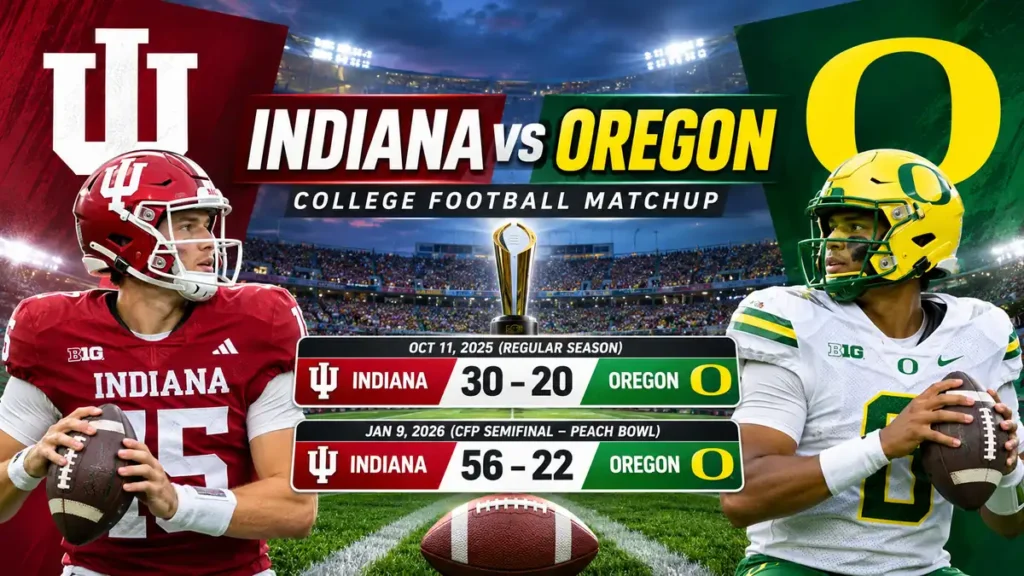
The indiana vs oregon matchup became one of college football’s most compelling stories during the 2025 season. Two ambitious Big Ten programs met twice, first in a competitive regular-season contest and later in a College Football Playoff semifinal with a national championship appearance at stake.
Indiana defeated Oregon in both meetings, winning 30–20 on October 11, 2025, and 56–22 in the Peach Bowl semifinal on January 9, 2026. The Hoosiers’ disciplined defense, efficient quarterback play, and ability to capitalize on turnovers proved decisive against the Ducks.
The two games also illustrated how quickly the balance of power can change in college football. Oregon entered the season with an established national reputation, while Indiana was building a remarkable championship campaign under head coach Curt Cignetti.
indiana vs oregon: Latest Results and Final Scores
Indiana Hoosiers
56
Winner
Oregon Ducks
22
Final
January 9, 2026 · College Football Playoff semifinal · Chick-fil-A Peach Bowl · Mercedes-Benz Stadium, Atlanta
The most recent meeting ended with Indiana recording a convincing 34-point victory over Oregon. The Hoosiers advanced to the national championship game, while the Ducks finished their season with a 13–2 record.
Results of the two 2025-season meetings
| Game | Indiana | Oregon | Winner |
|---|---|---|---|
| October 11, 2025 — Big Ten regular season | 30 | 20 | Indiana |
| January 9, 2026 — CFP semifinal | 56 | 22 | Indiana |
Indiana outscored Oregon 86–42 across the two games, demonstrating an advantage that became especially pronounced in the playoff rematch.
The regular-season meeting took place at Autzen Stadium in Eugene, Oregon. The playoff semifinal was held at Mercedes-Benz Stadium in Atlanta, Georgia, on a neutral field. College Football Playoff+1
How Indiana Dominated Oregon in the 2026 Peach Bowl
The January 9 semifinal was expected to be a major test for both teams. Indiana entered undefeated as the No. 1 seed, while fifth-seeded Oregon had already demonstrated its postseason credentials.
Instead of a close contest, Indiana took control almost immediately.
First-quarter interception changed the game
Oregon’s opening offensive play became one of the defining moments of the semifinal.
Indiana defensive back D’Angelo Ponds intercepted Dante Moore’s pass and returned it for a touchdown. The pick-six gave Indiana an immediate 7–0 lead without its offense taking the field.
Oregon responded with a touchdown pass from Moore to Jamari Johnson, briefly tying the score at 7–7.
Indiana then regained the lead through an eight-yard touchdown reception by Omar Cooper Jr. from quarterback Fernando Mendoza.
The opening quarter ended with Indiana leading 14–7.
Second-quarter turnovers created a decisive lead
The second quarter separated the teams.
Indiana’s defense continued creating pressure, forcing turnovers that repeatedly gave the Hoosiers advantageous field position. Oregon struggled to establish its running game or maintain consistent protection for Moore.
Indiana scored 21 unanswered points in the quarter, including touchdowns involving Kaelon Black, Charlie Becker, and Elijah Sarratt.
By halftime, the score was Indiana 35, Oregon 7.
That 28-point margin left Oregon needing an extraordinary comeback against one of the nation’s most efficient teams.
Second-half performance
Indiana extended its lead to 42–7 during the third quarter when Mendoza connected with E.J. Williams Jr. for another touchdown.
Oregon responded through a Jay Harris rushing touchdown and successful two-point conversion, reducing the deficit to 42–15.
The Hoosiers maintained control in the fourth quarter. Mendoza found Sarratt for another touchdown, and Black added a 23-yard rushing score.
Oregon’s Roger Saleapaga caught a late touchdown pass, but the outcome had already been decided.
Peach Bowl scoring by quarter
Points scored by quarter
January 9, 2026 playoff semifinal
Indiana
Oregon
061218241st2nd3rd4th
Indiana’s 21-point second quarter was the biggest difference-maker. Oregon never recovered from that scoring burst. College Football Playoff+2
Indiana vs Oregon Player Stats and Team Comparison
The semifinal box score reveals an interesting detail: Oregon actually gained more total offensive yards than Indiana.
However, Indiana made significantly better use of its possessions, particularly on third downs and after takeaways.
Team statistics from the Peach Bowl
| Statistic | Indiana | Oregon |
|---|---|---|
| Final score | 56 | 22 |
| Total offensive yards | 362 | 378 |
| Passing yards | 177 | 285 |
| Rushing yards | 185 | 93 |
| First downs | 18 | 20 |
| Third-down conversions | 11 of 14 | 8 of 13 |
| Time of possession | 31:13 | 28:47 |
| Penalty yards | 23 | 43 |
University of Oregon Athletics+1
Oregon’s passing offense generated 285 yards, but Indiana’s running game was considerably more productive. The Hoosiers finished with 185 rushing yards, nearly twice Oregon’s total.
Indiana also converted approximately 79% of its third-down opportunities, compared with Oregon’s 62%.
Those numbers help explain why Indiana sustained drives and controlled the pace despite having fewer total yards.
Fernando Mendoza’s performance
Fernando Mendoza delivered one of the most memorable quarterback performances of the 2025–26 College Football Playoff.
The Heisman Trophy winner completed 17 of 20 passes for 177 yards and five touchdowns against Oregon.
His performance stood out for several reasons:
- Exceptional passing accuracy under postseason pressure.
- Five touchdown passes without needing a high passing-yard total.
- Effective distribution of the football among multiple receivers.
- Strong execution in scoring situations and on important downs.
Mendoza’s performance demonstrated that quarterback efficiency can matter more than raw passing volume.
Dante Moore’s performance
Oregon quarterback Dante Moore finished with 285 passing yards, exceeding Mendoza’s total.
He connected with Jamari Johnson and Roger Saleapaga for touchdowns, but Oregon’s offense struggled with turnovers and difficult field position.
Moore lost two fumbles, while his interception on the opening play immediately put the Ducks behind.
Oregon also entered the game without leading rushers Noah Whittington and Jordon Davison, limiting the offensive support available to its quarterback.
The result illustrates why passing yards alone cannot determine which quarterback or offense performed better. AP News+1
indiana vs oregon: October 2025 Regular-Season Game
The first meeting of the 2025 season was much more competitive than the playoff rematch.
On October 11, Indiana traveled to Autzen Stadium in Eugene to face Oregon in a nationally significant Big Ten matchup.
The Hoosiers won 30–20, handing the Ducks their first defeat of the season.
First-half battle
Indiana opened the scoring with a field goal before Oregon took a 7–3 lead on a 44-yard touchdown pass from Dante Moore to Malik Benson.
Indiana answered with a rushing touchdown by Roman Hemby, taking a 10–7 advantage.
Oregon tied the game with a field goal in the second quarter, but Indiana kicker Brendan Franke converted a 58-yard field goal as time expired in the first half.
Indiana entered halftime leading 13–10.
How the fourth quarter decided the result
The teams remained close throughout the third quarter.
Indiana moved ahead 20–13 on another Hemby touchdown, but Oregon tied the score in the fourth quarter when Brandon Finney Jr. returned an interception for a touchdown.
At 20–20, the game was still undecided.
Mendoza then led a crucial scoring drive, finding Elijah Sarratt for an eight-yard touchdown.
Indiana added a late field goal to secure its 30–20 victory.
The result was particularly significant because Indiana won on the road against a highly ranked Oregon team rather than relying solely on home-field advantage.
October 11 scoring breakdown
| Quarter | Indiana | Oregon |
|---|---|---|
| First | 10 | 7 |
| Second | 3 | 3 |
| Third | 7 | 3 |
| Fourth | 10 | 7 |
| Final | 30 | 20 |
The official attendance was 59,625, reflecting the importance of the matchup at Autzen Stadium. static.iuhoosiers.com+1
Indiana vs Oregon Head-to-Head History
Although Indiana and Oregon have become familiar Big Ten opponents, their football history stretches back more than six decades.
The programs first met on November 16, 1963, when Oregon defeated Indiana 28–22.
Oregon also won their 1964 meeting, but Indiana reversed the trend in 2004.
The Hoosiers have since won three consecutive games in the series.
Complete head-to-head results
| Date | Winning team | Score | Location |
|---|---|---|---|
| November 16, 1963 | Oregon | 28–22 | Portland, Oregon |
| November 14, 1964 | Oregon | 29–21 | Bloomington, Indiana |
| September 11, 2004 | Indiana | 30–24 | Eugene, Oregon |
| October 11, 2025 | Indiana | 30–20 | Eugene, Oregon |
| January 9, 2026 | Indiana | 56–22 | Atlanta, Georgia |
All-time series record
3 wins
Indiana
2 wins
Oregon
Indiana leads the series 3–2 and holds a three-game winning streak.
Indiana’s 56–22 Peach Bowl victory represents the largest winning margin by either team in the series.
Interestingly, Indiana has won both of its meetings at Oregon’s Autzen Stadium since 2004.
The historical record shows how the matchup has shifted from Oregon’s early advantage to Indiana’s recent success. Indiana University Athletics+1
Why Indiana Had the Advantage Over Oregon
Indiana’s success was not based on a single explosive player or isolated coaching decision. Several tactical factors consistently favored the Hoosiers.
Defensive pressure and turnovers
Indiana’s defense created the most important momentum swings in the playoff semifinal.
The opening pick-six established an immediate advantage, while subsequent takeaways helped Indiana build its halftime lead.
Three first-half turnovers contributed directly to scoring opportunities.
Turnovers matter beyond the possession itself. They can shorten the field, disrupt offensive rhythm, and force an opponent to abandon its preferred game plan.
Against Oregon, those consequences were particularly severe.
Third-down efficiency
Indiana’s offense converted 11 of 14 third downs in the Peach Bowl.
This allowed the Hoosiers to extend drives and limit Oregon’s opportunities to regain momentum.
The difference was not simply that Indiana scored frequently. It was that the offense repeatedly executed when a drive was at risk of ending.
Strong rushing production
Indiana gained 185 rushing yards against Oregon’s 93.
A productive running game helped the Hoosiers maintain offensive balance and reduce pressure on Mendoza.
For Oregon, the lack of consistent rushing production made the offense more dependent on Moore’s passing ability.
That imbalance became increasingly difficult to overcome once Indiana established a substantial lead.
Coaching and preparation
Indiana head coach Curt Cignetti and Oregon head coach Dan Lanning entered the matchup with different challenges.
Cignetti’s team emphasized disciplined execution, offensive efficiency, and aggressive defensive play.
Lanning’s Ducks had an established reputation for speed, athleticism, and offensive versatility.
Indiana’s execution was more effective in both meetings. The semifinal particularly highlighted the Hoosiers’ ability to exploit mistakes while maintaining their own offensive structure.
Key takeaway: Indiana did not need to dominate every statistical category. Its advantage came from converting opportunities into points and avoiding the prolonged mistakes that undermined Oregon.
What the Matchups Meant for the College Football Playoff
The January 2026 Peach Bowl carried much greater significance than an ordinary conference matchup.
Indiana entered as the No. 1 playoff seed after an undefeated regular season and a Big Ten championship victory over Ohio State.
The Hoosiers then defeated Alabama 38–3 in the Rose Bowl quarterfinal.
Oregon entered the semifinal as the No. 5 seed, having defeated James Madison 51–34 and shut out Texas Tech 23–0 in the Orange Bowl quarterfinal.
Both teams had already beaten nationally respected opponents.
Indiana’s road to the national championship
Indiana’s playoff campaign included three major victories:
| Round | Opponent | Result |
|---|---|---|
| Quarterfinal | Alabama | Won 38–3 |
| Semifinal | Oregon | Won 56–22 |
| National championship | Miami | Won 27–21 |
Indiana completed the 2025 season with a perfect 16–0 record, winning the national championship against Miami on January 19, 2026.
The Hoosiers’ victory over Oregon therefore became a central moment in their championship season, rather than simply an impressive standalone win.
Oregon’s postseason achievement
Despite the semifinal defeat, Oregon finished 13–2 and reached the final four of the College Football Playoff.
The Ducks had also recorded 13 wins during the previous season, demonstrating sustained success under Lanning.
Their postseason run included a shutout of Texas Tech, but the Indiana matchup exposed the cost of turnovers and limited rushing production against elite opposition. University of Oregon Athletics+2
Indiana vs Oregon in the Big Ten Conference
The matchup also reflects the changing competitive landscape of the Big Ten.
Oregon joined the conference in 2024 as part of a major expansion that also included Washington, USC, and UCLA.
That expansion brought geographically distant programs into regular competition and created new high-profile conference matchups.
Indiana and Oregon represent contrasting football traditions.
Indiana’s football identity
Indiana University is located in Bloomington, Indiana, and plays its home games at Memorial Stadium.
Historically, the university has been especially associated with basketball, but its football program achieved unprecedented national prominence during Cignetti’s championship campaign.
The Hoosiers’ success demonstrated how effective coaching, player development, and roster construction can transform a program’s competitive standing.
Oregon’s football identity
The University of Oregon is located in Eugene, Oregon, and plays home games at Autzen Stadium.
The Ducks have been nationally prominent for years, with a reputation for innovative offenses, distinctive uniforms, and strong recruiting.
Oregon’s association with Nike and its recognizable green-and-yellow branding have also contributed to the program’s visibility.
However, the Indiana games reinforced that national reputation and individual talent do not automatically translate into victories against disciplined opponents.
Why the matchup matters
The Big Ten now features a broader collection of national contenders.
Indiana’s victories over Oregon demonstrated that conference competition is not determined solely by historical program prestige.
Future meetings could carry implications for conference standings, postseason rankings, and College Football Playoff qualification.
Will Indiana and Oregon Play Again in 2026?
As of November 16, 2026, Indiana and Oregon are not scheduled to meet during the 2026 regular season.
Indiana’s remaining scheduled regular-season opponents include Washington and Purdue, while Oregon is scheduled to face Michigan State and Washington.
A postseason meeting remains possible depending on the teams’ results, conference standings, and playoff qualification, but no rematch has been confirmed.
Fans following the matchup should distinguish between a scheduled game and a potential postseason pairing. The two programs can only meet again in 2026 if the postseason schedule creates that opportunity. Indiana University Athletics+2
What Future Indiana vs Oregon Games Could Depend On
The previous meetings offer several lessons for evaluating a future matchup, although personnel and team performance can change substantially between seasons.
Quarterback decision-making
The 2026 Peach Bowl showed how quickly an interception or lost fumble can change the direction of a game.
A future Oregon quarterback would need to protect the football, recognize defensive pressure, and avoid giving Indiana short fields.
Indiana, meanwhile, would need to maintain efficient passing execution regardless of changes to its roster.
Offensive-line performance
Protection and run blocking would be major factors.
Oregon struggled to generate consistent rushing production in the semifinal, making its offense more predictable.
A stronger rushing attack could help the Ducks sustain drives and prevent opposing defenses from concentrating on passing situations.
Defensive adjustments
Indiana’s defense successfully exploited Oregon’s mistakes in both matchups.
Future Oregon teams would need to adjust their protection schemes, passing concepts, and responses to defensive pressure.
Indiana would also need to account for any changes Oregon makes to its offensive personnel and play-calling.
Turnover margin and field position
The most important statistical lesson from the playoff semifinal is that total yards do not necessarily predict the final score.
Oregon gained 378 yards to Indiana’s 362, yet lost by 34 points.
Field position, turnovers, red-zone execution, and third-down efficiency provided a much clearer explanation of the outcome.
For future meetings, those situational statistics may be more revealing than total offensive production alone.
Final Thoughts on indiana vs oregon
The indiana vs oregon football series has become more significant following the teams’ two meetings during the 2025 season.
Indiana won the regular-season contest 30–20 before delivering a dominant 56–22 victory in the College Football Playoff semifinal.
The Hoosiers now lead the all-time series 3–2, with three consecutive victories dating back to 2004.
Fernando Mendoza’s efficient passing, Indiana’s defensive takeaways, and the team’s superior situational execution were central to the most recent result.
Oregon remains a nationally competitive program, but its losses to Indiana demonstrate how costly turnovers and offensive imbalance can be against championship-level opposition.
With both programs competing in the Big Ten, future meetings could become increasingly important. For now, Indiana holds the historical advantage and the distinction of winning the teams’ most consequential matchup.