Boiling eggs sounds simple until you crack one open and discover a runny yolk when you wanted it firm, or a chalky center when you wanted it creamy. The difference often comes down to just one or two minutes.
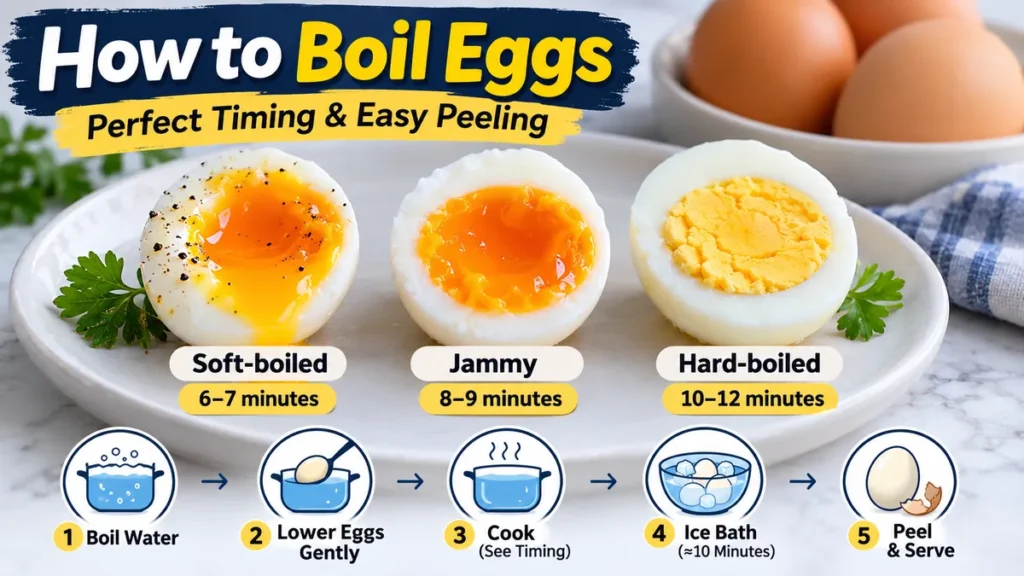
For large eggs placed directly into gently boiling water, cook for 6 minutes for a soft-boiled yolk, 7–8 minutes for a jammy center, 9–10 minutes for a mostly set yolk, or 11–12 minutes for fully hard-boiled eggs. Transfer the eggs to ice water immediately afterward to stop further cooking.
These times are reliable starting points for large, refrigerated chicken eggs at or near sea level. Egg size, starting temperature, altitude, and water temperature can change the results.
how long to boil eggs: Quick Cooking Time Chart
Soft Boiled Egg: 6-Minute Method for a Runny Yolk – InstaCuppa Store
6 minutes — Soft-boiled
Set white, flowing yolk
How Long To Soft-Boil Eggs For The Jammy Yolks Of Your Dreams
7–8 minutes — Jammy
Thick, creamy yolk
Medium-boiled egg, Top view. How many eggs a day concept.
9–10 minutes — Medium
Mostly set, slightly soft center
11–12 minutes — Hard-boiled
Firm white and fully cooked yolk
| Cooking time | Yolk texture | Best uses |
|---|---|---|
| 5 minutes | Very runny; whites may be soft | Dipping toast |
| 6 minutes | Runny | Breakfast egg cups |
| 7 minutes | Soft and jammy | Ramen, toast |
| 8 minutes | Creamy, thick center | Salads, grain bowls |
| 9 minutes | Mostly set, slightly soft | Sandwiches |
| 10 minutes | Nearly firm | Egg salads |
| 11–12 minutes | Fully firm | Deviled eggs, meal prep |
| 13–14 minutes | Very firm, potentially dry | Recipes requiring a firm yolk |
Timing starts when the eggs enter already-boiling water, not when you first turn on the stove.
How to Boil Eggs Perfectly Every Time
The hot-water-start method provides a clear starting point for timing and makes it easier to repeat your preferred result.
Step 1: Prepare the eggs and water
Choose eggs of approximately the same size so they cook evenly. Fill a saucepan with enough water to cover the eggs by about one inch (2.5 cm).
Bring the water to a boil over medium-high heat. A pot large enough to hold the eggs in a single layer is ideal.
Step 2: Lower the eggs gently
Use a slotted spoon to lower the eggs into the boiling water. Avoid dropping them, which can crack their shells.
Refrigerated eggs can go directly into hot water, although the sudden temperature change may occasionally cause cracking. Lowering them carefully helps reduce this risk.
Step 3: Start the timer
Start timing as soon as the eggs enter the water. Adjust the heat to maintain a gentle but steady boil rather than a violent rolling boil.
Choose the time according to your preferred yolk texture:
- 6 minutes for soft-boiled eggs
- 7–8 minutes for jammy eggs
- 9–10 minutes for medium-boiled eggs
- 11–12 minutes for hard-boiled eggs
Avoid crowding the saucepan. Adding too many cold eggs can lower the water temperature and affect cooking consistency.
Step 4: Transfer eggs to an ice bath
Prepare a bowl containing cold water and ice while the eggs cook.
When the timer ends, remove the eggs with a slotted spoon and transfer them immediately to the ice bath.
Cool them for approximately 5 minutes if serving soon, or 10–15 minutes for fully cooled eggs that you plan to peel or refrigerate.
Step 5: Peel or serve
Gently tap the shell on a countertop and roll the egg to create small cracks. Begin peeling near the wider end, where an air pocket often makes it easier to get beneath the membrane.
Peeling under cool running water can help separate stubborn shell fragments.
For a soft-boiled egg, you can instead slice off the top and serve it in an egg cup.
How Long to Boil Eggs for Different Yolk Textures
Soft-boiled eggs: 6 minutes
Soft-boiled eggs have cooked whites surrounding a liquid yolk. They work particularly well with toast soldiers, breakfast bowls, and dishes where the yolk acts as a sauce.
Six minutes is a useful starting point for large eggs. If you prefer an especially liquid center, a slightly shorter time may work, although the whites may not be completely firm.
Because soft-boiled eggs may be undercooked, people at higher risk of foodborne illness should choose fully cooked eggs or appropriately pasteurized eggs.
Jammy eggs: 7–8 minutes
Jammy eggs fall between soft-boiled and hard-boiled eggs. Their yolks are thick, glossy, and spreadable rather than liquid or crumbly.
Seven minutes generally produces a softer center, while eight minutes creates a more custard-like texture.
This style is popular in ramen, rice bowls, avocado toast, and composed salads.
Medium-boiled eggs: 9–10 minutes
Medium-boiled eggs have firm whites and yolks that are mostly set but retain some moisture in the center.
They are useful when you want an egg that can be sliced neatly without the dryness sometimes associated with prolonged boiling.
For a firmer center, use the upper end of the timing range.
Hard-boiled eggs: 11–12 minutes
Hard-boiled eggs have completely set whites and yolks. They are especially useful for egg salad, deviled eggs, potato salad, and packed lunches.
For large eggs, 11–12 minutes in gently boiling water usually produces a firm center. Extra-large eggs may need a little longer.
Cooking beyond the necessary time can produce a dry, chalky yolk and sometimes a gray-green ring.
How Egg Size Affects Boiling Time
Egg size influences how quickly heat reaches the center. A small egg generally cooks faster than a jumbo egg under the same conditions.
The following are approximate adjustments for eggs placed into already-boiling water.
| Egg size | Soft-boiled | Hard-boiled |
|---|---|---|
| Small | 5–6 minutes | 9–10 minutes |
| Medium | 5–6 minutes | 10–11 minutes |
| Large | 6 minutes | 11–12 minutes |
| Extra-large | 7 minutes | 12–13 minutes |
| Jumbo | 7–8 minutes | 13–14 minutes |
These times are guides rather than guarantees. Shell thickness, egg temperature, and the intensity of the boil can cause small variations.
For consistent results, use the same egg size, pot, water volume, and cooking method each time.
Should You Start Eggs in Cold or Boiling Water?
Both methods work, but the cooking times are not interchangeable.
Boiling-water method
In this method, the water reaches a boil before you add the eggs.
The main advantage is predictable timing. You can start a timer immediately after lowering the eggs into the water.
A hot-water start can also make peeling easier, particularly when compared with slowly heating eggs in cold water. BBC Good Food+1
Cold-water method
For the cold-water method:
- Place eggs in a saucepan in a single layer.
- Cover them with about one inch of cold water.
- Bring the water to a boil.
- Remove the saucepan from the heat, cover it, and allow the eggs to stand in the hot water.
- For large hard-boiled eggs, begin with approximately 12 minutes of covered standing time.
- Transfer immediately to ice water.
The exact timing depends on the pot, water volume, and egg size. Because the eggs begin cooking as the water heats, do not use the boiling-water timing chart for this method.
For beginners who want to compare soft, jammy, and hard-boiled results, starting with boiling water is generally easier.
How to Peel Hard-Boiled Eggs Easily
A perfectly cooked egg can still be frustrating if the shell sticks to the white. Fortunately, a few simple techniques improve the chances of a clean peel.
Use an ice bath immediately
Rapid cooling helps stop residual cooking and makes the eggs more comfortable to handle.
Allow fully hard-boiled eggs to cool for approximately 10–15 minutes before peeling.
Crack the shell all over
Rather than removing one large piece immediately, gently tap the egg in several places.
Roll it lightly across the countertop to loosen the shell and its thin inner membrane.
Start at the wider end
The broad end of an egg usually contains an air cell. Starting here may provide enough space to slip a finger beneath the membrane.
Peel slowly, keeping the membrane attached to the shell whenever possible.
Try peeling under water
Running cool water over the egg, or peeling it in a bowl of water, can help loosen shell fragments.
Fresh eggs can be more difficult to peel than eggs that have been refrigerated for several days. However, cooking technique also matters, so older eggs are not a requirement for successful peeling.
Why Boiled Eggs Sometimes Turn Out Wrong
Why does a boiled egg have a green ring around the yolk?
A gray-green ring can develop when an egg is cooked for too long or remains hot after cooking.
The discoloration results from a reaction involving sulfur compounds in the white and iron in the yolk, producing iron sulfide near their boundary.
The ring is generally harmless and does not automatically mean the egg has spoiled.
To reduce discoloration, avoid excessive cooking and cool the eggs promptly. Foodsafety+1
Why do eggs crack while boiling?
Eggshells can crack because of sudden temperature changes, collisions with the saucepan, or existing hairline fractures.
To minimize cracking:
- Lower eggs gently with a spoon.
- Maintain a controlled boil rather than violent bubbling.
- Avoid overcrowding.
- Check eggs for cracks before cooking.
Adding vinegar or salt to the water is sometimes suggested, but neither reliably prevents shells from cracking. Careful handling is more useful.
Why is the egg white rubbery?
Egg whites contain proteins that unfold and bond together when heated. Excessive cooking can cause these protein networks to tighten, producing a rubbery texture.
Using the shortest cooking time that achieves your desired yolk texture helps maintain tenderness.
Why is the yolk still runny after 10 minutes?
Possible explanations include an unusually large egg, a low cooking temperature, high altitude, or timing that began before the water was sufficiently hot.
If the center is softer than expected, increase the next batch’s cooking time by approximately one minute while keeping the other conditions consistent.
Does Altitude Affect How Long to Boil Eggs?
Yes. Water boils at a lower temperature as altitude increases.
At sea level, water boils at approximately 212°F (100°C). At higher elevations, its boiling temperature decreases, meaning eggs may cook more slowly even when the water is bubbling.
For example, at approximately 5,000 feet (1,524 meters), water boils near 203°F (95°C), depending on atmospheric pressure.
There is no single additional cooking time that works for every elevation. Begin with the standard timing chart, then increase the cooking time gradually until you achieve the desired consistency.
For fully cooked eggs at higher altitudes, a longer cooking period may be necessary.
How Long Do Boiled Eggs Last in the Refrigerator?
Hard-boiled eggs are convenient for meal preparation, but they still require proper refrigeration.
According to the U.S. Food and Drug Administration (FDA), hard-cooked eggs should be eaten within one week after cooking, whether peeled or unpeeled. FDA+1
| Storage condition | Recommended limit |
|---|---|
| Hard-boiled eggs, shell intact, refrigerated | Up to 7 days |
| Peeled hard-boiled eggs, refrigerated | Up to 7 days |
| Cooked eggs at room temperature | No more than 2 hours |
| Cooked eggs in temperatures above 90°F (32°C) | No more than 1 hour |
Store eggs in a clean, covered container at 40°F (4°C) or below. Refrigerate them promptly after cooling.
If an egg develops an unpleasant odor, slimy surface, or other signs of spoilage, discard it. However, harmful bacteria are not always detectable through smell or appearance.
Can you freeze hard-boiled eggs?
Freezing whole hard-boiled eggs is generally not recommended because the whites can become tough, rubbery, and watery after thawing.
Cooked yolks can be frozen separately for certain recipes, but refrigeration is the better choice for ordinary hard-boiled eggs.
Are Soft-Boiled and Hard-Boiled Eggs Safe to Eat?
Eggs can sometimes contain Salmonella, a bacterium associated with foodborne illness.
Cooking eggs until both the yolk and white are firm reduces this risk. The FDA recommends fully cooking eggs, particularly when serving people more vulnerable to serious foodborne illness. Ask USDA+1
Those groups include young children, pregnant people, older adults, and people with weakened immune systems.
Soft-boiled and jammy eggs have partially cooked yolks, so they carry more risk than fully cooked eggs. Using pasteurized shell eggs can reduce the risk when preparing dishes with runny yolks.
Always wash your hands and clean utensils and surfaces after handling raw eggs.
How to Boil Multiple Eggs at Once
Boiling six or twelve eggs does not necessarily require doubling the cooking time.
If the eggs are similar in size, sit in a single layer, and remain surrounded by gently boiling water, their cooking times can be close to those of a smaller batch.
However, adding a large number of refrigerated eggs can temporarily reduce the water temperature.
For more consistent results:
- Use a saucepan large enough to prevent overcrowding.
- Add enough water to cover every egg.
- Lower the eggs gently into boiling water.
- Maintain sufficient heat for the water to return to a steady boil.
- Use the appropriate timing for the egg size and preferred yolk.
- Prepare a large ice bath so all the eggs can cool quickly.
When cooking large batches, test one egg first and adjust your timing if necessary.
Boiling Eggs vs. Steaming Eggs
Steaming is another useful way to prepare soft-boiled and hard-boiled eggs.
Instead of submerging the eggs, place them in a steamer basket above boiling water and cover the pot.
Steam transfers heat efficiently, and this method can produce eggs that peel cleanly.
For large eggs, approximately 6–7 minutes of steaming can produce a soft yolk, while around 12–13 minutes can produce a firm yolk. These are starting points, and actual results depend on the equipment and egg temperature.
Steaming is particularly useful when preparing a batch because you do not need enough water to submerge every egg.
Regardless of the method, promptly cooling the eggs helps control the final texture.
Common Mistakes to Avoid When Boiling Eggs
Small differences in technique can affect the finished egg more than expected.
| Mistake | What happens | Better approach |
|---|---|---|
| Not using a timer | Inconsistent yolks | Time each batch |
| Overcrowding the pan | Uneven heating | Keep eggs in one layer |
| Boiling too vigorously | Shells may crack | Maintain a gentle boil |
| Skipping the ice bath | Residual heat continues cooking | Cool immediately |
| Using the wrong size timing | Yolks may be too soft or firm | Adjust for egg size |
| Peeling without loosening the membrane | Whites tear | Crack gently and peel under water |
| Leaving cooked eggs unrefrigerated | Food safety risk increases | Refrigerate promptly |
The most useful improvement is consistency. Once you find a cooking time that works with your saucepan and stove, repeat the same process rather than changing several variables at once.
Final Thoughts on how long to boil eggs
For most large eggs added to gently boiling water, 6 minutes produces a runny yolk, 7–8 minutes creates a jammy center, 9–10 minutes gives a mostly set yolk, and 11–12 minutes produces a firm hard-boiled egg.
Use a timer, account for egg size, and cool the eggs immediately afterward. These simple habits make it easier to achieve the same texture every time, whether you’re preparing a quick breakfast, ramen topping, egg salad, or a batch of hard-boiled eggs for the week.